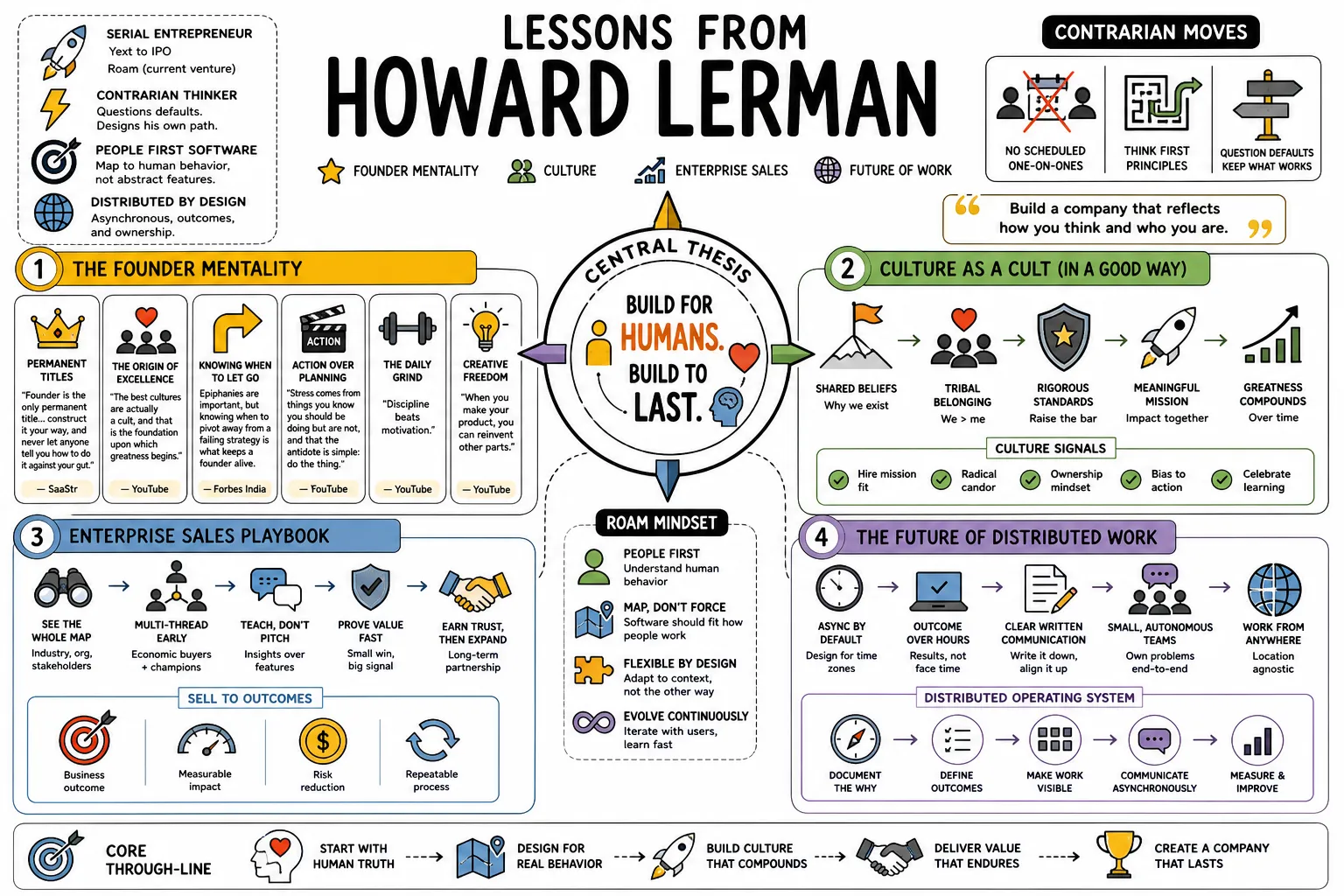
Lessons from Howard Lerman
Howard Lerman co-founded Yext and later started Roam. After running a large distributed team, he wanted collaboration software that made colleagues visible and allowed brief, unscheduled conversations across locations. These lessons examine his company-building, sales, leadership, and workplace-design ideas. — Fortune Leadership Next Interview.
Part 1: The Founder Mentality
- On Permanent Titles: Lerman treats founder as a lasting identity even when the CEO role changes, and urges founders to shape their companies according to their own judgment. — SaaStr: 10 Cheat Codes.
- On Intense Cultures: Lerman has provocatively described the strongest company cultures as cult-like: a shared intensity and belief can form the basis for exceptional work. — Collin Cadmus Podcast.
- On Knowing When to Pivot: Lerman described Yext’s move from its small-business offering to listings and enterprise accounts as a difficult pivot that required a different sales and service organization. — TDM Scaling Up Interview.
- On Finding the Listings Business: Yext moved from call-tracking and data-discrepancy products toward a listings network after Lerman recognized that businesses needed to control their own information across services. He says the company then made a consequential financial commitment to break the marketplace deadlock. — TDM Scaling Up Interview.
- On Founder Resilience: Lerman says early rejection helped him grow a thick skin and become comfortable looking ridiculous while attempting something new. — TDM Scaling Up Interview.
- On Creative Freedom: For Lerman, a company is a founder’s creative canvas: he encourages founders to choose their own operating methods rather than blindly copy someone else’s playbook. — SaaStr: 10 Cheat Codes.
- On Taking Risks: A question in the original Collin Cadmus episode draws on Lerman’s post contrasting hard work with willingness to take substantial risks among people he knows who succeeded. — Collin Cadmus Podcast.
- On Avoiding Dogma: Lerman urges founders to make their companies their own and to reject advice that does not fit their circumstances, even when it comes from experienced operators. — SaaStr: 10 Cheat Codes.
- On Being Seen Taking Risks: Lerman links his comfort with public performance and looking foolish to the willingness to try unusual things as a founder. — TDM Scaling Up Interview.
- On Your First Customers: When applicable, Lerman recommends building a B2B product the founding team itself needs; Roam’s first alpha users followed after outsiders saw the team using it. — SaaStr CRO Confidential.
Part 2: Product & Building
- On Fitting How Teams Work: Lerman argued that collaboration software should adapt to a company’s actual mix of synchronous and asynchronous work, rather than force everyone into one meeting pattern. — Fortune Leadership Next Interview.
- On Rapid Iteration: During Roam’s first 56 weeks, Lerman said the team shipped 56 releases while using the product itself and observing early users. That is a concrete iteration practice, not proof that speed always outranks quality. — SaaStr CRO Confidential.
- On Human Connection: Lerman says Roam is meant to help distributed colleagues feel present together; even as AI handles more tasks, he sees human creativity and interaction as central to work. — Eat Sleep Work Repeat Interview.
- On Business-Controlled Facts: Lerman describes Yext’s founding principle as letting businesses authoritatively publish and control their own factual information across digital services. — TDM Scaling Up Interview.
- On the Gap Between Meetings: Lerman recalls that early Yext employees solved many issues in short, unplanned office conversations. Roam was his attempt to make those interactions possible for distributed colleagues. — Fortune Leadership Next Interview.
- On Vision and Reality: In a discussion prompted by one of Lerman’s posts, he frames adaptation as deciding when to hold firm on a vision and when to bend to the world as it is. — Collin Cadmus Podcast.
- On the Company as a Canvas: Lerman encourages founders to treat the company as something they can design for themselves, including the way they operate, rather than merely copy a standard management template. — SaaStr: 10 Cheat Codes.
- On Showing Customers the Result: In Yext’s early pay-per-action model, Lerman said the company bore the risk of irrelevant calls and showed customers the recorded leads so they could see what they were paying for. — TechCrunch: The $25 Million Demo.
- On Designing for Spontaneity: Lerman says Roam’s virtual floor plan lets teammates see who is present and drop into conversations, borrowing spatial cues from a physical office. — Eat Sleep Work Repeat Interview.
- On AI Collaboration: In 2025, Lerman described Roam’s AI agents as an emerging part of its virtual office vision: he expected them to help with meeting summaries, follow-up actions and scheduling alongside people. — Eat Sleep Work Repeat Interview.
Part 3: Leadership & Energy
- On Communicating the Vision: As Yext grew, Lerman says his CEO job shifted toward defining a concrete vision and repeatedly communicating it through stories that employees could remember. — TechCrunch Interview with Howard Lerman.
- On Customer Problems: Lerman advises founders to speak with customers to learn the problem, while leaving room for inventors and product teams to devise a solution customers may not have imagined. — TDM Scaling Up Interview.
- On Recurring One-on-Ones: Lerman objects to automatically scheduled one-on-ones because they consume a large share of managers’ time and can cause issues to wait for the next calendar slot. — Eat Sleep Work Repeat Interview.
- On Immediate Communication: Rejecting scheduled one-on-ones does not mean avoiding colleagues: Lerman prefers brief conversations as a need arises instead of queuing urgent decisions for a weekly meeting. — Eat Sleep Work Repeat Interview.
- On Changing the Leadership Team: At public-company scale, Lerman said he spent less time on product details and more on recruiting and interpersonal leadership; he also brought experienced operators alongside him. — TechCrunch Interview with Howard Lerman.
- On Adapting as CEO: Lerman says he made several adjustments as Yext scaled; a founder who wants to remain CEO must learn new skills rather than keep operating as in the first small-team stage. — TechCrunch Interview with Howard Lerman.
- On Memorizing the Story: Lerman treats telling the company’s story as a core founder skill and recommends memorizing its wording until the message is short, clear and easy to recall. — SaaStr: 10 Cheat Codes.
- On Unblocking Teams: Lerman says quick ad-hoc conversations let people address issues when they arise, instead of waiting for a scheduled meeting; Roam was designed to enable that pattern across locations. — Fortune Leadership Next Interview.
Part 4: Scaling & Growth
- On Starting Again: After leading Yext for more than 15 years, Lerman described founding Roam as the chance to build from zero to one again around a collaboration problem he had experienced himself. — Fortune Leadership Next Interview.
- On Selecting Sales Talent: Lerman said he would favor a top seller at a middling company over a middling seller at a celebrated employer, putting individual performance ahead of company prestige. — Collin Cadmus Podcast.
- On a Message People Care About: Lerman tied company positioning to building something people care about and explaining that value clearly. The article’s more detailed mission-and-mantra formula came from another CEO, Ryan Howard. — Entrepreneur CEO Interviews.
- On Broadcasting the Message: Once Yext had its message, Lerman urged getting it into the market through channels that could scale rather than keeping it within the founding team. — Entrepreneur CEO Interviews.
- On Early Public Relations: Lerman said early Yext favored public relations over paid advertising when money was limited, then assessed channels for return rather than assuming every trade show or campaign was worthwhile. — Entrepreneur CEO Interviews.
- On Founder-Owned Product–Market Fit: Lerman argues that founders can delegate many functions as a company grows, but should remain personally responsible for learning whether the product truly fits customer needs. — SaaStr: 10 Cheat Codes.
- On Rebuilding for Enterprise Sales: Moving Yext from small-business transactions to large enterprise deals required a different sales organization and more substantial customer support, Lerman recalled. — TDM Scaling Up Interview.
- On Learning from Scaled Operators: As Yext grew, Lerman brought in executives with large-company experience and says he learned from them while continuing to lead the business. — TechCrunch Interview with Howard Lerman.
Part 5: Rethinking the Workplace & Roam
- On Visible Presence: The incident that prompted Roam was a missed video invitation at Yext; Lerman wanted a company-wide view showing who was present and talking, even when colleagues worked in different places. — Fortune Leadership Next Interview.
- On Overscheduled Video Work: Lerman argues that reliable video conferencing unintentionally encouraged back-to-back scheduled calls; Roam was designed to make shorter, unscheduled conversations easier. — Fortune Leadership Next Interview.
Part 6: Sales & Market Strategy
- On Live Demonstrations: Lerman favors showing the product live despite the risk of technical glitches, because a real demonstration lets the audience see the experience rather than only hear a pitch. — SaaStr: 10 Cheat Codes.
- On Selling Through Story: Lerman says a CEO has to make the company vision memorable through storytelling; for Yext, communicating that story became a central part of his public-company role. — TechCrunch Interview with Howard Lerman.
- On Advisor-Led Introductions: Lerman argues that senior advisors with relevant relationships can open executive conversations more effectively than relying only on junior cold outbound; he used this approach for Roam and earlier ventures. — SaaStr: 10 Cheat Codes.
- On GymTicket’s First Distribution: Lerman recounts seeking the health-club trade association’s help to recruit gyms for GymTicket, then expanding the lead-generation model to other local-service categories when the gym market hit a ceiling. — Startupr Founder Interview.
- On Founder Conviction: Lerman argues that founders should hold on to product–market fit and develop conviction around a differentiated idea before scaling sales and marketing. — Startupr Founder Interview.
- On Demonstrating Roam: Roam used product demonstrations and founder-level implementation conversations to show buyers how the virtual headquarters would work for an entire company. — SaaStr CRO Confidential.
Part 7: Resilience & Risk-Taking
- On the Solitude of Founding: Lerman warns that founding is a hard, sometimes lonely commitment, and says caring deeply about a problem matters more than wanting the founder title. — Howard Lerman on Founding.
- On Sustained Founder Energy: Lerman says belief in Roam’s vision continues to energize his day-to-day work; he distinguishes that motivation from pursuing another financial exit alone. — Startupr Founder Interview.
- On Anticipating Problems: Lerman described a Sunday-night executive meeting as a way for a startup team to identify the coming week’s problems and agree on priorities before Monday. — SaaStr: 10 Cheat Codes.
- On the Next Empirical Step: Looking back, Lerman says he now favors taking the best small action available in the present over relying on a detailed long-range plan that may quickly become obsolete. — Howard Lerman on Empirical Action.
Part 8: The Second Act & Reflection
- On Public-Market Constraints: Lerman said leading public Yext required more guarded financial communication and a different relationship with investors than earlier fundraising rounds. — TechCrunch Interview with Howard Lerman.
- On Applying Prior Lessons Differently: As he builds a second company, Lerman says he is reconsidering choices he made while scaling Yext and intends to manage some stages differently at Roam. — Startupr Founder Interview.
- On Solving a Felt Problem: Lerman says the reason to found a company is conviction that you are suited to solve a problem you care about, not attraction to the founder title or another exit alone. — Howard Lerman on Founding.
- On Continuing to Learn: Lerman says he values people who keep learning and improving themselves, a view he connects to advice from Charlie Munger rather than claiming as an original maxim. — Startupr Founder Interview.
- On Moving Between Product Eras: Lerman’s two ventures addressed different shifts: Yext helped businesses control information across search and maps, while Roam was built around distributed collaboration and emerging AI assistance. — Startupr Founder Interview.
- On Discipline Without Motivation: Lerman says he relies on discipline to do necessary work even when he does not feel motivated, treating discomfort as a signal to act rather than wait. — Startupr Founder Interview.