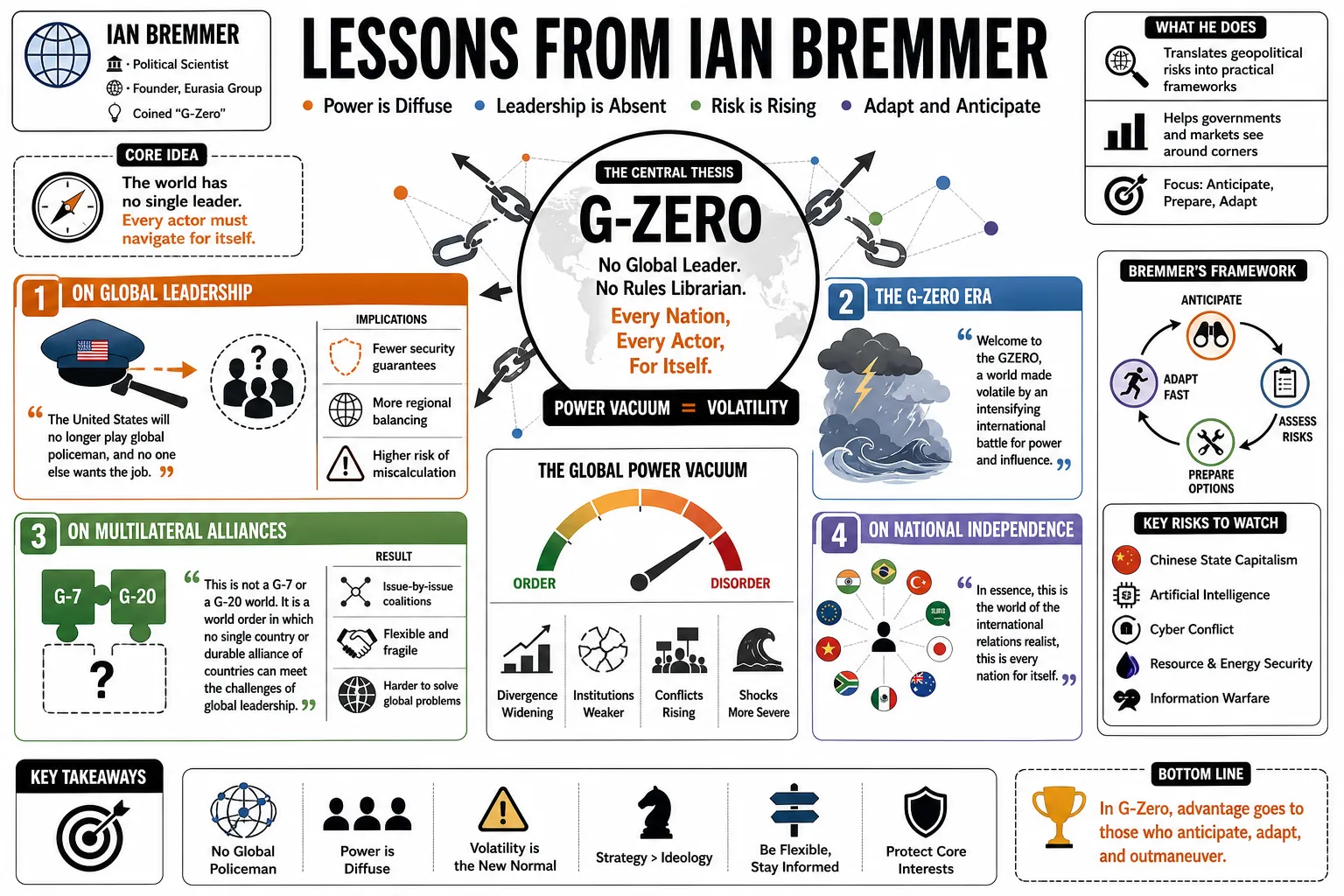
Lessons from Ian Bremmer
Political scientist Ian Bremmer founded the Eurasia Group and coined "G-Zero" to describe a world without a dominant global leader. He translates geopolitical risks like Chinese state capitalism and artificial intelligence into practical frameworks for governments and markets. This profile collects his direct observations on how power is shifting away from traditional states and what that means for international stability.
Part 1: The G-Zero World
- On Global Leadership: "The United States will no longer play global policeman, and no one else wants the job." — Source: GZERO Media
- On the G-Zero Era: Bremmer's GZERO World framing describes a volatile world shaped by intensifying battles for power and influence rather than stable global leadership. — Reference: GZERO World podcast description
- On Multilateral Alliances: "This is not a G-7 or a G-20 world. It is a world order in which no single country or durable alliance of countries can meet the challenges of global leadership." — Source: 92NY
- On National Independence: "In essence, this is the world of the international relations realist, this is every nation for itself." — Source: Carnegie Council
- On the Global Power Vacuum: "There is too large a divergence at the moment in the interests and values of the world's most powerful states." — Source: Eurasia Group
- On Global Policemen: "The United States is increasingly less willing to act as the global policeman, and no other power has the capacity or desire to fill that void." — Source: Diplomatic Courier
- On Institutional Paralysis: "Because no single power or alliance is willing to provide global leadership, the world has entered a state of institutional paralysis." — Source: Goodreads
- On International Agendas: "As emerging powers remain focused on their own domestic challenges, the world lacks the political and economic muscle to drive a coordinated international agenda." — Source: Diplomatic Courier
- On Global Problem Solving: "Global challenges are increasingly managed through unilateral or regional actions rather than global cooperation." — Source: Carnegie Council
- On America's Changing Role: "The post-World War II order, led by the United States, provided a level of stability and collective global governance that is now unwinding." — Source: Eurasia Group
Part 2: Geopolitical Recession and US Politics
- On Geopolitical Recession: "We are in a geopolitical recession, a long-term phase characterized by the erosion of global leadership and the weakening of international institutions." — Source: CIRSD
- On Internal US Conflict: In his 2024 State of the World address, Bremmer framed the U.S. election as a sign of America being politically at war with itself. — Reference: GZERO State of the World address
- On Democratic Legitimacy: "No matter who wins, many Americans will not accept the legitimacy of the election." — Source: Buenos Aires Times
- On the US Political Revolution: "The United States is itself unwinding its own global order. The world's most powerful country is in the throes of a political revolution." — Source: London Stock Exchange
- On Electoral Anxiety: "The 2024 election cycle is the 'Voldemort' of election years, a process that inspires intense anxiety and concern globally." — Source: GZERO Media
- On the US Turning Inward: "The biggest global risk today is the United States turning inward, which worsens political dysfunction and tests democracy." — Source: Eurasia Group
- On Institutional Mistrust: Bremmer's State of the World work links U.S. political conflict and declining trust to a more unstable domestic and international environment. — Reference: GZERO State of the World address
- On Partisanship: "The great thing about partisanship is you don't have to spend time understanding the issues to know what side you're on." — Source: Wikiquote
- On America's Global Standing: "The United States is not respected around the world and is not viewed as dependable, driven by structural issues regardless of who is in the White House." — Source: Reddit
- On Political Identities: "Both Democrats and Republicans are struggling to define their core identities amid deep polarization and anti-establishment sentiments." — Source: Simplecast
Part 3: Artificial Intelligence and Technopolarity
- On Geopolitical Stakes of AI: Eurasia Group frames AI as a geopolitical force that can upend governance structures, social systems, and international power balances. — Reference: Eurasia Group report hub on the geopolitics of AI
- On the Balance of Power: "AI will trigger a fundamental shift in the structure and balance of global power, creating a challenge for institutions." — Source: IMF
- On Corporate Power: Bremmer argues that major technology firms now exercise geopolitical influence and forms of sovereignty over digital space that can rival states. — Reference: Foreign Affairs essay on the technopolar paradox
- On Weapons of Mass Disruption: "U.S.-based social media and AI tools act as Weapons of Mass Disruption that can undermine democracy." — Source: GZERO Media
- On AI and Societal Stability: Bremmer warns that near-term AI risk includes systems that shape behavior, thought, and social reality faster than guardrails can adapt. — Reference: TIME top global risks essay by Ian Bremmer
- On Technoprudentialism: "Because AI is unpredictable, governance must be innovative, adaptive, and evolutionary, what I call technoprudentialism." — Source: GZERO Media
- On Global AI Coordination: "Effective AI governance requires a high level of coordination from governments, including strategic competitors and adversaries." — Source: IMF
- On the AI Arms Race: "If we don't manage the U.S.-China rivalry in AI, we'll have an AI Cuban missile crisis type moment." — Source: GZERO Media
- On Algorithmic Radicalism: Bremmer compares AI's social-risk profile to social media, arguing that AI can go beyond capturing attention to programming behavior and mediating reality. — Reference: TIME top global risks essay by Ian Bremmer
- On Corporate Identity Control: Bremmer's technopolar argument is that platform and AI companies increasingly shape what people see, hear, believe, and can do in digital life. — Reference: Foreign Affairs essay on tech power and state power
Part 4: China and State Capitalism
- On State Capitalism: "In China, the state controls the corporations, whereas in the United States, the corporations control the state." — Source: AZ Quotes
- On U.S.-China Friction: Bremmer describes a bifurcated digital order in which a technopolar United States and a statist China pressure the rest of the world to align. — Reference: Foreign Affairs essay on the technopolar paradox
- On Chinese Alignment: Bremmer's 2026 risks essay argues that China can gain influence by offering energy, mobility, and industrial infrastructure while the U.S. remains tied to older-energy politics. — Reference: TIME top global risks essay by Ian Bremmer
- On U.S. Policy Failures: In the Ezra Klein episode description, Bremmer uses China and Iran to argue that recent U.S. foreign policy has entered a period of incoherence. — Reference: Ezra Klein Show episode with Ian Bremmer
- On Model Resilience: "China’s state-capitalist system has proven to be more resilient and sustainable than many Western observers originally anticipated." — Source: Time
- On the Surveillance State: "The social credit system is a tool the state can use to decide whether it can trust you. If the state cannot trust you, you’re not going anywhere." — Source: Goodreads
- On Hedging Bets: GZERO's 2025 State of the World summary highlights Bremmer's view that U.S. unreliability pushes allies toward defense-first, hedge-second strategies. — Reference: GZERO State of the World 2025 summary
- On Technopolarity and China: "Technology is a key driver of the U.S.-China competition, with China seeking self-reliance in response to U.S. export controls." — Source: Fox Business
- On Internal Priorities: "The two most powerful countries, the U.S. and China, are increasingly focused on internal enemies and short-term political stability rather than global leadership." — Source: Carnegie Corporation
Part 5: Globalization and Populism
- On Globalism's Failure: "Were the wave of populist nationalism sweeping the United States and Europe the only signs of globalism's failure, it would be bad enough." — Source: Penguin Random House
- On Exporting Turmoil: "The storms creating turmoil in the U.S. and Europe are now headed across borders and into the developing world, where institutions aren't ready." — Source: Penguin Random House
- On Defining Them: "‘Them’ is often the ethnic, religious, or sectarian minorities with roots that are older than the borders themselves." — Source: Goodreads
- On the Working Class: "Many of the storms creating turmoil are driven by technological change in the workplace and broader awareness of income inequality." — Source: Penguin Random House
- On Wealth Concentration: Bremmer's 2026 risk frame treats economic discontent and perceptions of an unfair system as part of the political instability surrounding the United States. — Reference: TIME top global risks essay by Ian Bremmer
- On Middle-Power Influence: Bremmer's global-risk analysis emphasizes a world with weaker guardrails, more regional friction, and less dependable U.S.-led order. — Reference: TIME top global risks essay by Ian Bremmer
- On Democratic Disruption: "The biggest driver of global risk today is how the world's most powerful country's domestic political shifts impact the rest of the world." — Source: GZERO Media
- On Corporate vs State Power: "The government has to be on the side of the people if the corporations take too much power." — Source: AZ Quotes
- On Systemic Volatility: "A world made volatile by an intensifying battle for power and influence is the direct result of a geopolitical recession." — Source: CIRSD
Part 6: Global Crises and Climate Change
- On the Goldilocks Crisis: "A Goldilocks crisis is just right, it isn’t so small that we ignore it, but not so big that governments become paralyzed." — Source: Next Big Idea Club
- On Climate Change Action: "Climate represents a Goldilocks crisis, not so big that we crawl into a circle and wait for the end, but not so small that we keep behaving the way we used to." — Source: PBS
- On Forcing Cooperation: "The Goldilocks nature of such crises provides the external pressure required to overcome political inertia and compel nations to work together." — Source: Bocconi University
- On the Pandemic's Winner: "COVID had started a war, and nobody won. Let me amend that. Technology won." — Source: Goodreads
- On the Indispensability of Tech: "COVID didn't put an end to criticisms, but it reminded policymakers and citizens just how indispensable digital technologies have become." — Source: Goodreads
- On Future Global Systems: "It will be much tougher and more complicated to create a new global public health system than it was to work toward nuclear reductions." — Source: Goodreads
- On Reforming Institutions: "Crises have the power to force the creation of more effective global institutions if we use them to change our behavior going forward." — Source: CIRSD
- On Managing Global Fallout: "We must reinvent the way energy is produced and delivered while managing the massive fallout from climate change." — Source: Goodreads
- On Overcoming Paralysis: "A crisis cannot be so destructive that governments curl up in a ball and feel incapable of action." — Source: Future Hindsight
Part 7: The J-Curve and Political Risk
- On the J-Curve Concept: Bremmer's J Curve framework links a country's stability to its openness, with political transitions often becoming less stable before they become more open and durable. — Reference: Carnegie Council review of The J Curve
- On Authoritarian Stability: "Some nations are stable because they are closed, like authoritarian regimes, while others are stable because they are open." — Source: Wikipedia
- On the Threat of Information: "As citizens of closed states learn more about life beyond their borders, tyrants must expend more effort to isolate their societies." — Source: Cambridge University Press
- On Defining Emerging Markets: "Emerging markets are those countries where politics matters at least as much as economics for market outcomes." — Source: Eurasia Group
- On the Discipline of Political Risk: "Geopolitics historically focused on states, but today's world requires navigating the intersections of private sector ambition, technological power, and state interests." — Source: Eurasia Group
- On Globalization's Energies: "The energies of globalization open up the least politically and economically developed areas of the world, disrupting closed systems." — Source: Cambridge University Press
- On Foreign Policy Incoherence: The Ezra Klein episode synopsis quotes Bremmer's argument that U.S. foreign policy has entered a period of absolute incoherence. — Reference: Ezra Klein Show episode with Ian Bremmer
- On Living Well: "Sometimes you check things off because you've done them. If you aren't checking stuff off your bucket list, you aren't living very well." — Source: AZ Quotes
- On the Complex Global Environment: "Political risk is no longer a peripheral concern; it is the central framework for understanding global market outcomes." — Source: Eurasia Group
Part 8: Leadership and Institutions
- On the Need for Coordination: "The global order lacks the capacity to consistently lead because states are increasingly prioritizing internal disputes over international alignment." — Source: GZERO Media
- On Institutional Design: "Our current international institutions were built for a world that no longer exists, and they must adapt to a multipolar, tech-driven reality." — Source: Future Hindsight
- On the Erosion of US Power Pillars: "The pillars of U.S. power, such as its willingness to promote Western values and lead global trade, have faced significant erosion." — Source: Time
- On New Alignments: "We are seeing the fracture of old alliances and the formation of new, transactional alignments based on immediate economic or security needs." — Source: GZERO Media
- On State Power vs. Tech Leaders: Bremmer uses Starlink's role in Ukraine to show how an unelected technology leader can affect military and national-security decisions once reserved for states. — Reference: Foreign Affairs essay on the technopolar paradox
- On Building Resilience: "Countries that succeed in this volatile era will be those that build resilience against both domestic polarization and external shocks." — Source: KPMG
- On Transnational Threats: "Threats like pandemics and climate change do not respect borders, making isolated nationalistic responses fundamentally inadequate." — Source: PolyCrisis
- On the Future of Global Governance: "We must create a system to identify and mitigate risks to global stability without choking off the innovation needed to solve them." — Source: GZERO Media
- On Navigating the G-Zero: "In a G-Zero world, agility and the ability to forge ad-hoc coalitions will define successful global leadership." — Source: 92NY