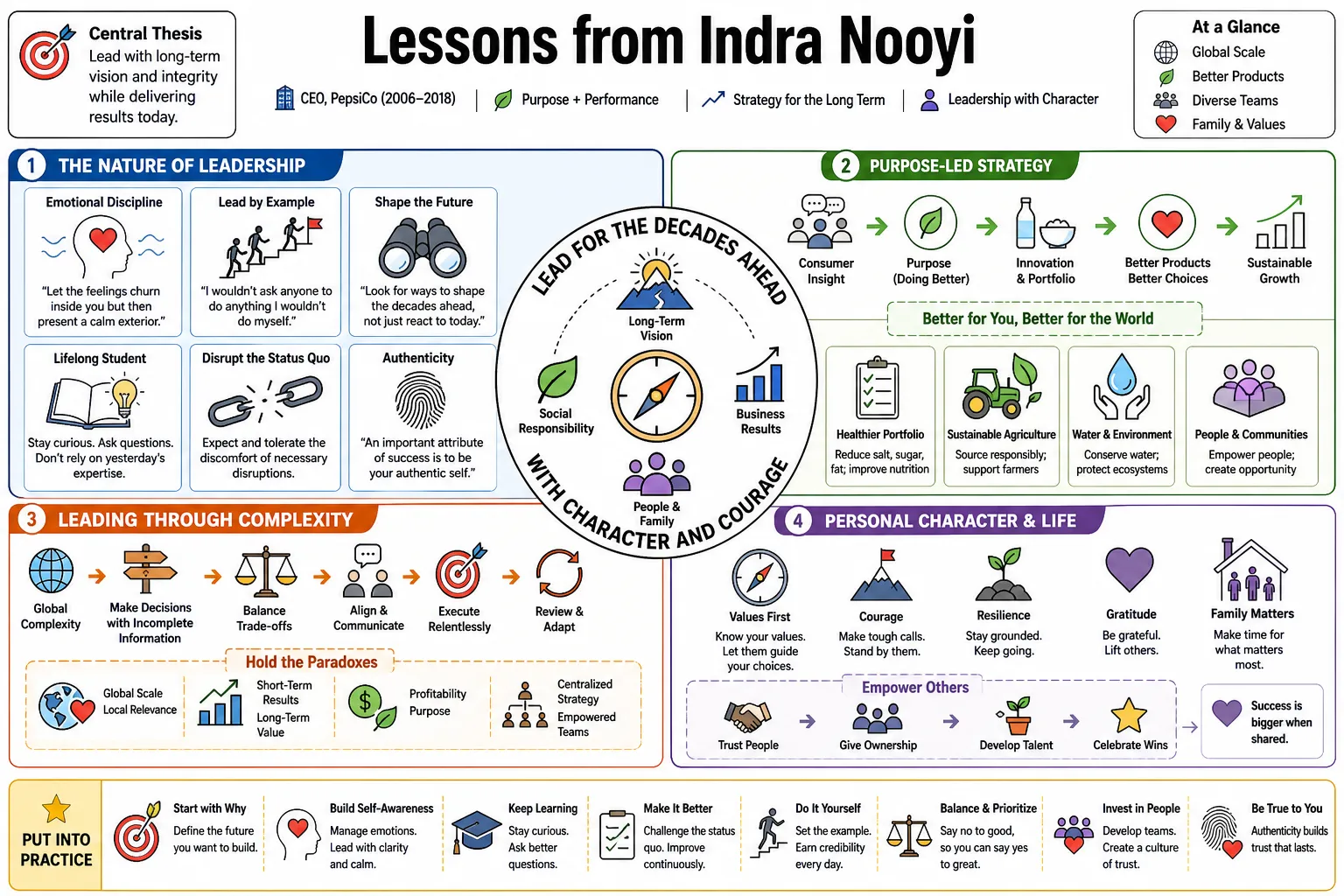
Lessons from Indra Nooyi
Indra Nooyi ran PepsiCo from 2006 to 2018, pushing the company to sell healthier products while remaining fiercely pragmatic about the realities of balancing a global corporation, social responsibility, and family life. This profile collects her ideas on business strategy and personal character to offer straightforward lessons for navigating work.
Part 1: The Nature of Leadership
- On calm under pressure: Describing an activist-investor campaign, Nooyi said "deep down inside, you know, I was in turmoil," but "to the employees, I had to show that I was calm, I was in control." — The Knowledge Project: Lessons from the top of PepsiCo and the cost of getting there (June 2025).
- On learning the business yourself: Having never run a P&L, Nooyi said "my replacement for having not run a P&L was go and learn each business from the ground up." — The Knowledge Project: Lessons from the top of PepsiCo and the cost of getting there (June 2025).
- On the long term: Nooyi told the Economic Club that a new kind of CEO must "think long term and align all metrics in the company at every level on the longer-term," and that "we need to embed a culture of long-term thinking." — Economic Club of Washington, D.C.: Indra Nooyi on the CEO of the future (May 2009).
- On lifelong learning: Nooyi said "The day you stop lifelong-learning, Ellen, you will atrophy," and described reading widely on new technologies after retiring. — Kellogg Insight podcast: Former PepsiCo CEO Indra Nooyi on her climb to the top (January 2025).
- On welcoming uncomfortable input: She said companies need to "encourage debate, foster a culture of dissent, and welcome uncomfortable input." — Economic Club of Washington, D.C.: Indra Nooyi on the CEO of the future (May 2009).
- On finding purpose in any job: Nooyi said her first jobs taught her purpose in business: "if you're in a job where there's no purpose or meaning, think hard about how to inject purpose or meaning into it." — Taken for Granted with Adam Grant: Indra Nooyi wants us to reimagine the return to work (October 2021).
- On courage in decision-making: On pushing a health agenda she said you must be "willing to take the blows" and "stay confident, and courageous through it all because you're firmly convinced that this is the way this company is going to be successful." — Taken for Granted with Adam Grant: Indra Nooyi wants us to reimagine the return to work (October 2021).
- On the climb to the top: Nooyi said "It's a climb. It's a tough climb," and "people don't realize that as you get more senior in an organization, it's up or out." — The Knowledge Project: Lessons from the top of PepsiCo and the cost of getting there (June 2025).
- On understanding a crisis: In a crisis, Nooyi said, ask "all the questions you need to ask to understand exactly the root cause of the crisis," then step back and decide the messaging. — The Knowledge Project: Lessons from the top of PepsiCo and the cost of getting there (June 2025).
Part 2: Family, Work, and Identity
- On the roles only you can play: Recalling her mother's advice after she became president, Nooyi said "somebody else can take my place in the company, but at home, who else is gonna be the wife and the mother and the daughter? Nobody else but me." — The Knowledge Project: Lessons from the top of PepsiCo and the cost of getting there (June 2025).
- On balance: Nooyi said "There's nothing called balance... It's juggling all those roles," and you "hope the most important balls every day don't fall and crash and burn." — The Knowledge Project: Lessons from the top of PepsiCo and the cost of getting there (June 2025).
- On putting family into the future of work: She said the future-of-work conversation "does not talk about family. It doesn't talk about women, young family builders who are all central to this idea of the future of work." — Taken for Granted with Adam Grant: Indra Nooyi wants us to reimagine the return to work (October 2021).
- On guilt: Nooyi said of her years as a working mother: "yes, I had a lot of guilt. I had a lot of tug of heartstrings." — Taken for Granted with Adam Grant: Indra Nooyi wants us to reimagine the return to work (October 2021).
- On juggling many roles: In 2010 she described herself as "trying to juggle being a CEO, a mom, a wife, a daughter, and a daughter-in-law." — BCG: Indra K. Nooyi on performance with purpose (January 2010).
- On an education-first upbringing: Nooyi said her family put education first: "the first rupees would go towards our education. It was a gift my parents gave us." — Kellogg Insight podcast: Former PepsiCo CEO Indra Nooyi on her climb to the top (January 2025).
- On a supportive spouse: Nooyi said "the most important thing is I had a supportive spouse," and that "the two of us worked as a team." — The Knowledge Project: Lessons from the top of PepsiCo and the cost of getting there (June 2025).
- On reading everything: On CEO workload, she said of the 400-500 page pre-reads: "I would read every page and write notes for myself." — Taken for Granted with Adam Grant: Indra Nooyi wants us to reimagine the return to work (October 2021).
- On family helping: Nooyi said that in the early days of their kids "various aunts and uncles came in from India to help us," for months at a time. — Kellogg Insight podcast: Former PepsiCo CEO Indra Nooyi on her climb to the top (January 2025).
Part 3: Performance with Purpose
- On more than the earnings cycle: Describing Performance with Purpose, Nooyi said "there is more to business than the earnings cycle," and that "Its performance and its purpose are not separate entities, they merge." — Economic Club of Washington, D.C.: Indra Nooyi on the CEO of the future (May 2009).
- On saving money by being greener: Nooyi said Performance with Purpose reduced PepsiCo's footprint: "We've reduced our environmental footprint, saved $600 million in costs, and our people are much happier." — Yale Insights: Can a positive impact be profitable? (January 2017).
- On the megatrends: Nooyi said she had to "take stock of the company and look forward 10 to 15 years at the big megatrends" that would affect consumer products. — Duke Fuqua Dialogue Project: Companies can be a force for good.
- On having a life: One pillar of purpose, she said, is "How do we make sure that people who work for PepsiCo are able not just to make a living but also to have a life?" — BCG: Indra K. Nooyi on performance with purpose (January 2010).
- On short versus long term: Nooyi said "the whole perspective in which companies are viewed needs to shift from the short to the long term." — Economic Club of Washington, D.C.: Indra Nooyi on the CEO of the future (May 2009).
- On giving something back: She argued that advocates of the corporation forgot that "a company operates under license and therefore has to give something back." — Economic Club of Washington, D.C.: Indra Nooyi on the CEO of the future (May 2009).
- On water: Nooyi recalled that "We were using two and a half liters of water to make a liter of Pepsi," and she "wanted to get it down to 1.2 or 1.3." — The Knowledge Project: Lessons from the top of PepsiCo and the cost of getting there (June 2025).
- On transforming the portfolio: She said "If we do not transform our portfolio, we cannot sustain performance. If we do not become greener than we are today, young people are not going to come to work for us." — BCG: Indra K. Nooyi on performance with purpose (January 2010).
- On skeptical investors: On resistance to her health agenda she said "people kept calling me Mother Teresa," but she wanted to "stay a step ahead of the regulation." — Taken for Granted with Adam Grant: Indra Nooyi wants us to reimagine the return to work (October 2021).
Part 4: Strategy and the Long View
- On changing before you must: Nooyi said "Change before the change forces you to make the change," which means "you've got to anticipate what's going to happen based on all the trends." — Kellogg Insight podcast: Former PepsiCo CEO Indra Nooyi on her climb to the top (January 2025).
- On zooming in before zooming out: Her philosophy from consulting: "zoom in before you zoom out." — The Knowledge Project: Lessons from the top of PepsiCo and the cost of getting there (June 2025).
- On the grind of change: Of persuading PepsiCo to change, she said "It was long hours and relentless, but it had to be done." — Kellogg Insight podcast: Former PepsiCo CEO Indra Nooyi on her climb to the top (January 2025).
- On micro understanding: Nooyi said "What I was focused on was micro understanding," because "if you don't understand the business down to where the rubber meets the road, you can make decisions at the top which are not implementable." — The Knowledge Project: Lessons from the top of PepsiCo and the cost of getting there (June 2025).
- On a future-back burning platform: She said that while PepsiCo "was doing very well," she "had a future backed burning platform" from looking at the market trends. — Kellogg Insight podcast: Former PepsiCo CEO Indra Nooyi on her climb to the top (January 2025).
- On time overseas: Nooyi said "it will be very hard for CEOs of tomorrow to be successful unless on the way up they have spent a significant amount of time overseas." — Economic Club of Washington, D.C.: Indra Nooyi on the CEO of the future (May 2009).
- On data and intuition: On how decisions get made she said you "looked at reams of data, you marry it with experience, with little bit of intuition, a lot of counseling with other people." — The Knowledge Project: Lessons from the top of PepsiCo and the cost of getting there (June 2025).
- On strategy that can be implemented: Nooyi said "if you craft a strategy which is not implementable, it's not a strategy." — The Knowledge Project: Lessons from the top of PepsiCo and the cost of getting there (June 2025).
- On downturns: In 2010 she said "During this downturn, people realized that it's even more important to focus on portfolio transformations and to be green." — BCG: Indra K. Nooyi on performance with purpose (January 2010).
Part 5: Managing and Lifting Talent
- On developing the next generation: Nooyi said "a leader's biggest legacy is to develop the next generation of talent," who need to be "identified, nurtured, coached, celebrated and retained." — LEADERS magazine: interview with Indra Nooyi (2022).
- On stretch assignments: On mentorship she said "Give them stretch assignments, help them jump up to those stretch assignments. And when you think they're not jumping high enough, find a way to give them a little stool to jump up." — Taken for Granted with Adam Grant: Indra Nooyi wants us to reimagine the return to work (October 2021).
- On spotting future leaders: She looked for "brilliant ideas that challenged your thinking and took us to a better place," because "you don't want yes people around you." — The Knowledge Project: Lessons from the top of PepsiCo and the cost of getting there (June 2025).
- On toughness, kindness and clarity: Asked how to give feedback, Nooyi answered "Toughness, kindness, and clarity, all three." — The Knowledge Project: Lessons from the top of PepsiCo and the cost of getting there (June 2025).
- On diverse voices: Nooyi said of PepsiCo's executive committee: "That diversity is what keeps our company grounded and helps us make market-based, sensible decisions." — Economic Club of Washington, D.C.: Indra Nooyi on the CEO of the future (May 2009).
- On holding on to talent: Recalling a colleague's request for flexibility, Nooyi said "Ellen's a talent. We have to hold on to her. If that means working flexibly for a couple of years, hell, let's do it." — Kellogg Insight podcast: Former PepsiCo CEO Indra Nooyi on her climb to the top (January 2025).
- On clear feedback: Nooyi said "give the message, do it in a supportive way, and make sure that whatever you tell them they have to work on, you help them get to that." — The Knowledge Project: Lessons from the top of PepsiCo and the cost of getting there (June 2025).
- On developing people: Nooyi said "I think if you really care about people development, you've gotta think that way," even if that means helping someone leave for a better opportunity. — The Knowledge Project: Lessons from the top of PepsiCo and the cost of getting there (June 2025).
- On respecting the frontline: Nooyi said "it's having respect for the frontline, so you talk to them in a language that they're familiar with." — The Knowledge Project: Lessons from the top of PepsiCo and the cost of getting there (June 2025).
Part 6: Communication and Connection
- On asking and listening: Nooyi said "Socrates learns by asking probing questions and listening. That is the way we have to learn in the little republic of the corporation." — Economic Club of Washington, D.C.: Indra Nooyi on the CEO of the future (May 2009).
- On how a message is sent: Nooyi said "you've got to think about the message you're sending and also how you're sending the message, because ultimately you're talking to people, not to machines." — Taken for Granted with Adam Grant: Indra Nooyi wants us to reimagine the return to work (October 2021).
- On writing to parents: She described writing to the parents of her top executives: "thank you for the gift of your child to PepsiCo." — Taken for Granted with Adam Grant: Indra Nooyi wants us to reimagine the return to work (October 2021).
- On learning your audience: Nooyi said "CEOs need to get off the executive floor and start talking to people of all generations, not to pass judgment but to learn their language." — Economic Club of Washington, D.C.: Indra Nooyi on the CEO of the future (May 2009).
- On adapting to local cultures: She said "traditional Western global business models cannot be exported, as opportunities and problems there are local and have to be addressed this way." — Economic Club of Washington, D.C.: Indra Nooyi on the CEO of the future (May 2009).
- On honesty in a crisis: Nooyi said "Honesty is critically important. When you have a crisis, be honest with your employees, with the outside world." — The Knowledge Project: Lessons from the top of PepsiCo and the cost of getting there (June 2025).
- On big words in a crisis: She warned that "when you try to use big words to hide the crisis, or you're just trying to deflect responsibility, people just don't have time for this, including your own employees." — The Knowledge Project: Lessons from the top of PepsiCo and the cost of getting there (June 2025).
- On listening to feedback: Nooyi said "You listen to it carefully, and if you trust the person who's giving you the feedback... then you will pause and say, okay, how do I change what I'm doing?" — Kellogg Insight podcast: Former PepsiCo CEO Indra Nooyi on her climb to the top (January 2025).
Part 7: Execution and Standards
- On finding the data: Nooyi recalled using satellite photos to size a competitor's plant: "don't tell me you can't get the data. Find a way to get the data." — The Knowledge Project: Lessons from the top of PepsiCo and the cost of getting there (June 2025).
- On implementing strategy: Of her Power of One strategy she said "Don't just sit there saying, 'We should have Power of One.' Talk about what is it gonna take to implement it." — The Knowledge Project: Lessons from the top of PepsiCo and the cost of getting there (June 2025).
- On blame and credit: Nooyi said "If something goes wrong with the decision you made, the blame is yours. If it goes well, give it to the team that worked on it." — The Knowledge Project: Lessons from the top of PepsiCo and the cost of getting there (June 2025).
- On layers and spans: On running PepsiCo's organization she said "we monitored all of that carefully," asking "Are we adding layers for no reason?" — The Knowledge Project: Lessons from the top of PepsiCo and the cost of getting there (June 2025).
- On dropping the bone: Recalling an early health-and-wellness push that executives rejected, Nooyi said "I should have stuck with it," and that she was known as "a dog with a bone. That's the one time I dropped the bone." — Taken for Granted with Adam Grant: Indra Nooyi wants us to reimagine the return to work (October 2021).
- On the shelf as media: On retail execution she said "When your consumer sees the product on the shelf, that's the media talking to you." — The Knowledge Project: Lessons from the top of PepsiCo and the cost of getting there (June 2025).
- On taking responsibility: Of her best people, Nooyi said "they would put their hand up for difficult assignments," and if something went wrong "they didn't look for somebody else to blame." — The Knowledge Project: Lessons from the top of PepsiCo and the cost of getting there (June 2025).
Part 8: The Role of Business in Society
- On public-private partnerships: Nooyi said "A good, modern company cannot function without these partnerships" between the public and private sectors. — Economic Club of Washington, D.C.: Indra Nooyi on the CEO of the future (May 2009).
- On a healthy society: She said "a healthy society means healthy corporations and vice versa." — Economic Club of Washington, D.C.: Indra Nooyi on the CEO of the future (May 2009).
- On local knowledge: On acting local, she said it "requires – especially for those in the West – acquiring profound, new knowledge." — Economic Club of Washington, D.C.: Indra Nooyi on the CEO of the future (May 2009).
- On care: Nooyi said "We are at a moment in time where we can take this whole issue of family and care and family builders and make it more central to our discussions." — Taken for Granted with Adam Grant: Indra Nooyi wants us to reimagine the return to work (October 2021).
- On an aging population: She cited demographics: "One out of every 10 persons is now 60 years and above. By 2050, one out of five will be 60 years or older." — Economic Club of Washington, D.C.: Indra Nooyi on the CEO of the future (May 2009).
- On Pepsi Refresh: Nooyi described moving more than half of Super Bowl advertising money into community grants through Pepsi Refresh after the financial crisis, and said critics who cited lost market share missed the point. — Taken for Granted with Adam Grant: Indra Nooyi wants us to reimagine the return to work (October 2021).
- On reskilling: Nooyi said "businesses need to think about reskilling," and that companies have "a duty of care to their societies." — Roland Berger: Indra Nooyi on having a career and a family (October 2022).
- On learning each other's fields: Co-chairing Reopen Connecticut with an epidemiologist, Nooyi said "we both invested enormous time in learning each other's disciplines, because we wanted to understand the impact on lives and livelihoods." — Taken for Granted with Adam Grant: Indra Nooyi wants us to reimagine the return to work (October 2021).