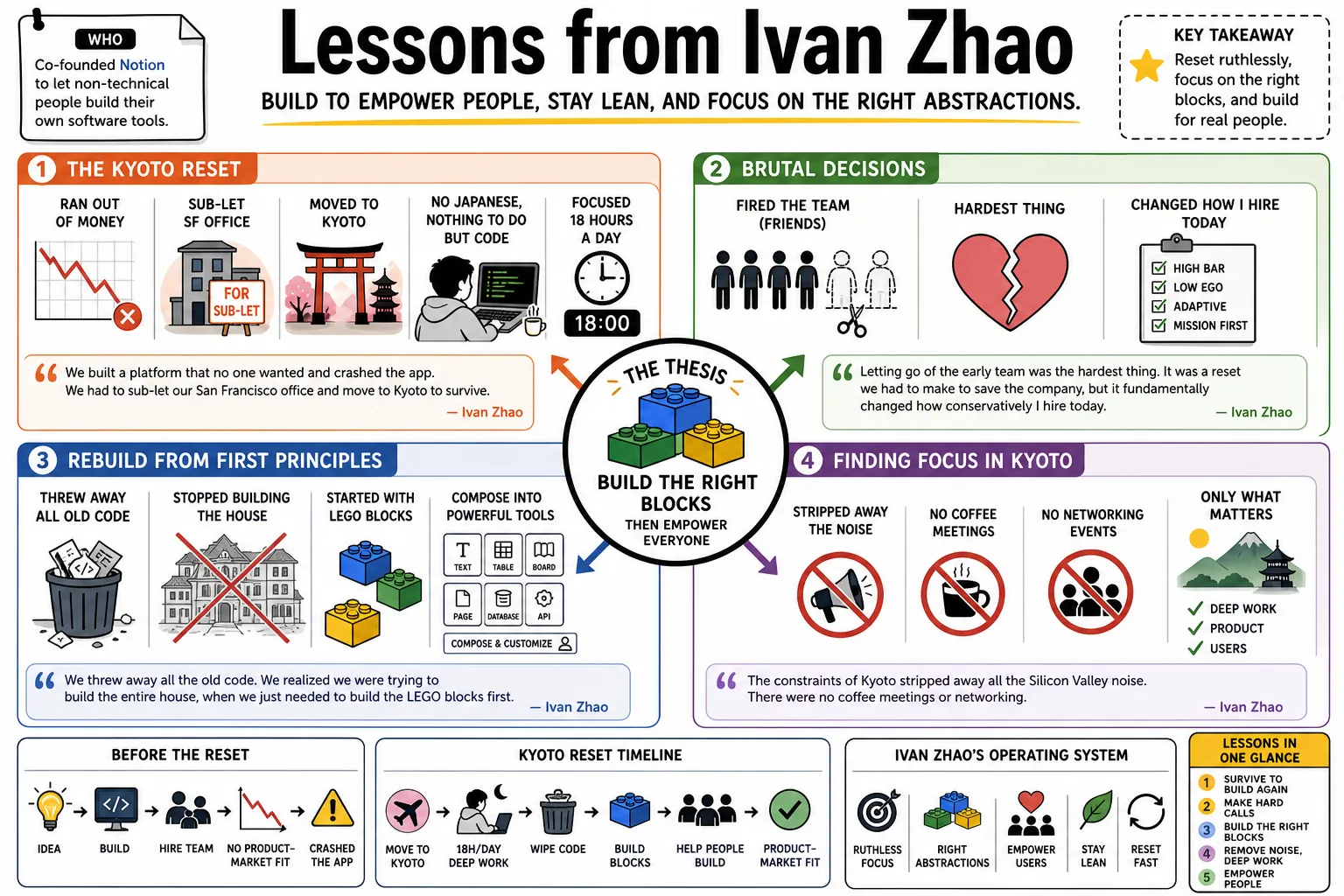
Lessons from Ivan Zhao
Ivan Zhao co-founded Notion to let non-technical people build their own software tools. Before the app became a workplace standard, he and his co-founder nearly went broke, fired their team, and moved to Kyoto to rewrite it from scratch. The notes below cover his approach to design, computing history, and running lean companies.
Part 1: The Kyoto Reset
- On laying everyone off: Zhao said "we decided to lay off everybody," and that by subleasing their apartment and office "We're actually making money living in Japan and then San Francisco." — Podcast transcript: Notion's lost years, near collapse during COVID, staying small to move fast, building horizontal, Ivan Zhao (March 2025).
- On rapid coding: Of the time in Kyoto Zhao said "once you land, you start coding—just that rapid coding, eating, coding, eating rhythm. It's actually really liberating." — Sequoia Capital podcast: Notion's Ivan Zhao, the Refounder.
- On saying goodbye to the team: Zhao said "You have to say goodbye to your teammates," and that "morale obviously there was really low." — Podcast transcript: Notion's lost years, near collapse during COVID, staying small to move fast, building horizontal, Ivan Zhao (March 2025).
- On resetting: Zhao said "Definitely don't be afraid to reset," and that "you can create progress through better abstractions." — Podcast transcript: Notion's lost years, near collapse during COVID, staying small to move fast, building horizontal, Ivan Zhao (March 2025).
- On craft in Kyoto: Zhao said of Kyoto "It's a craft central. And how can you not be inspired to build better software?" — Sequoia Capital podcast: Notion's Ivan Zhao, the Refounder.
- On a durable energy source: Zhao said building something authentic that is also useful to others "feels like a more durable energy source for all those dark years, loss years during Notion." — Podcast transcript: Notion's lost years, near collapse during COVID, staying small to move fast, building horizontal, Ivan Zhao (March 2025).
- On the wrong technical foundation: Zhao said "in the middle of that I realized we built on the wrong technical foundation," a bet on Web Components, and "Then we have to restart the company, rebuild the whole thing." — Podcast transcript: Notion's lost years, near collapse during COVID, staying small to move fast, building horizontal, Ivan Zhao (March 2025).
- On how long the rebuild took: Asked how long the rebuild took, Zhao said "It took a year and a half to rebuild from scratch." — Sequoia Capital podcast: Notion's Ivan Zhao, the Refounder.
Part 2: Computing History
- On Douglas Engelbart: Of Engelbart's paper Augmenting Human Intellect, Zhao said "If you are making software, if you know how to code or design, this is the highest leverage thing you can do for other people." — Podcast transcript: Notion's lost years, near collapse during COVID, staying small to move fast, building horizontal, Ivan Zhao (March 2025).
- On Alan Kay: Zhao described Smalltalk on the Xerox Alto as a system where "There's no thing called application. Everything is malleable. You can change the tools." — Podcast transcript: Notion's lost years, near collapse during COVID, staying small to move fast, building horizontal, Ivan Zhao (March 2025).
- On builders and users: Zhao said the first-generation pioneers believed "there shouldn't be a separation between builders and users. It's the same medium." — Podcast transcript: Notion's lost years, near collapse during COVID, staying small to move fast, building horizontal, Ivan Zhao (March 2025).
- On toolmaking: Zhao said "Humans are toolmakers by nature, yet very few of us have the skills or knowledge to modify the software tools that we use every day." — Ness Labs: Building the world's most customizable workspace with Ivan Zhao (March 2021).
- On Xerox PARC and what Steve Jobs missed: Zhao said of Steve Jobs's Xerox PARC visit "He only saw the graphic user interface. He did not see the underlying object or the environment power." — Podcast transcript: Notion's lost years, near collapse during COVID, staying small to move fast, building horizontal, Ivan Zhao (March 2025).
- On continuing a lineage: Zhao said he and his co-founder were in the tools-for-thought community, traced back to the first generation of computing pioneers, and "I wanted to continue that lineage." — Sequoia Capital podcast: Notion's Ivan Zhao, the Refounder.
- On a medium for more people: Zhao said reading the pioneers' papers made him realize "this is the most meaningful thing I can do. By being a programmer, by being a designer. Bring this medium of computing to more people, democratize it." — Possible podcast: How Notion rebuilt for the age of AI, Ivan Zhao (March 2026).
Part 3: Product Strategy
- On sugar-coated broccoli: Zhao said "We call it sugar-coated broccoli. People don't want to eat the broccoli but people like sugar, so give them the sugar then hide the broccoli inside of it." — Podcast transcript: Notion's lost years, near collapse during COVID, staying small to move fast, building horizontal, Ivan Zhao (March 2025).
- On building horizontal: Zhao said "The advantage of building horizontal, there's no wall," but "you need to create a wall yourself" for go-to-market. — Podcast transcript: Notion's lost years, near collapse during COVID, staying small to move fast, building horizontal, Ivan Zhao (March 2025).
- On Lego bricks and Lego boxes: Zhao said "Only hardcore Lego fans care about Lego bricks. Most people care about Lego boxes. And they actually want the Lego box to be ready-made." — Podcast transcript: Notion's lost years, near collapse during COVID, staying small to move fast, building horizontal, Ivan Zhao (March 2025).
- On consolidating tools: Zhao said "if a customer use Notion, they can address those three, four use cases in one place." — Podcast transcript: Notion's lost years, near collapse during COVID, staying small to move fast, building horizontal, Ivan Zhao (March 2025).
- On starting with a template: Zhao advised new users to find something small to organize and said "Another tip is to start with a template — there's one for every kind of person or team — and they are right in the product." — Ness Labs: Building the world's most customizable workspace with Ivan Zhao (March 2021).
- On building in the Lego way: After hard-coding a sprint feature that did not fit the product, Zhao said "if you build in a Lego way inside Notion in the code base or product, the system work for you." — Podcast transcript: Notion's lost years, near collapse during COVID, staying small to move fast, building horizontal, Ivan Zhao (March 2025).
- On bottom-up growth: Zhao described Notion's internal strategy as B2C2B, and said "Half our B2B customers coming from prior personal users." — Podcast transcript: Notion's lost years, near collapse during COVID, staying small to move fast, building horizontal, Ivan Zhao (March 2025).
- On noticing small lags: Zhao said he was filing a bug before the interview about typing in the title of a page: "It's a little bit laggier than when you're typing in the body." — Grit podcast video: How Notion Reimagined Productivity Tools, Ivan Zhao (August 2025).
- On bundling and unbundling: Zhao traced software from paper to the PC to Microsoft's suite to SaaS and said "there's more value to be created through bundling, at least for now." — Podcast transcript: Notion's lost years, near collapse during COVID, staying small to move fast, building horizontal, Ivan Zhao (March 2025).
Part 4: Design as a Medium
- On a quiet environment: Zhao said "You don't want to hear noise, but you also don't want to see ugly things," so the team prefers timeless tools and furniture. — Possible podcast: How Notion rebuilt for the age of AI, Ivan Zhao (March 2026).
- On sensing when something is off: Asked whether he is even more attentive in software, Zhao said he is good at picking up bugs, and "when things off a little bit I can sense it. I feel it." — Grit podcast video: How Notion Reimagined Productivity Tools, Ivan Zhao (August 2025).
- On timeless tools: Zhao said "We name our conference room after timeless tools in history," such as the original Macintosh, Lamy 2000 pens and Toshiba rice cookers, because they are inspirations. — Podcast transcript: Notion's lost years, near collapse during COVID, staying small to move fast, building horizontal, Ivan Zhao (March 2025).
Part 5: Lean Operations
- On jazz mode: Zhao said the company mantra became "we want to be a jazz band, not a marching band," adding "jazz mode has some structure. You don't want to be—you want other people to contribute." — Sequoia Capital podcast: Notion's Ivan Zhao, the Refounder.
- On a small bus: Zhao said "Notion's a small bus. The bus, the smaller the bus, it's easier to turn corners, easier to accelerate, easier to maneuver." — Podcast transcript: Notion's lost years, near collapse during COVID, staying small to move fast, building horizontal, Ivan Zhao (March 2025).
- On designers who code: Zhao said "We were one of the first to hire designers who can code," and that engineers with strong product sense and PMs "not afraid to roll up their sleeves" shine at Notion. — Sequoia Capital podcast: Notion's Ivan Zhao, the Refounder.
- On talent density: Zhao said "we have this internal Notion called talent density. We don't try to track number of people but we try to track how talent-dense, revenue per employee we are." — Podcast transcript: Notion's lost years, near collapse during COVID, staying small to move fast, building horizontal, Ivan Zhao (March 2025).
- On offices that feel like homes: Zhao said the office vision "should feels like artist studio or should feel like your home," so people spend more time and feel more creative. — Podcast transcript: Notion's lost years, near collapse during COVID, staying small to move fast, building horizontal, Ivan Zhao (March 2025).
- On not needing validation: After an investor told him he did not need money and was seeking external validation, Zhao said "Then we just went back to building." — Podcast transcript: Notion's lost years, near collapse during COVID, staying small to move fast, building horizontal, Ivan Zhao (March 2025).
- On decentralizing marketing: Zhao said that after breaking up the CMO organization, "Just let both sides figure it out themselves," then corrected himself: "more decentralized." — Sequoia Capital podcast: Notion's Ivan Zhao, the Refounder.
- On refounding: Zhao said "the best artists reinvent themselves," and of resetting "sometimes your body just tells you you have to do it. You know you're dead if you don't do it." — Sequoia Capital podcast: Notion's Ivan Zhao, the Refounder.
- On meeting blocks: Zhao described his schedule: "A lot of 25-minute blocks. I usually like five minutes between meetings and 25, 25, 25." — Sequoia Capital podcast: Notion's Ivan Zhao, the Refounder.
Part 6: Building Notion
- On community: Zhao said "We owe so much to our community. It's our not-so-secret weapon and our biggest strength," and that one ambassador "runs our subreddit with nearly 100,000 subscribers." — Ness Labs: Building the world's most customizable workspace with Ivan Zhao (March 2021).
- On communities around the world: Zhao said ambassadors run communities around the world: "Another runs our Facebook Group in Korea with over 20,000 folks. Another has an Arabic community with over 30,000 folks in it." — Ness Labs: Building the world's most customizable workspace with Ivan Zhao (March 2021).
- On the doomsday clock: Zhao said Notion ran on one Postgres instance, and "there's a doomsday clock that when we're going to truly run out of this space to store everything in Notion and Notion got a complete shutdown." — Podcast transcript: Notion's lost years, near collapse during COVID, staying small to move fast, building horizontal, Ivan Zhao (March 2025).
- On running the company on Notion: Zhao said "Notion itself is a meta tool to build other tools. So we pretty much run everything on Notion." — Podcast transcript: Notion's lost years, near collapse during COVID, staying small to move fast, building horizontal, Ivan Zhao (March 2025).
- On early feedback: Zhao said "In the early days, I spent a lot of time replying one-on-one to users on Twitter, making sure they knew there was a human behind Notion. We also logged every piece of feedback we got and tagged it." — Ness Labs: Building the world's most customizable workspace with Ivan Zhao (March 2021).
Part 7: AI and the Future
- On a new material: Zhao said of GPT-4 class models "it's a brand new material that's just like relational database, just like bitmap display." — Possible podcast: How Notion rebuilt for the age of AI, Ivan Zhao (March 2026).
- On bundled context: Zhao said "AI is really good with bundled offerings. AI is really good with horizontal tools." — Podcast transcript: Notion's lost years, near collapse during COVID, staying small to move fast, building horizontal, Ivan Zhao (March 2025).
- On the first AI product: Zhao said "The first product was our AI writer product. Second product is AI Q&A or connectors." — Podcast transcript: Notion's lost years, near collapse during COVID, staying small to move fast, building horizontal, Ivan Zhao (March 2025).
- On triaging with AI: Zhao said he now trusts an intermediate layer to know what is important in his inbox: "Surface the one to me then archive the rest." — Possible podcast: How Notion rebuilt for the age of AI, Ivan Zhao (March 2026).
- On moving up the loop: Zhao said language models can do information passing and alignment so that "humans can elevate to more strategic outer loop way of thinking rather than information passing." — Possible podcast: How Notion rebuilt for the age of AI, Ivan Zhao (March 2026).
- On AI Q&A: Zhao said AI is "so good at reasoning and understanding and searching things," so Notion built "AI Q&A or connectors" to look at all the information in Notion and give an answer. — Podcast transcript: Notion's lost years, near collapse during COVID, staying small to move fast, building horizontal, Ivan Zhao (March 2025).
- On agents at work: Zhao wrote "Alongside our 1,000 employees, more than 700 agents now handle repetitive work." — Notion blog by Ivan Zhao: Steam, Steel, and Infinite Minds (December 2025).
- On the chatbot stage: Zhao wrote "Today, we see this as AI chatbots which mimic Google search boxes. We're now deep in that uncomfortable transition phase which happens with every new technology shift." — Notion blog by Ivan Zhao: Steam, Steel, and Infinite Minds (December 2025).
- On being conscious of what is lost: Zhao said "let's be conscious of what's in gain. Let's be conscious of what's lost. Let's constantly flip this thing. See the humans in the center, if that's what you care about." — Possible podcast: How Notion rebuilt for the age of AI, Ivan Zhao (March 2026).
Part 8: Personal Philosophy
- On childhood computing: Zhao said he picked the programming competition "I was really into computer games at the time so of course I picked the programming one so I can play computers all day long," and in college "Did a lot of art actually, art and science." — Podcast transcript: Notion's lost years, near collapse during COVID, staying small to move fast, building horizontal, Ivan Zhao (March 2025).
- On better than last week: Zhao said progress was never a milestone: "It's more just like, 'Can we do the same that's in our head and better than we did last week?'" — Podcast transcript: Notion's lost years, near collapse during COVID, staying small to move fast, building horizontal, Ivan Zhao (March 2025).
- On learning from history: Zhao said "If you go back to history, there's a massive amount of patterns and shapes and trade-offs you can steal from." — Podcast transcript: Notion's lost years, near collapse during COVID, staying small to move fast, building horizontal, Ivan Zhao (March 2025).
- On steady highs and lows: Zhao said "I'm lucky and Simon lucky that high is never too high, low is never too low for us." — Podcast transcript: Notion's lost years, near collapse during COVID, staying small to move fast, building horizontal, Ivan Zhao (March 2025).
- On seeing people use Notion: Zhao said "it never gets old when you walk by coffee shop and see people using Notion." — Podcast transcript: Notion's lost years, near collapse during COVID, staying small to move fast, building horizontal, Ivan Zhao (March 2025).
- On despair before product-market fit: Zhao said "Just the early days, pre-product-market fit is despair. You don't know where it's coming from, you don't know where to go." — Sequoia Capital podcast: Notion's Ivan Zhao, the Refounder.
- On balancing self and business: Zhao said "Too much of yourself, then there's no users," and "too much for a business, you're building a commodity." — Podcast transcript: Notion's lost years, near collapse during COVID, staying small to move fast, building horizontal, Ivan Zhao (March 2025).
- On craft and business: Zhao said "If you just only care about craft, then you don't build a business. You might as well just be an artist." — Sequoia Capital podcast: Notion's Ivan Zhao, the Refounder.
- On new skills as the company changes: Zhao said "Every 12, 18 month, Notion's like a new company or at least they require different skill set coming from me. So I need to pick up new things." — Podcast transcript: Notion's lost years, near collapse during COVID, staying small to move fast, building horizontal, Ivan Zhao (March 2025).
- On preserving what makes us human: Zhao ended by saying he hopes "we preserve what makes us humans, human in the meanwhile." — Possible podcast: How Notion rebuilt for the age of AI, Ivan Zhao (March 2026).