Jack Kokko is the founder and CEO of AlphaSense, a search engine he built to solve the information overload he experienced as a financial analyst. He is known for applying artificial intelligence to market intelligence, specifically focusing on how to make AI reliable enough for high-stakes business decisions. This profile compiles his thoughts on managing data, building enterprise software, and navigating risk as an entrepreneur.
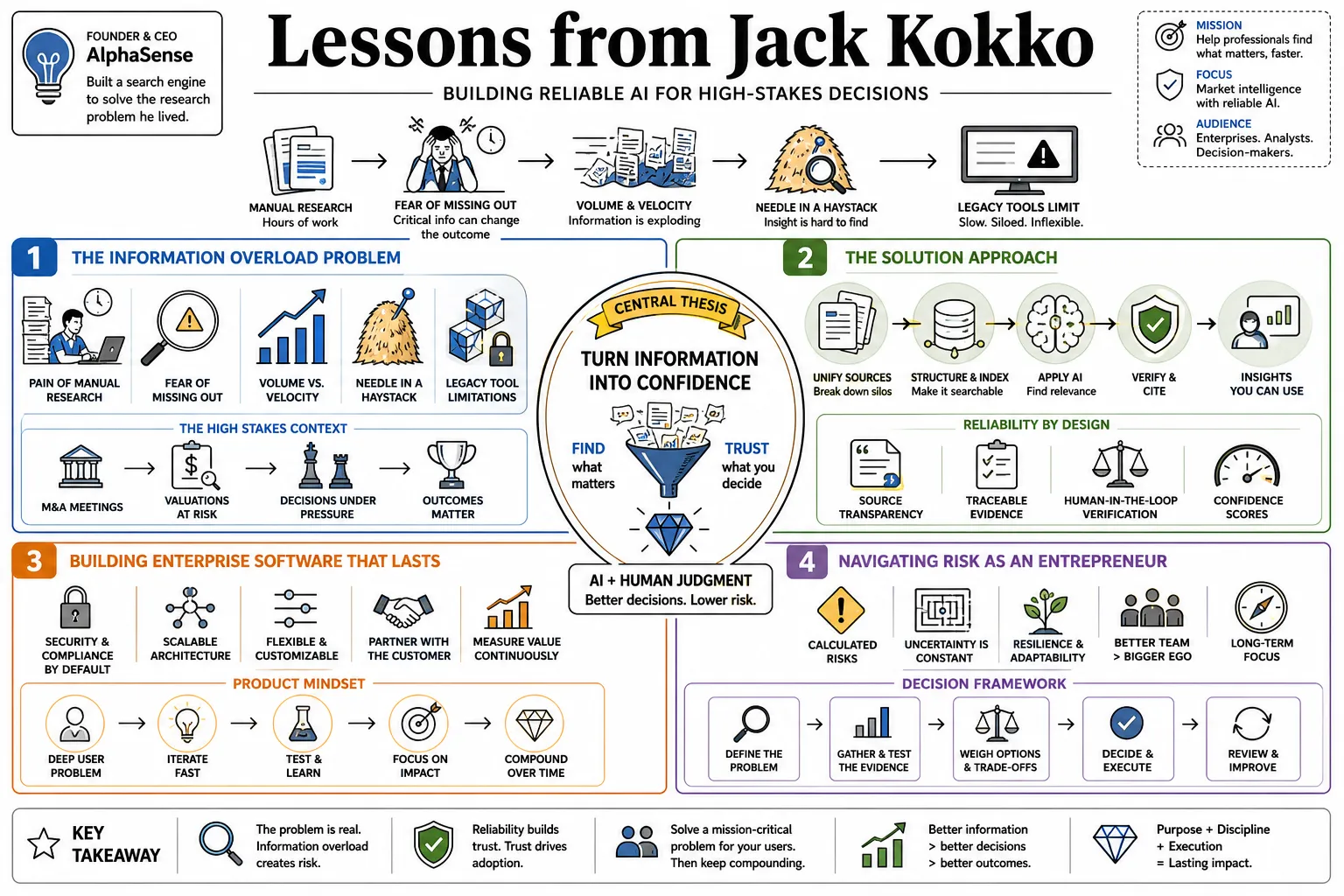
Part 1: The Information Overload Problem
- On the pain of manual research: "I spent hours as an analyst poring over large amounts of information and gathering data to help value and execute large M&A deals." — Source: [Morgan Stanley Alumni]
- On the fear of missing out: "The intense fear as an analyst of missing critical information in high-stakes M&A meetings is what drove me to build a solution." — Source: [Riffon]
- On volume versus velocity: "The volume and velocity of information today make it increasingly difficult for businesses to identify what matters and act with confidence." — Source: [OTC Markets]
- On finding a needle in a haystack: The challenge in finance isn't a lack of data, but the inability to quickly find the specific insight that changes a valuation. — Source: [AlphaSense Blog]
- On the limitations of legacy tools: Traditional search tools simply weren't built to understand the semantic nuances of financial language. — Source: [Capital Allocators Podcast]
- On unstructured data: The vast majority of valuable business information lives in unstructured formats like transcripts and filings, which are difficult to parse manually. — Source: [Montgomery Summit]
- On the cost of missed insights: Failing to connect the dots across fragmented information sources can lead directly to lost revenue or poor investments. — Source: [Inc. Magazine]
- On cognitive fatigue: Analysts burn out not from doing high-level analysis, but from the rote mechanical work of gathering the inputs for that analysis. — Source: [The Financial Revolutionist]
- On early career realizations: Working in tech M&A in Menlo Park made it immediately clear that the speed of business was outpacing the speed of our research tools. — Source: [Morgan Stanley Alumni]
Part 2: The Founding of AlphaSense
- On solving your own problem: "What inspired me was my own experience as an investment banker where I desperately needed a product like AlphaSense." — Source: [Morgan Stanley Alumni]
- On initial product vision: The early goal was to create a "Google for finance" that could understand the specific terminology used by Wall Street. — Source: [The Financial Revolutionist]
- On taking the leap: Moving from the stability of investment banking to starting a software company required embracing daily uncertainty. — Source: [Medium]
- On the power of a technical co-founder: Partnering with someone who deeply understands search architecture and natural language processing was critical to translating the financial use case into reality. — Source: [Capital Allocators Podcast]
- On early customer feedback: The first iterations were rough, but early adopters saw the potential to save hours of manual reading. — Source: [AlphaSense Blog]
- On domain specificity: We realized quickly that a general search engine couldn't handle the complexities of financial documents; it had to be purpose-built. — Source: [Montgomery Summit]
- On naming the company: The name reflects the goal: helping users find the signal (alpha) amidst the noise (sense). — Source: [Inc. Magazine]
- On patience in development: Building the foundational semantic search engine took years before the market fully understood the value of the technology. — Source: [Forbes]
- On the original mission: "We set out to close the gap between critical insights and decision-making at speed." — Source: [OTC Markets]
Part 3: Building Enterprise-Grade AI
- On competitive moats: "What makes AlphaSense unique? It's the combination of the market's broadest content universe, purpose-built AI, and workflows designed for high-stakes decision making." — Source: [AlphaSense Blog]
- On continuous learning: "At AlphaSense, we're building a continuously learning intelligence platform that combines proprietary content, deep insights from expert interviews, and purpose-built AI." — Source: [Investing News]
- On consumer vs. enterprise AI: Consumer AI can afford to be occasionally wrong; enterprise AI used in financial models cannot. — Source: [SoftBank Vision Fund]
- On the importance of proprietary data: An AI model is only as useful as the content it is trained on and the specific data it has access to. — Source: [Montgomery Summit]
- On integrating LLMs: Generative AI isn't a standalone product; it needs to be integrated deeply into the existing workflows of professionals. — Source: [Capital Allocators Podcast]
- On iterative development: "We have to keep evolving it" by balancing the raw power of language models with rigorous human evaluation. — Source: [AlphaSense Blog]
- On avoiding gimmicks: Enterprise customers don't want AI chatbots for the sake of having them; they want tools that demonstrably speed up their research process. — Source: [Inc. Magazine]
- On workflow design: The interface matters just as much as the algorithm; if the workflow isn't intuitive, analysts simply won't adopt it. — Source: [The Financial Revolutionist]
- On the "always-on" machine: The goal is an intelligence factory that processes information continuously, alerting users to changes before they even ask. — Source: [AlphaSense Blog]
- On technical debt: When building enterprise search infrastructure, taking shortcuts early on will inevitably bottleneck scale later. — Source: [Capital Allocators Podcast]
Part 4: Verifiability and Trust in AI
- On the core technical challenge: "The key technical challenge is verifiability." — Source: [Mustachian Post]
- On AI scaffolding: "For high-stakes business decisions, AI outputs must include 'scaffolding' and 'guard rails' that allow users to trace information back to the original source." — Source: [Mustachian Post]
- On building confidence: "Giving users trust that they know exactly where each bit of information is coming from" has been the core value since day one. — Source: [SoftBank Vision Fund]
- On hallucinations: In the financial sector, an AI hallucination isn't just an error; it's a liability that can lead to catastrophic capital allocation. — Source: [Inc. Magazine]
- On auditability: Every claim generated by the system must have a clickable link back to the exact sentence in the SEC filing or transcript it came from. — Source: [AlphaSense Blog]
- On human-in-the-loop: The technology is meant to augment the analyst, not replace them; the human must always have the final say on the data's validity. — Source: [Montgomery Summit]
- On evaluating models: We spend as much time evaluating and testing the accuracy of the outputs as we do training the models themselves. — Source: [Capital Allocators Podcast]
- On the narrative vs. the facts: "We can then find the best results and create a narrative around them, while still staying true" to the underlying data. — Source: [SoftBank Vision Fund]
- On institutional trust: Once an organization loses trust in a search tool's accuracy, it is incredibly difficult to win it back. — Source: [The Financial Revolutionist]
- On mitigating bias: Ensuring that the AI weighs sources appropriately, favoring official filings over rumors, is critical to maintaining data integrity. — Source: [Forbes]
Part 5: Navigating Risk and High-Stakes Decisions
- On risk and passion: "As an analyst, you need to understand risk. As an entrepreneur, you live risk each and every day. Given that, make sure you have passion." — Source: [Medium]
- On building conviction: The ultimate goal of market intelligence isn't just to gather data, but to allow executives to "make faster, higher-conviction decisions in complex environments." — Source: [Investing News]
- On the cost of being wrong: In M&A and asset management, decisions are often binary and the financial consequences of missing a single risk factor are massive. — Source: [Inc. Magazine]
- On seeing around corners: Great investors don't just react to news; they anticipate it by connecting disparate pieces of information before the broader market does. — Source: [AlphaSense Blog]
- On managing startup risk: You mitigate entrepreneurial risk by focusing obsessively on solving a very specific, undeniable pain point for your customer. — Source: [Capital Allocators Podcast]
- On the illusion of safety: Relying on the same manual processes that everyone else uses might feel safe, but it guarantees you won't find an edge. — Source: [Montgomery Summit]
- On information asymmetry: Historically, the advantage went to whoever had access to the data; today, it goes to whoever can process it the fastest. — Source: [SoftBank Vision Fund]
- On pivoting: "We have to be very much ready to pivot when something changes. That readiness to pivot and the flexibility is perhaps one of the bigger learnings." — Source: [AlphaSense Blog]
- On taking calculated bets: Whether investing capital or building a product roadmap, success requires taking informed bets based on the best available intelligence. — Source: [Forbes]
- On execution speed: In dynamic markets, possessing the right data isn't enough if you cannot synthesize and act on it before the window of opportunity closes. — Source: [Inc. Magazine]
Part 6: Scaling and Leadership
- On defining the market: "This milestone reflects... a broader shift in market intelligence – from fragmented information to end-to-end AI-driven workflows." — Source: [GlobeNewswire]
- On inevitable outcomes: "I don't think anybody would be actively looking to go public right now if they didn't have to, but it's something we've always seen as an inevitable outcome." — Source: [Business Insider]
- On maintaining focus: As you scale from serving a niche group of analysts to broader corporate strategy teams, the core mission of surfacing truth quickly must remain intact. — Source: [Capital Allocators Podcast]
- On hiring: You need people who are comfortable with the ambiguity of building a new category, not just executing an existing playbook. — Source: [Inc. Magazine]
- On leading through technological shifts: When generative AI arrived, it wasn't a threat to our business model; it was an accelerant to the vision we had been executing for years. — Source: [AlphaSense Blog]
- On customer retention: In B2B software, your product has to become an indispensable part of the user's daily routine, or they will eventually churn. — Source: [The Financial Revolutionist]
- On capital allocation: Raising money is a tool to accelerate product development, not a metric of success in itself. — Source: [Montgomery Summit]
- On organizational agility: The larger a company gets, the harder leadership must work to preserve the speed of decision-making that made the startup successful. — Source: [Forbes]
- On long-term vision: Building a durable company means looking past short-term market fluctuations and focusing on the compounding value of your technology. — Source: [SoftBank Vision Fund]
Part 7: The Evolution of Market Intelligence
- On the shift in research: We are moving away from basic keyword searches toward semantic understanding where the system knows what you mean, not just what you type. — Source: [Capital Allocators Podcast]
- On expert networks: Accessing transcripts of expert interviews provides qualitative color that raw financial statements often lack. — Source: [AlphaSense Blog]
- On breaking silos: Corporate strategy teams and investor relations departments are increasingly adopting the rigorous research habits of hedge funds. — Source: [Inc. Magazine]
- On real-time analysis: The half-life of financial information is shrinking; intelligence must be delivered in real time to be actionable. — Source: [OTC Markets]
- On the democratization of data: Better search tools level the playing field, allowing smaller firms to conduct the same depth of research as massive institutions. — Source: [The Financial Revolutionist]
- On sentiment analysis: It's no longer enough to know what a CEO said; you need technology to measure the tonal shifts in how they said it over the last four quarters. — Source: [Montgomery Summit]
- On global coverage: True market intelligence requires parsing documents in multiple languages and across diverse international regulatory frameworks. — Source: [Forbes]
- On the value of historical context: AI doesn't just synthesize today's news; it can instantly surface historical precedents from a decade ago to contextualize current events. — Source: [AlphaSense Blog]
- On workflow consolidation: Analysts prefer a single pane of glass where they can find, highlight, annotate, and model data without switching between disparate applications. — Source: [SoftBank Vision Fund]
Part 8: The Future of Knowledge Work
- On the changing role of the analyst: Analysts will spend less time gathering data and more time synthesizing complex cross-sector trends. — Source: [Morgan Stanley Alumni]
- On AI as a copilot: We view AI not as a replacement for human judgment, but as a hyper-competent research assistant that works alongside you. — Source: [SoftBank Vision Fund]
- On the speed of innovation: "In a world where AI is moving at a million miles per hour," the winners will be those who figure out how to safely deploy it in enterprise settings. — Source: [AlphaSense Blog]
- On cognitive augmentation: The future of work is about freeing up human cognitive capacity to focus on strategic thinking rather than mechanical retrieval. — Source: [Inc. Magazine]
- On learning curves: As tools become more conversational, the barrier to entry for performing complex market research will lower significantly. — Source: [The Financial Revolutionist]
- On the commoditization of base information: If everyone has access to the same raw data, the competitive advantage shifts to who has the best interpretive frameworks. — Source: [Capital Allocators Podcast]
- On continuous adaptation: Professionals who learn to prompt and interact with AI effectively will outpace those who stubbornly stick to legacy methods. — Source: [Forbes]
- On proactive intelligence: Systems will eventually transition from answering queries to proactively surfacing anomalies and opportunities before the user asks. — Source: [Montgomery Summit]
- On the ultimate goal: The end state of this technology is an environment where every business decision is backed by the totality of available global knowledge. — Source: [AlphaSense Blog]