Jacob Lauritzen is the Chief Technology Officer at Legora, where he builds AI workspaces designed for complex legal workflows. He is known for his critiques of "tokenmaxxing" and his concept of "context rot," detailing how AI models lose critical information during long tasks. This profile collects his arguments for moving beyond simple chat interfaces and designing software that prioritizes human oversight and measurable efficiency.
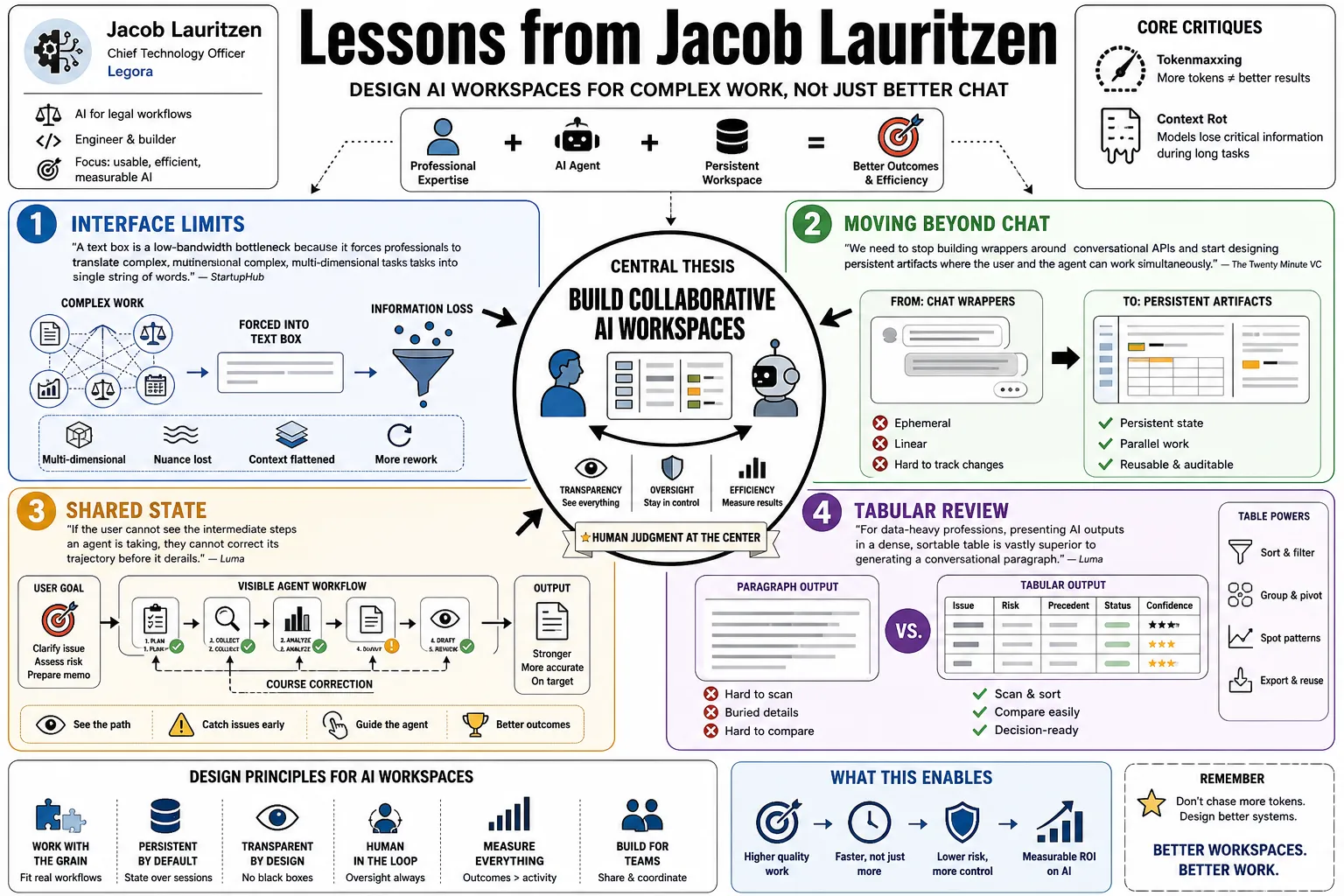
Part 1: Collaborative AI Workspaces
- On Interface Limits: "A text box is a low-bandwidth bottleneck because it forces professionals to translate complex, multi-dimensional tasks into a single string of words." — Source: StartupHub
- On Moving Beyond Chat: "We need to stop building wrappers around conversational APIs and start designing persistent artifacts where the user and the agent can work simultaneously." — Source: The Twenty Minute VC
- On Shared State: "If the user cannot see the intermediate steps an agent is taking, they cannot correct its trajectory before it derails." — Source: Luma
- On Tabular Review: In his AI Engineer Europe talk, Lauritzen uses Legora's tabular review as the example of a known primitive that lets users scan many contracts quickly, flag only the items that need judgment, and keep review dense instead of conversational. — Reference: AI Engineer Europe talk on tabular review as a high-control review surface
- On Workspace Design: "The application should look more like an integrated development environment and less like a messaging app." — Source: Taeho's Tech Blog
- On High-Bandwidth Inputs: "Allowing a user to highlight a clause and click a single modification button transfers more intent than typing out a lengthy prompt." — Source: StartupHub
- On Synchronous Collaboration: "The machine should draft while the human edits, rather than the human waiting idle for the machine to finish a thought." — Source: The Twenty Minute VC
- On Persistent Memory: "Workspaces succeed when they maintain the history of a project natively, removing the burden from the user to continually remind the AI of the premise." — Source: Elastic Conf
- On Visualizing Agent Logic: "Exposing the underlying logic tree of an automated decision builds more trust than a confident, text-based hallucination." — Source: Luma
- On Reducing Friction: Lauritzen argues that humans and agents should collaborate in persistent, high-bandwidth artifacts like documents where you can highlight a clause, comment inline, and hand sections to specialized agents, instead of bouncing work through chat and copy-paste loops. — Reference: AI Engineer Europe talk on persistent high-bandwidth artifacts replacing chat friction
Part 2: The Fallacy of Tokenmaxxing
- On Vanity Metrics: "Incentivizing employees based on how many tokens they consume is a really stupid way to evaluate software adoption." — Source: Business Insider
- On Dashboard Theater: "Tracking raw API calls looks great on an internal slide deck but tells you absolutely nothing about whether the work got faster or better." — Source: Let's Data Science
- On Punishing Efficiency: "If an engineer writes a perfectly optimized prompt that uses half the context window, tokenmaxxing metrics will perversely penalize them." — Source: Business Insider
- On Hollow Usage: "We are seeing companies artificially inflate their AI usage just to justify the enterprise licenses they purchased." — Source: Crypto Briefing
- On Measuring Outcomes: "Reward your team for the time they save and the quality of the final deliverable, regardless of whether it took a billion tokens or zero." — Source: Let's Data Science
- On Misaligned Incentives: "When you make the tool the goal, people stop focusing on the actual business problem they were hired to solve." — Source: Business Insider
- On Financial Waste: "Chasing high token volume actively burns company capital on compute costs that provide zero marginal return." — Source: Crypto Briefing
- On Demonstrating Value: "Host a hack day to see what your employees can actually build with these tools instead of auditing their chat history." — Source: Business Insider
- On True Adoption: "Real adoption happens when the tool becomes invisible to the user because it simply removes a painful part of their day." — Source: Let's Data Science
Part 3: Preventing Context Rot
- On Memory Compaction: "As an agent processes long multi-step workflows, it naturally compresses early instructions, a process that leads directly to context rot." — Source: Taeho's Tech Blog
- On Losing Granularity: Lauritzen describes compaction as the moment a long-running agent starts forgetting the original instructions and slips into a context-rot state, which is why narrow constraints from the start of a workflow cannot be trusted to survive untouched through a long chain of steps. — Reference: AI Engineer Europe talk on compaction causing context rot and forgotten instructions
- On Cascading Failures: "A tiny hallucination early in a document review process will compound until the final summary is entirely detached from reality." — Source: Taeho's Tech Blog
- On Chunking Tasks: "You cannot hand an agent a fifty-page brief and ask for magic; you have to enforce strict, modular boundaries around its memory." — Source: GitHub Discussions
- On Stateful Architecture: "Store critical facts in an external database and inject them at runtime rather than relying on the model's internal attention mechanism to hold it all." — Source: Taeho's Tech Blog
- On Evaluating Prompts: Lauritzen frames agent quality around verifiability rather than one-shot cleverness: if you cannot still check the work after a long sequence of steps, you have not really built a dependable workflow no matter how good the first answer looked. — Reference: AI Engineer Europe talk on verifier-driven evaluation for long-running agent work
- On Handling Feedback: "When an agent suffers from context rot, it loses the ability to correctly apply user corrections because it can no longer ground them in the original document." — Source: Taeho's Tech Blog
- On Attention Limits: "Just because the API accepts two million tokens does not mean the model is actually reasoning effectively across all of them." — Source: GitHub Discussions
- On Designing Resiliency: Lauritzen says trust goes up when you deliberately limit what an agent can do, for example by restricting the files it can edit or the websites it can search, so resilient systems rely on explicit guardrails rather than assuming the model will remember every boundary on its own. — Reference: AI Engineer Europe talk on guardrails and limiting agent actions to increase trust
Part 4: The Future of Legal Tech
- On Legal Workflows: "Lawyers do not want a co-pilot that writes creative fiction; they want a deterministic engine that finds exact contradictions in a contract." — Source: The Twenty Minute VC
- On Professional Liability: "In consumer software, a hallucination is funny. In legal tech, it is a malpractice lawsuit waiting to happen." — Source: StartupHub
- On Citation Accuracy: Lauritzen explains that legal teams need proxy checks they can actually verify, such as comparing a new contract against trusted golden contracts and firm standards, instead of accepting unsupported text generation as if it were self-validating. — Reference: AI Engineer Europe talk on using golden contracts as a proxy for legal verification
- On Moving Past Search: "Keyword retrieval solved the problem of finding the document. The next era is about extracting and structuring the obligations within that document." — Source: The Twenty Minute VC
- On Evaluating Models: "General benchmarks mean nothing to us. We only care how a model performs on dense, heavily redlined indemnification clauses." — Source: Luma
- On Structured Data: "The true value of language models in law is converting messy, unstructured prose into clean databases that can be queried programmatically." — Source: StartupHub
- On Attorney Adoption: "You win over skeptical partners by showing them a tool that handles the mind-numbing administrative review, freeing them to do actual strategy." — Source: The Twenty Minute VC
- On Domain Expertise: Legora's workflow product is explicitly built around firm expertise, precedents, reference documents, and style guides, reinforcing Lauritzen's broader point that useful legal software has to encode how lawyers already work rather than treating law as generic text manipulation. — Reference: Legora Workflows page on using precedents, style guides, and firm expertise
- On Contract Lifecycle: "The goal is to track the semantic intent of a clause from the first draft through three rounds of negotiation without losing the thread." — Source: StartupHub
- On Security Demands: "Enterprise clients require absolute certainty that their sensitive deal documents are not training your foundational model." — Source: The Twenty Minute VC
Part 5: Human Oversight in AI
- On Shifting Bottlenecks: "As models get better at generating output, the primary constraint shifts from code creation to human planning and review." — Source: Crypto Briefing
- On Approval Gates: "High-stakes autonomous workflows must pause and require a physical human sign-off before executing destructive or final actions." — Source: Taeho's Tech Blog
- On Review Fatigue: Lauritzen's alternative to dumping full agent output on a lawyer is to surface only the clauses that need a judgment call in a review table, because concentrated review on exceptions is far more sustainable than forcing people to reread every generated line end to end. — Reference: AI Engineer Europe talk on tabular review flagging only the items that need judgment
- On Designing for Trust: "Trust is earned by showing the user exactly what parameters were used to reach a conclusion, leaving no black boxes in the UI." — Source: Luma
- On The Editing Mindset: "Professionals are transitioning from being primary creators of content to being editors of highly competent drafts." — Source: Crypto Briefing
- On Exception Handling: "The system should gracefully hand control back to the user the moment it detects ambiguity it cannot confidently resolve." — Source: Taeho's Tech Blog
- On Transparent Confidence: Lauritzen treats trust as proportional to inspectability: when confidence is low, the user should be able to review the exact agent trace and see precisely what the system did, rather than being asked to accept a polished answer without the underlying path. — Reference: AI Engineer Europe talk on low-trust workflows requiring exact agent-trace visibility
- On Supervisory Tools: "We lack good dashboards for managers to monitor fleet-level agent behavior and intervene when a process drifts." — Source: Crypto Briefing
- On The Human Edge: "Machines are currently excellent at pattern matching, but humans remain strictly superior at understanding nuanced business context." — Source: Luma
Part 6: Engineering and Product Leadership
- On Pragmatic Hiring: "I prefer engineers who care about solving a user's problem over those who are obsessed with the underlying architecture." — Source: Jacob's Substack
- On Rapid Prototyping: "Ship the ugliest functional version of the feature by Friday to see if the core interaction actually makes sense." — Source: GitHub Discussions
- On Feature Bloat: "Saying no to a customer request is often the most important technical decision an engineering leader can make." — Source: Jacob's Substack
- On Hack Days: "Internal hackathons reveal the tools your team actually wants to use when nobody is tracking their metrics." — Source: Business Insider
- On Technical Debt: "You can borrow against your architecture for speed, but you have to pay it back before it bankrupts your deployment cycle." — Source: GitHub Discussions
- On Shipping Velocity: "Speed is a feature. If the feedback loop between a user request and a shipped fix takes weeks, you lose trust." — Source: Jacob's Substack
- On Managing Trends: "Do not rewrite your entire stack just because a new paper was published over the weekend." — Source: Elastic Conf
- On Code Review: "A good pull request review focuses on the logic and the trade-offs, not just formatting arguments." — Source: GitHub Discussions
- On Cross-Functional Teams: "Engineers build better software when they are forced to sit on sales calls and hear the customer's frustration firsthand." — Source: Jacob's Substack
Part 7: The Writing Process for Builders
- On Clear Communication: "Good code is useless if you cannot write a clear design document explaining why it needs to exist." — Source: Jacob's Substack
- On Internal Documentation: "Writing things down forces clarity of thought. If you cannot explain the architecture in plain text, you do not understand it yet." — Source: Jacob's Substack
- On Public Writing: "Publishing your technical trade-offs publicly acts as a massive filter, attracting engineers who agree with your philosophy." — Source: The Twenty Minute VC
- On Async Work: "Remote teams fail when they rely on meetings for alignment instead of maintaining rigorous, searchable written logs." — Source: Jacob's Substack
- On Editing: "Treat your writing like your codebase. Delete aggressively and refactor paragraphs until they serve a single clear purpose." — Source: Jacob's Substack
- On Avoiding Jargon: "Complexity in writing is usually a shield used to hide a lack of actual insight." — Source: The Twenty Minute VC
- On Developer Relations: "The best marketing for a developer tool is a deeply honest blog post about a technical failure you survived." — Source: Jacob's Substack
- On Structuring Ideas: "Start with the conclusion. Engineers do not want a mystery novel; they want to know the outcome in the first paragraph." — Source: Jacob's Substack
- On Consistent Output: "The habit of writing every week compounds your ability to articulate strategy when it actually matters." — Source: The Twenty Minute VC
Part 8: Navigating the AI Hype Cycle
- On Durable Products: "If your entire value proposition is wiped out by a minor model update, you never had a product to begin with." — Source: StartupHub
- On Real Problems: "Stop looking for places to insert artificial intelligence and start looking for workflows where people are consistently miserable." — Source: Crypto Briefing
- On Model Agnosticism: "Build your infrastructure so you can swap out the underlying provider over the weekend without the user noticing." — Source: StartupHub
- On Building Moats: "Your competitive advantage is the proprietary data you hold and the specific user workflow you dominate, not the API key you rent." — Source: Elastic Conf
- On Ignoring Noise: "Most of the discourse on social media is driven by people selling courses, not people shipping enterprise software." — Source: Crypto Briefing
- On Foundational Models: "The big labs are fighting a commodity war on price and speed, leaving the application layer wide open for specialized companies." — Source: StartupHub
- On User Apathy: "Your customers do not care if you use a vector database or a transformer. They care if the report is accurate and on time." — Source: Elastic Conf
- On Premature Optimization: "Do not spend three months fine-tuning an open-source model before you have validated that the user actually wants the feature." — Source: Crypto Briefing
- On Pragmatic Adoption: "Wait for a technology to prove it can solve a boring problem reliably before betting your core architecture on it." — Source: StartupHub
- On The Next Decade: "The winners will be the companies that treat AI as a standard software component rather than a magical cure-all." — Source: Elastic Conf