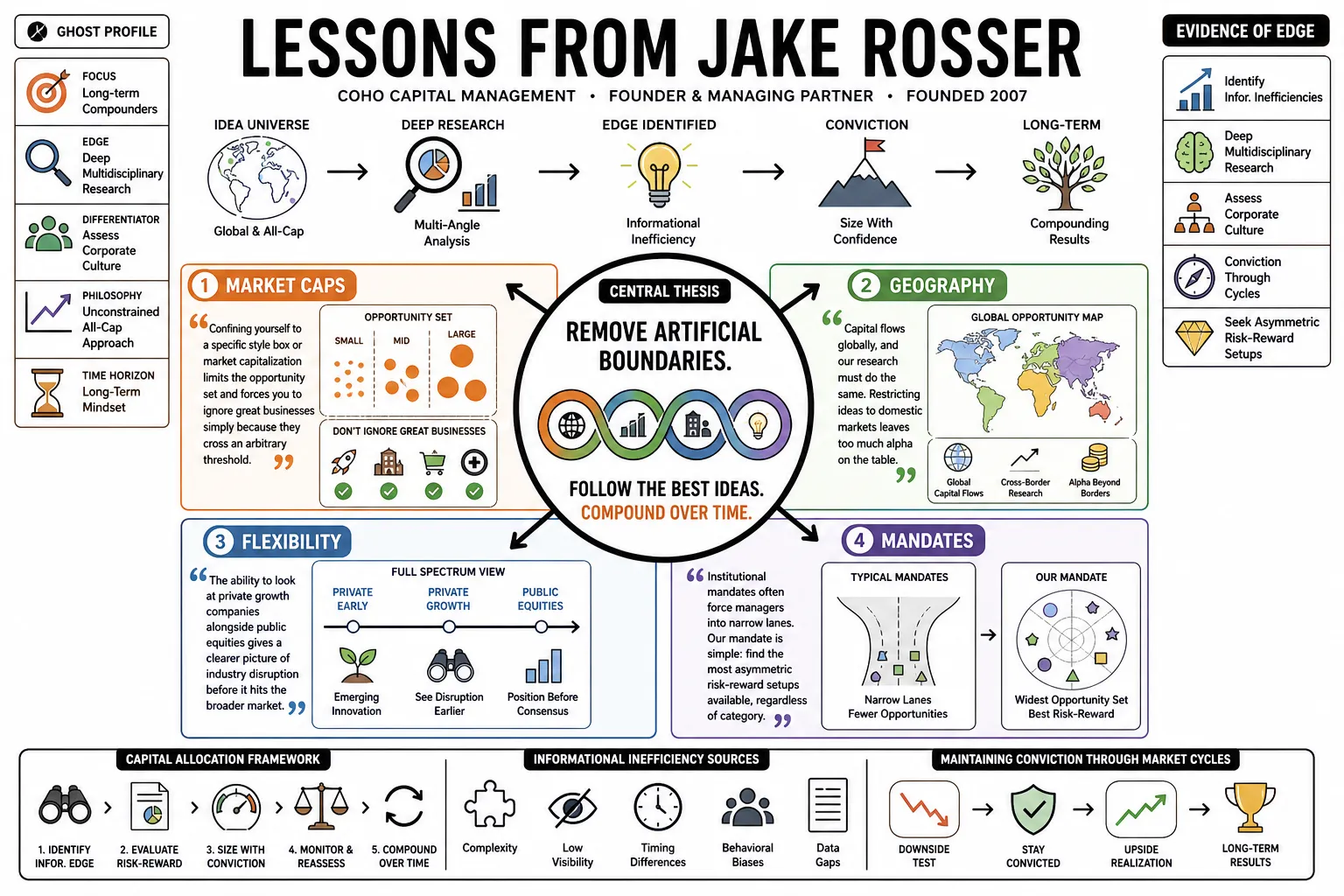
Jake Rosser is the managing partner of Coho Capital Management, which he founded in 2007 after equity research roles at the Auxier Focus Fund and Pacific Crest Securities; he described it as "an all-cap fund unconstrained by style boxes" that is "agnostic with respect to geography." — Hedge Fund Alpha: Interview With Jake Rosser, Coho Capital (reposting The Manual of Ideas interview).
Part 1: Unconstrained Investing
- On Market Caps: Rosser said "Coho Capital is an all-cap fund unconstrained by style boxes and is agnostic with respect to geography." — Hedge Fund Alpha: Interview With Jake Rosser, Coho Capital (reposting The Manual of Ideas interview).
- On the right business: Rosser said "Successful investment outcomes derive from buying the right business at the right price." — Hedge Fund Alpha: Interview With Jake Rosser, Coho Capital (reposting The Manual of Ideas interview)
- On the model he followed: Rosser said "Unlike the vast majority of investment vehicles, it was clear that Pabrai's vehicle was designed to make money with his investors rather than off his investors." — Hedge Fund Alpha: Interview With Jake Rosser, Coho Capital (reposting The Manual of Ideas interview)
- On learning the business first: Rosser said of Jeff Auxier "he taught me to be a business analyst before a stock analyst." — Hedge Fund Alpha: Interview With Jake Rosser, Coho Capital (reposting The Manual of Ideas interview)
- On Geography: Rosser said "Our all-cap mandate and lack of geographic confinement allow us to fish from a well stocked pond." — Hedge Fund Alpha: Interview With Jake Rosser, Coho Capital (reposting The Manual of Ideas interview).
- On Idea Generation: Rosser said "I once described my job as sitting between four walls, reading, and thinking. That truly represents the majority of my day." — The Manual of Ideas, January 2012 issue: Exclusive Interview with Jake Rosser (PDF copy).
Part 2: Multidisciplinary Thinking
- On Reading Habits: Rosser said "At its heart, investing is a multi-disciplinary endeavor. Thus, one has to know a little about everything to make informed decisions." — The Manual of Ideas, January 2012 issue: Exclusive Interview with Jake Rosser (PDF copy).
- On cultivating curiosity: Rosser said "The great thing about investing is you get to cultivate your curiosity about the world at large." — The Manual of Ideas, January 2012 issue: Exclusive Interview with Jake Rosser (PDF copy)
- On staying within what you understand: Rosser said "To have enough conviction to hold a stock when the market is moving against you, you have to be able to understand it." — The Manual of Ideas, January 2012 issue: Exclusive Interview with Jake Rosser (PDF copy)
- On Intellectual Curiosity: Rosser wrote "The best investors are driven by perpetual curiosity." — Coho Capital partner letter of February 11, 2021 (year-end 2020 letter), by Jake Rosser.
Part 3: Identifying Compounders
- On Moats: Rosser said "we spend a lot of time searching for companies that have some type of competitive moat affording the company pricing power." — The Manual of Ideas, January 2012 issue: Exclusive Interview with Jake Rosser (PDF copy).
- On what can go wrong: Rosser said "We bring a jaundiced eye to our research process and actively focus on what can go wrong with our investments." — The Manual of Ideas, January 2012 issue: Exclusive Interview with Jake Rosser (PDF copy)
- On waiting for a sale: Rosser said of great businesses "These businesses are rarely cheap, however, so we are often left in the position of not being able to act on our research." — The Manual of Ideas, January 2012 issue: Exclusive Interview with Jake Rosser (PDF copy)
- On Network Effects: Rosser wrote of Facebook "The greater the number of users on Facebook, the greater its utility for all users." — Coho Capital Partners 2016 annual letter (published by Hedge Fund Alpha, March 2017).
- On Scalability: Rosser wrote "As a software based business, Visa can grow with only minimal increased capital investment." — Coho Capital Partners 2016 annual letter (published by Hedge Fund Alpha, March 2017).
- On a business that compounds for you: Rosser wrote "Visa is emblematic of what we want from all our holdings, a company that does the compounding for you." — Coho Capital Partners 2016 annual letter (published by Hedge Fund Alpha, March 2017)
- On errors of omission: Rosser wrote "The company is one of our all-time great errors of omission." — Coho Capital Partners 2016 annual letter (published by Hedge Fund Alpha, March 2017)
- On inevitable businesses: Rosser wrote "Part of what makes a business inevitable is a self-reinforcing business model." — Coho Capital Partners 2016 annual letter (published by Hedge Fund Alpha, March 2017)
Part 5: Informational Inefficiencies
- On Market Efficiency: Rosser wrote "It is easy to talk about market inefficiencies but there is great value in collective wisdom and the market is right most of the time." — Coho Capital partner letter of February 11, 2021 (year-end 2020 letter), by Jake Rosser.
- On Time Arbitrage: Rosser wrote "we would rather win the decade than win the year." — Coho Capital partner letter of February 11, 2021 (year-end 2020 letter), by Jake Rosser.
- On removing the pressure to win: Rosser wrote "Taking away the performance anxiety of beating the S&P 500 was tremendously liberating." — Coho Capital partner letter of February 11, 2021 (year-end 2020 letter), by Jake Rosser
- On melting ice cubes: Rosser wrote "melting ice cube businesses were unsafe at any price." — Coho Capital partner letter of February 11, 2021 (year-end 2020 letter), by Jake Rosser
- On a bull market: Rosser wrote "A bull market hides a multitude of investment sins giving investors the impression they can't lose." — Coho Capital partner letter of February 11, 2021 (year-end 2020 letter), by Jake Rosser
- On Spinoffs: Rosser said "We also find that informational inefficiencies are often present in spin-off situations, busted IPOs or post re-org opportunities." — The Manual of Ideas, January 2012 issue: Exclusive Interview with Jake Rosser (PDF copy).
- On Primary Research: Rosser said his sell-side experience "gave me a solid foundation for deconstructing company financials and conducting scuttlebutt research." — Hedge Fund Alpha: Interview With Jake Rosser, Coho Capital (reposting The Manual of Ideas interview).
Part 6: Market Volatility and Patience
- On Noise: Rosser wrote "The firehose of information makes reading intentionally more critical than ever." — Coho Capital partner letter of February 11, 2021 (year-end 2020 letter), by Jake Rosser.
- On Patience: Rosser wrote "A predilection for patience helps an investor take control of their psychology and leave the heavy lifting to portfolio stalwarts." — Coho Capital partner letter of February 11, 2021 (year-end 2020 letter), by Jake Rosser.
- On selling early growth: Rosser wrote "If the company is still early in its growth trajectory, and thus years away from multiple compression, selling is a cardinal sin." — Coho Capital partner letter of February 11, 2021 (year-end 2020 letter), by Jake Rosser
- On taking a walk: Rosser wrote "Now we're better at taking a walk." — Coho Capital partner letter of February 11, 2021 (year-end 2020 letter), by Jake Rosser
Part 7: Assessing Quality
- On S&P Global: Rosser wrote of S&P Global "Together with Moody's, S&P is a government sanctioned duopoly with each company controlling 40% of the market for credit ratings." — Coho Capital Partners 2016 annual letter (published by Hedge Fund Alpha, March 2017).
Part 8: The Psychology of Investing
- On Discipline: Rosser said "It takes discipline not to get sucked into the chatter." — Hedge Fund Alpha: Interview With Jake Rosser, Coho Capital (reposting The Manual of Ideas interview).
- On Confirmation Bias: Rosser wrote "one of the hacks we apply when researching a new company is to assume we are wrong." — Coho Capital partner letter of February 11, 2021 (year-end 2020 letter), by Jake Rosser.
- On knowing where you err: Rosser wrote "if success is avoiding stupidity, then best find out in which circumstances you're likely to make stupid mistakes." — Coho Capital partner letter of February 11, 2021 (year-end 2020 letter), by Jake Rosser
- On course-correcting: Rosser wrote "The ability to course-correct is one of the most underrated skills in investing." — Coho Capital partner letter of February 11, 2021 (year-end 2020 letter), by Jake Rosser
- On cutting losses: Rosser wrote "if the writing is on the wall, admit your mistake, study it, and move on." — Coho Capital partner letter of February 11, 2021 (year-end 2020 letter), by Jake Rosser
- On Humility: Rosser wrote "We are always paranoid we don't know enough about an investment and continually play Devil's advocate with our thesis." — Coho Capital partner letter of February 11, 2021 (year-end 2020 letter), by Jake Rosser.
- On Emotional Control: Rosser wrote "While investing is a zero-sum game it is ultimately about mastering yourself." — Coho Capital partner letter of February 11, 2021 (year-end 2020 letter), by Jake Rosser.
- On Envy: Rosser wrote "If you are getting your satisfaction from the travails of others, you are doing it wrong." — Coho Capital partner letter of February 11, 2021 (year-end 2020 letter), by Jake Rosser.
- On Overconfidence: Rosser wrote "Ego is the enemy of investing." — Coho Capital partner letter of February 11, 2021 (year-end 2020 letter), by Jake Rosser.
- On failure: Rosser wrote "Failure, however, is a great teacher." — Coho Capital partner letter of February 11, 2021 (year-end 2020 letter), by Jake Rosser
- On repeated mistakes: Rosser wrote "Learned talent rarely makes the same mistake twice whereas innate talent is quick to assign blame." — Coho Capital partner letter of February 11, 2021 (year-end 2020 letter), by Jake Rosser
- On trying: Rosser wrote "If you're not making mistakes you're not trying." — Coho Capital partner letter of February 11, 2021 (year-end 2020 letter), by Jake Rosser
- On optimism: Rosser wrote "I have found I need to engage skeptically with my pessimism not my optimism." — Coho Capital partner letter of February 11, 2021 (year-end 2020 letter), by Jake Rosser
- On being the best version of yourself: Rosser wrote "Winning at investing does not entail crushing someone else but rather being the best version of yourself." — Coho Capital partner letter of February 11, 2021 (year-end 2020 letter), by Jake Rosser
- On protecting time to think: Rosser wrote "We only write to investors twice a year, have a two-year lock-up for new investors, and closely guard against all other commitments that imperil our ability to be thoughtful." — Coho Capital partner letter of February 11, 2021 (year-end 2020 letter), by Jake Rosser
- On Long-Term Thinking: Rosser wrote "we consider annual results short-term in nature and focus our efforts on compounding capital over the long-term." — Coho Capital Partners 2016 annual letter (published by Hedge Fund Alpha, March 2017).