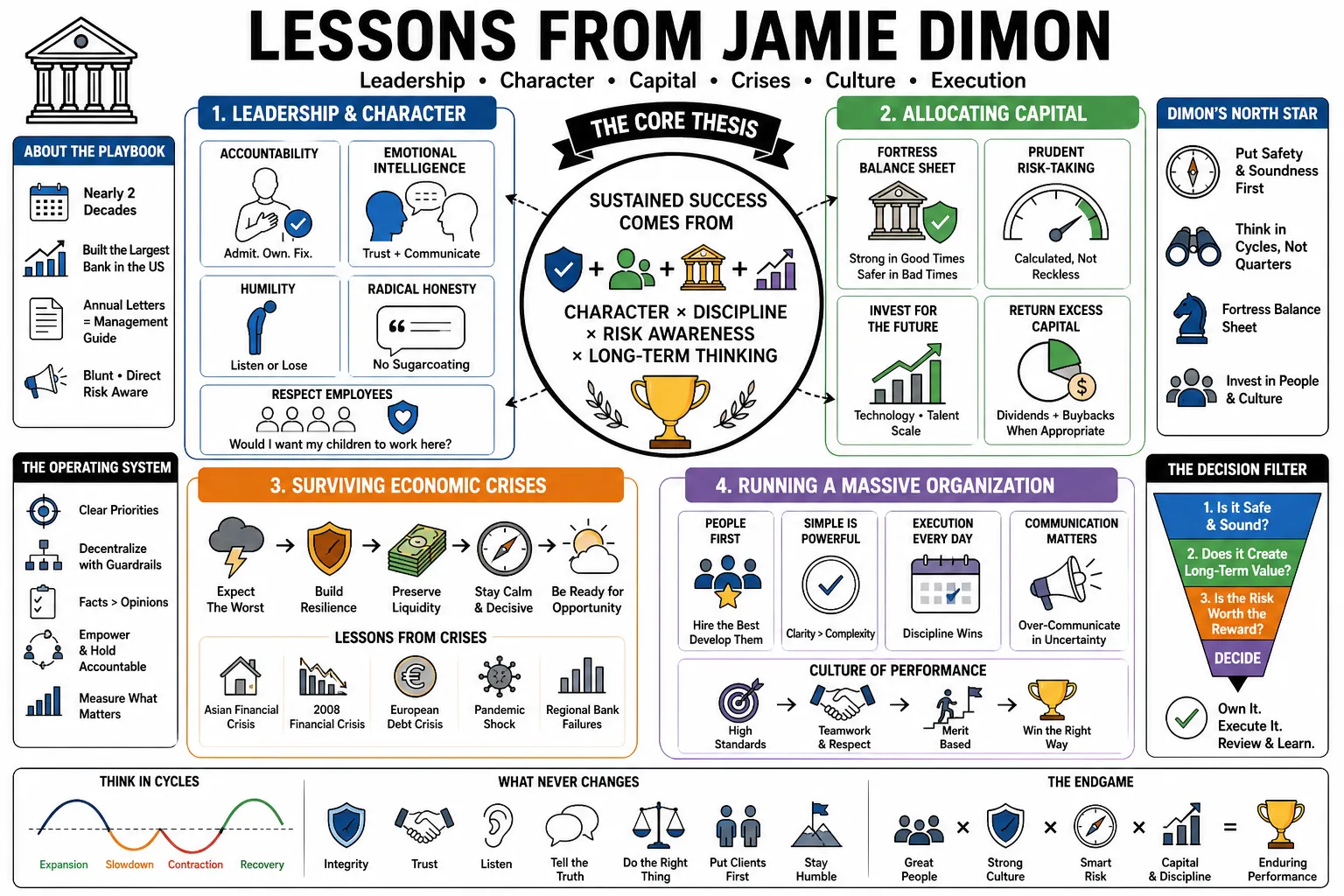
Lessons from Jamie Dimon
Jamie Dimon has spent nearly two decades building JPMorgan Chase into the largest bank in the US. His annual shareholder letters double as a practical management guide, known for their blunt takes on corporate complacency and risk. What follows is his approach to allocating capital, surviving economic crises, and running a massive organization.
Part 1: Leadership and Character
- On Accountability: "The best leaders have the confidence to admit when they are wrong. They don't try to hide their mistakes; they own them and fix them." — Source: [JPMorgan Chase 2023 Annual Report]
- On Emotional Intelligence: "IQ is a commodity. Emotional intelligence, meaning you are trustworthy and can communicate clearly, is what actually sets a leader apart." — Source: [Harvard Business Review Interview]
- On Humility: "You have to be humble. If you become arrogant, you will stop listening, and the moment you stop listening, you are dead." — Source: [Stanford GSB View From The Top]
- On Radical Honesty: "Do not sugarcoat reality. People need the unvarnished truth to make the right decisions." — Source: [Lex Fridman Podcast]
- On Respecting Employees: "I always ask myself: Would I want to work for you? Would I let my children work for you? If the answer is no, you shouldn't be a manager." — Source: [CNBC Squawk Box]
- On Decision Fatigue: "Never make a major decision on a Friday afternoon when you are exhausted and want to go home. Wait until Monday." — Source: [Bloomberg Markets]
- On Setting Standards: "If you want to be a winner, compare yourself to the best. Acknowledge that achieving that level requires relentless, unglamorous hard work." — Source: [JPMorgan Chase 2018 Annual Report]
- On Authentic Leadership: "You can't fake caring. If you don't genuinely care about the people working for you, they will figure it out immediately." — Source: [McKinsey Quarterly Interview]
- On Asking Questions: "A good leader is a constant questioner. You should be asking 'why' until you fully understand the mechanics of the problem." — Source: [The Wall Street Journal CEO Council]
- On Continuous Learning: "Leaders must be lifelong readers. If you aren't consuming information constantly, your mental models will become obsolete." — Source: [JPMorgan Chase 2021 Annual Report]
Part 2: Bureaucracy and Complacency
- On Organizational Decay: "Complacency and bureaucracy are the primary drivers of corporate decline. You have to fight them every single day." — Source: [JPMorgan Chase 2019 Annual Report]
- On Committees: "Committees don't make decisions; individuals do. If you need a committee to make a simple choice, your organization is too slow." — Source: [CNBC Delivering Alpha]
- On Office Politics: "Politics is a disease that thrives in bureaucracy. We have zero tolerance for people who try to get ahead by undermining others." — Source: [Financial Times Interview]
- On Killing Inefficiency: "You have to be ruthless about cutting away processes that no longer serve the customer. Bureaucracy is a self-replicating organism." — Source: [JPMorgan Chase 2022 Annual Report]
- On Meetings: "If a meeting doesn't have a clear agenda and a decision-maker in the room, cancel it. It is a waste of human capital." — Source: [Bloomberg Television]
- On Agility: "Size is not an excuse for being slow. A large company must fight to maintain the agility of a startup." — Source: [JPMorgan Chase 2016 Annual Report]
- On Internal Focus: "When companies spend more time looking inward at their own processes rather than outward at their competitors and clients, they are dying." — Source: [Stanford GSB View From The Top]
- On Silos: "Silos destroy value. The moment different departments start optimizing for themselves instead of the firm, the client loses." — Source: [Harvard Business Review Interview]
- On Entitlement: "Success is rented, not owned, and the rent is due every day. No past victory guarantees future survival." — Source: [Lex Fridman Podcast]
Part 3: Risk Management and Paranoia
- On Fortress Balance Sheets: "A fortress balance sheet is a necessity. It ensures you can survive the worst-case scenario without relying on hope." — Source: [JPMorgan Chase 2008 Annual Report]
- On Healthy Paranoia: "You must cultivate a state of healthy paranoia. Always ask what could go wrong, especially when things are going well." — Source: [The Wall Street Journal]
- On Tail Risks: "Most risk models fail because they don't account for the unimaginable. You have to stress test for scenarios worse than history suggests are possible." — Source: [Financial Times Interview]
- On Market Volatility: "Volatility is a feature of the market. Your business model must be built to withstand regular shocks." — Source: [CNBC Squawk Box]
- On Blind Spots: "The biggest risks are the ones everyone is ignoring because the current environment makes them seem improbable." — Source: [JPMorgan Chase 2020 Annual Report]
- On Cybersecurity: "Cyber warfare is the most significant threat to the financial system. We must assume attackers are already inside the walls." — Source: [Bloomberg Markets]
- On Credit Cycles: "Credit is cyclical. If you loosen your underwriting standards during a boom, you will pay for it during the bust." — Source: [JPMorgan Chase 2010 Annual Report]
- On Regulatory Compliance: "Compliance is the license to operate. Treat regulators with respect and complete transparency." — Source: [McKinsey Quarterly Interview]
- On Liquidity: "Profitability means nothing if you run out of cash. Liquidity is the oxygen of a financial institution." — Source: [JPMorgan Chase 2012 Annual Report]
- On Avoiding Stupidity: "Don't do anything stupid. Let your competitors make unforced errors and waste money; then you can buy their assets for pennies." — Source: [Lex Fridman Podcast]
Part 4: Managing People and Teams
- On Hiring: "Hire people who are smarter than you. If you are the smartest person in the room, you have built a weak team." — Source: [Stanford GSB View From The Top]
- On Firing: "Firing someone is painful, but leaving an incompetent or toxic person in a key role destroys the morale of everyone else." — Source: [Harvard Business Review Interview]
- On Meritocracy: "A true meritocracy means promoting the best person for the job, regardless of tenure or politics. Anything else breeds resentment." — Source: [JPMorgan Chase 2017 Annual Report]
- On Feedback: "Give feedback constantly and directly. Waiting for an annual review to tell someone they are failing is managerial malpractice." — Source: [Bloomberg Television]
- On Loyalty: "Loyalty is a two-way street. You cannot expect employees to be loyal to the firm if the firm is not loyal to them during hard times." — Source: [CNBC Delivering Alpha]
- On Diversity: "Diversity of thought is a competitive advantage. If everyone on your team has the same background, you will miss obvious threats and opportunities." — Source: [JPMorgan Chase 2021 Annual Report]
- On Compensation: "Pay people fairly, but understand that money alone is insufficient. People want purpose and the opportunity to expand their skills." — Source: [The Wall Street Journal CEO Council]
- On Micromanagement: "Tell people what the goal is, give them the resources, and get out of their way. Micromanagement scales poorly." — Source: [Financial Times Interview]
- On Training: "Good management consists of showing average people how to do the work of superior people. Training is an investment, not an expense." — Source: [Lex Fridman Podcast]
Part 5: Capital Allocation and Strategy
- On Long-Term Thinking: "We do not run this company for the next quarter. We run it for the next decade." — Source: [JPMorgan Chase 2014 Annual Report]
- On M&A Strategy: "Acquisitions must make strategic sense first, and financial sense second. Never buy a company just to get bigger." — Source: [Bloomberg Markets]
- On Tech Investments: "Technology is the core of the business. If you underinvest in tech, you are signing your own death warrant." — Source: [JPMorgan Chase 2019 Annual Report]
- On Capital Discipline: "Only deploy capital when the returns justify the risk. Sometimes the best action is to return money to shareholders." — Source: [CNBC Squawk Box]
- On Innovation: "Innovation usually doesn't come from a grand vision. It comes from fixing thousands of small frictions for the customer." — Source: [Harvard Business Review Interview]
- On Data over Dogma: "Base your strategy on facts and data, not ideology. When the facts change, your strategy must change." — Source: [Lex Fridman Podcast]
- On Organic Growth: "Organic growth is the hardest to achieve but the most valuable. It proves your core product is actually desired by the market." — Source: [JPMorgan Chase 2015 Annual Report]
- On Competitor Analysis: "Respect your competitors. Study what they do better than you and steal their best ideas." — Source: [Stanford GSB View From The Top]
- On Simplicity: "Complex strategies usually fail. A good strategy can be explained on a single piece of paper." — Source: [The Wall Street Journal]
Part 6: Navigating Crises and Failure
- On The 2008 Financial Crisis: "The crisis was a failure of risk management across the entire system. We survived because we acknowledged the rot early and took the pain." — Source: [JPMorgan Chase 2009 Annual Report]
- On Blame: "During a crisis, looking for someone to blame is useless. Focus entirely on fixing the problem." — Source: [Bloomberg Television]
- On Facing Problems: "Bad news does not age well. The longer you wait to address a problem, the more expensive it becomes to fix." — Source: [Lex Fridman Podcast]
- On Resilience: "I am a practical optimist. If something fails, I accept it and try again. Resilience is a muscle you have to build." — Source: [CNBC Delivering Alpha]
- On Panic: "Panic is not a strategy. When the market is melting down, you need cold, analytical decision-making." — Source: [Financial Times Interview]
- On Apologizing: "When you make a mistake, admit it quickly and publicly. The market forgives errors, but it punishes cover-ups." — Source: [JPMorgan Chase 2012 Annual Report]
- On Post-Mortems: "After a failure, do a brutal post-mortem. Understand exactly how the system broke so it never happens the same way again." — Source: [McKinsey Quarterly Interview]
- On Focus During Chaos: "In a crisis, narrow your focus to the things you can control. Ignore the noise and manage the variables in front of you." — Source: [Harvard Business Review Interview]
- On Bearing Pain: "Sometimes you just have to take the loss. Selling a bad position early is often the cheapest way out." — Source: [The Wall Street Journal CEO Council]
Part 7: Life, Health, and Balance
- On Priorities: "Your health and your family must come first. The bank will go on without you, but your family will not." — Source: [Stanford GSB View From The Top]
- On Physical Fitness: "Taking care of your body is a professional obligation. You cannot make high-stakes decisions if you are physically depleted." — Source: [Lex Fridman Podcast]
- On Reading: "I spend hours every morning reading. It is the only way to build a broad enough perspective to understand the world." — Source: [Bloomberg Markets]
- On Sleep: "Bragging about working on three hours of sleep is bragging about being impaired. You need proper rest to function effectively." — Source: [CNBC Squawk Box]
- On Managing Time: "Guard your calendar fiercely. If you let other people dictate your schedule, you will spend your life fighting fires." — Source: [Financial Times Interview]
- On Friendships: "Maintain relationships outside of your industry. If everyone you know is a banker, your worldview will be dangerously narrow." — Source: [The Wall Street Journal]
- On Vacations: "Take your vacation. Disconnect entirely. It is necessary for mental recovery and gives your team a chance to lead." — Source: [Harvard Business Review Interview]
- On Dealing with Stress: "Stress is a reaction, not a state of reality. You can train yourself to remain calm under pressure." — Source: [McKinsey Quarterly Interview]
- On Legacy: "At the end of your life, you will not care about your net worth. You will care about the respect of your peers and the love of your family." — Source: [JPMorgan Chase 2023 Annual Report]
Part 8: Public Policy and Society
- On Capitalism: "Free enterprise is the greatest engine of prosperity ever invented. It is imperfect, but it is vastly superior to the alternatives." — Source: [JPMorgan Chase 2019 Annual Report]
- On Government Efficiency: "We need governments to operate with the same accountability as the private sector. Incompetent policy hurts the most vulnerable." — Source: [CNBC Delivering Alpha]
- On Income Inequality: "The wealth gap is a serious threat to social stability. The private sector must help build skills and create accessible jobs." — Source: [The Wall Street Journal CEO Council]
- On Infrastructure: "Underinvesting in infrastructure is a choice to make our economy slower and less competitive. It is an unforced error." — Source: [JPMorgan Chase 2020 Annual Report]
- On Education: "Our education system is leaving too many people behind. If you do not give people a path to dignity, society breaks down." — Source: [Bloomberg Television]
- On American Exceptionalism: "The United States has the deepest capital markets and the most innovative economy. We must not squander these advantages through political gridlock." — Source: [JPMorgan Chase 2022 Annual Report]
- On Regulation: "Smart regulation makes the system safer. Dumb regulation creates paperwork and drives risk into the shadows." — Source: [Lex Fridman Podcast]
- On Climate Change: "The transition to a lower-carbon economy is necessary, but it must be managed practically to avoid energy shortages and price shocks." — Source: [JPMorgan Chase 2021 Annual Report]
- On Immigration: "We need policies that attract the smartest people in the world. Forcing international students to leave after we educate them is insane." — Source: [Financial Times Interview]
- On Corporate Responsibility: "Companies exist within society, not apart from it. Serving communities is a prerequisite for long-term shareholder value." — Source: [JPMorgan Chase 2018 Annual Report]