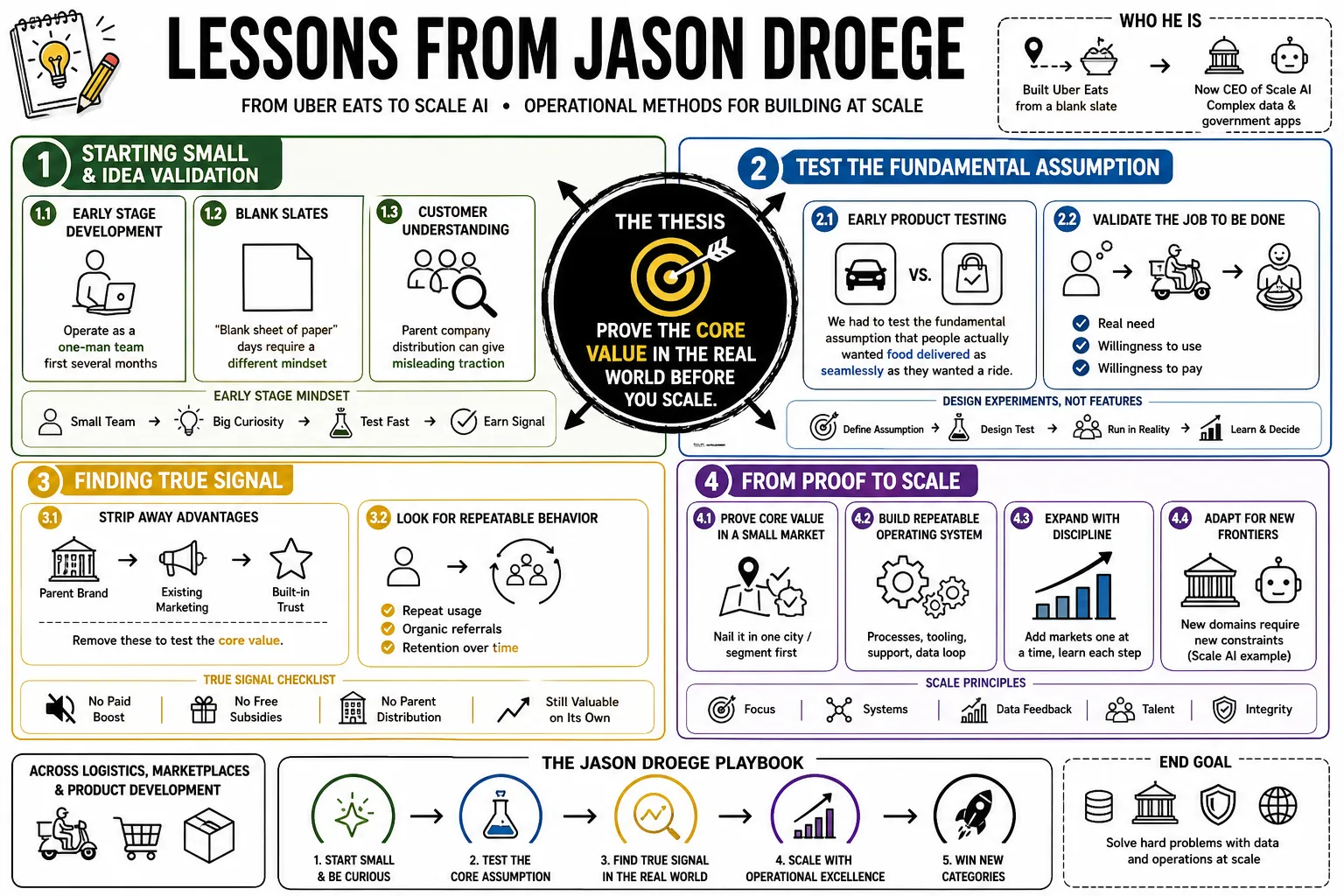
Lessons from Jason Droege
Jason Droege joined Uber in 2014 with a blank piece of paper to grow the business beyond ridesharing and scaled Uber Eats to a global $20 billion GMV run rate. He later succeeded Alexandr Wang as CEO of Scale AI, where he says the most important thing is "making AI reliable enough so that you can see the ROI." — Invest Like the Best: Jason Droege, Building Uber Eats (October 2022).
Part 1: Starting Small & Idea Validation
- On risking failure: Droege said "I used to say that you have to risk career-ending failure, to find career-defining success." — Invest Like the Best: Jason Droege, Building Uber Eats (October 2022).
- On early signal: Of the December 2015 launch in Toronto, Droege said "within two hours we had done $20,000 for the sales. It was crazy how quickly we saw that it was the right idea and the unit economics were good." — Lenny's Podcast: First interview with Scale AI's CEO, Jason Droege (October 2025).
Part 2: Scaling Operations
- On the pace of scaling: Droege said Uber Eats went "0 to 20 billion in four and a half years, which is pretty good. Uber was very good at scaling things." — Lenny's Podcast: First interview with Scale AI's CEO, Jason Droege (October 2025).
- On onboarding a global partner: Of onboarding McDonald's, Droege said "we basically went global with them in six months, and at this point the business was less than two years old." — Lenny's Podcast: First interview with Scale AI's CEO, Jason Droege (October 2025).
Part 3: Managing Trade-Offs & Incumbents
- On belief inside a big company: Droege said of Uber's culture "Uber believed in you more than you believed in you." — Invest Like the Best: Jason Droege, Building Uber Eats (October 2022).
- On everything being negotiable: Droege said "I think that the main lesson is that in business and in startups, everything's negotiable." — Lenny's Podcast: First interview with Scale AI's CEO, Jason Droege (October 2025)
Part 4: Product Development & Solving Problems
- On urgency: Droege said "the biggest thing people miss when they're building new products is the urgency of the buyer part of it. You can build something that provides a lot of value, but if it's not the top thing that the customer is thinking about in their busy days, then you're just going to have a long road to a small town." — Lenny's Podcast: First interview with Scale AI's CEO, Jason Droege (October 2025).
- On independent thinking: Droege said "If your research is highly influenced by what the world is saying around you, you're not going to have an independent insight. You have to go off and do your own thing." — Lenny's Podcast: First interview with Scale AI's CEO, Jason Droege (October 2025).
- On not falling in love with ideas: Droege said "you can't fall in love with your ideas." — Lenny's Podcast: First interview with Scale AI's CEO, Jason Droege (October 2025)
- On questioning everything: Droege said "I think my process is I'm constantly questioning every single thing that I'm hearing at the beginning of anything." — Lenny's Podcast: First interview with Scale AI's CEO, Jason Droege (October 2025)
Part 5: Leadership & Hiring
- On interviewing: Droege said "I have to interview across all kinds of expertises, which is hard. I can't be an expert in everything. And so, I reduce it down to just three things." — Lenny's Podcast: First interview with Scale AI's CEO, Jason Droege (October 2025).
- On curious problem-solving: Droege said the first of his three questions is "are you a curious problem solver and can you articulate that verbally?" — Lenny's Podcast: First interview with Scale AI's CEO, Jason Droege (October 2025).
- On working across a team: Droege said the second is "Can you work across people? Are you humble enough to work across." — Lenny's Podcast: First interview with Scale AI's CEO, Jason Droege (October 2025).
- On leadership: Droege said the third is "are you a good leader? And if you just do those three things, I think you have a pretty high chance of success." — Lenny's Podcast: First interview with Scale AI's CEO, Jason Droege (October 2025).
- On composing a team: Of the Uber Eats management team, Droege said "I was trying to compose almost like an organism of strengths and then minimize the conflicts." — Lenny's Podcast: First interview with Scale AI's CEO, Jason Droege (October 2025)
Part 6: Restaurant Economics & Marketplace Dynamics
- On getting your hands dirty: Describing how his team studied restaurants, Droege said "we ordered just a bunch of food from these places, and then we got a restaurant supplier to give us a base catalog, and we just matched up how much does the ham weigh? How much does the cheese weigh? How much does the bread weigh?" — Lenny's Podcast: First interview with Scale AI's CEO, Jason Droege (October 2025).
- On restaurant margins: Droege said "roughly a restaurant pays 20 to 30% of every meal to ingredients, and they pay roughly 20 or 30% to labor, and they pay roughly 10% to real estate." — Lenny's Podcast: First interview with Scale AI's CEO, Jason Droege (October 2025).
- On operational chiseling: Droege said "There's always some operational chiseling that's going on in all of these industries." — Lenny's Podcast: First interview with Scale AI's CEO, Jason Droege (October 2025)
- On incremental revenue: Droege said that for restaurants "the most valuable thing" was "incremental demand," because "if you were to take a restaurant location and triple demand based on the same labor but you're just scaling ingredients, you've got a 70, 80% incremental gross margin product." — Lenny's Podcast: First interview with Scale AI's CEO, Jason Droege (October 2025).
- On the gross margin filter: Droege said "start at a 60% gross margin. Why does that not work?" because it short circuits to "what the real problem is." — Lenny's Podcast: First interview with Scale AI's CEO, Jason Droege (October 2025)
Part 7: AI & The Future of Data
- On AI reliability: Droege told Axios "The cost of mistakes in these environments can be high," referring to mission-critical use by business, military and government. — Axios interview: Scale AI CEO Jason Droege pushes "reliability" reality (May 2026).
- On mission-critical AI: Droege said "the most important thing is making AI reliable enough so that you can see the ROI [return on investment] on the huge investment that you've made." — Axios interview: Scale AI CEO Jason Droege pushes "reliability" reality (May 2026).
- On focus: Droege told Axios "I think I'm really good at figuring out the two or three things that are important and just reinforcing those constantly." — Axios interview: Scale AI CEO Jason Droege pushes "reliability" reality (May 2026)
- On the data bottleneck: Droege said "digitizing judgment, human judgment, true subject matter, deep expertise is becoming a bottleneck that we're unblocking for our customers." — Lenny's Podcast: First interview with Scale AI's CEO, Jason Droege (October 2025).
- On autonomous vehicles: Droege said "Autonomous vehicles do not need as much data labeling as they did in the past." — Lenny's Podcast: First interview with Scale AI's CEO, Jason Droege (October 2025)
- On enterprise timelines: Droege said "These things take 6 to 12 months to get them truly robust enough where an important process can be automated." — Lenny's Podcast: First interview with Scale AI's CEO, Jason Droege (October 2025).
- On RL environments: Droege said "There's these things called RL environments that effectively are sandboxes for AI agents to play in to accomplish a goal so that they can learn how to accomplish that goal." — Lenny's Podcast: First interview with Scale AI's CEO, Jason Droege (October 2025)
Part 8: Early Career & Entrepreneurial Lessons
- On thinking upfront: Droege said "I think you can spend a little bit of time thinking upfront to save yourself a lot of pain downstream." — Lenny's Podcast: First interview with Scale AI's CEO, Jason Droege (October 2025).
- On luck: Droege said "Luck is part of the game, so do not begrudge people for luck." — Lenny's Podcast: First interview with Scale AI's CEO, Jason Droege (October 2025).
- On persistence: Droege said the most important thing is "that the founder is just a force of nature over a long duration of time. Because you're going to have to pivot, you have to have that energy to pivot." — Lenny's Podcast: First interview with Scale AI's CEO, Jason Droege (October 2025).
- On risk: Droege said "the best entrepreneurs and the best business owners look at the risk profile of the decisions that they're making and they try to make asymmetrically positive decisions all along the way." — Lenny's Podcast: First interview with Scale AI's CEO, Jason Droege (October 2025).
- On high-risk decisions: Droege said "If you ever get on the other side of a high reward, high risk decision, it is so painful because you are just cooked." — Lenny's Podcast: First interview with Scale AI's CEO, Jason Droege (October 2025)
- On ideas and execution: Droege said "I'm a big believer that ideas are very important and execution is a whole lot of it." — Invest Like the Best: Jason Droege, Building Uber Eats (October 2022).
- On survival: Droege said "Survival is just part of the game, and most people just give up before they get their timing right." — Lenny's Podcast: First interview with Scale AI's CEO, Jason Droege (October 2025).
- On new concepts: Droege said "there's new concepts coming up all the time and I need to stay on top of it." — Lenny's Podcast: First interview with Scale AI's CEO, Jason Droege (October 2025)