Lessons from Jason Robins
Jason Robins co-founded DraftKings in 2012, turning sports gaming into a daily habit instead of a season-long commitment. He took the company from a spare bedroom to a public offering following the repeal of PASPA, surviving intense regulatory fights along the way. This piece covers his operating decisions on product design and market expansion.
Part 1: The Startup Origin
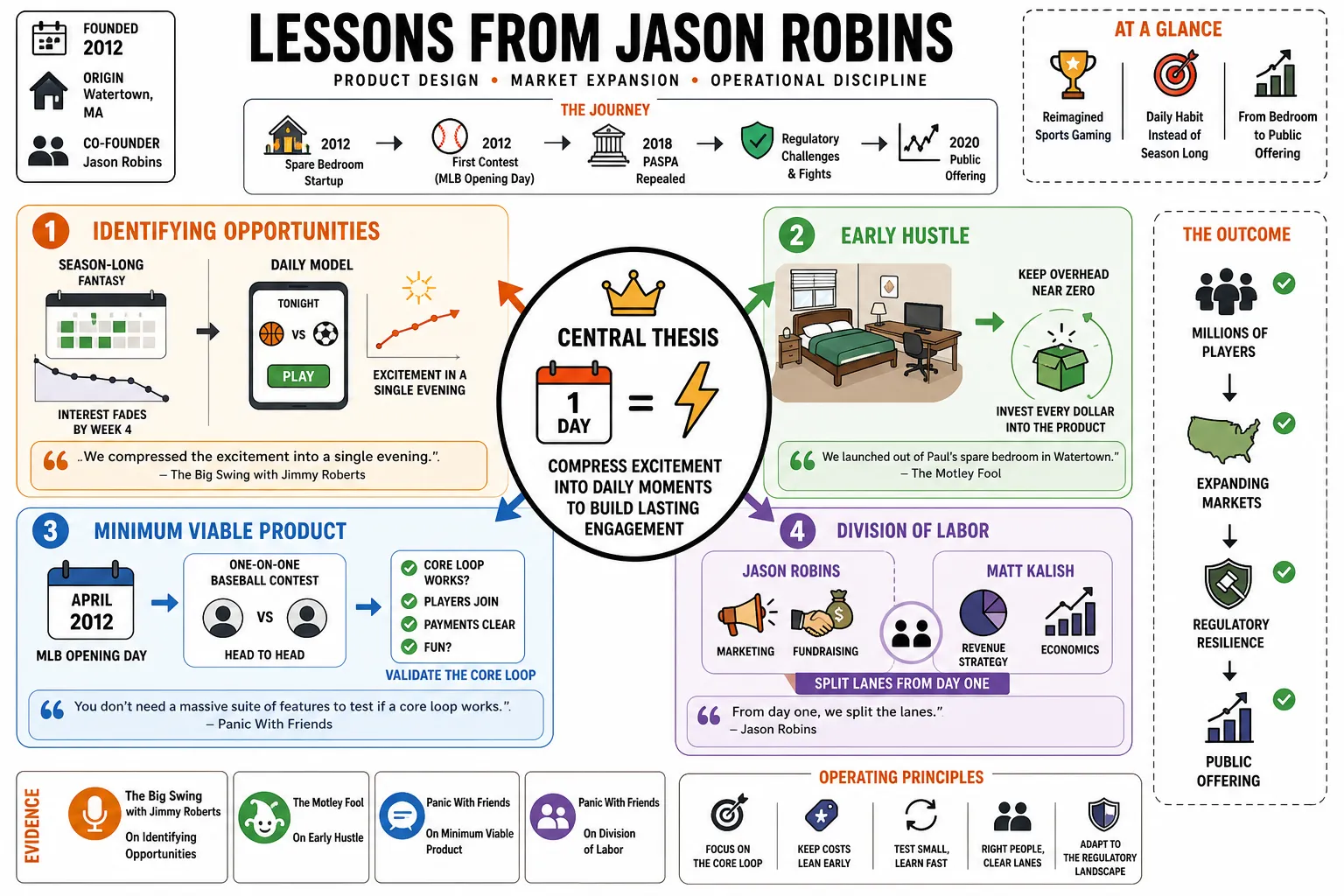
- On Identifying Opportunities: DraftKings' official company history says Robins, Paul Liberman, and Matt Kalish believed daily fantasy could be better than season-long fantasy, which captures the core opportunity they saw in making the format shorter and more immediately engaging. — Reference: DraftKings company history on why the founders chose daily fantasy
- On Early Hustle: "We launched out of Paul's spare bedroom in Watertown. It wasn't glamorous, but keeping overhead near zero meant we could pour every early dollar into the product." — Source: The Motley Fool
- On Minimum Viable Product: "Our first contest was a simple one-on-one baseball game for the 2012 MLB Opening Day. You don't need a massive suite of features to test if a core loop works." — Source: Panic With Friends
- On Division of Labor: "From day one, we split the lanes. I handled marketing and fundraising, Matt designed the revenue strategy, and Paul built the backend. You can't have three co-founders trying to do the same job." — Source: Masters of Scale
- On First Movers vs. Fast Followers: "We weren't the very first to do daily fantasy, but we were the fastest to figure out how to structure the payouts and acquire users effectively." — Source: Bloomberg Talks
- On Vistaprint's Influence: "My time at Vistaprint taught me how an internet-based company actually thinks. We learned rapid testing, user interface mechanics, and strict analytics before starting DraftKings." — Source: Medium
- On Early Rejection: "When we first pitched investors, gambling was seen as a toxic asset class. We had to relentlessly reframe it as a skill-based, data-driven entertainment product." — Source: Masters of Scale
- On Launch Timing: DraftKings says the daily fantasy platform launched in 2012 after the founders decided the shorter format was the better version of fantasy sports, underscoring that the company treated early entry into a new cadence of play as a foundational strategic bet. — Reference: DraftKings company history on the 2012 launch of the daily fantasy platform
- On Raising Seed Capital: "Our $1.4 million seed round from Atlas Venture finally let us move into a real office in Boston. It validated the model enough to let us step on the gas." — Source: The Motley Fool
- On Co-founder Trust: "You need to build a company with people who will tell you when your idea is terrible. Matt and Paul never hesitated to check my assumptions." — Source: Panic With Friends
Part 2: Building the Product
- On Game Design: "The interface has to feel intuitive for a casual fan but deep enough for a spreadsheet power user. Balancing those two extremes is the hardest part of our product design." — Source: Sloan Sports Analytics Conference
- On Feature Expansion: "Adding more options for parlays creates a win-win situation. It drives engagement and offers the dynamic experience users actually want." — Source: Legal Sports Report
- On Pricing Mechanics: "Salary cap formats work because they force constraints. If you can draft anyone, there's no skill. The constraint is where the game actually lives." — Source: The Motley Fool
- On Mobile Prioritization: "Once we saw the shift in traffic, we stopped treating mobile as a secondary platform. Betting is inherently a second-screen experience while watching a game." — Source: Bloomberg Talks
- On Data Infrastructure: "During an NFL Sunday, our backend experiences traffic spikes that look like a heart attack on a chart. Uptime during those three hours is the entire business." — Source: Masters of Scale
- On User Feedback: In the Redpoint interview, Robins says DraftKings watches metrics for every feature, tests changes with customers, and then quickly adjusts the product when the data shows friction, such as challenge requests getting lost before better notifications were added. — Reference: Redpoint interview on testing features with customers and fixing friction
- On Prediction Markets: "We are heavily investing in prediction markets because fans want to trade on outcomes outside of traditional sports lines." — Source: Bloomberg Talks
- On Continuous Iteration: "We never consider a product finished. The moment a season ends, we are tearing down the UI and rebuilding it for the next year based on drop-off data." — Source: Sloan Sports Analytics Conference
- On Real-Time Engagement: "In-play betting changes the nature of sports viewing. You stop waiting passively for the final score and become invested in the outcome of the next pitch or drive." — Source: CNBC Mad Money
- On Proprietary Technology: "Owning our tech stack, especially after acquiring SBTech, meant we stopped relying on third parties to dictate our product roadmap." — Source: Panic With Friends
Part 3: Customer Acquisition and Marketing
- On Aggressive Ad Spend: "There was a window in 2015 where we bought almost every available ad slot on sports television. We knew the lifetime value of a customer justified the upfront cost." — Source: Masters of Scale
- On Customer Segmentation: "We track different types of players closely. The bonus hunters actually make up less than 10% of the audience, while the core users stick around for the entertainment." — Source: GPWA
- On League Partnerships: "Becoming the first DFS company to partner with MLB in 2013 gave us mainstream legitimacy overnight." — Source: Sloan Sports Analytics Conference
- On Brand Recognition: "In a crowded market, brand is a moat. We spent heavily early on so that when sports betting became legal, DraftKings was the first word that came to mind." — Source: CNBC Mad Money
- On Promotional Mechanics: "Free-to-play pools act as the top of our funnel. We let users experience the interface without financial risk, which builds trust before they ever make a deposit." — Source: Bloomberg Talks
- On Content Integration: In Bloomberg Talks, Robins frames ESPN's unmatched sports content, talent, and distribution as the ideal partner for DraftKings, reinforcing his long-running view that betting works best when it is woven directly into the broader sports-media experience. — Reference: Bloomberg Talks episode on the ESPN odds-provider partnership
- On Customer Retention: "Acquiring a user is expensive, but losing them because your withdrawal process is clunky is unforgivable. We focus heavily on frictionless payouts." — Source: Masters of Scale
- On Social Proof: "Daily fantasy grew entirely on social proof. When someone wins a tournament and posts their screenshot, that serves as better marketing than anything we can produce internally." — Source: Panic With Friends
- On Cross-Selling: "Our strategy is simple: acquire a user for fantasy sports, and when their state legalizes sports betting or iGaming, migrate them over." — Source: The Motley Fool
- On Localized Marketing: "You can't market in Ohio the exact same way you market in New York. You have to tailor the messaging to the local teams and fan behavior." — Source: Sloan Sports Analytics Conference
Part 4: Navigating Regulation and Compliance
- On Legal Uncertainty: "In the early days, we operated in a gray area. We had to firmly believe that our interpretation of the skill-gaming laws would hold up under scrutiny." — Source: Masters of Scale
- On State-by-State Rules: "Rolling out across the US represents fifty different launches. Every state has a different tax code, a different regulator, and a different set of compliance rules." — Source: Bloomberg Talks
- On the PASPA Repeal: "When the Supreme Court struck down PASPA in 2018, we already had the blueprints ready. We knew we had to pivot immediately from DFS to a full sportsbook." — Source: The Motley Fool
- On Ethical Boundaries: "The answer for the future of the gambling industry likely lies in reasonable restrictions, not a free-for-all. We have to self-regulate before someone else does it for us." — Source: Masters of Scale
- On Tax Policy: "We believe that a tax rate aligned with the rest of the market balances the state's need to meet its fiscal projections while giving operators the ability to provide a best-in-class experience." — Source: New York State Senate Testimony
- On Responsible Gaming: "Providing tools for players to set limits on their deposits and time spent serves as both a regulatory requirement and an essential foundation for the long-term sustainability of the business." — Source: CNBC Mad Money
- On Lobbying: "You can't sit back and hope lawmakers understand your product. You have to be in the room, explaining the mechanics and proving that the regulated market is safer than the black market." — Source: Panic With Friends
- On Regulatory Battles: Boston Magazine reports that Robins viewed the attorney-general crackdown on fantasy sports as one of the most humiliating and existentially threatening moments the company had faced, which makes the regulatory fights look less like background noise and more like a survival test. — Reference: Boston Magazine profile on the state crackdowns DraftKings survived
- On Working with Regulators: "Regulators aren't the enemy. They want a safe, taxable market, and we want a predictable operating environment. The goals align perfectly." — Source: Bloomberg Talks
Part 5: Scaling the Organization
- On Hiring: "Early on, you hire for raw horsepower and adaptability. Later, you have to hire specialists who have seen a specific scale of infrastructure before." — Source: Masters of Scale
- On Startup Community: "People want to help each other in the startup community. There's so much optimism and disruption and ambition in the air." — Source: Panic With Friends
- On Internal Communication: "When you go from 30 employees to 3,000, the biggest thing that breaks is how information moves. You have to intentionally design communication structures." — Source: The Motley Fool
- On Remote Work: "We found that while you can maintain productivity remotely, the creative collisions that lead to new product ideas usually happen when people are in the same room." — Source: Bloomberg Talks
- On Dealing with Crises: "A server crash on an NFL Sunday feels like the end of the world. As a leader, you have to absorb the panic and direct the engineering team calmly." — Source: Sloan Sports Analytics Conference
- On Retaining Talent: "The best engineers and marketers want to work on hard problems. We retain people by exposing them to the raw complexity of the data we handle." — Source: CNBC Mad Money
- On Cultural Dilution: "You protect the culture by firing people who achieve their metrics while treating their colleagues poorly." — Source: Masters of Scale
- On Office Expansion: WCVB reported that DraftKings opened a 105,000-square-foot Boston headquarters with more than 600 employees, showing that its office footprint expanded alongside rapid hiring and the broader push to scale the business in newly opening markets. — Reference: WCVB report on the Boston headquarters opening and workforce scale
- On Executive Leadership: "My role shifted from doing the work to managing the people doing the work, to eventually managing the people who manage the people. That requires entirely different skill sets." — Source: Panic With Friends
Part 6: The Capital Journey and Public Markets
- On Raising Capital: "Every funding round is a translation exercise. You have to translate your user metrics into a story about future cash flows that an investor can underwrite." — Source: Masters of Scale
- On the SPAC Route: "Going public via SPAC during the pandemic allowed us to move fast and secure the capital we needed to fund our expansion into new states." — Source: Panic With Friends
- On Public Markets: "Once you are public, you operate in a glass house. Every quarter is a report card, and you have to balance short-term expectations with long-term strategic investments." — Source: CNBC Mad Money
- On Valuation Volatility: "You can't let the stock price dictate your mood or your product roadmap. The market will swing wildly, but our job is executing the core business plan." — Source: Bloomberg Talks
- On Profitability vs. Growth: "In the early years of legalized sports betting, the priority was land-grab market share. Now, the market expects a clear, demonstrated path to profitability." — Source: The Motley Fool
- On Mergers & Acquisitions: "The SBTech acquisition achieved vertical integration. We needed our own trading and pricing engine to improve our margins and control our destiny." — Source: Sloan Sports Analytics Conference
- On Investor Relations: "Transparency builds the most trust. If a state delays its legalization timeline, tell the street immediately because surprises destroy credibility." — Source: CNBC Mad Money
- On Capital Efficiency: "As the cost of capital goes up, you have to look inward and figure out how to acquire users without writing massive checks for promotional credits." — Source: Bloomberg Talks
- On The Pressure of Being CEO: In DraftKings' Q4 2025 earnings call, Robins says the market punished the company when guidance disappointed and rewarded it when execution consistently beat and raised expectations, a plain illustration of how public-company leadership turns every forecast into a credibility test. — Reference: Motley Fool transcript of the Q4 2025 DraftKings earnings call
Part 7: Strategy and Competition
- On Beating Rivals: "Our main competitor was always right across the street. That intense rivalry forced both of us to innovate faster than we ever would have in a monopoly." — Source: Panic With Friends
- On Network Effects: "In a marketplace business, liquidity is everything. The platform with the most users can offer the biggest prize pools, which inevitably attracts even more users." — Source: Masters of Scale
- On Diversification: "We operate as more than a sports betting company. By adding iGaming and media properties, we are building a complete digital entertainment ecosystem." — Source: Bloomberg Talks
- On Analyzing Competitors: "You watch what the competition does, but you never copy them. If you are always reacting, you are always twelve months behind." — Source: Sloan Sports Analytics Conference
- On Adapting to Change: Built In Boston reported that when COVID suspended live sports, DraftKings kept customers engaged by adding contests around esports, table tennis, and pop-culture events, showing Robins' willingness to widen the product set quickly when the usual supply of games disappeared. — Reference: Built In Boston report on the COVID-era pivot into esports and other contests
- On Strategic Partnerships: "Partnering with Michael Jordan went beyond his public image. It allowed us to bring his unparalleled competitive mindset directly into our boardroom." — Source: CNBC Mad Money
- On Margin Improvement: "The shift from relying on third-party odds providers to pricing our own lines in-house fundamentally changed our unit economics for the better." — Source: The Motley Fool
- On Expanding the Demographic: "Sports betting traditionally skewed older. By leaning heavily into fantasy and mobile tech, we brought a completely new, younger demographic into the market." — Source: Sloan Sports Analytics Conference
- On Brand Exclusivity: "Securing exclusive rights to certain data feeds means we can offer in-game bets that literally no one else in the market has the capability to match." — Source: Bloomberg Talks
Part 8: Future Markets and Industry Evolution
- On Prediction Markets: "Prediction markets are the next frontier. We see a massive appetite from users who want to wager on financial outcomes, entertainment, and cultural events." — Source: Bloomberg Talks
- On Esports Integration: "The viewership numbers for esports are too large to ignore. Structuring betting products for a digital-native audience requires a completely different approach to pacing." — Source: Sloan Sports Analytics Conference
- On the Future of Golf: The Apple Podcasts description for Robins' appearance on The Big Swing says he joined Jimmy Roberts to discuss the future of golf wagering, which supports treating golf as a meaningful strategic growth area for DraftKings rather than a niche side category. — Reference: Apple Podcasts listing for The Big Swing episode with Jason Robins
- On Digital Ownership: "Digital collectibles and NFTs create new ways for fans to own a piece of the action. We view it as an extension of the daily fantasy engagement loop." — Source: Masters of Scale
- On Women's Sports: "The explosion of interest in women's sports is real, and the betting handle follows the viewership. We are rapidly expanding our offerings to capture that momentum." — Source: CNBC Mad Money
- On Artificial Intelligence: "AI will eventually allow us to generate highly personalized betting lines for individual users based on their historical playing habits." — Source: Sloan Sports Analytics Conference
- On Media Convergence: "The line between watching a game and betting on a game is vanishing. Eventually, it will all happen on the exact same screen simultaneously." — Source: Panic With Friends
- On Global Expansion: "While the US remains our primary focus, the technology stack we've built is entirely portable to international markets when the regulatory timing aligns." — Source: Bloomberg Talks
- On the Long-Term Vision: "We want to be the center of the sports fan's universe. If you are interacting with sports, we want to own a piece of that experience." — Source: The Motley Fool