Jean Hynes is the CEO of Wellington Management and a longtime portfolio manager for the Vanguard Health Care Fund. She is known for her deep-research approach to biotechnology investing and her unconventional career path, having joined Wellington as an administrative assistant before rising to chief executive. This profile compiles her perspectives on navigating complex healthcare markets, maintaining conviction through volatility, and leading a global asset management firm.
Part 1: Career Progression and Ascending the Ranks
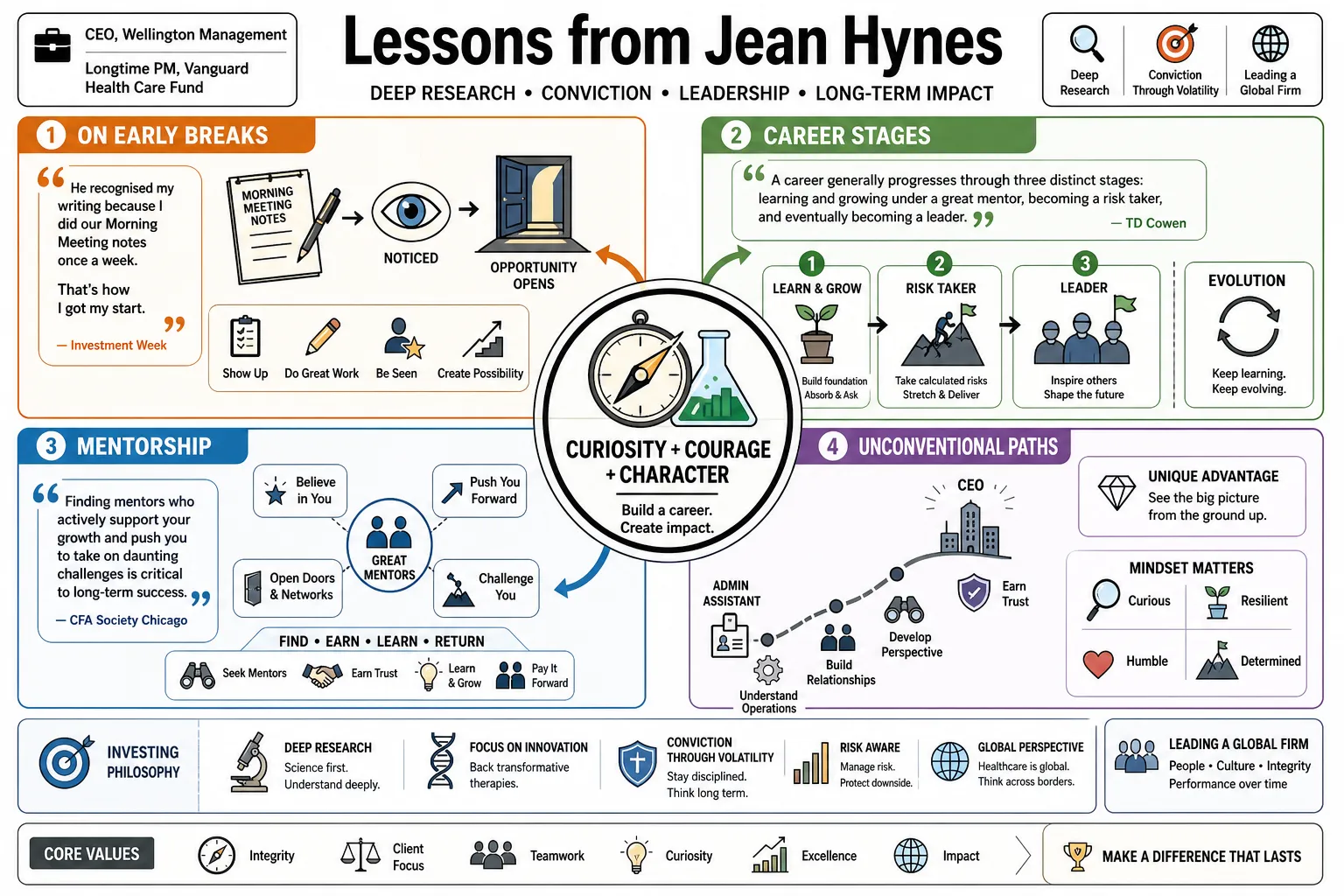
- On Early Breaks: "He [Edward Owens] recognised my writing because I did our Morning Meeting notes once a week. That's how I got my start." — Source: Investment Week
- On Career Stages: "A career generally progresses through three distinct stages: learning and growing under a great mentor, becoming a risk taker, and eventually becoming a leader." — Source: TD Cowen
- On Mentorship: "Finding mentors who actively support your growth and push you to take on daunting challenges is critical to long-term success." — Source: CFA Society Chicago
- On Unconventional Paths: "Starting as an administrative assistant provided a unique vantage point on the firm's operations before transitioning to the analyst side." — Source: Bloomberg Masters in Business
- On Active Engagement: "As an investment-led organization, there is immense power in having a CEO who is actively investing alongside our clients." — Source: RankiaPro
- On Embracing Opportunities: "Saying 'yes' to challenges that seem overwhelming is often the fastest way to accelerate professional growth." — Source: Rockefeller Capital Management
- On Forging Your Own Path: "I always encourage young professionals to do things their own way rather than simply trying to emulate their predecessors." — Source: TD Cowen
- On Dual Roles: "Managing a major healthcare fund while stepping into the CEO role is only possible when you have assembled an exceptionally deep and capable team around you." — Source: Bloomberg Masters in Business
- On Continuous Growth: "Throughout my 30 years at Wellington, the ability to continually evolve has been a hallmark of personal and institutional success." — Source: Wellington Management
- On Retaining Talent: "Motivating existing talent requires a commitment to providing continuous growth and new opportunities within the firm." — Source: Wellington Management
Part 2: The Evolving Biotech and Healthcare Landscape
- On Sector Expansion: "The biotech investment universe has expanded drastically; what used to be a concentrated market now offers a magnitude more public and private companies." — Source: TD Cowen
- On Identifying Signal: "The primary challenge in biotech investing is separating true scientific signal from the constant noise of the market." — Source: Morgan Stanley
- On Healthcare's Real Impact: "Our mission as healthcare investors is ultimately tied to the real people served by our clients, from hospital patients to pensioners." — Source: Wellington Management
- On Macro Awareness: "Successful biotech investing requires incorporating the bigger picture, including regulatory environments and political impacts in Washington, rather than just bottom-up analysis." — Source: Goldman Sachs
- On the Breadth of Choice: "The ten-fold growth in the number of biotech firms provides investors with significantly more choice, but also demands a more rigorous selection process." — Source: TD Cowen
- On Industry Maturation: "The biopharma industry has matured to a point where specialized knowledge of subsectors is a prerequisite for generating returns." — Source: TD Cowen
- On Patent Cliffs: "Navigating patent cliffs requires deeply analyzing drug pipelines to forecast where long-term value creation will truly originate." — Source: Morgan Stanley
- On Scientific Innovation: "We rely on a deep bench of Ph.D.s and M.D.s to identify the long-term inflection points in medical innovation." — Source: Wellington Management
- On Sector Responsibility: "During global health crises, healthcare investors have a responsibility to understand the broader implications of the sector for the economy and society." — Source: Goldman Sachs
Part 3: Deep Research and Navigating Complexity
- On Specialized Expertise: "Having deep knowledge of individual securities, scientific innovation, and specific subsectors is what distinguishes great healthcare investors." — Source: Goldman Sachs
- On Research Depth: "Rigorous, fundamental research is the only way to effectively dissect complex drug pipelines." — Source: Morgan Stanley
- On the Value of Ph.D.s: "Integrating medical doctors and scientists into our investment teams provides an edge in evaluating early-stage biotech companies." — Source: Wellington Management
- On Digging Deep: "You have to dig deep and hold your position when the underlying research confirms your thesis, regardless of short-term market reactions." — Source: Morgan Stanley
- On Analyzing Policy: "Understanding the intersection of healthcare policy and market dynamics is just as critical as evaluating clinical trial data." — Source: Goldman Sachs
- On Long-Term Inflection Points: "Our goal is to identify scientific breakthroughs early enough to capture the long-term inflection points in value." — Source: Wellington Management
- On Differentiating Ideas: "The sheer volume of new healthcare companies means that distinguishing a truly novel mechanism of action from incremental improvements is paramount." — Source: TD Cowen
- On Team Collaboration: "Complex sectors demand that portfolio managers and analysts challenge each other’s research findings continuously." — Source: CFA Society Australia
- On Evolving Methodologies: "As science advances, our research methodologies must evolve at an equal or faster pace to remain competitive." — Source: Wellington Management
- On Evaluating Risk: "The risk in biotech isn't just clinical failure; it's also regulatory hurdles, commercial execution, and intellectual property challenges." — Source: Morgan Stanley
Part 4: Dealing with Volatility and Maintaining Conviction
- On Holding Conviction: "There will be times when stocks fall significantly, testing your conviction; you must maintain a long-term view if the fundamental thesis is intact." — Source: Morgan Stanley
- On Market Turbulence: "Short-term market turbulence is inevitable, but reacting emotionally rather than analytically harms long-term returns." — Source: Morgan Stanley
- On Business Clarity: "Companies like to operate with clarity, and when there's uncertainty—such as with trade policies and tariffs—it's hard to run a business." — Source: Investment Week
- On Enduring Drawdowns: "Experiencing a stock drop of 90% overnight is a harsh reality of biotech investing that requires an iron stomach and unwavering belief in your research." — Source: Morgan Stanley
- On Patience: "Long-term value creation in healthcare often unfolds over decades, requiring a patience that runs counter to modern market expectations." — Source: Wellington Management
- On Staying the Course: "When the macro environment shifts abruptly, revisiting your initial investment thesis is necessary, but abandoning it prematurely is a mistake." — Source: Morgan Stanley
- On Managing Pressure: "The ability to tune out market noise and focus strictly on scientific and commercial milestones is what separates durable investors from the rest." — Source: Bloomberg Masters in Business
- On Assessing Failure: "In biotech, a failed clinical trial is part of the business; the key is sizing positions appropriately so that a binary failure doesn't derail the portfolio." — Source: Morgan Stanley
- On Resilience: "Resilience in finance isn't just about surviving downturns; it's about having the mental flexibility to adapt when the facts change." — Source: CFA Society Boston
Part 5: Leadership Philosophy and Management Strategy
- On Setting Priorities: "One of the key messages was the importance of establishing clear, tangible priorities — or as one CEO put it, 'the things you have to get right.'" — Source: Wellington Management
- On True North: "Year in and year out, our 'true north' priorities include delivering investment excellence over time and being a trusted advisor to our clients." — Source: Wellington Management
- On Decentralized Authority: "I really believe in empowering the leader and so we have a management team... very excited about our leadership team." — Source: Bloomberg Masters in Business
- On Strategic Vision: "A CEO must look beyond the immediate quarter and focus on the firm's roadmap for the next decade." — Source: Bloomberg Wealth
- On Global Expansion: "Expanding our international footprint is essential to serving a truly global client base effectively." — Source: Wellington Management
- On Adapting Leadership: "The transition from risk taker to organizational leader requires a shift from focusing on individual wins to facilitating the success of the entire enterprise." — Source: TD Cowen
- On Consistency: "Operating with a clear set of core values allows a firm to navigate both bull and bear markets without losing its identity." — Source: Wellington Management
- On Listening: "Effective leadership involves seeking out dissenting opinions and being willing to have your convictions challenged by your team." — Source: CFA Society Australia
- On Governance: "Governance in a partnership model relies on collective responsibility and ensuring that decisions align with long-term client outcomes." — Source: Financial Times
Part 6: Empowering Teams and Institutional Culture
- On the Morning Meeting: "Our daily morning meeting has been a signature event since 1958, designed to ensure that portfolio managers and analysts can continuously challenge one another." — Source: Bloomberg Masters in Business
- On Firm Culture: "The culture of a firm is a key differentiator; it dictates how people collaborate and whether they feel empowered to voice their ideas." — Source: CFA Society Australia
- On Trusting Managers: "Empowering regional and business leaders by trusting their judgment is crucial for a global organization's agility." — Source: Bloomberg Masters in Business
- On Evolutionary Mindsets: "An evolutionary mindset is a hallmark of our firm, allowing us to adapt to new environments while preserving our core principles." — Source: Wellington Management
- On Healthy Debate: "Environments that encourage healthy debate yield more thoroughly vetted investment ideas and better outcomes for clients." — Source: CFA Society Australia
- On Global Connectivity: "Transforming our morning meeting from a Boston-centric event to a globally interconnected forum was vital for leveraging our worldwide expertise." — Source: Bloomberg Masters in Business
- On Attracting Skill Sets: "To stay ahead, we must continuously attract new and different skill sets that complement our existing knowledge base." — Source: Wellington Management
- On Mentorship at Scale: "Institutionalizing mentorship ensures that the next generation of investors benefits from the hard-earned wisdom of senior partners." — Source: TD Cowen
- On Ownership Mentality: "When employees think like owners, they prioritize long-term stability and client success over short-term personal gain." — Source: Financial Times
- On Intellectual Honesty: "Admitting when an investment thesis is broken requires intellectual honesty, which must be embedded in the firm's culture." — Source: CFA Society Boston
Part 7: Diversity, Equity, and Inclusion in Finance
- On the Novelty of Female CEOs: "The novelty of female CEOs in finance should wear off as more women gain experience in senior leadership positions." — Source: Bloomberg Masters in Business
- On Retaining Women: "We must ensure that young women are pursuing careers they are passionate about within organizations that actively support their long-term growth." — Source: TD Cowen
- On Cultivating Diverse Talent: "Advancing diversity, equity, and inclusion is not just a moral imperative, but a business necessity for generating varied investment perspectives." — Source: Wellington Management
- On Sponsorship: "Mentorship is important, but sponsorship—where senior leaders actively advocate for your advancement—is what truly changes career trajectories for women and minorities." — Source: CFA Society Chicago
- On Breaking Barriers: "My journey from administrative assistant to CEO underscores the importance of organizations being open to finding talent in non-traditional places." — Source: Bloomberg Masters in Business
- On Diverse Perspectives: "A team composed of people with similar backgrounds will inevitably fall victim to groupthink, which is detrimental to active management." — Source: CFA Society Boston
- On Industry Progress: "While the asset management industry has made strides in diversity, the lack of representation at the very top indicates how much work remains." — Source: Financial Times
- On Creating Pathways: "Firms must be intentional about creating pathways to partnership for individuals from historically underrepresented backgrounds." — Source: Notre Dame Business
- On Inclusive Cultures: "An inclusive culture ensures that once diverse talent is hired, they feel valued and empowered to contribute fully." — Source: Wellington Management
Part 8: The Future of Asset Management and Technology
- On the Role of Alpha: "Delivering alpha is expected to play an increasingly larger role in helping clients achieve their financial objectives in the years ahead." — Source: Wellington Management
- On Technological Integration: "Integrating technology deeply throughout our business operations is essential for maintaining our competitive edge." — Source: Wellington Management
- On AI in Investing: "We are actively exploring the potential of artificial intelligence to enhance our research and operational capabilities." — Source: Wellington Management
- On Active vs. Passive: "Despite the rise of passive indexing, active management remains crucial for navigating complex, inefficient markets like biotechnology." — Source: Bloomberg Masters in Business
- On Alternative Investments: "Our strategic roadmap includes thoughtful expansion into hedge funds and private markets to offer comprehensive solutions to our clients." — Source: Bloomberg Wealth
- On Strategic Alliances: "Building strategic partnerships, such as our relationships with Vanguard and Blackstone, expands our reach and capabilities in a rapidly consolidating industry." — Source: Bloomberg Wealth
- On Data Utilization: "The sheer volume of data available today means asset managers must invest heavily in systems that can distill information into actionable insights." — Source: Wellington Management
- On Adapting to Change: "The asset management firms that thrive over the next decade will be those that view technological disruption as an opportunity rather than a threat." — Source: Wellington Management
- On the Future of Work: "Technology changes how we execute our strategies, but the core of our business will always rely on human judgment and deep fundamental research." — Source: Wellington Management