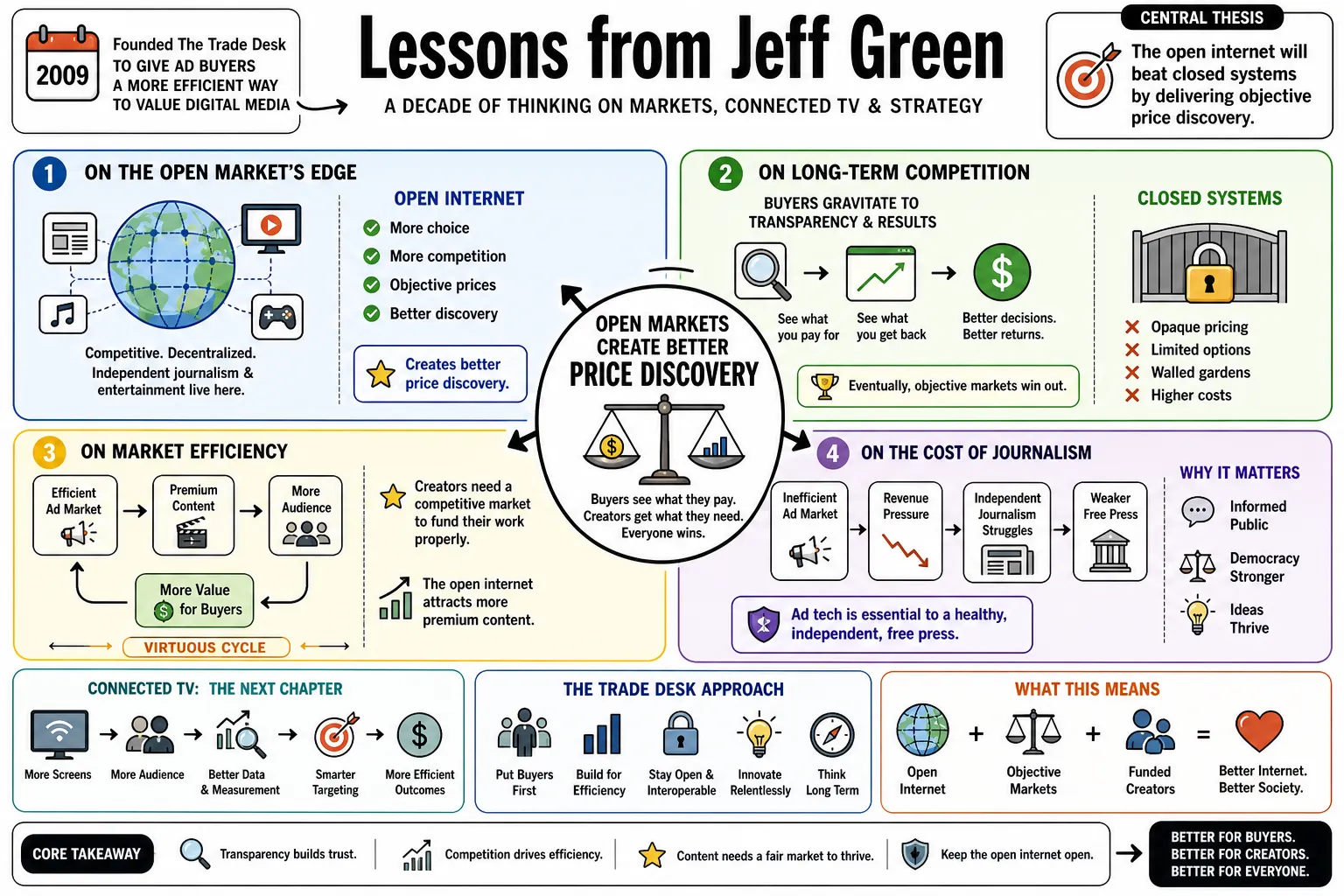
Lessons from Jeff Green
Jeff Green founded The Trade Desk in 2009 to give ad buyers a more efficient way to value digital media. He argues that the open internet will eventually beat closed systems like Google by offering advertisers objective price discovery. This profile collects a decade of his thinking on market dynamics, connected TV, and corporate strategy.
Part 1: The Open Internet
- On the open market's edge: "The open internet represents the competitive, decentralized spaces where independent journalism and entertainment live, which inherently creates better price discovery than closed ecosystems." — Source: The Current
- On long-term competition: "Eventually, objective markets win out because buyers gravitate to where they can see exactly what they are paying for and what return they are getting." — Source: Invest Like the Best
- On market efficiency: "The open internet will continually attract more premium content because creators need a competitive market to fund their work properly." — Source: The Current
- On the cost of journalism: "Without an efficient advertising market, independent journalism struggles to survive, making ad tech an essential component of a free press." — Source: The Trade Desk
- On price discovery: "If you can't compare the value of an ad impression across different publishers, you are flying blind. The open web solves this." — Source: Invest Like the Best
- On global reach: "Most of the world’s internet usage happens outside of search and social media, meaning the biggest opportunity lies in funding the rest of the web." — Source: Seeking Alpha
- On publisher independence: "Publishers must retain control over their data and yield, rather than handing it over to closed platforms that grade their own homework." — Source: Digiday
- On fragmentation: "A fragmented internet is a healthy internet, provided that advertisers have the tools to buy across it efficiently." — Source: ADOTAT
- On aligning incentives: "Our goal was never to buy media for ourselves, but to build a tool that helps buyers find the best value on the open web." — Source: Invest Like the Best
- On independent tech: In his OpenPath essay, Green says The Trade Desk is sustainable because it represents the buy side objectively, does not own media, and is aligned with advertisers rather than trying to serve every side of the market at once. — Reference: The Current essay on The Trade Desk staying aligned with the buy side
Part 2: Walled Gardens and Tech Giants
- On Google's conflict of interest: "You cannot effectively represent the buyer, represent the seller, and own the largest media properties all at the same time." — Source: Invest Like the Best
- On third-party cookies: "I didn't believe that deprecating cookies was in the best interest of big Google; it always seemed driven by antitrust fears rather than consumer privacy." — Source: Digiday
- On Amazon's advertising business: "The Amazon DSP is overrated and heavily reliant on their own retail footprint rather than offering true market-wide objectivity." — Source: Business Insider
- On grading their own homework: "Walled gardens ask advertisers to trust their internal metrics without allowing independent verification, which is fundamentally at odds with rational buying." — Source: The Current
- On regulatory pressure: "Antitrust scrutiny on major tech platforms will inevitably lead to a more balanced playing field for independent companies." — Source: Seeking Alpha
- On Google exiting the open web: "I do think you can expect Google to exit the open internet at some point, simply because strategically, it's good for them and reduces their regulatory risk." — Source: The Current
- On closed ecosystems: "Closed ecosystems try to lock in advertiser budgets, but eventually, buyers demand to know where their money is going." — Source: Invest Like the Best
- On Apple's privacy moves: "Apple’s restrictions on tracking are designed to benefit their own business model and hardware sales, not necessarily to protect the internet ecosystem." — Source: ADOTAT
- On the limits of search: "Search advertising is highly effective for capturing intent, but it cannot build brand awareness the way premium video can." — Source: The Trade Desk
- On long-term trends: In his 2025 open-internet essay, Green argues that digital advertising is following the same pattern as other maturing markets, bending toward efficiency, transparency, and objectivity over time rather than remaining trapped inside opaque walled gardens. — Reference: The Current op-ed on markets bending toward efficiency, transparency, and objectivity
Part 3: Connected TV (CTV)
- On the shift to streaming: "The transition from linear television to connected TV is the most significant shift in advertising history." — Source: Seeking Alpha
- On premium content: "Television has always been the most effective advertising medium because of sight, sound, and motion; CTV just makes it measurable." — Source: The Current
- On ad loads: "Consumers hate linear TV because there are too many ads. CTV allows us to show fewer, more relevant ads, improving the viewer experience." — Source: The Trade Desk
- On live sports: "Live sports are the last stronghold of linear TV, and as they move to streaming, the entire advertising market will follow." — Source: Digiday
- On CTV operating systems: "We launched Ventura to give hardware manufacturers an operating system that prioritizes a clean, transparent supply chain over conflicts of interest." — Source: The Current
- On subscription fatigue: "Consumers will not pay for ten different subscription services. Ad-supported streaming is the only mathematical way to fund the golden age of television." — Source: Invest Like the Best
- On addressability: "For the first time, advertisers can apply data to television screens, meaning they only pay for the audiences they actually want to reach." — Source: Seeking Alpha
- On the upfronts: "The traditional upfront buying model is outdated; advertisers need agility to shift budgets based on real-time data, which CTV provides." — Source: Business Insider
- On user experience: In The Current's write-up on Green's TV comments, he says CTV needs an open ecosystem so advertisers can manage reach and frequency instead of showing viewers the same ad repeatedly, tying a better ad experience directly to a more valuable TV market. — Reference: The Current article on using open CTV buying to reduce repetitive ad exposure
- On global adoption: "While the US led the shift to CTV, the international market is rapidly adopting ad-supported streaming as infrastructure improves." — Source: Seeking Alpha
Part 4: Artificial Intelligence in Ad Tech
- On data processing: The Trade Desk's Marketecture Live recap says Green framed programmatic advertising as especially well suited for AI because the platform has to process enormous numbers of ad opportunities, campaigns, and buyer decisions in real time. — Reference: The Trade Desk recap of Jeff Green's Marketecture Live discussion of AI in programmatic advertising
- On machine learning's role: "AI is not a new concept for us; it has been the foundation of our bidding engine for years, helping buyers make sense of massive data sets." — Source: The Current
- On objective data: "Objectivity matters even more in an AI world, and sharing data with conflicted players will become increasingly dangerous for brands." — Source: The Current
- On Kokai: "Our distributed AI approach, Kokai, surfaces insights exactly when the media buyer needs them, rather than keeping them hidden in a black box." — Source: The Trade Desk
- On human oversight: "AI will not replace media buyers; it will allow them to focus on strategy while algorithms handle the math." — Source: Invest Like the Best
- On generative AI: "While generative AI helps create ad copy and images, predictive AI is what actually figures out who should see those ads and when." — Source: Digiday
- On bid optimization: In the Motley Fool interview, Green says the industry needs to move from using roughly one fact on an ad impression toward using closer to 100 facts, which captures his view that better bidding comes from applying more data to each decision instead of relying on blunt heuristics. — Reference: Motley Fool interview on using far more data points in each ad decision
- On software valuations: "Despite market fears about AI eroding software margins, companies with deep, specialized expertise will use AI to widen their moats." — Source: The Current
- On campaign setup: "AI simplifies the user interface for advertisers, translating a brand's high-level business goals directly into trading strategies." — Source: Seeking Alpha
Part 5: The Value of Data and Objectivity
- On first-party data: "Brands have realized that their own customer data is their most valuable asset, and they need a safe environment to activate it." — Source: The Current
- On data portability: "Advertisers must be able to move their data across different publishers and channels to measure performance accurately." — Source: Invest Like the Best
- On independent measurement: "You cannot trust the entity selling you the media to also report on how well that media performed." — Source: Digiday
- On contextual signals: "While identity is important, analyzing the context of where an ad appears still provides massive value to advertisers." — Source: ADOTAT
- On data security: "Technologies that allow brands to match their data with publisher data without moving it or exposing it are the future of digital marketing." — Source: Seeking Alpha
- On price vs. value: "The cheapest ad is rarely the most effective; data helps buyers understand the true value of premium placements." — Source: The Trade Desk
- On audience fragmentation: "As consumers spread their attention across more devices, unified data is the only way a brand can tell a cohesive story." — Source: Business Insider
- On real-time feedback: In Forbes, Green says he was drawn to data-driven advertising because it lets marketers target and measure campaigns like never before, supporting the broader lesson that digital media creates a faster feedback loop than traditional bundled buying. — Reference: Forbes profile on why Jeff Green was drawn to measurable digital advertising
- On data monopolies: "When one company hoards data, the entire market suffers; an open data ecosystem benefits both brands and consumers." — Source: Invest Like the Best
Part 6: Retail Media and the Supply Chain
- On retail media's rise: "Retailers have the holy grail of data, actual purchase history, which bridges the gap between seeing an ad and buying a product." — Source: Seeking Alpha
- On shopper marketing: "Budgets that used to go to end-cap displays in physical stores are now moving to digital platforms where they can be measured." — Source: The Current
- On supply chain transparency: "The industry must clean up its supply path, removing unnecessary middlemen who extract fees without adding value." — Source: ADOTAT
- On OpenPath: In his OpenPath essay, Green says the product transparently shares bids and asks with publishers through Prebid so the market can replace Google's black-box supply chain with a cleaner and more competitive path to premium inventory. — Reference: The Current essay on OpenPath opening visibility into the supply path
- On retailer partnerships: "Retailers are becoming media networks, and they need independent tech partners to help them monetize their audiences outside of their own websites." — Source: Digiday
- On closed-loop measurement: "The ability to tie a streaming TV ad directly to an in-store purchase is the most powerful development in modern marketing." — Source: The Trade Desk
- On brand relationships: "Our fastest-growing segment consists of brands signing joint business plans directly with us, growing faster than traditional agency spend." — Source: ADOTAT
- On margin compression: "As the supply chain becomes more transparent, the take rates of intermediaries will compress, leaving more money for publishers and better ROI for brands." — Source: Invest Like the Best
- On the future of commerce: "Every major retailer will eventually have a media business because the margins on advertising are simply too attractive to ignore." — Source: Seeking Alpha
Part 7: Identity and Privacy (UID2)
- On Unified ID 2.0: "UID2 was built to upgrade the internet's identity framework, moving away from cookies toward a secure, encrypted system." — Source: The Current
- On consumer control: "Privacy should mean that consumers understand exactly what they are sharing and get a clear benefit, like free content, in return." — Source: Invest Like the Best
- On email authentication: "Logging into a website with an email address creates a direct relationship between the publisher and the user, which is far better than a silent tracker." — Source: Digiday
- On industry collaboration: "No single company can solve identity alone; it requires an open-source standard that the entire ecosystem can adopt." — Source: The Trade Desk
- On the failure of cookies: In his 2025 open-internet essay, Green groups the death and resurrection of cookies with the industry shifts that forced advertising infrastructure to evolve, which supports the more conservative takeaway that the market needs identity and privacy standards better suited to modern digital advertising than legacy cookies. — Reference: The Current op-ed on the industry moving beyond legacy cookie-era assumptions
- On government regulation: "Clear privacy regulations help the industry by setting standard rules of the road, rather than leaving enforcement up to browser monopolies." — Source: Seeking Alpha
- On cross-device tracking: "A stable identity solution allows advertisers to manage frequency caps across a user's phone, laptop, and television, preventing ad fatigue." — Source: Business Insider
- On open-source trust: "By handing the administration of UID2 over to independent third parties, we ensured it would remain an industry utility rather than a corporate asset." — Source: The Current
- On publisher revenue: "Publishers who implement authenticated identity solutions see significantly higher CPMs because advertisers are willing to pay more for certainty." — Source: ADOTAT
Part 8: Leadership and Building The Trade Desk
- On founder conviction: "I'm putting my money where my mouth is. I've never been more convinced that our approach to the open internet is the right one." — Source: The Current
- On corporate culture: "A strong culture requires aligning every employee's incentives with the long-term success of the clients they serve." — Source: Invest Like the Best
- On long-term thinking: "We operate the business with a five-to-ten-year horizon, which allows us to invest in structural changes like CTV while others focus on quarterly earnings." — Source: Seeking Alpha
- On financial discipline: "We have been profitable since our early days because we believed that sustainable growth required strong fundamental unit economics." — Source: The Trade Desk
- On engineering focus: In Forbes, Green says The Trade Desk evaluates more than 9 million ad opportunities each second and has to consider quadrillions of permutations for advertisers, presenting ad tech as an infrastructure and engineering problem before it is anything else. — Reference: Forbes profile on the scale and mathematical complexity of The Trade Desk platform
- On working with agencies: "Agencies remain essential partners because they provide the strategic services and creative direction that technology alone cannot replace." — Source: Digiday
- On hiring talent: "We look for people who are highly collaborative but also possess an obsessive passion for solving complex, esoteric problems." — Source: The Current
- On continuous evolution: "The moment you stop rebuilding your core technology is the moment you start becoming obsolete in this industry." — Source: Business Insider
- On market opportunity: "Despite our growth, we are still in the early innings of digital advertising; the transition of global ad spend to programmatic is the greatest opportunity I have ever seen." — Source: Seeking Alpha