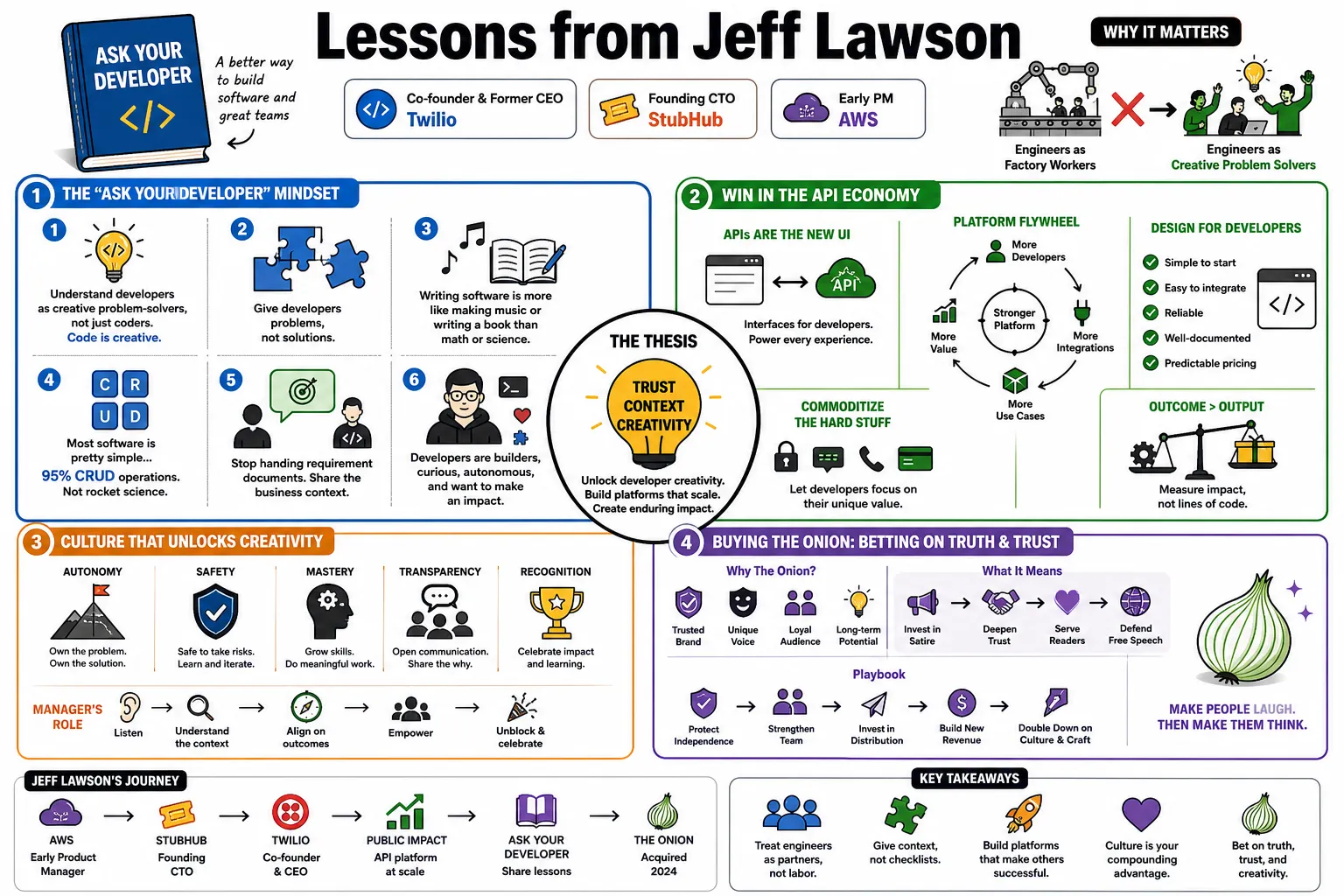
Lessons from Jeff Lawson
Jeff Lawson is the co-founder and former CEO of Twilio, the founding CTO of StubHub, and an early product manager at Amazon Web Services. In his book Ask Your Developer, he argued that companies waste talent by treating engineers like factory workers instead of creative problem solvers. This profile breaks down his operating lessons on the API economy, company culture, and his recent acquisition of The Onion.
Part 1: The "Ask Your Developer" Mindset
- On creative problem solving: "Understand developers as creative problem-solvers, not just coders. Code is creative." — Source: [SaaStr]
- On assigning work: "The most important thing is to give developers problems, not solutions." — Source: [Goodreads]
- On the nature of coding: "Writing software is more similar to making music or writing a book than it is to doing math or science." — Source: [ChiefMartec]
- On software simplicity: "The truth is that most software is pretty simple... 95 percent CRUD operations. This isn't rocket science." — Source: [Medium]
- On treating developers as partners: Management must stop handing technical teams requirement documents and instead share the business context behind the request. — Source: [EchoBind]
- On the developer persona: Developers build the new digital environment faster than ever before when treated as partners rather than subordinates. — Source: [Shortform]
- On removing friction: When developers are merely reading a specification document, they become isolated from the people who will actually use the software. — Source: [Medium]
- On bad code: Code becomes clunky and error-prone when developers are kept in the dark about how people are actually going to use it. — Source: [Medium]
- On the ticket taker trap: The biggest mistake companies make is treating developers as factory workers who simply execute predefined specs. — Source: [Goodreads]
- On unleashing potential: If you want innovation, you have to trust the people writing the code to understand the customer's pain points. — Source: [McKinsey]
Part 2: The API Economy and "Build vs. Die"
- On the new natural law: "Build software or risk extinction in the digital age. Build vs. Die is becoming a natural law of business." — Source: [SoBrief]
- On buying differentiation: "You can’t buy differentiation. You can only build it." — Source: [Goodreads]
- On customer-facing tech: Anything that directly touches the customer experience must be built in-house to maintain control and agility. — Source: [JV Codes]
- On commodity software: Buy off-the-shelf software only for non-differentiating functions like payroll, HR, or internal email. — Source: [a16z]
- On APIs as raw ingredients: APIs are the building blocks of innovation, allowing developers to skip the undifferentiated heavy lifting. — Source: [No Jitter]
- On the shift in buyers: The software purchasing decision has shifted from the CIO's office to the individual developer using a credit card. — Source: [Shortform]
- On business development as a service: Breakaway API companies abstract away complex real-world relationships, like Twilio managing global telecom carriers so developers avoid the mess. — Source: [SaaStr]
- On Capex as a service: Cloud infrastructure turns massive capital expenditures into variable operating expenses that anyone can access. — Source: [SaaStr]
- On Algorithm as a service: APIs provide access to highly complex logic, like machine learning, that is too expensive for most companies to build from scratch. — Source: [SaaStr]
- On speed as an advantage: The API economy lowers the cost of failure, allowing companies to run hundreds of small experiments and iterate faster. — Source: [The Letter Two]
Part 3: Company Culture and "Twilio Magic"
- On actionable values: Core values should be verbs or nouns, avoiding abstract adjectives like integrity or excellence. — Source: [NOBL]
- On Drawing the Owl: There is no instruction manual for innovation; you have to take the basic idea and figure the rest out as you go. — Source: [Zurb]
- On embracing uncertainty: Draw the Owl is shorthand for taking on a vague, difficult task and successfully shipping it. — Source: [Hey]
- On wearing the customers' shoes: The apostrophe in customers' is plural, emphasizing the need to build empathy for the collective market. — Source: [Medium]
- On No Shenanigans: Giving employees explicit permission to call out behavior that feels dishonest or overly political keeps the culture clean. — Source: [Slab]
- On writing it down: Clear thinking requires documentation; teams must write down their plans, decision criteria, and lessons learned. — Source: [Slab]
- On the builder mentality: Embracing a can-do attitude means loving hard problems and using ingenuity to solve them. — Source: [Slab]
- On being a Positron: Employees should be a positive force, empowering others and standing up for what is right for the community. — Source: [Slab]
- On articulating culture: You do not create values from thin air; you articulate the best behaviors that are already present in your highest-performing teams. — Source: [YouTube]
- On the teenage years of startups: Companies should wait until they have 20 to 40 people before codifying values, allowing the culture time to bake. — Source: [YouTube]
Part 4: Product Management and Problem Solving
- On the role of product managers: "Great product managers are not a layer between customer needs and developers." — Source: [Medium]
- On removing barriers: Effective PMs eliminate preconceived solutions, streamline communications, and connect developers directly to the customer's reality. — Source: [Medium]
- On experimentation: "Experimentation is the prerequisite to innovation." — Source: [Goodreads]
- On cheap failures: "When you reach a dead end quickly and cheaply, that’s valuable to the business." — Source: [Goodreads]
- On punishing hypotheses: "The thing that kills an entrepreneurial, experimental culture is when people get punished for running an experiment that proves a hypothesis false." — Source: [Goodreads]
- On the four attributes of software: There are four attributes: features, deadlines, quality, and certainty. You can pick any three, but you can’t have all four. — Source: [Goodreads]
- On lowering the cost of failure: Building infrastructure that makes it cheap to fail allows teams to test ideas rapidly and discard what does not work. — Source: [Books-A-Million]
- On server usage: "What matters isn’t how you use servers, but rather how you serve users." — Source: [Medium]
- On PowerPoint: Presentation decks are a terrible tool for decision-making because they gloss over complex details. — Source: [McKinsey]
Part 5: Leadership and "Strategy"
- On strategy as a dirty word: "I often say that strategy is a dirty word in business; it should be struck." — Source: [Weekend Fund]
- On getting off course: "Any time you find yourself talking about strategy, you're probably off-course, actually." — Source: [Not Boring]
- On the only real strategy: "There's only one business strategy: serve your customers." — Source: [NFX]
- On top-down blindness: Using strategy to describe an executive mandate forces people to pay attention to the C-suite rather than listening to the market. — Source: [NFX]
- On setting guardrails: "By creating rules, you paradoxically set people free—in the space between guardrails." — Source: [Goodreads]
- On the essence of autonomy: "The essence of autonomy is feeling trusted to make decisions. If someone else can just veto whatever decisions you make, then you’re not really all that autonomous." — Source: [Goodreads]
- On providing support: "Instead of ‘sink or swim,’ we give people swim lessons—and even let them wear floaties if they need them." — Source: [Goodreads]
- On Hamilton Helmer's 7 Powers: Focusing on the structural conditions that create defensible value is more useful than traditional top-down strategic planning. — Source: [NFX]
- On values as an operating system: Culture is the code that runs the company; if the values are vague and buggy, the organization will fail to scale. — Source: [NOBL]
Part 6: His Amazon/AWS Era and Origins
- On the StubHub founding: Writing the first line of code and launching the StubHub platform in six weeks taught him the necessity of total commitment to a startup's mission. — Source: [Computer History Museum]
- On joining AWS: Working as one of the first technical product managers at Amazon under Andy Jassy helped him understand how to build infrastructure for developers. — Source: [LibertyRPF]
- On Amazon's true identity: Hearing Jeff Bezos declare that Amazon was a software company, rather than a retailer, fundamentally shifted his perspective on business. — Source: [LibertyRPF]
- On software as a competitive edge: The sequence of 0s and 1s is what enables a company to out-innovate its competitors in any industry. — Source: [LibertyRPF]
- On computing primitives: Amazon's strategy of exposing the atomic-level building blocks of computing via APIs became the direct blueprint for Twilio. — Source: [Heller Search]
- On developers as alchemists: Bezos taught the team that developers are alchemists, and the company's job is to do everything possible to let them do their alchemy. — Source: [Heller Search]
- On telecom as a primitive: He realized he could take the messy world of global telephony and turn it into a simple API call, mirroring Amazon's approach with servers. — Source: [Heller Search]
- On two-pizza teams: He adopted Amazon's organizational structure, ensuring teams remain small enough to be fed by two pizzas to maintain speed and ownership. — Source: [Heller Search]
- On learning from Bezos: His entire approach to empowering software engineers to solve business problems was forged during his time observing Amazon's leadership. — Source: [LibertyRPF]
Part 7: Customer Empathy and Support
- On support rotations: Every developer must spend time doing customer support to understand exactly where their code fails. — Source: [YouTube]
- On building intuition: Shielding engineering teams from frustrated users destroys the intuition required to design empathetic software. — Source: [Goodreads]
- On direct feedback loops: Answering support tickets creates a direct line between the creator and the consumer, leading to fundamentally better architecture. — Source: [YouTube]
- On non-technical staff building apps: Everyone in the company, from HR to Finance, should build and demo an application to truly understand the core product. — Source: [YouTube]
- On the Wear the Cape tradition: Earning a track jacket by building a functional app ensures the entire organization aligns with the developer's perspective. — Source: [YouTube]
- On eliminating proxies: Product managers should not act as proxies who summarize customer pain; developers need to hear the frustration directly. — Source: [SaaStr]
- On solving over building: Managers must focus on detailing the customer's struggle rather than dictating the specific features to be built. — Source: [EchoBind]
- On software as a relationship: Software is the primary interface for winning the market, rather than a back-office utility. — Source: [SaaStr]
- On customer-centric product roadmaps: The roadmap should be dictated by the obstacles users face, rather than what competitors are doing. — Source: [Medium]
Part 8: The Media Transition and "The Onion"
- On acquiring The Onion: He purchased the satirical news site to rescue it from byzantine cookie dialogs, paywalls, and clickbait. — Source: [SFGate]
- On unleashing creatives: His primary goal with the acquisition is to protect the publication's legacy and unleash the creative team to do their best work. — Source: [Axios]
- On applying tech principles to media: He aims to bring a customer-first builder mentality to a media brand without stripping away its identity. — Source: [Apple Podcasts]
- On the necessity of satire: Satire is a necessary tool to counter a polarized and fractured information environment. — Source: [Apple Podcasts]
- On the Infowars bid: The attempt to buy Alex Jones' platform was designed to turn a hub of conspiracy theories into a parody of itself. — Source: [Apple Podcasts]
- On saving the good internet: His mandate for The Onion is to bring back the era of the internet where content was accessible, funny, and free from intrusive monetization. — Source: [Fast Company]
- On Global Tetrahedron: He embraced the joke by naming his holding company after the fictional, evil megacorporation that has been a running gag in The Onion for decades. — Source: [Axios]
- On stepping down from Twilio: After a 15-year run building a massive infrastructure company, he wanted to pivot toward projects that directly impact culture and truth. — Source: [Apple Podcasts]
- On tech leaders entering media: Unlike other billionaires who buy legacy papers for influence, his approach focuses on preserving the specific mechanics of comedy and satire. — Source: [SFGate]