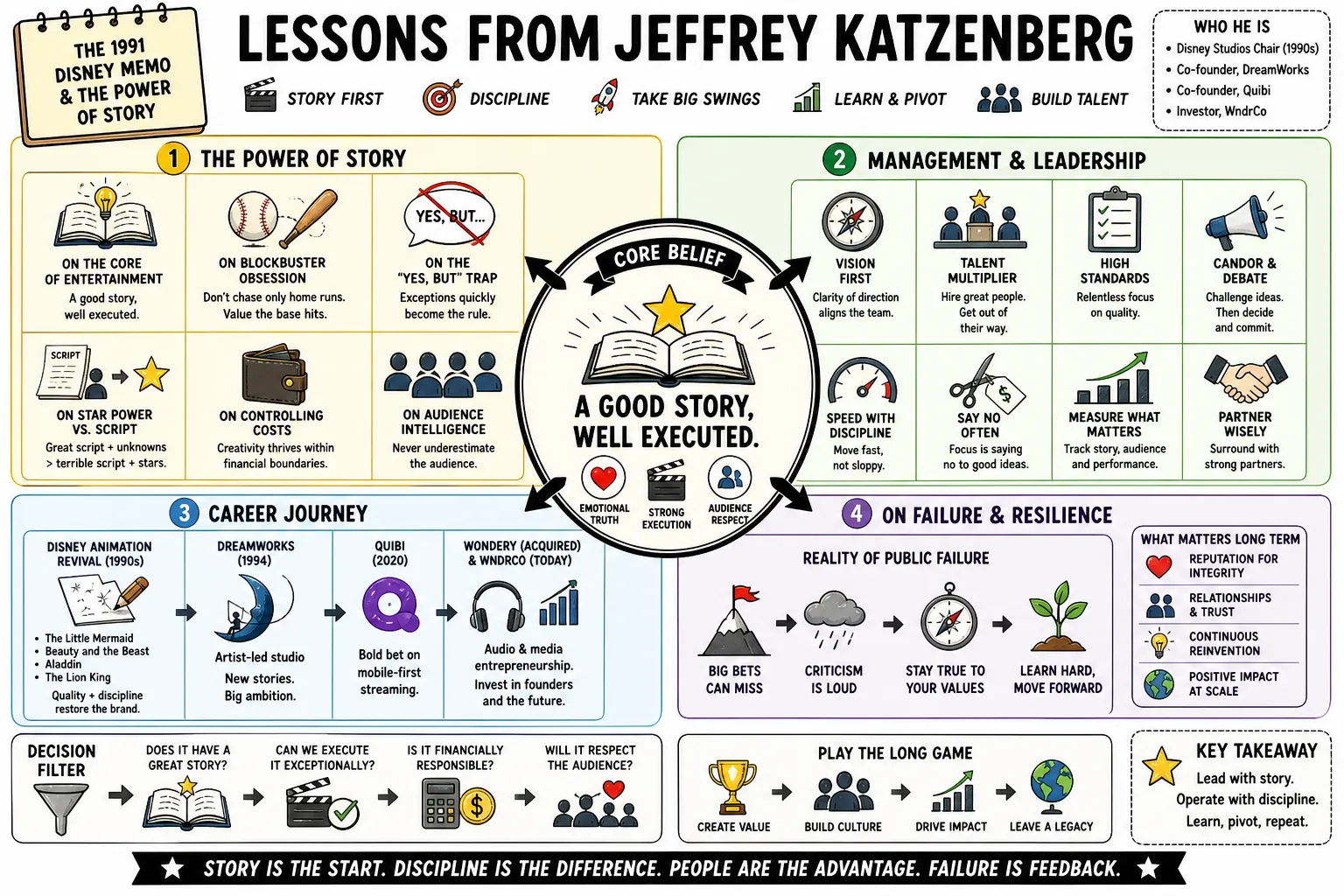
Lessons from Jeffrey Katzenberg
Jeffrey Katzenberg ran Walt Disney Studios during its 1990s animation revival before co-founding DreamWorks and the short-lived streaming platform Quibi. Known for an aggressive management style that prioritized story over budget, he later pivoted to venture capital with WndrCo. This collection gathers his views on film production, corporate management, and the realities of public failure.
Part 1: The 1991 Disney Memo & The Power of Story
- On the core of entertainment: "A good story, well executed." — Source: [The Black List]
- On blockbuster obsession: "Chasing only home runs in the film industry often leads to neglecting the solid base hits that sustain a studio." — Source: [Sriram Krishnan]
- On the 'Yes, But' trap: "Beware of justifying expensive, risky projects with 'Yes, it's expensive, but...' because exceptions quickly become the rule." — Source: [Sriram Krishnan]
- On star power vs. script: "A great script with unknown actors is always a better investment than a terrible script with massive stars." — Source: [No Film School]
- On controlling costs: "Creativity thrives within financial boundaries; unlimited budgets often disguise weak storytelling." — Source: [Forbes]
- On audience intelligence: "Never underestimate the audience; they can sense when a story lacks genuine heart or effort." — Source: [Variety]
- On the foundation of success: "The idea is king." — Source: [Los Angeles Times]
- On story development: "You cannot rush the writing process; a flawed script cannot be fixed in post-production." — Source: [The Hollywood Reporter]
- On returning to roots: "When a company loses its way, the fastest path back to success is returning to its original core principles." — Source: [Sriram Krishnan]
- On execution: "An average idea executed brilliantly will always beat a brilliant idea executed poorly." — Source: [Fast Company]
Part 2: Leadership & Management Evolution
- On evolving as a leader: "Getting fired when you're doing your best work can wake you up pretty well. It's called a swift kick in the butt. But I learned from that experience that change is good." — Source: [Forbes]
- On referent power: "The most effective leadership relies on referent power and earning the deep respect of your team." — Source: [Lumen Learning]
- On empowering others: "To build a great organization, you must surround yourself with brilliant people and then actively get out of their way." — Source: [Lumen Learning]
- On the two-way street of respect: "A leader is only as strong as their followers; you must show genuine value to those you lead." — Source: [Lumen Learning]
- On authoritarianism: "A dictatorial management style might drive short-term results, but it eventually stifles the creativity required for long-term survival." — Source: [SlideShare]
- On visibility: "During tough times, leaders cannot hide; they must hold company-wide meetings and face difficult questions head-on." — Source: [XYZ University]
- On transformational leadership: "True leadership is about transforming the culture to foster openness and accessibility at every level." — Source: [Scribd]
- On leading by example: "A manager must demonstrate fearless leadership by running toward challenges rather than away from them." — Source: [XYZ University]
- On micromanagement: "Moving from a micromanager to an empowering leader is a necessary evolution for scaling any creative business." — Source: [Harvard Business Review]
Part 3: Innovation, Technology & Animation
- On the essence of animation: "What I love most about animation is, it's a team sport, and everything we do is about pure imagination." — Source: [AZ Quotes]
- On the digital shift: "Embracing computer animation represented a fundamental shift in how stories could be visualized rather than a simple technological upgrade." — Source: [Wired]
- On the 3D revolution: "Technological gimmicks fade, but technologies that deepen emotional immersion will always endure." — Source: [TechCrunch]
- On resisting stagnation: "If change is uncomfortable, irrelevance is going to be harder." — Source: [Innovation Leader]
- On continuous improvement: "The idea that you can't change anything? I don't buy it." — Source: [YouTube]
- On blending art and science: "The best animation studios operate at the exact intersection of cutting-edge technology and timeless artistry." — Source: [The New York Times]
- On competitive advantage: "Innovation is not a one-time event; it must be a repeatable process ingrained in the company culture." — Source: [Fast Company]
- On the pace of tech: "If you wait for a technology to be perfected before you adopt it, your competitors will already be on the next iteration." — Source: [VentureBeat]
- On creative boundaries: "Technology should never dictate the story; rather, the story should demand new technological solutions." — Source: [Animation World Network]
Part 4: Taking Risks & Embracing Failure
- On the necessity of failure: "When you're put in the wrong place at the wrong time, you learn amazing things about life, you experience moments of sacrifice, and learn how to be a leader." — Source: [Stanford University]
- On optimism: "My attitude is when one door closes, another opens." — Source: [Forbes]
- On owning your misses: "I’m humbled by the failure, and it is crucial to focus on owning our miss rather than making excuses." — Source: [The Wrap]
- On product-market fit: "Even with high-quality content and massive funding, a business cannot survive if it ultimately lacks product-market fit." — Source: [dot.la]
- On failing fast: "When a moonshot isn't working, agility is key; returning capital to investors quickly is better than burning it all in denial." — Source: [dot.la]
- On aiming high: "Career fulfillment comes from operating as a home run hitter and aiming for targets somewhere between the improbable and impossible." — Source: [Bessemer Venture Partners]
- On resilience: "The sting of a public failure is temporary, but the lessons learned become permanent assets for your next venture." — Source: [Business Insider]
- On calculated bets: "Risk should not be avoided, but it must be clearly measured against the potential upside and the capacity to absorb a loss." — Source: [Wall Street Journal]
- On the danger of comfort: "The moment an organization feels entirely safe is the moment it is most vulnerable to disruption." — Source: [Inc.]
- On public scrutiny: "If you are going to take big swings, you must be prepared to fail loudly and take the criticism without deflection." — Source: [Reddit]
Part 5: The Business of Content & Hollywood
- On focus: "A company like DreamWorks, all we do is make product. That's all we do. We don't own distribution. We are purely in the creation of content." — Source: [AZ Quotes]
- On franchise building: "A successful movie is an event, but a successful franchise is a self-sustaining ecosystem that requires careful nurturing." — Source: [Variety]
- On audience demographics: "Never talk down to children in family films; if you write for adults, the kids will elevate to it." — Source: [The Hollywood Reporter]
- On the value of IP: "In the modern entertainment landscape, owning globally recognizable intellectual property is the only true leverage." — Source: [Deadline]
- On shifting mediums: "The core of storytelling remains the same whether it is consumed in a theater, on a television, or on a mobile phone." — Source: [Medium]
- On creative friction: "A healthy amount of tension between the business side and the creative side is necessary to produce commercially viable art." — Source: [Los Angeles Times]
- On the global market: "Content must be designed with a global audience in mind from day one rather than retrofitted for international markets later." — Source: [Forbes]
- On adapting to consumers: "The industry does not dictate how people consume media; the consumer dictates the industry's future." — Source: [TechCrunch]
- On distribution vs. creation: "While distribution models constantly shift and consolidate, the premium placed on original, high-quality creation only increases." — Source: [QuoteFancy]
- On the danger of sequels: "A sequel should only be made if there is a compelling new story to tell." — Source: [Entertainment Weekly]
Part 6: Hiring, Talent & Team Building
- On interview questions: "Asking candidates what they are best at doing and worst at doing forces a level of honesty and self-reflection crucial for team fit." — Source: [Lumen Learning]
- On creative partnerships: "The best teams are built by pairing visionary creatives with ruthlessly pragmatic operational operators." — Source: [Harvard Business Review]
- On identifying talent: "Look for individuals who demonstrate an obsessive dedication to their craft, regardless of their past pedigree." — Source: [Fast Company]
- On fostering loyalty: "Loyalty is not demanded; it is earned by protecting your team from corporate bureaucracy and championing their work." — Source: [SlideShare]
- On constructive feedback: "Feedback must be direct and immediate while always focusing on the work rather than the worth of the individual." — Source: [Inc.]
- On diverse perspectives: "Inspiration comes from all different places." — Source: [AZ Quotes]
- On the hiring bar: "Every new hire should raise the average talent level of the room; never hire simply to fill a seat quickly." — Source: [VentureBeat]
- On managing egos: "In a room full of brilliant creators, the leader's job is to recognize and elevate the best idea rather than generating it themselves." — Source: [The New York Times]
- On cultivating culture: "Culture is defined by how the team treats each other when a project is failing, ignoring superficial office perks." — Source: [XYZ University]
Part 7: Navigating Crisis & Change
- On industry disruption: "When big tech platforms begin to squeeze traditional media, the only response is to pivot and find new greenfields." — Source: [Business Insider]
- On surviving downturns: "Maintaining transparency and honest communication during economic hardships is the only way to preserve organizational trust." — Source: [XYZ University]
- On decisive action: "In a crisis, the worst decision is indecision; you must act quickly with the best information available, even if it is incomplete." — Source: [Wall Street Journal]
- On shifting paradigms: "Recognizing when a business model is fundamentally broken requires stepping outside your own legacy and past successes." — Source: [Forbes]
- On external shocks: "While you cannot predict macroeconomic shocks or pandemics, you can build a balance sheet and a culture resilient enough to withstand them." — Source: [The Wrap]
- On admitting defeat: "Shutting down a project early requires more courage than stringing it along in the vain hope of a miracle turnaround." — Source: [Medium]
- On the aftermath of crisis: "How a leader treats their employees during a company shutdown defines their reputation far more than any past box office success." — Source: [dot.la]
- On continuous reinvention: "You must be willing to completely cannibalize your own successful business before a competitor does it for you." — Source: [Wired]
- On maintaining morale: "During turbulent periods, a leader must absorb the anxiety of the organization and project clear, calm direction." — Source: [Inc.]
Part 8: Investing & The Next Chapter (WndrCo)
- On the power of storytelling in VC: "In venture capital, the ability to craft a compelling narrative is just as crucial for a startup as its underlying technology." — Source: [Pandora]
- On long-term building: "Venture capital requires patiently backing and building businesses for the long haul rather than focusing solely on financial engineering." — Source: [MAGNiTT]
- On pivoting industries: "Applying the lessons of media to completely different sectors like cybersecurity and developer infrastructure reveals universal truths about consumer behavior." — Source: [Venture Capital Journal]
- On spotting trends: "The most lucrative investments often lie in the unglamorous infrastructure that powers the next wave of consumer technology." — Source: [YouTube]
- On founder partnerships: "An investor's role is to serve as a strategic partner who has already navigated the operational pitfalls a young founder is facing." — Source: [Bessemer Venture Partners]
- On consumer privacy: "The next massive shifts in technology will be driven by companies that prioritize and protect user privacy as a core feature." — Source: [Business Insider]
- On assessing founders: "A founder's most important trait is their adaptability when their initial idea inevitably hits a wall." — Source: [Masters of Scale]
- On value creation: "True value is created when a company solves a genuine pain point so effectively that the technology becomes invisible to the user." — Source: [TechCrunch]
- On legacy: "A career should not be measured by the avoidance of failure, but by the continuous willingness to step up to the plate and take the next swing." — Source: [Bessemer Venture Partners]