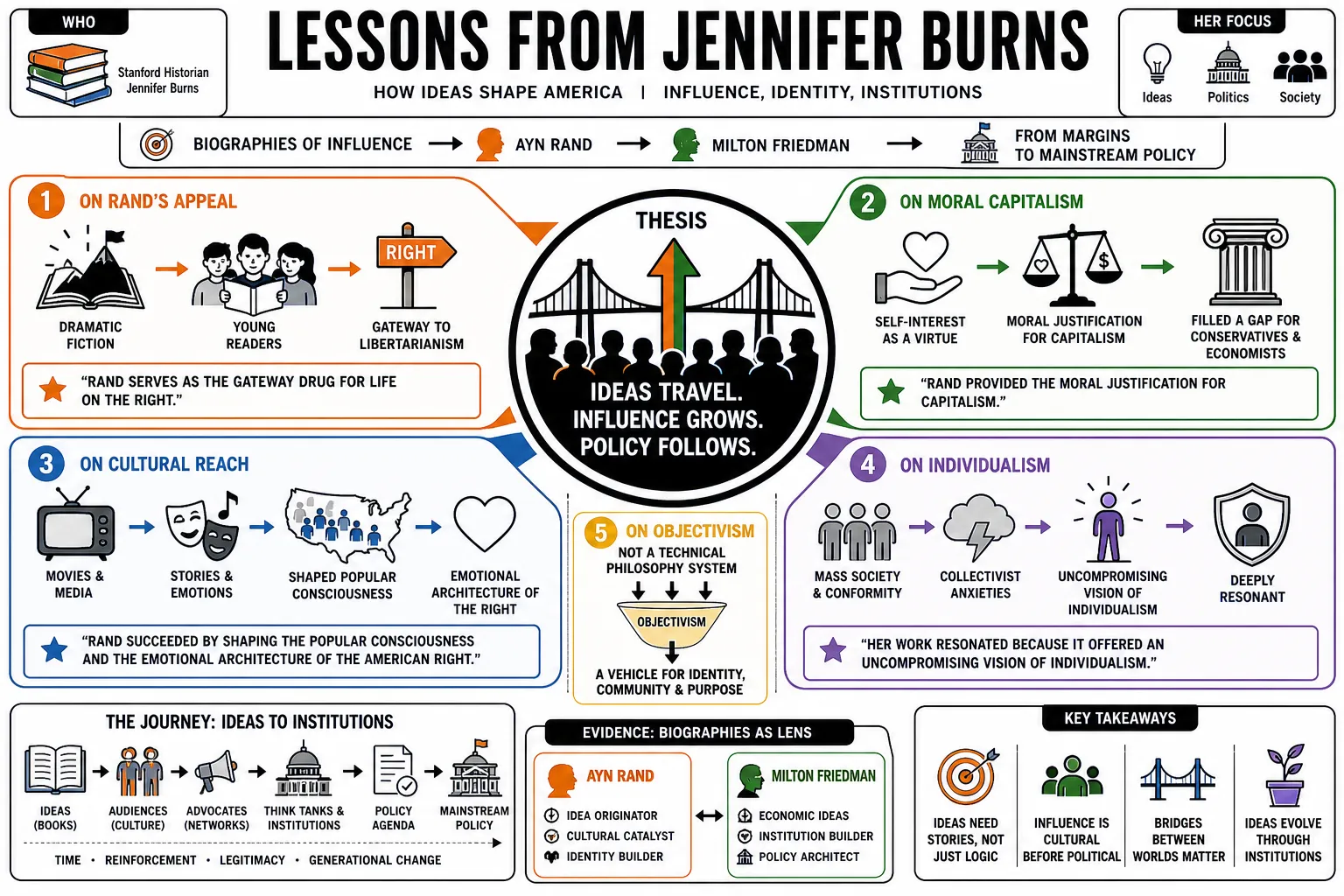
Lessons from Jennifer Burns
Stanford historian Jennifer Burns studies how economic and political ideas shape American society. Her biographies of Ayn Rand and Milton Friedman track how free-market arguments moved from academic margins into mainstream policy. This collection covers her research on intellectual influence and the development of American conservatism.
Part 1: The Influence of Ayn Rand
- On Rand's Appeal: "Rand serves as the gateway drug for life on the right, pulling young readers into libertarianism through dramatic fiction rather than dry economic texts." — Source: [Lex Fridman Podcast]
- On Moral Capitalism: "Rand provided the moral justification for capitalism that traditional conservatives and economists struggled to articulate, framing self-interest as a virtue rather than a vice." — Source: [Goddess of the Market]
- On Cultural Reach: "Rand succeeded by shaping the popular consciousness and the emotional architecture of the American right rather than writing academic philosophy." — Source: [EconTalk]
- On Individualism: "Her work resonated because it offered an uncompromising vision of individualism during an era defined by mass society and collectivist anxieties." — Source: [Goddess of the Market]
- On Objectivism: "Objectivism functioned less as a traditional philosophy and more as a totalizing worldview, providing adherents with a pre-packaged lens for understanding culture and politics." — Source: [Conversations with Tyler]
- On Conservative Alliances: "Rand maintained a tense, often hostile relationship with traditional conservatives like William F. Buckley, despising their reliance on religion as a foundation for liberty." — Source: [Goddess of the Market]
- On The Fountainhead: "The success of The Fountainhead proved that there was a massive, untapped market for literature that elevated the creator above the collective." — Source: [Lex Fridman Podcast]
- On Intellectual Gatekeeping: "Rand's inner circle operated with intense purity tests, creating a paradoxical environment of strict intellectual conformity in the name of radical individualism." — Source: [Goddess of the Market]
- On Political Realignment: "By wedding fierce anti-communism with absolute free-market orthodoxy, Rand helped forge the ideological coalition that would dominate late-twentieth-century conservatism." — Source: [EconTalk]
- On Her Legacy: "Rand remains a foundational, if sometimes unacknowledged, pillar of modern libertarian thought, continuing to sell hundreds of thousands of books decades after her death." — Source: [Goddess of the Market]
Part 2: Milton Friedman and Monetarism
- On Friedman's Optimism: "Friedman approached economics with a profound, almost relentless optimism about human freedom and the capacity of markets to solve complex social problems." — Source: [Milton Friedman: The Last Conservative]
- On Monetarism: "He shifted the center of macroeconomic gravity from fiscal policy to the money supply, arguing that inflation was always and everywhere a monetary phenomenon." — Source: [Lex Fridman Podcast]
- On Crisis and Change: "Friedman understood that only a crisis produces real change, and that the policies adopted depend on the ideas that are lying around ready to be implemented." — Source: [The Fitzwilliam]
- On The Great Depression: "His reinterpretation of the Great Depression, blaming the Federal Reserve's monetary contraction rather than a failure of capitalism, completely altered the historical narrative." — Source: [Milton Friedman: The Last Conservative]
- On Public Persuasion: "Friedman was rare among elite economists because he took the public seriously, translating complex monetary theory into accessible arguments through television and popular writing." — Source: [EconTalk]
- On the Chicago School: "He built the Chicago School into a formidable institutional counterweight to the prevailing Keynesian consensus on the East Coast." — Source: [Milton Friedman: The Last Conservative]
- On the Draft: "Friedman's argument against military conscription was fundamentally an argument about bodily autonomy and the hidden taxation of forced labor." — Source: [Conversations with Tyler]
- On School Choice: "His proposal for educational vouchers introduced market mechanisms into public schooling, fundamentally changing how we debate educational equity." — Source: [Milton Friedman: The Last Conservative]
- On Floating Exchange Rates: "Friedman foresaw the collapse of the Bretton Woods system and provided the intellectual framework for the era of floating fiat currencies." — Source: [Lex Fridman Podcast]
- On His Conservatism: "Calling him the 'last conservative' is a nod to a specific intellectual tradition of classical liberalism that has been increasingly degraded in the modern populist era." — Source: [JenniferBurns.org]
Part 3: The Evolution of American Conservatism
- On Post-War Conservatism: "The modern conservative movement was not inevitable. It was consciously constructed by intellectuals who felt entirely marginalized by the New Deal consensus." — Source: [Hoover Institution]
- On the Fusionist Consensus: "Cold War conservatism relied on a fragile fusion of traditionalists and free-market libertarians united primarily by shared anti-communism." — Source: [Goddess of the Market]
- On Populism vs. Elitism: "There has always been a tension on the right between the elite, idea-driven intellectuals and the populist, grassroots base that actually wins elections." — Source: [Lex Fridman Podcast]
- On the Role of Think Tanks: "Institutions like the Hoover Institution and AEI created an alternative ecosystem where conservative ideas could incubate outside hostile academia." — Source: [Milton Friedman: The Last Conservative]
- On Neoliberalism: "The term neoliberalism often obscures more than it clarifies, flattening a complex debate among classical liberals about the proper scope of state capacity." — Source: [EconTalk]
- On the Reagan Revolution: "Reagan's political success was the culmination of decades of groundwork laid by intellectuals who changed the boundaries of what was politically imaginable." — Source: [Stanford University]
- On the Loss of Tradition: "Contemporary conservatism has largely abandoned the intellectual rigor and caution of its mid-century founders in favor of grievance and populism." — Source: [JenniferBurns.org]
- On the Administrative State: "The central target of twentieth-century conservative thought was the expanding administrative state, which they viewed as an existential threat to democratic accountability." — Source: [Hoover Institution]
- On Economic Orthodoxy: "Supply-side economics succeeded politically because it offered a painless version of conservatism by promising tax cuts without the discipline of spending cuts." — Source: [Milton Friedman: The Last Conservative]
Part 4: Intellectual History Methodology
- On Tracing Ideas: "Intellectual history is about tracing how an abstract idea moves from an elite, academic space into popular culture and eventually into public policy." — Source: [Lex Fridman Podcast]
- On Archival Work: "The real story of a thinker is rarely found in their published treatises. It lives in the margins of their letters, drafts, and private correspondences." — Source: [Conversations with Tyler]
- On Contextualizing Thought: "You cannot separate a philosopher's ideas from the historical context in which they lived, since ideas are always responses to specific environmental pressures." — Source: [Stanford Humanities Center]
- On Unconventional Sources: "To understand political realignment, historians must look past the politicians and study novelists, economists, and public intellectuals." — Source: [Goddess of the Market]
- On the Search for Meaning: "At its core, intellectual history is a search for meaning regarding how people in the past understood their world and tried to shape its future." — Source: [Lex Fridman Podcast]
- On Intellectual Lineage: "Ideas rarely emerge fully formed. They are passed down, mutated, and adapted through generations of thinkers responding to one another." — Source: [Milton Friedman: The Last Conservative]
- On Correcting the Record: "Biographers must often work to undo the damage done by their subjects' own memoirs, which are inevitably exercises in self-mythologizing." — Source: [Conversations with Tyler]
- On Marginalized Figures: "Focusing on neglected figures of political conservatism reveals the blind spots of mainstream historical narratives." — Source: [Hoover Institution]
- On the Role of the Biographer: "A biographer's job is not to act as a judge. It is to act as an interpreter, clarifying the internal logic of a worldview even if they disagree with it." — Source: [Lex Fridman Podcast]
Part 5: Women in Conservative Thought
- On Ayn Rand's Gender: "Rand's gender aided her success. As a woman, she could adopt a fiercely aggressive, uncompromising posture that might have alienated audiences if it came from a man." — Source: [Goddess of the Market]
- On Rose Friedman: "Rose Director Friedman acted as Milton's most frequent intellectual partner and editor, shaping the clarity and force of his arguments." — Source: [Milton Friedman: The Last Conservative]
- On the Director Sisters: "The intellectual network of the Chicago School was deeply influenced by women like Rose and her sisters, who provided a sounding board for early neoliberal ideas." — Source: [Conversations with Tyler]
- On Conservative Feminism: "Many early female conservative thinkers rejected the label of feminism, yet lived fiercely independent, career-driven lives that defied traditional gender norms." — Source: [Goddess of the Market]
- On Anna Schwartz: "Anna Schwartz was the indispensable co-author of A Monetary History of the United States, providing the rigorous empirical foundation for Friedman's monetary theories." — Source: [Milton Friedman: The Last Conservative]
- On Overlooked Contributions: "The history of economic thought frequently marginalizes the contributions of female researchers who did the heavy data lifting for famous male economists." — Source: [EconTalk]
- On Rand's Fictional Women: "Rand's heroines were unprecedented in conservative literature. They were sexually liberated and entirely motivated by their own productive capacity." — Source: [Goddess of the Market]
- On Intellectual Partnerships: "Behind many great male conservative intellectuals was a female partner who served as the uncredited architect of their public-facing work." — Source: [Milton Friedman: The Last Conservative]
- On the Paradox of Traditionalism: "Women on the right often found themselves advocating for a traditional society while actively participating in the public sphere in highly non-traditional ways." — Source: [Hoover Institution]
Part 6: Capitalism and Freedom
- On the Definition of Capitalism: "Capitalism operates as a cultural and intellectual framework that shapes how individuals perceive their own agency, beyond functioning as a system of exchange." — Source: [Stanford Approaches to Capitalism Workshop]
- On Economic and Political Freedom: "Friedman fiercely argued that you cannot maintain political freedom in a society that lacks economic freedom and competitive markets." — Source: [Milton Friedman: The Last Conservative]
- On the Limits of the State: "The core argument of mid-century classical liberals was that state planning, no matter how well-intentioned, inevitably leads to the suppression of individual liberty." — Source: [Lex Fridman Podcast]
- On the Role of the Entrepreneur: "Rand elevated the entrepreneur from a mere businessman to a Promethean hero, treating them as the sole engine of human progress and innovation." — Source: [Goddess of the Market]
- On the Price System: "The price mechanism is the most efficient information-processing system ever devised, capable of coordinating the actions of millions without central direction." — Source: [Milton Friedman: The Last Conservative]
- On Regulatory Capture: "Conservative economists correctly identified that regulation often serves to protect incumbent industries rather than the consumers it was ostensibly designed to help." — Source: [EconTalk]
- On the Welfare State: "Critiques of the welfare state were often rooted in a structural analysis of how government dependency alters civic virtue, rather than a lack of compassion." — Source: [Hoover Institution]
- On Spontaneous Order: "The beauty of a free market is spontaneous order, the idea that complex, highly functional societies can emerge without a master planner." — Source: [Lex Fridman Podcast]
- On the Moral Case for Markets: "Defending capitalism requires a moral argument about human flourishing and the right to the fruits of one's labor, rather than merely pointing to GDP growth." — Source: [Conversations with Tyler]
Part 7: The Interplay of Politics and Economics
- On the Political Power of Ideas: "Economic theories do not win out merely because they are mathematically sound. They win because they align with the political needs of the moment." — Source: [Stanford University]
- On the Nixon Shock: "Nixon's decision to close the gold window was a political necessity that inadvertently ushered in the era of floating fiat currency Friedman had predicted." — Source: [Milton Friedman: The Last Conservative]
- On the Phillips Curve: "The stagflation of the 1970s destroyed the Keynesian consensus, proving Friedman's argument that you cannot permanently trade higher inflation for lower unemployment." — Source: [EconTalk]
- On Intellectual Flexibility: "The most effective public intellectuals are those who can adapt their core economic principles to address shifting political realities." — Source: [Lex Fridman Podcast]
- On the Fed's Independence: "The Federal Reserve is inherently a political institution, constantly balancing its economic mandate against the pressures of the executive branch." — Source: [Milton Friedman: The Last Conservative]
- On the Laffer Curve: "The political genius of the Laffer Curve was that it allowed politicians to promise lower taxes and balanced budgets, completely bypassing hard fiscal choices." — Source: [Conversations with Tyler]
- On Economic Consensus: "When a society reaches a broad economic consensus, the political battles shift entirely to cultural and social issues." — Source: [Hoover Institution]
- On Globalization: "The architects of the late-twentieth-century global economy believed that free trade would inevitably lead to political liberalization, a theory that history has severely tested." — Source: [Stanford Humanities Center]
- On Crisis Management: "In a panic, policymakers reach for the ideas they already know. This is why intellectual groundwork during quiet periods is so vital." — Source: [The Fitzwilliam]
- On Economic Narrative: "Voters rarely understand the intricacies of monetary policy. They respond to the moral and narrative framework in which that policy is presented." — Source: [Lex Fridman Podcast]
Part 8: The Role of Ideas in Society
- On Shaping the Future: "Ideas are the underlying architecture of society. Long before a policy is enacted, an intellectual had to conceive of it." — Source: [Stanford University]
- On Intellectual Bravery: "It takes a specific kind of courage to hold an unpopular intellectual position for decades, waiting for the historical moment when the world finally catches up." — Source: [Milton Friedman: The Last Conservative]
- On the Academy vs. The Public: "Academics often sneer at public intellectuals, fundamentally misunderstanding the skill required to translate complex concepts for a mass audience." — Source: [EconTalk]
- On the Longevity of Ideas: "Bad ideas are rarely defeated by facts alone. They are only defeated by better, more compelling ideas." — Source: [Lex Fridman Podcast]
- On Ideological Purity: "Movements that demand absolute ideological purity inevitably fracture, trading broader political influence for internal ideological consistency." — Source: [Goddess of the Market]
- On the Marketplace of Ideas: "A healthy intellectual ecosystem requires genuine friction and the active collision of opposing worldviews rather than isolated echo chambers." — Source: [Hoover Institution]
- On Historical Memory: "How we remember intellectual figures is often shaped more by the needs of the present than the realities of the past." — Source: [Conversations with Tyler]
- On Cultural Osmosis: "You don't have to read Ayn Rand to be influenced by her. Her defense of self-interest has seeped into the groundwater of American culture." — Source: [Goddess of the Market]
- On the Power of the Pen: "Ultimately, the most durable form of political power is the ability to define the terms of the debate." — Source: [Milton Friedman: The Last Conservative]