Jennifer Doudna is a biochemist who co-invented CRISPR-Cas9, a tool that allows researchers to precisely cut and edit DNA. As her discovery moved from the laboratory to global application, she shifted her focus toward establishing ethical boundaries for heritable gene editing and advocating for affordable medical access. This collection outlines her perspective on the mechanics of biological research, the risks of altering human evolution, and the reality of navigating the scientific establishment.
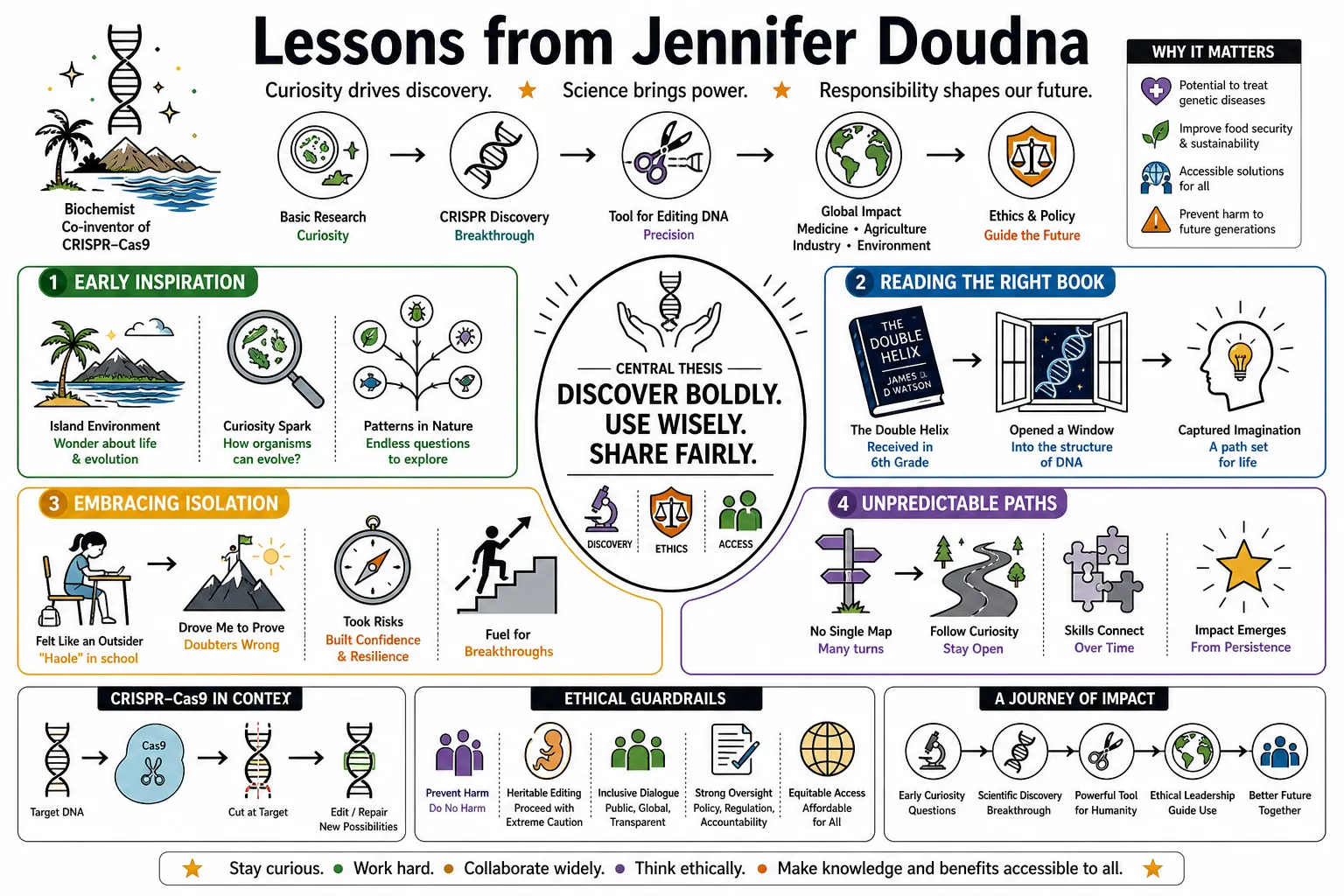
Part 1: The Foundations of Curiosity and Scientific Discovery
- On Early Inspiration: "When I think back on how I got interested in science and biology and chemistry, it really, I think, stems from growing up in that island environment and wondering about how organisms can evolve." — Source: [UC Berkeley]
- On Reading the Right Book: Receiving James Watson's The Double Helix in the sixth grade opened a window into the structure of DNA and permanently captured her imagination. — Source: [Yale News]
- On Embracing Isolation: "Growing up as a 'haole,' I felt really alone and isolated at school. This 'outsider' feeling drove me to take risks and prove doubters wrong." — Source: [NobelPrize.org]
- On Unpredictable Paths: The appeal of science lies in its unpredictability; you can never know in advance where a simple question or a routine experiment might lead. — Source: [NobelPrize.org]
- On the Nature of Discovery: "The more we know, the more we realise there is to know." — Source: [Daily Dose of Science]
- On Curiosity-Driven Research: "CRISPR really started with curiosity-driven, fundamental science," originating not from a desire to invent a product, but from a need to understand bacterial immunity. — Source: [Fred Hutch]
- On Basic Science: Pursuing research for the sake of understanding the natural world is crucial, as it often lays the unseen groundwork for transformative technologies. — Source: [Goodreads]
- On Creative Dot-Connecting: "Science is a creative process. It requires imagination, the ability to connect dots that maybe other people haven't connected before." — Source: [Gracious Quotes]
- On Endless Inquiry: "One of the exciting things about science is that every question answered leads to two new questions." — Source: [Gracious Quotes]
- On Human Nature: "Kids are natural scientists. They're curious about their world and, unless somebody squelches that, they're interested in the world that we inhabit." — Source: [AAMC]
Part 2: The Breakthrough: Reprogramming the Code of Life
- On the Origin of CRISPR: "Nature is the world's best inventor, and so we're finding ways to use what nature has discovered and turn it into a technology." — Source: [Gracious Quotes]
- On Reprogramming Biology: "What made this system truly revolutionary was the demonstration in 2012 that it could be reprogrammed with different pieces of guide RNA to edit virtually any genome in any species." — Source: [Quanta Magazine]
- On Collaborative Science: The CRISPR discovery brought together researchers from vastly different disciplines who joined forces to decode complex bacterial defenses. — Source: [NobelPrize.org]
- On Uncharted Horizons: Occasionally in research, a scientist realizes they are the very first person to look upon a horizon of completely untold possibility. — Source: [NobelPrize.org]
- On the Scale of the Tool: The precision and ease of CRISPR far surpassed any existing gene-editing tools, marking a permanent turning point in biological research. — Source: [Quanta Magazine]
- On the Code of Life: Humanity has entered a momentous era where we possess the capability to hack our own genetic code and directly edit our evolution. — Source: [Goodreads]
- On the Shift from Research to Application: "All of us realized that what had started as a fundamental research question was morphing into a very different kind of project" with enormous technical potential and risk. — Source: [AAMC]
- On the Inevitability of Progress: "The world around us is being revolutionized by CRISPR, whether we're ready for it or not." — Source: [Goodreads]
- On the Definition of Natural: Modern agriculture has already obscured the distinction between natural and unnatural, positioning gene editing as a continuation of human agricultural intervention. — Source: [Goodreads]
Part 3: The Weight of Responsibility and Ethics
- On Awesome Power: "The power to control our species' genetic future is awesome and terrifying. Deciding how to handle it may be the biggest challenge we have ever faced." — Source: [Goodreads]
- On Striking a Balance: "Weighing the dangers inherent in a technology like CRISPR against the responsibility to use its power for the benefit of humanity and our planet will be a test like no other." — Source: [Goodreads]
- On Uncomfortable Conversations: "All scientists, regardless of discipline, need to be prepared to confront the broadest consequences of our work—but we need to communicate its more detailed aspects as well." — Source: [Goodreads]
- On Recognizing Risks: "Like any new technology, CRISPR comes with risks. It was clear early on that there were going to be some real ethical challenges." — Source: [AAMC]
- On the Duty to Engage: "I have many science colleagues who don't want to get involved. Yet it has to be done." — Source: [Genetic Literacy Project]
- On Societal Readiness: "Just because we are not ready for scientific progress does not mean it won't happen." — Source: [Goodreads]
- On Public Distrust: "We must break down the walls that have previously kept science and the public apart and that have encouraged distrust and ignorance to spread unchecked." — Source: [Goodreads]
- On Defining Noble Uses: Determining which medical and agricultural applications of gene editing are ethical requires careful, ongoing consideration of competing societal arguments. — Source: [SuperSummary]
- On International Guidelines: There is an urgent, ongoing need for internationally recognized regulations to govern the use of gene editing across borders. — Source: [Global Observatory]
Part 4: The Threat and Reality of Germline Editing
- On the Inevitability of Human Editing: "I have no doubt, this technology will — someday, somewhere — be used to change the genome of our own species in ways that are heritable." — Source: [Goodreads]
- On the CRISPR Babies Incident: "I felt stunned and sickened. I knew it was a possibility that someone might cross what we thought was a clear ethical red line." — Source: [Issues in Science and Technology]
- On Crossing the Red Line: Applying CRISPR to human embryos against scientific consensus realized the exact fears the research community had tried to prevent. — Source: [Issues in Science and Technology]
- On the Dangers of Privatized Eugenics: "We have to be extraordinarily careful, even in handing over to private individuals, private citizens, the capacity to select their own genomes or the genomes of their children." — Source: [UC Berkeley]
- On Preserving Human Diversity: Privatized genetic selection is often driven by flawed ideas of genetic superiority, threatening to radically diminish essential human diversity. — Source: [UC Berkeley]
- On the Ethics of Enhancement: The capability to edit genes brings forth complex dilemmas about whether we should enhance human traits like intelligence or appearance rather than strictly curing disease. — Source: [TEPSA]
- On Evolutionary Indifference: "The evolutionary process cares little about what happens to an organism once it has reproduced and passed on its genes." — Source: [Goodreads]
- On the Future of the Species: We possess the unprecedented biological ability to not just edit living humans, but to dictate the DNA of all future generations. — Source: [SuperSummary]
- On Navigating the Brave New World: We must collectively decide how to handle the profound moral implications of directing our own biological destiny before the technology outpaces legislation. — Source: [TEPSA]
Part 5: Agriculture, Climate, and Planetary Health
- On Immediate Climate Threats: "In agriculture, the potential to address climate change... is not a possibility in the future anymore. It's here, it's now." — Source: [Innovative Genomics Institute]
- On Soil Microbes: Researchers are actively exploring how to use CRISPR to manipulate soil microbiomes, improving plants' natural ability to withstand severe climate stress. — Source: [Innovative Genomics Institute]
- On Agricultural Resilience: "To overcome the twin challenges of preserving and increasing food production while minimizing greenhouse gases, agriculture has a powerful set of tools in CRISPR." — Source: [The Western Producer]
- On Crop Adaptation: CRISPR is currently being deployed to enhance crop yields, drought tolerance, and pest resistance, which are vital adaptations for global food security. — Source: [The Western Producer]
- On Working with Nature: Biotechnology can be utilized to work in harmony with nature, helping plants adapt faster to hotter, drier, and more unpredictable environments. — Source: [Reddit]
- On the Coming Agricultural Revolution: "There is a coming revolution right now with CRISPR" that will fundamentally change how we grow and secure our food supply. — Source: [Genetic Literacy Project]
- On Historical Context: Humans have been altering the genetics of crops through crossbreeding for centuries; CRISPR simply offers a more exact method to continue this adaptation. — Source: [Goodreads]
- On Global Reach: Developing climate-resilient crops through genetic modification has the potential to create a near-term, positive impact on a truly global scale. — Source: [Innovative Genomics Institute]
- On Environmental Responsibility: The power of gene editing must be harnessed not just for human medicine, but for the direct benefit and preservation of our planet's fragile ecosystems. — Source: [Goodreads]
- On the Scope of the Technology: The most immediate and widespread applications of CRISPR may lie in environmental conservation and sustainable farming rather than human therapeutics. — Source: [The Western Producer]
Part 6: Equity, Access, and Commercialization
- On the Imperative of Access: "We have to be cognizant of how to be sure that everyone who can benefit from this technology has access to it. That's something I'm very deeply committed to." — Source: [AAMC]
- On Commercial Divides: While commercialization is necessary to bring therapies to market, it must not create a medical system where only the privileged can afford genetic cures. — Source: [Roland Berger]
- On Technological Practicality: True accessibility requires advancing the science so that therapies are cheaper to manufacture, easier to deliver into the body, and effective at lower doses. — Source: [Harvard University]
- On Decentralizing Treatment: The ultimate goal is to simplify gene therapies so they can be administered in diverse clinical settings, rather than just highly specialized urban teaching hospitals. — Source: [UC Berkeley]
- On the Commercial Gap: There is a significant divide between commercially viable products and broad public medical needs, requiring robust public-sector collaboration to bridge. — Source: [California State Government]
- On Serving Humanity: For CRISPR to truly fulfill its promise, the conversation surrounding its deployment must include diverse voices and prioritize global health equity. — Source: [AAMC]
- On Affordable Cures: The rapid progress of gene-editing therapies brings a realistic optimism that we can eventually provide affordable treatments for everyone who needs them. — Source: [Roland Berger]
- On the Ethics of Pricing: The moral responsibility of the scientific community extends beyond the initial discovery to actively advocating for fair pricing of life-saving treatments. — Source: [Harvard University]
- On Broad Deployment: Now that the technology is proven safe and effective for treating certain diseases, the primary focus must shift to deploying it as widely as possible. — Source: [UC Berkeley]
Part 7: Women in STEM and Breaking the Glass Ceiling
- On the Reality of the Glass Ceiling: "I’ve gotten to a point where I do now see signs of the glass ceiling. I don’t think it’s always intentional bias, but... I do experience bias against women in some settings." — Source: [KQED]
- On the Struggle for Recognition: "Among women and girls, there is sometimes a sense that no matter what they do, their work will not be recognized as it would be if they were men." — Source: [Tecnológico de Monterrey]
- On Leadership Barriers: "It’s very difficult for women to break into the top echelons of leadership in science... in the highest levels of public policy and the government, as well as in company board rooms." — Source: [KQED]
- On Defying Expectations: "When someone tells me I can’t do something and I know that I can, it just makes me more resolved to do it." — Source: [Women in Medicine Legacy Foundation]
- On the Importance of Representation: Seeing a female biochemist from the University of Hawaii speak during high school was the exact moment science felt like a viable career option. — Source: [Women in Medicine Legacy Foundation]
- On Visualizing Success: "Sometimes you need to see that something is possible to really believe you can do it yourself." — Source: [Women in Medicine Legacy Foundation]
- On the Value of Diversity: The most innovative scientific outcomes reliably occur when individuals with diverse cultural and educational backgrounds converge to solve a problem. — Source: [AAMC]
- On Ignoring the Noise: Early in her career, she deliberately chose not to focus on her gender, opting instead to pour all her energy into her passion for laboratory research. — Source: [KQED]
- On Structural Barriers: As women advance into senior research and leadership roles, they face a systemic attrition pipeline that the scientific establishment must actively dismantle. — Source: [Cronicle Press]
Part 8: Philosophy, Resilience, and the Future
- On Going For It: "I honestly think the most important advice is to go for it. That means to embrace your interests, your passions, and really give it your all." — Source: [NobelPrize.org]
- On the Danger of Dabbling: True success requires full commitment; those who merely dabble in a subject rarely give themselves a genuine opportunity to excel. — Source: [NobelPrize.org]
- On Dealing with Failure: "We all have fears, but sometimes you try something and there is failure... Each of us has to find our own way to deal with that." — Source: [NobelPrize.org]
- On Frustration in Research: "Doing research is a lot about dealing with frustrations and failures. It's really part of being [a scientist]." — Source: [NobelPrize.org]
- On Scientific Integrity: Amidst the noise of commercialization and intense public debate, a researcher must remain grounded and true to who they are as a fundamental scientist. — Source: [The Guardian]
- On the Changing Nature of Research: "Ten years ago, I was in a very different place. I was a biochemist doing curiosity-driven research... But I had to grapple with the fact that CRISPR was different." — Source: [TIME]
- On the Excitement of the Era: "It's an extraordinary time to be getting into science. I'm really excited to see what you discover." — Source: [AAMC]
- On Continuous Learning: "If you're a curious person, science is a great field because you're always learning something new." — Source: [Gracious Quotes]
- On the Future of Medicine: The recent clinical approvals of CRISPR-based treatments for diseases like sickle cell are merely the beginning of a much larger narrative for medicine. — Source: [Substack]
- On the Unfinished Journey: "We’re in an era of programmable genome editing... and we need to continue to advance the technology so that it can be deployed more widely." — Source: [UC Berkeley]