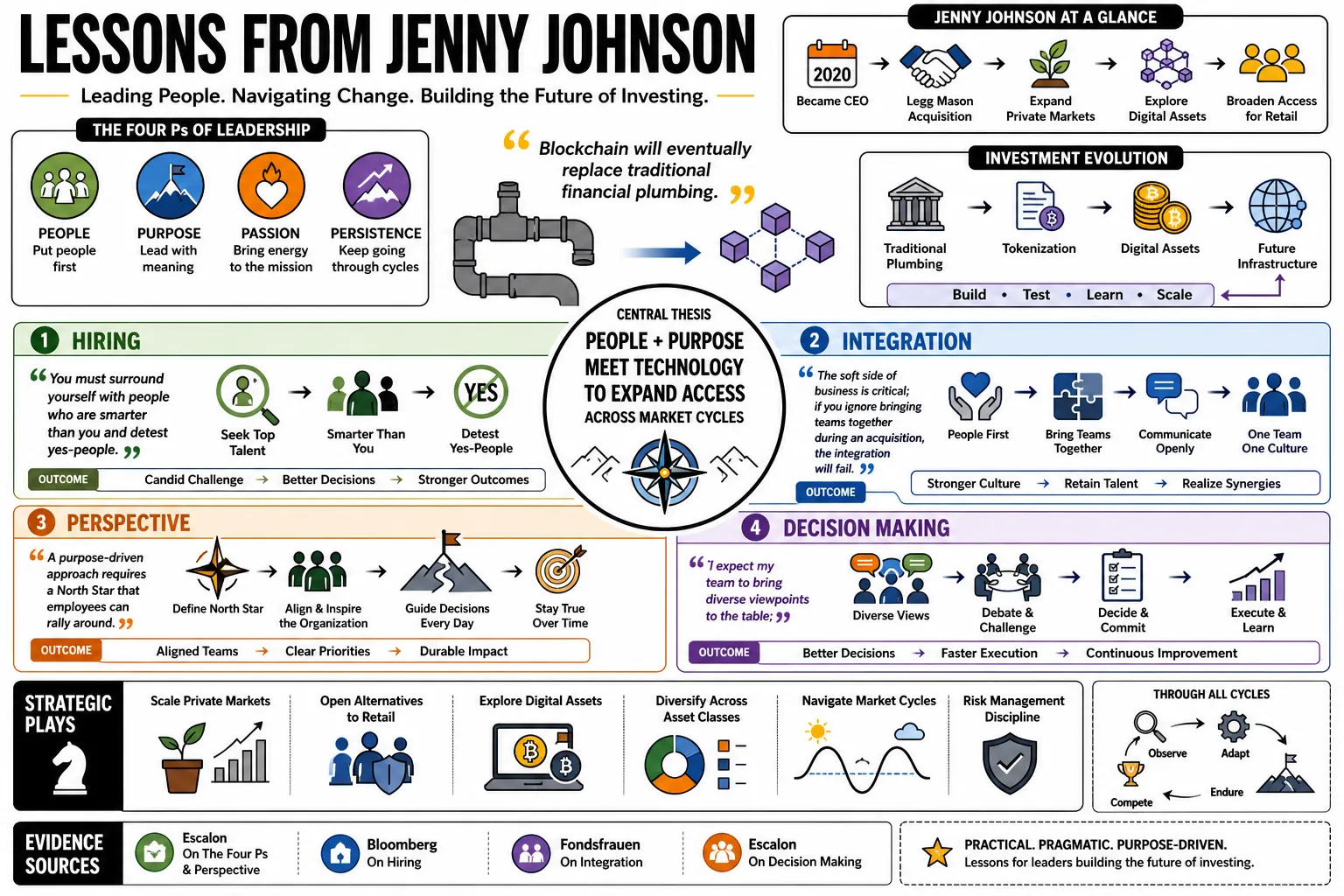
Jenny Johnson has served as the CEO of Franklin Templeton since 2020, guiding the asset manager through major acquisitions like Legg Mason and steering its expansion into private markets and digital assets. She is known for her pragmatic stance that blockchain will eventually replace traditional financial plumbing, as well as her push to give retail investors access to institutional-grade alternatives. This collection organizes her practical perspectives on navigating corporate hierarchies, adapting to technological shifts, and managing asset portfolios across market cycles.
Part 1: Leadership & Management
- On The Four Ps: "Leadership begins with people, purpose, passion, and persistence." — Source: Escalon
- On Hiring: "You must surround yourself with people who are smarter than you and detest yes-people." — Source: Bloomberg
- On Integration: "The soft side of business is critical; if you ignore bringing teams together during an acquisition, the integration will fail." — Source: Fondsfrauen
- On Perspective: "A purpose-driven approach requires a North Star that employees can rally around." — Source: Escalon
- On Decision Making: "I expect my team to bring diverse viewpoints to the table; consensus without debate is dangerous." — Source: Bloomberg
- On M&A Culture: "In major acquisitions like Legg Mason, preserving the unique investment cultures of the acquired boutiques matters more than forcing operational uniformity." — Source: Colossus
- On Trust: "You have to invest time in building trust among newly merged teams, otherwise the underlying mechanics of the business will break down." — Source: Fondsfrauen
- On Listening: "The best leaders are students of life who listen more than they speak." — Source: Carson Group
- On Change Management: "Start-ups adapt faster than incumbents because large organizations struggle fundamentally with change management." — Source: Oman Observer
- On Autonomy: "You hire smart people so they can tell you what to do, not the other way around." — Source: Bloomberg
Part 2: Career & Professional Growth
- On Working Your Way Up: "I joined Franklin Templeton in 1988 and held roles across distribution, technology, and operations before ever reaching the executive level." — Source: Bloomberg
- On Mentorship: "My father encouraged me to think about the future in a way that defied the traditional gendered expectations of the time." — Source: Bloomberg
- On Curiosity: "Being a student of life means constantly finding mentors who will pull you into complex conversations." — Source: Carson Group
- On Career Mobility: "Gaining experience in operations and technology is mandatory if you want to understand how a modern financial firm actually functions." — Source: Bloomberg
- On Finding Advocates: "You need to find sponsors who will actively advocate for you in rooms where you are not present." — Source: Carson Group
- On Family Legacy: "Growing up in a founder's family means you have to work twice as hard to prove your competence to the broader team." — Source: CNBC
- On Discomfort: "Growth happens when you take roles that force you to learn the mechanics of parts of the business you previously ignored." — Source: Colossus
- On Early Lessons: "Understanding the back-office plumbing of asset management early in my career gave me the confidence to drive digital transformation later." — Source: Bloomberg
- On Persistence: "The path to leadership is rarely a straight line; it requires an active willingness to solve whatever problem is put in front of you." — Source: Fondsfrauen
Part 3: Diversity & Women in Finance
- On Visibility: "If you can see it, you can be it. We need visible role models so the future of finance doesn't look like its past." — Source: Carson Group
- On The Default Experience: "People ask me what it's like to be a woman in finance. Well, the problem is I don't know what it's like not to be one." — Source: Bloomberg
- On Implicit Bias: "I once had my work credited to a male subordinate in a meeting, which taught me exactly why allies are mandatory." — Source: Carson Group
- On Encouragement: "I tell everyone: encourage your daughters, your sisters, and your wives to enter finance, and they will." — Source: Bloomberg
- On Better Outcomes: "I am passionate about attracting women to this industry simply because diverse teams produce better financial outcomes." — Source: Financial Content
- On Sponsorship vs. Mentorship: "Mentors offer advice, but sponsors spend their political capital to advance your career." — Source: Carson Group
- On Structural Barriers: "We have to intentionally build career off-ramps and on-ramps so women don't have to permanently exit the industry to raise families." — Source: American Banker
- On The Pipeline: "Fixing the gender imbalance requires us to go into high schools and colleges to change how the finance industry is perceived." — Source: Financial Times
- On Speaking Up: "Women often wait until they are fully qualified to ask for a promotion; we need to teach them to raise their hands earlier." — Source: Fondsfrauen
Part 4: Artificial Intelligence & Technology
- On Job Displacement Fears: "Every time a new technology emerges, people fear massive unemployment. But in the end, we still need humans." — Source: Fondsfrauen
- On Embracing AI: "Don't be afraid of AI—use it. Experiment with generative tools to understand how they can augment your daily workflows." — Source: Fondsfrauen
- On Technological Scale: "SpaceX reflects the greatest technological change of my lifetime in terms of execution and ambition." — Source: CNBC
- On Internal Disruption: "We launched our Intelligence Hub internally because asset managers must adopt AI for distribution and operational efficiency to survive." — Source: Seeking Alpha
- On Enterprise Software Risk: "AI will aggressively disrupt traditional enterprise software companies that fail to rewrite their codebases for machine learning." — Source: Financial Times
- On Data Foundations: "You cannot implement effective AI if your underlying corporate data is messy; organizing data is the mandatory first step." — Source: Advanced People Strategies
- On Market Concentration: "AI is acting as a massive thematic driver for market performance, concentrating returns in a few foundational tech companies." — Source: Bloomberg
- On Productivity: "The immediate benefit of generative AI is making our developers and analysts significantly more efficient at routine tasks." — Source: Colossus
- On Future Tools: "Once you put these new technological tools into people's hands, they invent solutions to problems we didn't even know we had." — Source: American Banker
- On Legacy Tech: "Incumbents carry technical debt that makes it hard to pivot, which is why we must aggressively invest in technology before it becomes obsolete." — Source: Oman Observer
Part 5: Blockchain & Digital Assets
- On The Dot-Com Parallel: "The crypto world is like the dot-com era; some of the biggest companies of the next decade will emerge from it, while a lot of noise will fade away." — Source: Traders Union
- On Plumbing Efficiency: "Blockchain is an incredibly efficient technology that will eventually replace the legacy plumbing of traditional financial systems." — Source: Traders Union
- On Intermediaries: "Blockchain poses a fundamental threat to the high-fee business models of traditional finance that rely entirely on extracting rent as intermediaries." — Source: Bitcoin Magazine
- On Tokenized Funds: "We launched the Benji tokenized money market fund on the Stellar blockchain to prove that natively on-chain assets are cheaper to administer." — Source: Stellar
- On Bitcoin as a Hedge: "In many parts of the world, Bitcoin serves as a legitimate sovereignty hedge against unstable fiat currencies." — Source: Joe Technologist
- On Institutional Custody: Johnson argues that self-custody does not eliminate the role of trusted institutions: as wealth moves on-chain, most investors and enterprises will still want regulated custodians and low-cost compliance rails. — Reference: CoinDesk report on Johnson, regulated custody, and blockchain compliance rails
- On Future Portfolios: "All ETFs and mutual funds will eventually be built and traded on distributed ledger technology." — Source: Binance
- On Digital Scarcity: "The underlying innovation of crypto is the ability to prove digital scarcity and ownership without a central clearinghouse." — Source: Colossus
- On Regulatory Clarity: "We need clear rules of the road from regulators so institutions can safely build the next generation of financial infrastructure." — Source: CNBC
- On Tokenizing Real Assets: "The real promise of blockchain is tokenizing private markets, real estate, and art to fractionalize ownership for retail investors." — Source: Disruption Banking
Part 6: The Future of Asset Management & ETFs
- On Active vs. Passive: "The debate shouldn't be active versus passive; it is about offering a platform that gives clients the exact exposure they need at the right price." — Source: Franklin Templeton
- On ETF Expansion: "ETFs are a critical delivery mechanism, and we have deliberately expanded our active ETF lineup to meet modern advisor demands." — Source: Franklin Templeton
- On Spot Bitcoin ETFs: "Our entry into the spot Bitcoin ETF market was driven by institutional demand for a regulated, familiar wrapper for digital assets." — Source: CNBC
- On Industry Consolidation: "Scale matters more than ever; asset managers without a massive distribution footprint or deep specialized expertise will struggle to survive." — Source: Bloomberg
- On Personalization: "The future of asset management is mass customization, where technology allows us to build bespoke portfolios for retail accounts at scale." — Source: Colossus
- On Fee Compression: "Technology must be used to drive down internal costs because fee compression across mutual funds and ETFs is a permanent reality." — Source: Financial Times
- On Advisor Education: "Our job is no longer just selling funds; it is educating financial advisors on how to construct complex portfolios across public and private markets." — Source: American Banker
- On Global Reach: "You cannot be a global asset manager without having distinct, localized investment teams operating directly in emerging markets." — Source: Bloomberg
- On Access: "The ultimate goal of all these new vehicle structures is to open access to asset classes previously reserved for large endowments." — Source: Colossus
Part 7: Crisis Management & Resilience
- On Tough Chapters: "During the toughest moments, I would wake up in the morning and find myself literally in the fetal position. You just have to put one foot in front of the other." — Source: CNBC
- On Solving Problems: "Don't let the macro environment paralyze you; just solve the daily operational problems as they arrive." — Source: Fondsfrauen
- On Market Volatility: "We manage money for decades, not quarters. Panicking during a cyclical downturn violates the core premise of being a fiduciary." — Source: Bloomberg
- On Regulatory Pressure: "Operating a global financial firm means accepting that regulatory friction is a constant; you have to build compliance into your culture, not treat it as an afterthought." — Source: Colossus
- On Board Relations: "Transparency during a crisis is non-negotiable. The worst thing a CEO can do is surprise their board with bad news late in the game." — Source: Bloomberg
- On Maintaining Focus: "When the media focuses on short-term outflows, my job is to keep the investment teams focused strictly on their five-year horizons." — Source: CNBC
- On Adaptation: "Resilience is about using a crisis as air cover to make structural changes you couldn't easily make during a bull market." — Source: American Banker
- On Empathy During Layoffs: "If you have to restructure, do it swiftly, but do it with deep empathy and generous support for the people leaving." — Source: Bloomberg
- On Endurance: "The financial industry is cyclical. If you stay in it long enough, you realize that every unprecedented crisis eventually becomes a historical footnote." — Source: Carson Group
Part 8: Private Markets & Investment Strategy
- On Private Credit: "As banks retreat from lending due to capital requirements, private credit has stepped in to fill a massive structural void in the economy." — Source: CNBC
- On Retail Access: "Retail investors deserve access to the illiquidity premium that institutional endowments have used to generate outsized returns for decades." — Source: Colossus
- On The IPO Drought: "Companies are staying private for much longer, which means a significant portion of wealth creation now happens entirely outside the public markets." — Source: Bloomberg
- On Secondary Markets: Johnson treats secondary private equity as part of Franklin Templeton's private-markets expansion: she told EL PAIS that acquisitions such as Lexington Partners let the firm play in secondary private equity, while suitability still matters as private markets broaden. — Reference: EL PAIS interview with Johnson on Franklin Templeton acquisitions and secondary private equity
- On India's Opportunity: "India represents one of the most compelling long-term macro growth stories, driven by demographics, digitalization, and infrastructure investment." — Source: FT Institutional
- On Real Estate: "Commercial real estate is undergoing a painful repricing, but dislocation creates the best entry points for patient capital." — Source: CNBC
- On Diversification: "The 60/40 portfolio isn't dead, but it needs to be supplemented with alternatives to protect against correlated drawdowns in equities and fixed income." — Source: Franklin Templeton
- On Due Diligence: "Investing in private markets requires a fundamentally different, much deeper level of operational due diligence than buying public equities." — Source: Colossus
- On Long-Term Thinking: "You cannot invest in private assets if you are worried about next month's liquidity needs; it requires a genuine commitment to lock up capital for growth." — Source: Bloomberg