Lessons from Jerry Jones
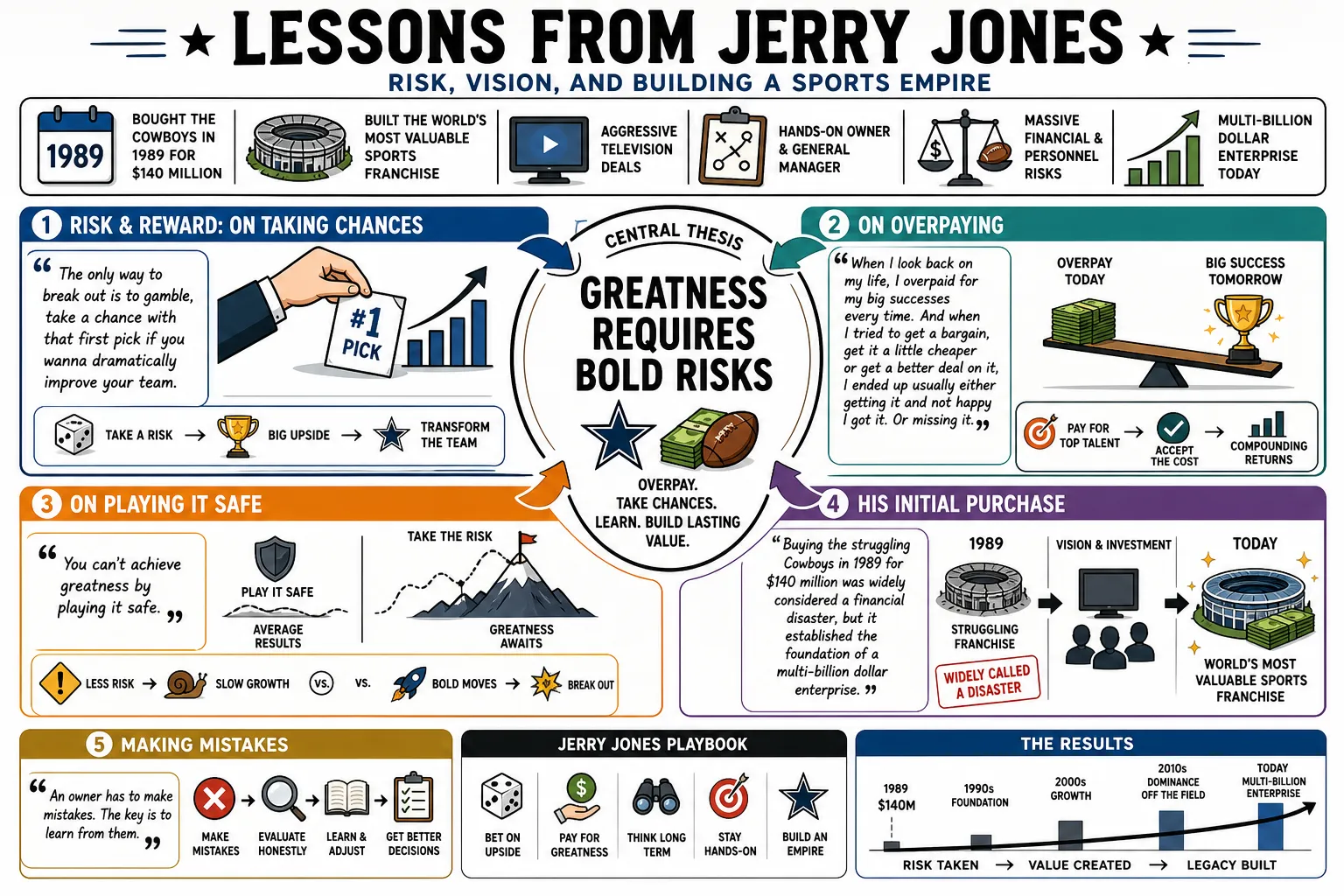
Jerry Jones bought the Dallas Cowboys in 1989 for $140 million and built the team into the world's most valuable sports franchise. As a notoriously hands-on owner and general manager, he built his reputation on aggressive television deals and an appetite for massive financial and personnel risks. This collection details his specific approach to roster management and the everyday business of running a modern sports empire.
Part 1: Risk and Reward
- On Taking Chances: "The only way to break out is to gamble, take a chance with that first pick if you wanna dramatically improve your team." — Source: [Medium]
- On Overpaying: "When I look back on my life, I overpaid for my big successes every time. And when I tried to get a bargain, get it a little cheaper or get a better deal on it, I ended up usually either getting it and not happy I got it. Or missing it." — Source: [Medium]
- On Playing it Safe: "You can't achieve greatness by playing it safe." — Source: [Bookey]
- On His Initial Purchase: "Buying the struggling Cowboys in 1989 for $140 million was widely considered a financial disaster, but it established the foundation of a multi-billion dollar enterprise." — Source: [CBS News]
- On Making Mistakes: "Any pick you make, or any player you sign, something can go wrong." — Source: [Medium]
- On Early Failure: "A first attempt to open a chain of pizza restaurants failed, teaching early lessons about capital and market timing before moving into the oil business." — Source: [SI]
- On Trusting Intuition: "I have never had a problem dealing in areas of ambiguity. I can make a decision and not have it all lined up just right." — Source: [QuoteFancy]
- On High Stakes: "The pressure of independent oil drilling in the 1970s shaped a lasting tolerance for massive financial risks." — Source: [SI]
- On Fear of Missing Out: "Missing an opportunity is often worse than paying a premium to secure a transformative asset." — Source: [Medium]
- On Calculated Gambles: "A wildcatter mindset requires drilling where others will not, a philosophy carried from the oil fields of Arkansas to the NFL draft room." — Source: [SI]
Part 2: Team Management and Roster Building
- On His Dual Role: "There's nobody living that's out cutting and shooting that can't give you a bunch of times they busted their a--. So hell no, there's nobody that could f---ing come in here and do all the contracts and be a GM any better than I can." — Source: [Fox Sports]
- On Accountability: "Plus, I'm where the buck stops. When it f---s up, I got to cover it. There's nobody else that can do it." — Source: [Fox Sports]
- On Developing Youth: "The positive of losing a player is that a young player, usually your depth, is going to get some reps, a player that can get better for the future." — Source: [SI]
- On Draft Strategy: "Focusing solely on immediate needs can cause a team to pass on generational talent that requires a longer view." — Source: [Medium]
- On Roster Trades: "Sacrificing a star player to acquire a massive haul of draft capital remains one of the defining roster moves in league history." — Source: [CBS News]
- On Roster Depth: "A team is only as resilient as its ability to weather injuries and plug untested talent into starting roles." — Source: [SI]
- On Player Evaluation: "I always start there. When you work for yourself, you have to evaluate and you have to change what you're doing. You don't fire yourself. That's an impossibility. You look at what you can do better & you go do it." — Source: [Reddit]
- On Star Power: "If we had picked Manziel, he'd guarantee our relevance for 10 years." — Source: [Cowboys Zone]
- On Changing Coaches: "The immediate firing of Tom Landry upon buying the team was widely criticized, yet it paved the way for three rapid championship victories." — Source: [CBS News]
- On Roster Chemistry: "Balancing high-profile stars with foundational role players is a continuous, year-round challenge." — Source: [SI]
Part 3: Leadership and Authority
- On Sharing Credit: "If you're willing to give others the credit, you can conquer the world." — Source: [Reddit]
- On Duty: "I promise you that during my life, I was more concerned about not letting people down, about doing my part, than I was ever into what it did for me." — Source: [Medium]
- On Collaborative Debate: "He actively encourages multiple perspectives from an inner circle while challenging staff to defend their positions." — Source: [Sports Business Journal]
- On Persistence from Staff: "Changing his mind requires repetition; staff members describe the process as planting a seed and watering it time and again to see if it grows." — Source: [Sports Business Journal]
- On Facing Criticism: "A leader must be willing to absorb public backlash to protect the internal operations of the organization." — Source: [Fox Sports]
- On Self-Correction: "When things go wrong, the owner must be the first to evaluate their own processes before blaming subordinates." — Source: [Reddit]
- On Final Say: "Having a single ultimate decision-maker prevents organizational paralysis during high-pressure draft moments." — Source: [Fox Sports]
- On Hard Work: "You look at anything I've been a part of, it's when the laboring, the fatigue, when some of those things happen, that's what shows what you're going to be." — Source: [Medium]
- On Early Responsibility: "Working as a greeter at his father's grocery store at age nine instilled an early understanding of customer relations and accountability." — Source: [SI]
Part 4: Business and Growth
- On Giving the Market What It Wants: "When the ducks quack, feed them." — Source: [AS]
- On Franchise Identity: "Tex Schramm immediately straightened me out. He said, 'Let Houston be the checkered tablecloth and the sawdust floor. The Dallas Cowboys are glitz and glamour. We're about beautiful.'" — Source: [CBS News]
- On Revenue Diversification: "He altered the league's financial structure by aggressively pursuing independent local sponsorship deals." — Source: [Janek]
- On Stadium Economics: "Building AT&T Stadium was a gamble that changed how modern sports venues generate income outside of game days." — Source: [Sports Business Journal]
- On Media Rights: "He understood early on that television broadcasting rights were the true engine of sports franchise valuations." — Source: [AS]
- On The Value of the Brand: "The star logo is an asset that requires constant promotion and protection to maintain global relevance." — Source: [CBS News]
- On Expanding the Schedule: "He advocated for more games and larger playoffs because he recognized the consumer demand for football content." — Source: [AS]
- On Investing in Infrastructure: "A premier training facility is not just for practice; it serves as a corporate headquarters and a secondary revenue generator." — Source: [Sports Business Journal]
- On Financial Independence: "Controlling the team's local marketing rights allowed the Cowboys to become the most valuable sports property on earth." — Source: [Janek]
Part 5: Salesmanship and Media
- On Generating Buzz: "The Dallas Cowboys are a soap opera 365 days a year. When it gets slow, I stir it up. There is controversy. That controversy is good stuff in terms of keeping and having people's attention." — Source: [SI]
- On Media Availability: "He makes himself constantly available to reporters because he views every interview as a free commercial for his brand." — Source: [SI]
- On Staying Relevant: "Keeping the team in the daily news cycle is a specific business strategy to maintain high valuations." — Source: [Cowboys Zone]
- On The Glory Days: "He expressed a desire for the franchise to return to the 'glory hole', turning a standard press conference into a viral marketing moment." — Source: [CBS News]
- On Emotional Selling: "Selling a vision requires connecting with the emotional aspirations of the fanbase rather than just stating the facts." — Source: [Janek]
- On Owning the Narrative: "If the organization fails to feed the press a storyline, the press will invent one, so it is better to control the noise." — Source: [SI]
- On Prime Time: "The Cowboys are built to be the center of attention and are expected to thrive under the scrutiny of national television." — Source: [CBS News]
- On Polarizing Figures: "A player who divides public opinion often generates more interest and merchandise sales than a quietly competent one." — Source: [Cowboys Zone]
- On Spectacle: "Football is an entertainment product that competes with every other form of media for consumer time." — Source: [AS]
Part 6: Dealing with Ambiguity and Failure
- On Navigating Uncertainty: "I have never had a problem dealing in areas of ambiguity. I can make a decision and not have it all lined up just right." — Source: [QuoteFancy]
- On Meaningless Metrics: "Stats are for losers. They relish in them." — Source: [Medium]
- On The Bottom Line: "The stat is the score. And when you don't win that score..." — Source: [Medium]
- On Moving On: "You cannot fire yourself when you own the company, so the only option is to honestly assess failures and adapt." — Source: [Reddit]
- On Drafting Busts: "Every decision carries the risk of failure; dwelling on a bad pick prevents a manager from making the next necessary gamble." — Source: [Medium]
- On Ignoring Critics: "Financial advisors told him buying the Cowboys in 1989 was a terrible idea, teaching him to trust his own math over conventional wisdom." — Source: [CBS News]
- On Institutional Friction: "Internal debates and friction are features of a functional decision-making process." — Source: [Sports Business Journal]
- On The Pressure to Win: "Sustained losing forces an organization to examine its fundamental processes rather than just tweaking surface-level issues." — Source: [SI]
- On Rapid Change: "Overhauling a failing system requires a willingness to endure intense short-term hatred for long-term viability." — Source: [CBS News]
Part 7: Motivation and Perseverance
- On Defining Character: "You look at anything I've been a part of, it's when the laboring, the fatigue, when some of those things happen, that's what shows what you're going to be." — Source: [Medium]
- On The Desire to Win: "I've never wanted anything as much as I want to win the next Super Bowl." — Source: [Medium]
- On Pushing Through: "Fatigue makes cowards of everyone, so outworking the competition in the final hours of negotiation is a core requirement." — Source: [Janek]
- On Financial Motivation: "His early wildcatting days taught him that the fear of ruin is a powerful motivator for meticulous preparation." — Source: [SI]
- On Meeting Obligations: "I promise you that during my life, I was more concerned about not letting people down, about doing my part, than I was ever into what it did for me." — Source: [Medium]
- On Relentless Pursuit: "A single failure in the oil business or the draft room just means the next attempt needs better capitalization and intelligence." — Source: [SI]
- On Competitive Stamina: "Maintaining energy through a decades-long career requires a genuine love for the operational grind of the sport." — Source: [Fox Sports]
- On Overcoming Deficits: "When the Cowboys were losing a million dollars a month in 1989, the only way out was aggressive restructuring and bold trades." — Source: [CBS News]
- On Embracing the Grind: "True leadership is revealed not when a team is winning, but during the brutal stretches of a losing season." — Source: [Medium]
- On Generational Drive: "He credits his work ethic to his father, who instilled a sense of retail discipline in him from early childhood." — Source: [SI]
Part 8: Life and Legacy
- On Family Milestones: "I think my greatest moments in life are family moments, births and marriages." — Source: [Medium]
- On The Ultimate Goal: "The pursuit of another championship drives every major financial and personnel decision in his later years." — Source: [Medium]
- On League Economics: "He views his legacy as tied to the modern financial structure of the entire league, not just the Dallas Cowboys." — Source: [Sports Business Journal]
- On Aging: "The urgency to win increases as time passes, altering how risk is calculated in draft picks and free agency." — Source: [Medium]
- On College Glory: "Winning a national championship as a co-captain at Arkansas in 1964 laid the foundational expectation for elite teamwork." — Source: [SI]
- On Generational Wealth: "He built a family enterprise that ensures his children and grandchildren remain central to the operation of the franchise." — Source: [CBS News]
- On Remembering Roots: "Despite his billionaire status, he frequently references his early days working at his father's grocery store in Arkansas." — Source: [SI]
- On Regrets: "The inability to replicate the dynasty of the 1990s remains a central frustration that fuels his continued involvement as general manager." — Source: [Fox Sports]
- On Leaving a Mark: "He wants to be remembered as someone who never played it safe and always pushed the boundaries of what a sports franchise could be." — Source: [Bookey]