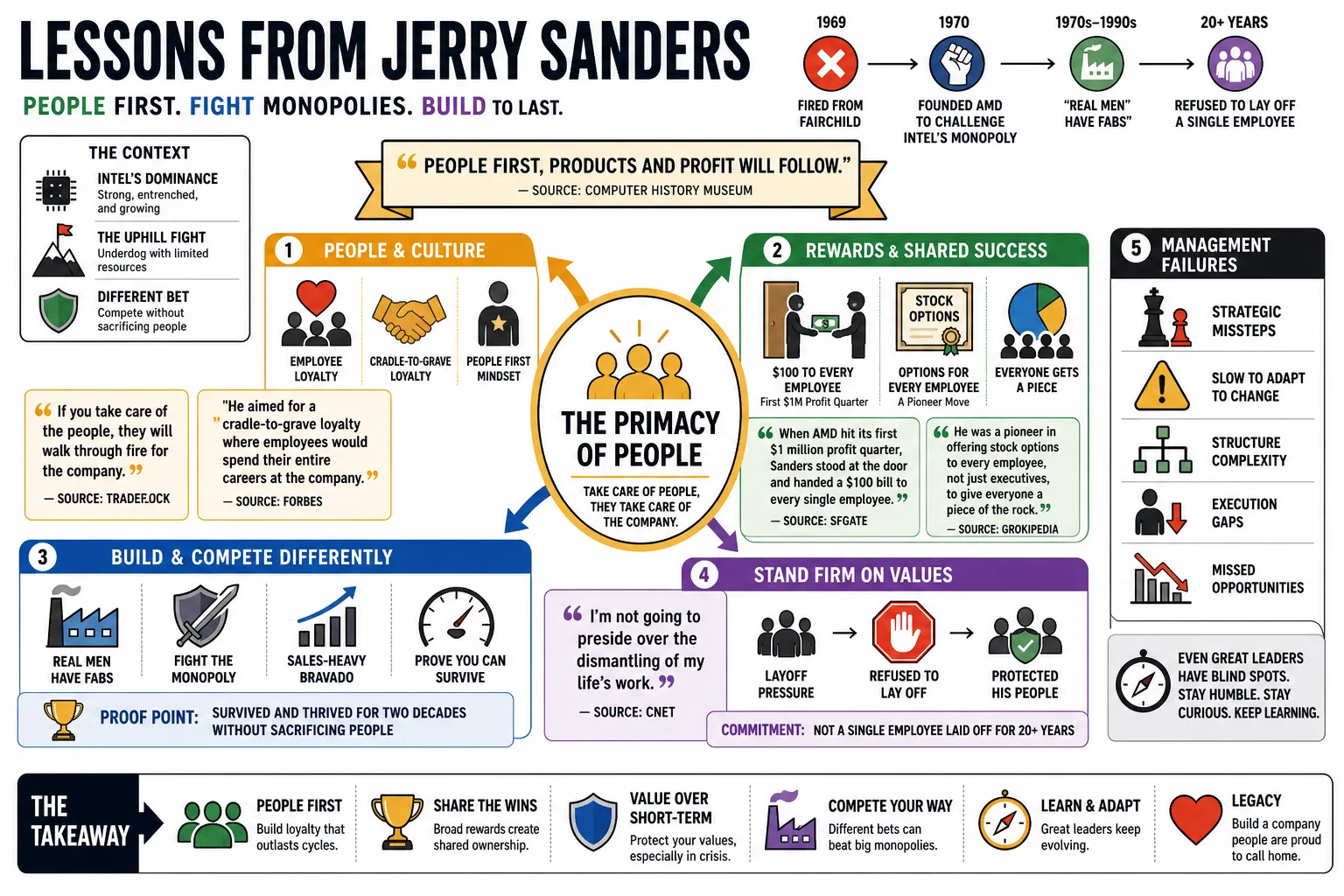
Lessons from Jerry Sanders
After being fired from Fairchild in 1969, Jerry Sanders spent two decades fighting Intel’s monopoly while famously refusing to lay off a single employee. He led AMD with a sales-heavy bravado and a "real men have fabs" philosophy that proved you could survive in semiconductors without sacrificing your people.
Part 1: The Primacy of People
- On Corporate Priorities: "People first, products and profit will follow." — Source: Computer History Museum
- On Employee Loyalty: "If you take care of the people, they will walk through fire for the company." — Source: TradeFlock
- On Shared Rewards: "When AMD hit its first $1 million profit quarter, Sanders stood at the door and handed a $100 bill to every single employee." — Source: SFGate
- On Layoff Resistance: "I'm not going to preside over the dismantling of my life's work." — Source: CNET
- On Life-Long Employment: "He aimed for a cradle-to-grave loyalty where employees would spend their entire careers at the company." — Source: Forbes
- On Management Failures: "Sanders viewed layoffs not as a necessary evil but as a fundamental failure of management to plan correctly." — Source: Semiconductor Engineering
- On The $1,000-a-Month Contest: "In 1980, he held a drawing where a production worker won $1,000 a month for 20 years to celebrate a sales milestone." — Source: CNET
- On Personal Connection: "He cultivated deep relationships with staff, often knowing production workers by name during the early years." — Source: Organizational Physics
- On Corporate Culture as a Shield: "A strong culture can sustain a workforce through economic downturns that kill competitors." — Source: IndustryWeek
Part 2: The Art of the Salesman
- On Technical Charisma: "Engineering with charisma is the only way an underdog can attract talent away from giants." — Source: Forbes
- On Marketing-Led Innovation: "Unlike the engineering-centric Intel, AMD was built as a marketing-led organization where sales defined the roadmap." — Source: Times Online
- On Visionary Communication: "Vision needs a voice; you should never mumble your goals to your employees or investors." — Source: TradeFlock
- On The Salesman Persona: "I was a salesman with an engineering degree, which made me the most dangerous person in the room." — Source: Computer History Museum
- On Using Image as a Tool: "He wore tailored suits and drove expensive cars to project an image of success even when the company was struggling." — Source: SFGate
- On The Power of Narrative: "Sanders didn't just sell chips; he sold the story of the scrappy fighter taking on a monopoly." — Source: Medium
- On Customer-Centricity: "Customers should come first at every stage of a company's activities." — Source: St. John's University
- On Recruiting Smarter People: "You must hire people smarter than yourself and then give them the stage to perform." — Source: Computerworld
- On The "Illinois Jerry" Character: "He appeared at meetings as an Indiana Jones-style character to keep the sales force motivated and entertained." — Source: CNET
- On Emotional Branding: "In a technical industry, the ability to build emotional relationships is often the difference between success and failure." — Source: IndustryWeek
Part 3: The Competitive Fire
- On The Intel Rivalry: "It is a fight between an 800-pound gorilla and a virtual gorilla." — Source: CNET
- On Monopolistic Pricing: "In the absence of open competition, consumers will pay a monopolistic tax." — Source: Microprocessor Forum 1997
- On AMD's Purpose: "AMD is here to cut the consumer's taxes." — Source: CNET
- On competitive drive: "Yea, though I walk through the valley of the shadow of death, I shall fear no evil -- for I am the meanest son of a bitch in the valley." — Source: SFGate profile of Jerry Sanders
- On Never Surrendering: "I can't walk away from a fight until the fight is won." — Source: SFGate
- On Ambition: "Competition is not a threat; it is an ambition." — Source: Forbes
- On The David and Goliath Dynamic: "He leaned into the underdog status to foster a 'us against the world' mentality inside AMD." — Source: Wikipedia
- On Industry Health: "The industry needs a strong number two to keep the number one honest." — Source: Computerworld
- On Market Parity: "He prioritized technological survival and market parity over incremental quarterly growth." — Source: LA Times
- On The Fighter Identity: "I am a fighter, and I have spent my life fighting for the right to exist in this market." — Source: Forbes
Part 4: Manufacturing and Ownership
- On Controlling Destiny: "Real men have fabs." — Source: Medium
- On Vertical Integration: "Owning your own fab is expensive and dangerous, but it is the only way to ensure your own quality." — Source: Semiconductor Engineering
- On The Pet Shark Analogy: "Owning a fab is like keeping a pet shark: it’s a symbol of machismo that requires constant feeding." — Source: CNET
- On Manufacturing as Competence: "He believed that a semiconductor company that doesn't manufacture its own chips isn't a real company." — Source: EE Times
- On Capital Investment: "Sanders was willing to steer the company into deep debt to build the next generation of fabrication plants." — Source: LA Times
- On Technological Autonomy: "If you don't own the means of production, you are at the mercy of your competitors' schedules." — Source: Computer History Museum
- On The Machismo of Machines: "He viewed the massive, billion-dollar factories as the physical manifestation of AMD's power." — Source: Forbes
- On Resisting Outsourcing: "Sanders fought against the fabless model for decades, viewing it as a surrender of core engineering value." — Source: PC Mag
Part 5: Strategy for the Underdog
- On The x86 License: "The 1982 cross-licensing deal with Intel was the lifeblood that allowed AMD to exist for the next 40 years." — Source: Wikipedia
- On The Sword of Damocles: "He lived for years with the constant fear that Intel would successfully revoke AMD's license in court." — Source: Forbes
- On Strategic Alliances: "He positioned AMD as the necessary 'second source' for IBM to force Intel into a licensing agreement." — Source: Semiconductor Engineering
- On The Asparagus Analogy: "High-margin products are like asparagus; you have to invest for years before you can harvest the profits." — Source: Computer History Museum
- On The NexGen Bet: "He told employees he had 'bet AMD's whole future' on the acquisition of the NexGen design team." — Source: Reddit /r/AMD
- On Legal Strategy: "Sanders used litigation as a defensive shield to buy time for his engineers to catch up technologically." — Source: SFGate
- On The Athlon Breakthrough: "He pushed for the Athlon processor to beat Intel to the 1GHz milestone, a major symbolic victory." — Source: CNET
- On Betting the Company: "In the chip business, if you aren't willing to bet the company every five years, you're already dead." — Source: IndustryWeek
- On Market Timing: "It smells like 1984; the industry is about to enter a spiral that only the prepared will survive." — Source: St. John's University
- On Second-Sourcing: "AMD started by making better versions of other companies' chips before it could afford to design its own." — Source: Academic Kids
Part 6: Resilience and the Hard Way
- On Personal Survival: "I can die, but I can't fail." — Source: Organizational Physics
- On The Teenage Beating: "Leaving me for dead in a garbage can was the best lesson I ever had in self-reliance." — Source: SFGate
- On Facing Death: "I spent three days in a coma and received last rites; after that, Intel didn't seem so scary." — Source: Organizational Physics
- On The Fairchild Firing: "My whole life has been about treating people fairly, and I wasn't treated fairly at Fairchild." — Source: Wikipedia
- On Hardship as a Forge: "A leader's character is forged in how they handle being left for dead by their peers." — Source: Medium
- On Chicago Roots: "His grandfather taught him that good things only come from hard work and that college was the only escape from dirt." — Source: Forbes
- On The Hogan's Heroes Clash: "He refused to let conservative management from Motorola crush the flamboyant culture he built at Fairchild." — Source: Semiconductor Engineering
- On Managing Fear: "There is a tautness in my stomach that has been there for thirty years, and I’ve learned to use it as fuel." — Source: Forbes
- On The Last Man Standing: "Of all the original founders who left Fairchild, he was the only one still running his company by the year 2000." — Source: Forbes
Part 7: Boldness and Vision
- On The American Dream: "I'm an American dream kind of guy who believes nothing is impossible with enough effort." — Source: St. John's University
- On Prescience: "If I ever questioned my prescience, I no longer do." — Source: Computer History Museum
- On Radical Transparency: "I was going to start a company based on what's right, not who's right." — Source: Computer History Museum
- On Lavish Rewards: "He hosted parties with rock stars like Rod Stewart to celebrate company milestones and reward his 'family'." — Source: CNET
- On Optimism: "I have always been optimistic because the alternative is to be dead, and I’ve already tried that." — Source: SFGate
- On Duty: "The reality is that there's a part of me which is duty-driven to fulfill the dream of AMD." — Source: Forbes
- On Public Persona: "He used his pink Rolls-Royce and white suits to ensure everyone knew AMD was a force to be reckoned with." — Source: CNET
- On Microsoft's Role: "Microsoft is God; our job is to ensure we are the best acolytes in the ecosystem." — Source: Quartr
- On Long-Term Bet Placement: "You have to be willing to look like a fool for three years to look like a genius in the fifth." — Source: Computerworld
Part 8: The Ethics of Leadership
- On Personal Debt: "I have zero personal debt and live entirely on my income; I am a pillar of humility in my private finances." — Source: LA Times
- On Corporate Risk vs. Personal Safety: "He bet the company's future daily but was personally conservative to ensure he never lost his grounding." — Source: LA Times
- On Fairness as Edge: "Fairness is a competitive advantage because people will work harder for someone who treats them with justice." — Source: Organizational Physics
- On Stewardship: "Being a founder means you have a moral obligation to the people who joined you in the early days." — Source: Forbes
- On Authenticity: "Sanders never tried to be a quiet engineer; he leaned into his flamboyance because it was who he was." — Source: IndustryWeek
- On Succession: "He recruited Héctor Ruiz and gave him broad direction, recognizing when the company needed a different kind of leader." — Source: TradeFlock
- On The Foundation of Success: "A company is just a collection of people; if you forget that, you lose everything." — Source: Computer History Museum
- On The Final Legacy: "He stepped down in 2002 after 33 years, having turned a $100,000 startup into a multibillion-dollar global competitor." — Source: CNET