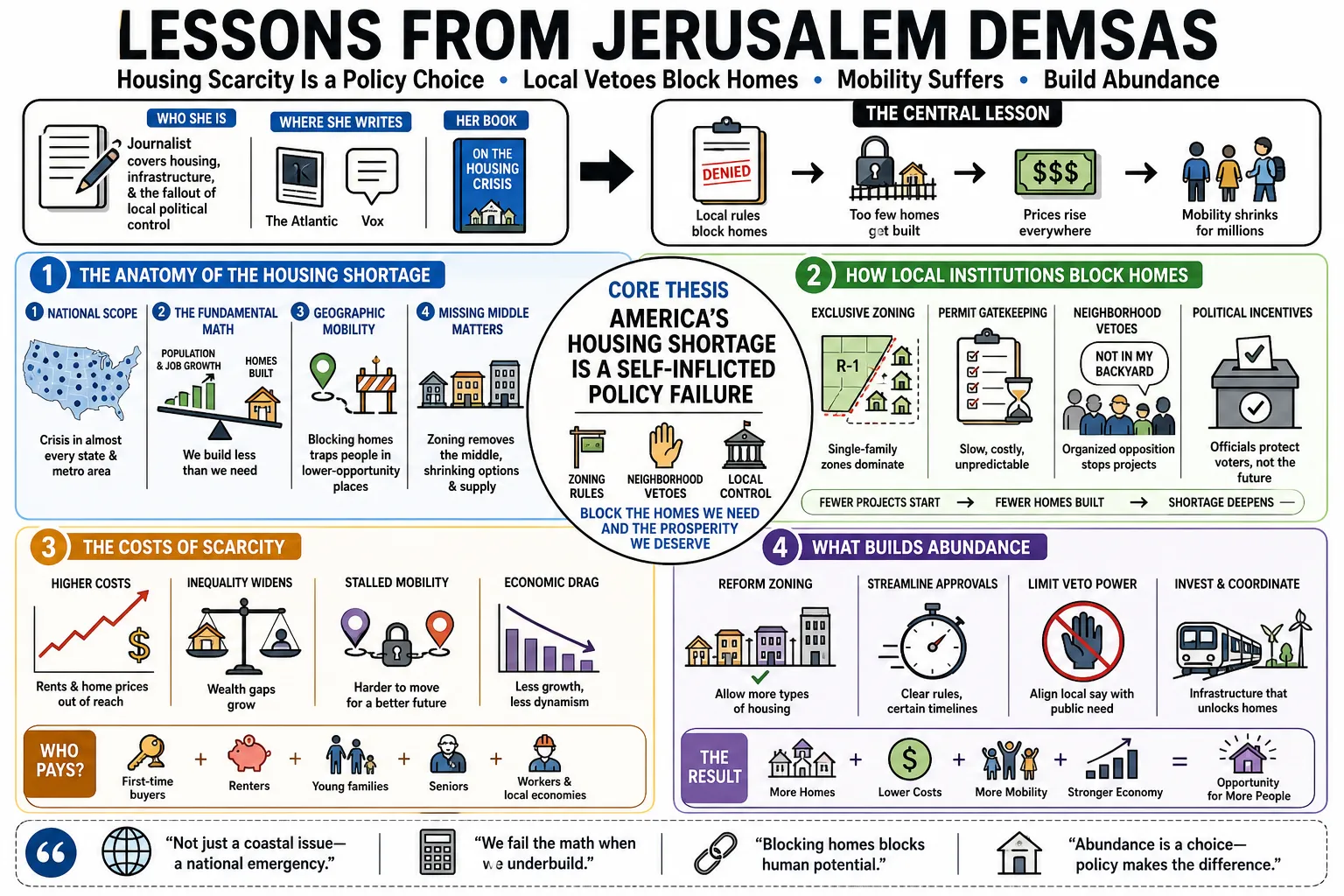
Lessons from Jerusalem Demsas
Journalist Jerusalem Demsas covers housing, infrastructure, and the fallout of local political control. In her writing for The Atlantic and Vox, and her book "On the Housing Crisis," she argues that America's housing shortage is a self-inflicted policy failure driven by zoning rules and neighborhood vetoes. This compilation outlines her reporting on how local institutions routinely block the development needed for economic mobility and affordability.
Part 1: The Anatomy of the Housing Shortage
- On the national scope: "The housing crisis is not just a coastal or 'superstar city' issue; it is a sprawling, national emergency affecting almost every state and metro area." — Source: [The Atlantic]
- On the fundamental math: "The primary reason housing is so impossibly expensive is simply that we have systematically failed to build enough homes to match population and job growth." — Source: [On the Housing Crisis]
- On geographic mobility: "When we block housing construction in productive regions, we trap people in lower-opportunity areas, effectively suffocating nationwide economic mobility." — Source: [Vox]
- On missing middle housing: "Through deliberate zoning regulations, local governments have functionally outlawed the construction of duplexes, triplexes, and small apartment buildings in the vast majority of American neighborhoods." — Source: [The Weeds]
- On the vacancy myth: "The idea that there are plenty of vacant homes just waiting to be filled is a statistical illusion; most vacancies are either in the wrong geographic locations or are merely temporarily between tenants." — Source: [The Atlantic]
- On supply and demand: "Housing is not uniquely exempt from the basic laws of supply and demand; building more market-rate housing reliably reduces upward price pressure across the entire regional market." — Source: [On the Housing Crisis]
- On the pandemic's acceleration: "The COVID-19 pandemic did not invent the housing crisis, but the sudden, massive shift in remote work supercharged demand for space, ruthlessly exposing our preexisting housing deficit." — Source: [The Atlantic]
- On terminology: "It is far more accurate to describe the current situation as a chronic, self-imposed shortage rather than a sudden, unpredictable crisis." — Source: [Good on Paper]
- On climate impact: "Forcing residents into sprawling, car-dependent suburbs because dense urban housing is legally prohibited is an absolute disaster for greenhouse gas emissions." — Source: [Vox]
- On the history of zoning: "Minimum lot sizes and single-family zoning mandates were historically designed to exclude lower-income and minority populations, and they continue to successfully execute that exact function today." — Source: [On the Housing Crisis]
Part 2: NIMBYism and the Politics of Exclusion
- On neighborhood defenders: "Homeowners often block new development not out of cartoonish malice, but because the local political system actively incentivizes them to protect their property values at all costs." — Source: [The Atlantic]
- On weaponizing progressivism: "Wealthy, left-leaning enclaves consistently weaponize environmental review laws and concerns about developer profits to kill badly needed housing projects." — Source: [On the Housing Crisis]
- On the imbalance of power: "The fatal flaw of local housing politics is that the people who would benefit most from new construction cannot vote in the municipal elections that block it." — Source: [Vox]
- On the irony of property values: "The irony of NIMBY resistance is that upzoning for denser housing often increases underlying land values, but incumbent homeowners still fear any disruption to their immediate built environment." — Source: [The Atlantic]
- On parking mandates: "Mandating arbitrary amounts of off-street parking for every new development acts as a massive, hidden tax that makes building affordable housing financially impossible." — Source: [The Weeds]
- On demonizing developers: "The casual political demonization of developers conveniently ignores the reality that someone actually has to physically build the homes society desperately needs to exist." — Source: [Good on Paper]
- On hyper-local control: "Deferring all land-use decisions to hyper-local control is a guaranteed recipe for scarcity, because every individual neighborhood has a rational incentive to simply say no." — Source: [On the Housing Crisis]
- On the dual nature of housing: "The United States insists on treating housing simultaneously as a primary vehicle for wealth accumulation and as a basic human need, two policy goals that are fundamentally at war with each other." — Source: [The Atlantic]
- On fear of the unknown: "Opposition to density is frequently less about rational economic selfishness and much more about a generalized fear of losing the familiar character of one's surroundings." — Source: [Vox]
Part 3: The Vetoocracy and Institutional Failure
- On procedural gridlock: "We have engineered a political system where it is incredibly easy for a tiny group of highly motivated people to stop things from happening, and agonizingly difficult for the state to build anything." — Source: [The Atlantic]
- On status quo bias: "Our current regulatory environment heavily biases the status quo, placing enormous and expensive procedural burdens on any attempt to alter the physical environment." — Source: [On the Housing Crisis]
- On institutional decay: "When a government consistently struggles to build basic infrastructure like transit lines or housing on time and on budget, it fundamentally degrades public trust in the state's competence." — Source: [Good on Paper]
- On NEPA: "The National Environmental Policy Act, originally drafted to protect nature, is now routinely weaponized to block the exact types of dense housing and clean energy projects required to fight climate change." — Source: [The Atlantic]
- On prioritizing voice over outcomes: "We have over-indexed on giving everyone a voice in the planning process, to the point where the endless process itself actively prevents us from delivering the outcomes the public actually wants." — Source: [The Weeds]
- On the weapon of time: "In development and infrastructure, time is literal money; subjecting a project to a multi-year discretionary review process can kill it just as effectively as a direct city council rejection." — Source: [Vox]
- On state capacity: "The chronic inability to build physical things is a glaring crisis of state capacity, revealing that modern liberalism often struggles profoundly with basic execution." — Source: [The Atlantic]
- On arbitrary approvals: "Subjecting every minor land-use change to a discretionary, case-by-case community review process guarantees unpredictable outcomes and stifles necessary regional growth." — Source: [On the Housing Crisis]
Part 4: Homelessness and the Poverty Trap
- On the root of homelessness: "Homelessness is, fundamentally and statistically, a housing problem; regions with the highest housing costs predictably have the highest rates of homelessness, regardless of local drug policies." — Source: [The Atlantic]
- On the addiction narrative: "While mental health crises and addiction are very real issues, they do not explain the massive variance in homelessness rates across different states; high regional rents do." — Source: [On the Housing Crisis]
- On Housing First: "The most effective, proven way to address homelessness is to give people stable, permanent housing first, without behavioral preconditions, before attempting to solve their other complex life challenges." — Source: [Vox]
- On cost burdens: "Exorbitant housing costs consume a vastly disproportionate share of the income of the poor, leaving low-income families incredibly vulnerable to even minor sudden economic shocks." — Source: [The Atlantic]
- On evictions: "An eviction is not merely a consequence of poverty; it is an active cause of further poverty, triggering job loss, health crises, and long-term family instability." — Source: [Good on Paper]
- On the limits of shelters: "Relying almost entirely on temporary congregate shelters instead of building permanent supportive housing is an expensive, perpetual stopgap measure that structurally fails to solve the underlying crisis." — Source: [The Atlantic]
- On public backlash: "The stark visibility of unsheltered homelessness in major cities often generates a fierce political backlash that prioritizes criminalization and sweeps rather than addressing the actual housing shortage." — Source: [The Weeds]
- On housing vouchers: "Federal housing vouchers are a vital lifeline, but if local zoning makes it illegal to build apartment buildings where voucher holders actually want to live, the subsidies are rendered useless." — Source: [Vox]
- On systemic failure: "The persistent existence of mass unsheltered homelessness in the wealthiest nation in human history is a profound institutional and political failure, not just a collection of personal failures." — Source: [On the Housing Crisis]
Part 5: Gentrification, Displacement, and Market Realities
- On misdiagnosing the disease: "The popular conversation around gentrification routinely focuses on the visible symptoms of neighborhood change rather than the underlying disease, which is a massive regional shortage of housing." — Source: [The Atlantic]
- On the futility of blocking construction: "Stopping a new market-rate apartment building in a gentrifying neighborhood does not stop gentrification; it simply forces wealthy newcomers to ruthlessly outbid existing residents for the older, existing housing stock." — Source: [Vox]
- On the real driver of displacement: "The most severe and rapid displacement happens precisely when nothing new is allowed to be built, causing rents for the existing, older units to skyrocket uncontrollably." — Source: [On the Housing Crisis]
- On filtering: "Over decades, as new luxury housing ages, it naturally becomes the affordable housing of the future; legally blocking new luxury housing today guarantees a severe lack of affordable housing tomorrow." — Source: [The Weeds]
- On community character: "The loss of cultural character is a painful reality for longtime residents, but the only sustainable solution is building enough housing across the entire region to relieve demand pressure on vulnerable neighborhoods." — Source: [The Atlantic]
- On the paradox of amenities: "When cities finally invest in transit or better parks in historically neglected areas, it can unintentionally trigger displacement if the housing supply isn't allowed to legally expand alongside those new amenities." — Source: [Vox]
- On inclusionary zoning pitfalls: "Mandating that developers include a high percentage of below-market units in new projects can inadvertently make the entire project financially unviable, resulting in absolutely zero new housing being built." — Source: [Good on Paper]
- On rent control: "While strict rent control provides essential, immediate stability for current tenants, it structurally fails to solve the long-term supply shortage and can aggressively deter future housing construction." — Source: [The Atlantic]
- On exclusionary suburbs: "The gentrification pressures felt in working-class urban neighborhoods are the direct, downstream result of decades of exclusionary zoning policies in wealthy suburbs that aggressively refused to build." — Source: [On the Housing Crisis]
Part 6: Infrastructure and the Capacity to Build
- On transit costs: "The United States routinely pays significantly more per mile to build public rail and transit than almost any other developed nation, reflecting a systemic failure of procurement, planning, and political will." — Source: [The Atlantic]
- On the green transition: "Transitioning to a clean energy economy requires building a staggering amount of new physical infrastructure, which our current hyper-cautious regulatory system makes nearly impossible to achieve on time." — Source: [Vox]
- On permitting reform: "To realistically achieve our climate goals, we must fundamentally rewrite how we permit infrastructure projects, explicitly prioritizing speed of deployment over addressing every conceivable hyper-local objection." — Source: [The Atlantic]
- On the loss of expertise: "By heavily outsourcing design and engineering capacity to private consulting firms, public transit agencies have lost the crucial in-house expertise required to effectively manage large-scale capital projects." — Source: [On the Housing Crisis]
- On political timidity: "Elected officials vastly prefer to hold press conferences announcing federal funding for grand infrastructure projects rather than doing the grueling, unglamorous political work of reforming the bureaucracy required to actually build them." — Source: [Good on Paper]
- On the urgency of climate action: "We simply cannot afford to indulge a decade-long environmental review process for a new clean energy transmission line when the reality of the climate crisis demands rapid, immediate decarbonization." — Source: [The Atlantic]
- On modern environmentalism: "True, effective modern environmentalism must center relentlessly on building green infrastructure and dense urban housing, not merely preserving pristine empty spaces in amber." — Source: [Vox]
- On federal spending: "While recent federal legislative investments in infrastructure are historic in scale, the actual money will be squandered if the underlying local regulatory environment prevents those projects from ever breaking ground." — Source: [The Weeds]
Part 7: Federalism and the Necessity of State Preemption
- On state intervention: "Because local municipal governments are structurally incentivized by their voting bases to block housing, state governments must step in and aggressively preempt local zoning laws to mandate growth." — Source: [The Atlantic]
- On federal limitations: "While the federal government can offer financial carrots, it has very limited direct legal authority to rewrite the highly localized land-use laws that actually restrict housing construction on the ground." — Source: [Vox]
- On legislative success: "We are finally seeing state legislatures in places like California, Oregon, and Washington act like adults and take back power from obstinate municipalities to legalize denser housing." — Source: [On the Housing Crisis]
- On the collective action problem: "Housing affordability is fundamentally a regional economic issue, but zoning is historically a local power; state preemption is the only viable way to solve this massive collective action problem." — Source: [The Atlantic]
- On the builder's remedy: "State laws that automatically approve housing projects when cities fail to plan for their fair share of growth serve as an incredibly powerful, necessary stick to force local compliance." — Source: [The Weeds]
- On legal accountability: "While litigation has historically been the favorite tool to block housing, a new wave of aggressive legal action is finally being used to hold recalcitrant cities accountable to state housing mandates." — Source: [The Atlantic]
- On political cover: "A major benefit of state preemption is that it allows local mayors and city councils to point the finger at the state capitol when angry constituents inevitably complain about new development." — Source: [Good on Paper]
- On leveraging federal funds: "The federal government should strongly consider conditioning lucrative transportation and infrastructure grants on whether local jurisdictions have reformed their zoning codes to allow for sufficient housing construction." — Source: [Vox]
- On the failure of localism: "When it comes to housing policy, the romanticized laboratories of democracy at the local level have not produced innovative solutions, but rather a tragic, universal replication of exclusionary practices." — Source: [On the Housing Crisis]
Part 8: Reforming the Local Democratic Process
- On community meetings: "The traditional neighborhood community meeting is a deeply flawed forum for democratic input, as it is overwhelmingly dominated by older, wealthier, white homeowners who are highly motivated to oppose change." — Source: [The Atlantic]
- On unrepresentative input: "The specific demographic of people who have the time to show up and protest a new apartment building on a Tuesday night do not accurately represent the broader public interest or the region's actual demographics." — Source: [Vox]
- On representative democracy: "We need to rely much more heavily on elected representatives to make broad, comprehensive regional plans, rather than subjecting every single individual building project to an ad-hoc, hyper-local democratic veto." — Source: [On the Housing Crisis]
- On the illusion of consensus: "Demanding absolute community consensus for any new development is a guaranteed recipe for paralysis; a functioning democracy must be capable of making decisions even when some constituents loudly object." — Source: [The Weeds]
- On procedural justice: "A local review process can be procedurally fair by giving everyone a chance to speak at a microphone, while still consistently producing deeply unjust and exclusionary material outcomes." — Source: [The Atlantic]
- On co-opting equity: "It is incredibly common for anti-development neighborhood groups to cynically co-opt the language of equity and environmental justice to block projects that would actually house marginalized people." — Source: [Good on Paper]
- On the barrier to entry: "The immense time, specialized knowledge, and sheer energy required to successfully navigate local development politics acts as a massive barrier to entry, ensuring only the most privileged voices are taken seriously." — Source: [Vox]
- On political courage: "Solving the housing shortage fundamentally requires politicians who are willing to absorb intense, short-term local anger in order to secure the long-term economic and social health of the entire region." — Source: [On the Housing Crisis]
- On true public input: "If we genuinely want democratic input on the built environment, planners must proactively seek out the voices of renters, young families, and future residents, rather than merely surrendering to the loudest voices in the hearing room." — Source: [The Atlantic]