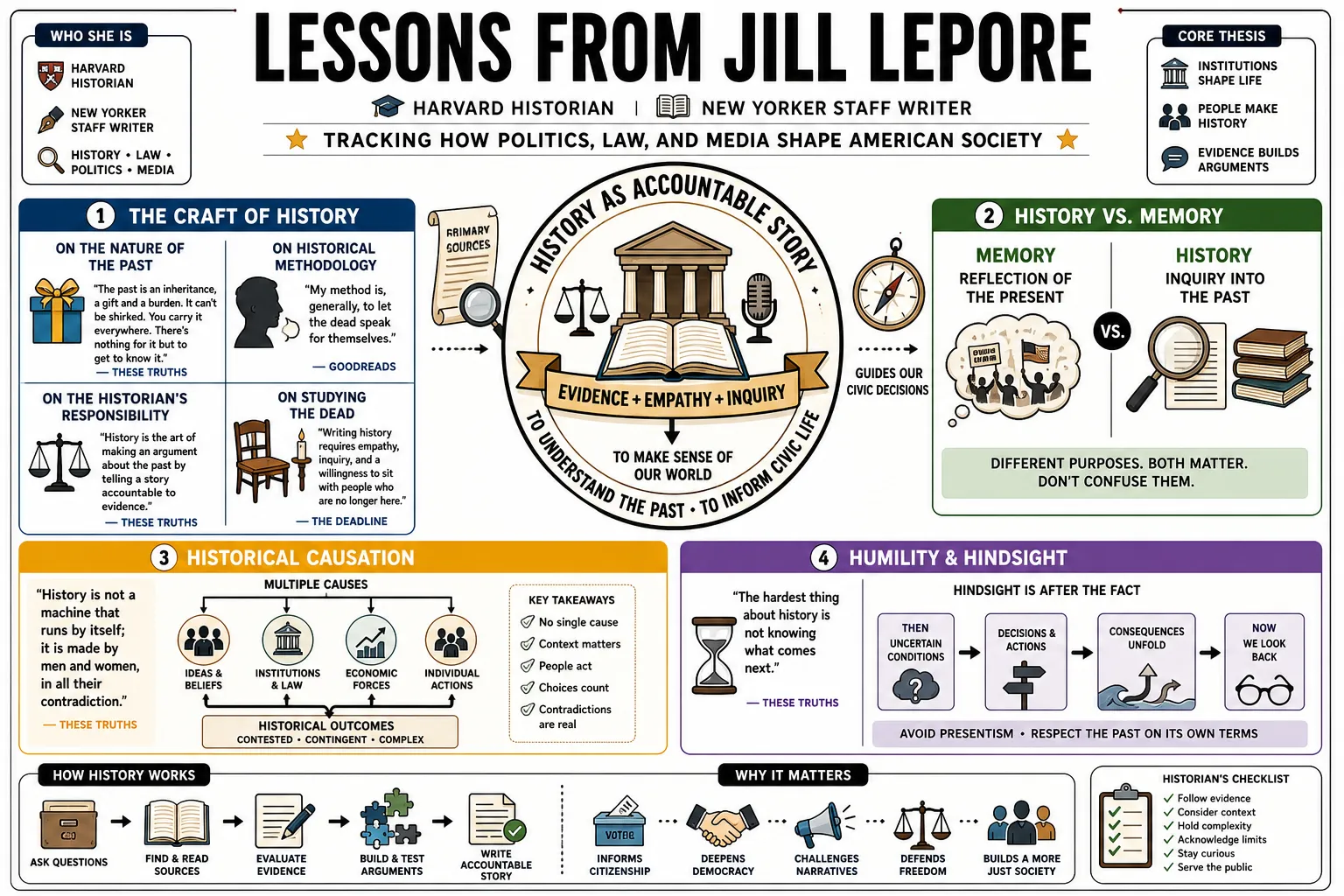
Lessons from Jill Lepore
As a Harvard historian and New Yorker staff writer, Jill Lepore tracks how politics, law, and media shape American society. This collection unpacks her approach to interpreting the past and her perspective on civic life.
Part 1: The Craft of History
- On the nature of the past: "The past is an inheritance, a gift and a burden. It can't be shirked. You carry it everywhere. There's nothing for it but to get to know it." — Source: These Truths
- On historical methodology: "My method is, generally, to let the dead speak for themselves." — Source: Goodreads
- On the historian's responsibility: "History is the art of making an argument about the past by telling a story accountable to evidence." — Source: These Truths
- On studying the dead: "Writing history requires empathy, inquiry, and a willingness to sit with people who are no longer here." — Source: The Deadline
- On history vs. memory: "Memory is a reflection of the present; history is an inquiry into the past." — Source: The Name of War
- On historical causation: "History is not a machine that runs by itself; it is made by men and women, in all their contradiction." — Source: These Truths
- On hindsight: "The hardest thing for a historian to do is to remember that the people in the past did not know how it was going to turn out." — Source: Conversations with Tyler
- On the illusion of inevitability: "Nothing in history is inevitable; it only looks that way in retrospect." — Source: Harvard Magazine
- On the use of history: "History is not a weapon to be wielded against political enemies, but a shared inheritance." — Source: The New Yorker
Part 2: The American Experiment
- On the founding ideals: "The American experiment rests on three political ideas—'these truths,' Thomas Jefferson called them—political equality, natural rights, and the sovereignty of the people." — Source: These Truths
- On the nation's origins: "A nation born in contradiction will fight forever over the meaning of its history." — Source: These Truths
- On the concept of equality: "Equality is a mathematical idea, a philosophical principle, and a political aspiration; it has never been a historical reality." — Source: Harvard Magazine
- On political divides: "The United States is a nation founded on both an ideal of liberty and the practice of slavery, a paradox that continues to shape its political divides." — Source: The New Yorker Radio Hour
- On the definition of a nation: "A nation is a group of people who share a common past, or at least the illusion of one." — Source: This America
- On nationalism versus patriotism: "Patriotism is a love of country; nationalism is an argument about who does and does not belong." — Source: This America
- On the fragility of republics: "Republics do not last forever; they are sustained only by the active participation of their citizens." — Source: These Truths
- On the Constitution: "The Constitution is not a machine that would go of itself; it is a document that requires constant interpretation." — Source: 99% Invisible
- On originalism: In a PBS NewsHour interview about We the People, Lepore argues that originalism can be defended as a judicial philosophy, but not as the Constitution’s original method of interpretation: the framers did not talk about interpretation that way, and the materials originalists rely on were not broadly available until much later. — Reference: PBS NewsHour interview with Lepore on originalism and constitutional interpretation
- On the struggle for rights: "The history of the United States is less a steady march toward progress than a series of bitter struggles over the definition of 'we the people.'" — Source: NPR
Part 3: Technology and Silicon Valley
- On the ethos of disruption: "Disruption is a theory of change founded on panic, anxiety, and a shaky grasp of history." — Source: The New Yorker
- On data collection: "We have built a society where the most powerful corporations operate by collecting our data without our meaningful consent." — Source: If Then
- On the origins of predictive algorithms: "The attempt to predict human behavior through data is not new; it has roots in the Cold War and the desire to control political outcomes." — Source: If Then
- On technology and democracy: "A democracy cannot function if its citizens are treated merely as data points to be manipulated." — Source: Conversations with Tyler
- On the hubris of Silicon Valley: "The technology industry often operates on the assumption that it can solve social problems without understanding their historical context." — Source: The Deadline
- On the Simulmatics Corporation: "The earliest attempts at algorithmic prediction were sold as objective science but were often just sophisticated guesswork." — Source: NPR
- On social media: "Platforms designed to capture attention have invariably amplified anger, because anger is the most engaging emotion." — Source: The New Yorker
- On artificial intelligence: "Treating human beings like machines is a very old mistake, now being repeated with new technology." — Source: If Then
- On the future of work: "The automation of thought, like the automation of labor, risks removing the moral agency of the individual." — Source: The New Yorker
Part 4: Women, Gender, and Power
- On women in the archive: "Women's history is often missing from the archive not because women didn't participate in history, but because their records were not preserved." — Source: Book of Ages
- On Jane Franklin: "To tell the story of Benjamin Franklin’s sister is to tell the story of the silence of women in the historical record." — Source: NPR
- On Wonder Woman: "Wonder Woman was conceived by her creator as a feminist icon, a psychological experiment, and a response to the violence of men." — Source: The Secret History of Wonder Woman
- On early feminism: "The struggle for women's rights has always been deeply intertwined with the battles over birth control and bodily autonomy." — Source: The New Yorker
- On political erasure: "The erasure of women from the grand narrative of American history was not an accident; it was a choice made by earlier historians." — Source: These Truths
- On maternal history: "Motherhood has been treated as a biological destiny rather than a historical experience with its own political weight." — Source: The Mansion of Happiness
- On the gender gap in historical recognition: "Genius is often remembered; unlettered brilliance is usually forgotten." — Source: Goodreads
- On women's suffrage: "The fight for the vote was only one chapter in a much larger, ongoing struggle for full civic participation." — Source: The Guardian
- On reproductive rights: "The legal and cultural battles over women's bodies reflect fundamental anxieties about who holds power in society." — Source: The New Yorker
Part 5: Truth, Evidence, and Journalism
- On the concept of truth: "The idea of empirical truth is the bedrock of the American experiment, and it is currently under severe strain." — Source: These Truths
- On evidence: "Facts do not speak for themselves; they must be marshaled into arguments and tested against skepticism." — Source: The Last Archive
- On the press: "A free press is not an auxiliary to democracy; it is the prerequisite." — Source: These Truths
- On political polling: "Polling changed the nature of political leadership, turning it from a matter of principle into a matter of measurement." — Source: If Then
- On the history of journalism: "Journalism evolved from a partisan brawl into a profession organized around the ideal of objectivity, an ideal that is now fraying." — Source: Harvard Magazine
- On conspiracy theories: "When people lose faith in institutions, they do not believe nothing; they believe anything." — Source: The Last Archive
- On the mystery form: "The detective story emerged in the nineteenth century precisely when society became obsessed with scientific evidence." — Source: The Last Archive
- On truth in the digital age: "The internet was supposed to democratize information, but it has often just democratized propaganda." — Source: The New Yorker
- On doubt: "Healthy skepticism is necessary for science and democracy; manufactured doubt is destructive to both." — Source: The Last Archive
Part 6: Writing and Storytelling
- On narrative: "Narrative history is a way of understanding the past that honors the human experience of time passing." — Source: Conversations with Tyler
- On essay writing: "An essay is an attempt to figure something out, not a platform to declare what you already know." — Source: The Deadline
- On the role of the writer: "The writer's job is to see the world as clearly as possible and to describe it as honestly as possible." — Source: The Deadline
- On biography: "Biography tends to exaggerate the agency of the individual at the expense of the context of the era." — Source: Book of Ages
- On clarity: "Academic jargon is often a way of hiding a lack of original thought." — Source: Conversations with Tyler
- On structure: "A book must have an architecture that the reader can feel, even if they cannot see the blueprints." — Source: The New Yorker Radio Hour
- On audience: "Write for the intelligent layperson, not just for the guild of specialists." — Source: Harvard Magazine
- On revisions: "Writing is rewriting. The first draft is just you telling yourself the story." — Source: The Deadline
- On empathy in writing: "You have to be willing to inhabit the minds of people you find abhorrent if you want to write good history." — Source: The Name of War
- On deadlines: "A deadline is a gift; it forces you to stop researching and start writing." — Source: The Deadline
Part 7: The Archive and Memory
- On historical records: "The archive is not a reflection of reality; it is a record of power." — Source: The Name of War
- On silence: "Historians must learn to listen to the silences in the archive, for that is often where the most marginalized lived." — Source: Book of Ages
- On preservation: "What gets saved is what society values; what gets discarded is what it wishes to forget." — Source: The Mansion of Happiness
- On discovering documents: "Finding a previously unread letter in an archive is the closest a historian comes to time travel." — Source: The Secret History of Wonder Woman
- On the nature of letters: "A letter is a performance of intimacy, written for an audience of one but subject to the scrutiny of history." — Source: Book of Ages
- On memory: "Memory is fallible and shaped by present needs; the archive is static but incomplete." — Source: The Name of War
- On physical objects: "Material culture—the things people made and used—often tells a truer story than the texts they left behind." — Source: The Mansion of Happiness
- On digitization: "Digitizing the archive makes it accessible, but it risks losing the tactile context of the original document." — Source: The New Yorker
- On the fragility of records: "Paper burns, ink fades, and digital files corrupt; the survival of history is a precarious accident." — Source: The Deadline
Part 8: Politics and the Constitution
- On free speech: "Free speech is not a week or a place. It is a long and strenuous argument, as maddening as the past and as painful as the truth." — Source: Goodreads
- On the amendment process: "The Constitution was designed to be amended, but we have largely lost the political will and capacity to do so." — Source: OPB Think Out Loud
- On political parties: "The founders feared political parties, yet the system they designed made parties inevitable." — Source: These Truths
- On the Supreme Court: "The politicization of the Supreme Court is not a recent aberration but a recurring feature of American history." — Source: The New Yorker
- On voting rights: "The expansion of the franchise has never been a straight line; it has always been met with fierce retrenchment." — Source: These Truths
- On the Tea Party: "Movements that dress up in the garb of the Revolution often do so to claim an unquestionable moral authority." — Source: The Whites of Their Eyes
- On conservatism: "Modern conservatism relies heavily on a specific, often mythical, interpretation of the American founding." — Source: The Whites of Their Eyes
- On populism: "Populism is a recurring fever in American politics, usually fueled by economic anxiety and directed against perceived elites." — Source: These Truths
- On civic education: "A republic cannot survive if its citizens do not understand how its government works or the history of its struggles." — Source: The Archive Project
- On the future of democracy: "Democracy is not a guarantee; it is a choice made anew by each generation." — Source: Harvard Magazine