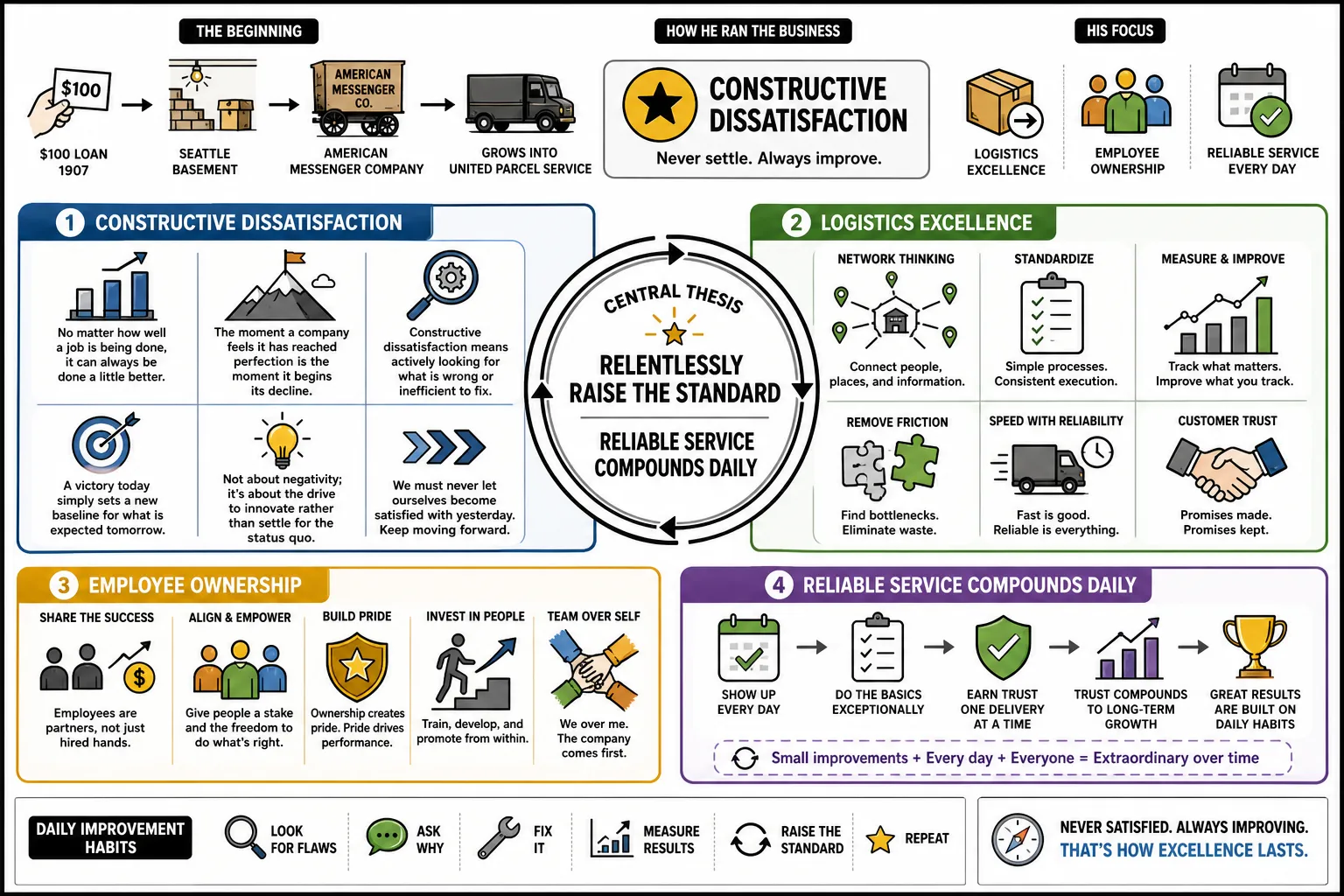
Lessons from Jim Casey
In 1907, Jim Casey used a $100 loan to start the American Messenger Company in a Seattle basement, eventually growing it into United Parcel Service. He ran the business on "constructive dissatisfaction," the belief that no process works so well it cannot be improved. This collection gathers his thinking on logistics and employee ownership, along with his insistence that reliable service is a compounding daily habit.
Part 1: Constructive Dissatisfaction
- On continuous improvement: "No matter how well a job is being done, it can always be done a little better." — Source: [Archbridge Institute]
- On the danger of complacency: "The moment a company feels it has reached perfection is the moment it begins its decline." — Source: [UPS History]
- On finding flaws: "Constructive dissatisfaction means actively looking for what is wrong or inefficient in order to fix it." — Source: [Capital Research Center]
- On defining success as temporary: "A victory today simply sets a new baseline for what is expected tomorrow." — Source: [Archbridge Institute]
- On the value of dissatisfaction: "Being constructively dissatisfied is not about negativity; it is about the drive to innovate rather than settle for the status quo." — Source: [Logistics Hall of Fame]
- On moving forward: "We must never let our current achievements blind us to the improvements we still need to make." — Source: [UPS History]
- On avoiding celebration: "We should be far more interested in fixing our defects than in celebrating our successes." — Source: [Capital Research Center]
- On measuring progress: "True progress is measured by the small inefficiencies we eliminate from our daily routines." — Source: [Logistics Hall of Fame]
- On operational evolution: "The systems that brought us here will not be the systems that take us to the next level." — Source: [Archbridge Institute]
- On setting higher standards: "When you solve a problem, you immediately raise the standard for everyone." — Source: [UPS History]
Part 2: The Promise of Service
- On promise-keeping: "Never promise more than you can deliver, and always deliver what you promise." — Source: [Archbridge Institute]
- On reliability: "The foundation of long-term business is extreme reliability and unquestioned integrity." — Source: [UPS History]
- On customer trust: "Trust is built over decades of keeping your word on the smallest of deliveries." — Source: [Logistics Hall of Fame]
- On delivering more than expected: "Our guiding motto must always be the best service and the lowest rates." — Source: [Capital Research Center]
- On the foundation of business: "Rendering perfect service to stores and their customers will naturally lead to financial rewards." — Source: [Archbridge Institute]
- On long-term relationships: "You do not build a business on a single transaction; you build it on the habit of reliability." — Source: [UPS History]
- On the definition of perfect service: "Service has no magic shortcuts; it is built on small things done well, day after day." — Source: [Logistics Hall of Fame]
- On reputation: "Your reputation is the only asset that cannot be easily replaced." — Source: [Capital Research Center]
- On service over profit: "Putting reward ahead of service is like putting the trailer before the tractor." — Source: [Archbridge Institute]
- On integrity in transactions: "Honesty in every single interaction is the only way to ensure the public will trust you tomorrow." — Source: [UPS History]
Part 3: Small Things and Efficiency
- On saving seconds: "Seconds saved become minutes over the course of a day." — Source: [Logistics Hall of Fame]
- On the sum of details: "Service is not a single heroic act, but the sum of many little things done well." — Source: [Archbridge Institute]
- On simple habits: "The most enduring businesses are built on simple, disciplined habits." — Source: [UPS History]
- On precision: "Precision in the small details prevents failure in the large objectives." — Source: [Capital Research Center]
- On minimizing waste: "Every unnecessary step is a tax on the customer and a burden on the company." — Source: [Logistics Hall of Fame]
- On daily consistency: "Consistency is far more valuable than occasional bursts of brilliance." — Source: [UPS History]
- On the compounding effect of minor improvements: "A fractional improvement made daily will compound into a massive advantage over time." — Source: [Archbridge Institute]
- On disciplined routines: "A Spartan approach of being simple, disciplined, and focused always outperforms flashiness." — Source: [Capital Research Center]
- On observation: "You learn how to save time by watching the actual work happen, not by reading a report." — Source: [Logistics Hall of Fame]
- On respecting time: "Time is the only inventory we cannot store, so we must use every second efficiently." — Source: [UPS History]
Part 4: Ownership and Partnership
- On sharing wealth: "The wealth of a company should be shared with those who helped create it." — Source: [Archbridge Institute]
- On mutual respect: "Our partnership legacy is based on mutual respect, kindness, and basic decency among all workers." — Source: [Capital Research Center]
- On employee dignity: "Good management means taking a genuine interest in the welfare and dignity of every employee." — Source: [UPS History]
- On treating workers as owners: "Individuals must feel that they are not just employees, but that they are the company itself." — Source: [Logistics Hall of Fame]
- On aligning interests: "When employees own a piece of the business, their interests align perfectly with the success of the firm." — Source: [Archbridge Institute]
- On collective success: "No single person builds a great enterprise; it requires a collective partnership." — Source: [UPS History]
- On partnership over hierarchy: "We operate as partners working toward a shared goal, not as a hierarchy dictating orders." — Source: [Capital Research Center]
- On building the company together: "Every person who sorts a package or drives a truck is building this company alongside me." — Source: [Logistics Hall of Fame]
- On democratic workplaces: "Soliciting ideas from all co-workers is the only way to ensure the best ideas surface." — Source: [Archbridge Institute]
Part 5: Leadership by Observation
- On hands-on management: "Leadership requires you to be on the street and in the sorting facilities." — Source: [Logistics Hall of Fame]
- On talking to the frontline: "I stop to ask drivers what they think of their jobs because they know the reality of the business." — Source: [UPS History]
- On understanding reality: "You cannot understand the reality of the ground floor from an office desk." — Source: [Archbridge Institute]
- On avoiding the ivory tower: "An executive who loses touch with the daily operations has lost the ability to lead." — Source: [Capital Research Center]
- On ground-level truth: "The truth of how well we are doing is found in the hands of the people doing the work." — Source: [Logistics Hall of Fame]
- On the limits of reports: "A spreadsheet can tell you what happened, but only observation can tell you why it happened." — Source: [UPS History]
- On observing processes: "Watch the process closely, and the solutions to your inefficiencies will reveal themselves." — Source: [Archbridge Institute]
- On leading by listening: "The most effective managers spend more time listening to frontline feedback than giving instructions." — Source: [Capital Research Center]
- On visible leadership: "Leaders must be visible to those they lead to earn their respect and trust." — Source: [UPS History]
Part 6: Empowering the Individual
- On building up others: "One measure of your success will be the degree to which you build up others who work with you." — Source: [Archbridge Institute]
- On the role of a manager: "While building up others, you will inevitably build up yourself." — Source: [Capital Research Center]
- On trusting employees: "Give people the tools they need and the trust they deserve, and they will exceed your expectations." — Source: [UPS History]
- On delegation: "You cannot scale a business if you insist on making every decision yourself." — Source: [Logistics Hall of Fame]
- On coaching vs. dictating: "A leader's responsibility is to coach others so they can eventually drive themselves." — Source: [Archbridge Institute]
- On recognizing potential: "There is untapped potential in every worker; management's job is to find it and nurture it." — Source: [Capital Research Center]
- On cultivating leaders from within: "We promote from within because those who have done the work are best equipped to lead it." — Source: [UPS History]
- On personal responsibility: "Empowerment means giving someone the responsibility for an outcome, not merely assigning a task." — Source: [Logistics Hall of Fame]
- On giving credit: "A good leader takes the blame for failure and distributes the credit for success." — Source: [Archbridge Institute]
Part 7: Ambition and Self-Drive
- On internal motivation: "You will not have to be driven every step of the way, but you will drive yourself." — Source: [Capital Research Center]
- On the necessity of drive: "Because you do drive yourself, it will be less necessary for you to drive others." — Source: [UPS History]
- On taking initiative: "Do not wait for instructions when you see a problem that needs to be solved." — Source: [Archbridge Institute]
- On determined people: "Determined men, working together, can do anything." — Source: [Logistics Hall of Fame]
- On the limits of external pressure: "External pressure produces compliance; internal drive produces excellence." — Source: [Capital Research Center]
- On relentless focus: "Maintain a focused ambition on doing your specific job better than anyone else in the world." — Source: [UPS History]
- On overcoming early obstacles: "A lack of capital is merely an obstacle; a lack of determination is a failure." — Source: [Archbridge Institute]
- On hard work: "There is no substitute for the sheer volume of hard work required to build something lasting." — Source: [Logistics Hall of Fame]
- On defining the horizon: "Our horizon is as distant as the mind's eye wishes it to be." — Source: [UPS History]
Part 8: Community and Generosity
- On investing more than money: "Money is not the only resource you can invest; time and experience are equally valuable." — Source: [Casey Family Programs]
- On supporting families: "A stable, supportive family environment is the bedrock of a healthy society." — Source: [Casey Family Programs]
- On the value of time: "Giving your time to mentor someone creates a lasting change that money cannot buy." — Source: [Archbridge Institute]
- On giving back: "We have an obligation to improve the communities where we live and operate." — Source: [UPS History]
- On the measure of a transaction: "It is unfortunate that so many kinds of business transactions must be measured in terms of money." — Source: [Capital Research Center]
- On true success: "Success is about making a difference in the lives of vulnerable children and families." — Source: [Casey Family Programs]
- On community strength: "A business can only be as strong as the community that surrounds it." — Source: [Logistics Hall of Fame]
- On the purpose of wealth: "The ultimate purpose of generating wealth is to use it to lift up those who need help." — Source: [Casey Family Programs]
- On leaving a mark: "Your legacy will not be defined by the packages you delivered, but by the people you helped." — Source: [Archbridge Institute]