Lessons from Jimmy Wales
Jimmy Wales co-founded Wikipedia and built the world's largest open encyclopedia by trusting volunteer editors over centralized control. This collection covers his views on how collaborative systems and digital communities actually work.
Part 1: The Vision and Mission
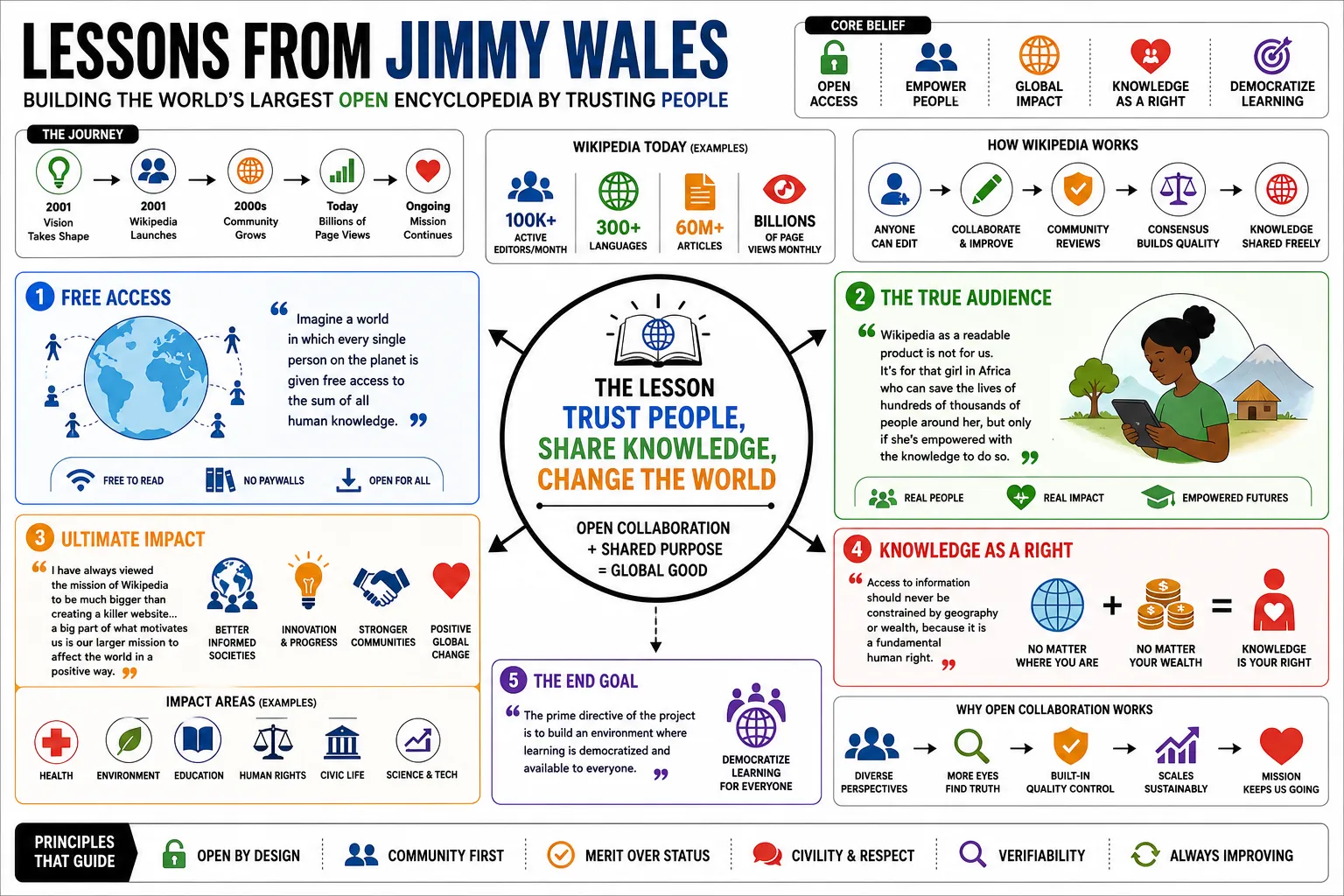
- On Free Access: "Imagine a world in which every single person on the planet is given free access to the sum of all human knowledge." — Source: [Wikipedia]
- On The True Audience: "Wikipedia as a readable product is not for us. It's for that girl in Africa who can save the lives of hundreds of thousands of people around her, but only if she's empowered with the knowledge to do so." — Source: [QuoteFancy]
- On Ultimate Impact: "I have always viewed the mission of Wikipedia to be much bigger than creating a killer website... a big part of what motivates us is our larger mission to affect the world in a positive way." — Source: [QuoteFancy]
- On Knowledge as a Right: "Access to information should never be constrained by geography or wealth, because it is a fundamental human right." — Source: [TED]
- On The End Goal: "The prime directive of the project is to build an environment where learning is democratized and available to everyone." — Source: [Managers.org.uk]
- On Ambition: "We didn't set out to build an encyclopedia as an academic exercise; we built it as a utility for the entire world." — Source: [The Tim Ferriss Show]
- On Scope: "The sum of all human knowledge includes context and cultural understanding across languages, extending far beyond simple facts." — Source: [Lex Fridman Podcast]
- On Global Reach: "A key metric of success is how effectively we serve readers in developing nations, rather than tracking raw page views in the West." — Source: [The Guardian]
- On Simplicity of Purpose: "The mission statement was designed to be easily understood and impossible to fully finish, providing endless motivation." — Source: [Leadershop]
- On Information Equality: "True equality begins with equal access to the foundational texts of human understanding." — Source: [Thinking Heads]
Part 2: Community and Collaboration
- On Assuming Good Faith: "When designing a collaborative system, starting with the assumption that most contributors are well-intentioned changes the entire social dynamic." — Source: [TWiT.tv]
- On Community Design: "The design of Wikipedia is the design of community." — Source: [The Long Now Foundation]
- On Behavioral Norms: "We are Wikipedians. This means that we should be kind, thoughtful, and open to different viewpoints." — Source: [Wikiquote]
- On Volunteer Motivation: "People contribute because they believe in the mission and enjoy the camaraderie of peers who share their values, rather than for financial reward." — Source: [The Interview BBC]
- On Decentralized Work: "A project can scale massively if you remove top-down bottlenecks and trust volunteers to self-organize around their interests." — Source: [Wikipedia]
- On Human Interaction: "We intentionally avoided automating certain social interactions, because human dialogue is vital to maintaining the integrity of the work." — Source: [The Long Now Foundation]
- On Constructive Disagreement: "A healthy community addresses conflict by creating structured ways to resolve disagreements using evidence rather than authority." — Source: [Lex Fridman Podcast]
- On Empathy: "Empathy is a requirement for collaboration at scale, as users must understand perspectives radically different from their own." — Source: [The Imperfects Podcast]
- On Collective Output: "When you give thousands of people the right tools and a shared goal, they can produce something far greater than any centralized team." — Source: [The Tim Ferriss Show]
- On Self-Correction: "The community must be allowed to make mistakes, because the capacity to self-correct is what builds long-term resilience." — Source: TED
Part 3: Trust and Neutrality
- On Neutral Point of View: "A neutral point of view requires representing all significant views fairly and without bias." — Source: [Wikipedia]
- On Shared Reality: "A functional society requires a shared baseline of facts to debate from, rather than everyone retreating into bespoke information bubbles." — Source: [ZME Science]
- On Earning Trust: "Trust requires continuous effort through transparent processes and an open acknowledgement of errors." — Source: [The Seven Rules of Trust]
- On Combating Misinformation: "The best antidote to bad information is a community empowered to check sources and discuss evidence openly." — Source: [Time]
- On Civility and Logic: "Discourse should be governed by logical reasoning and civil debate, rather than by volume or aggression." — Source: [TWiT.tv]
- On The Infrastructure of Trust: "Systems succeed when they are built on community norms of authenticity and logic, rather than technical code alone." — Source: [The Seven Rules of Trust]
- On Objectivity: "While perfect objectivity may be impossible, striving for it through rigorous editorial standards remains essential." — Source: [Lex Fridman Podcast]
- On Transparency: "Users trust the platform because they can view the entire edit history of any article and see exactly how a consensus was reached." — Source: [The Guardian]
- On Navigating Post-Truth: "In an era of political polarization, creating a neutral ground for facts is harder but more necessary than ever." — Source: [The Economist]
- On The Scientific Method: "The editorial process should mirror the scientific method by proposing edits, testing them against sources, and conducting peer review." — Source: [Thinking Heads]
Part 4: Leadership and Governance
- On Soft Power: "As a project matures, the role of the founder shifts from an active administrator dictating rules to a symbolic figurehead guiding the culture." — Source: [Wikipedia]
- On Changing Policies: "Leaders must be bold about changing our policies and also cautious about changing our policies." — Source: [Wikiquote]
- On Open Governance: "Authority in an open project should stem from respect and consensus, rather than from a title or corporate hierarchy." — Source: [Managers.org.uk]
- On The Role of a Founder: "The founder's job involves protecting the core principles that allow the community to thrive, rather than controlling the final outcome." — Source: [The Tim Ferriss Show]
- On Resolving Disputes: "Instead of locking down controversial topics, a leader should help establish frameworks where users can calmly negotiate the facts." — Source: [The Interview BBC]
- On Managing Scale: "You cannot govern a massive project by micromanaging; you must build scalable social norms." — Source: [Leadershop]
- On Credentialism: "We value the quality of the argument and the evidence provided above formal academic credentials." — Source: [TWiT.tv]
- On Patience: "Building consensus takes longer than issuing a decree, but the resulting decision is far more resilient." — Source: [The Imperfects Podcast]
- On Cultivating Culture: "A leader must actively model the behavior they want to see, especially regarding civility and openness to criticism." — Source: [Lex Fridman Podcast]
Part 5: Artificial Intelligence and the Future
- On AI Hallucinations: "While AI-generated content can be a useful tool, its tendency to confidently present false information makes human oversight mandatory." — Source: [Time]
- On Human Baseline: "In an era dominated by AI, human-generated collaborative platforms will become even more important as a verifiable anchor to reality." — Source: [ZME Science]
- On The Limits of Automation: "Algorithms cannot adjudicate complex editorial disputes or weigh the nuances of a neutral point of view without human judgment." — Source: [The Economist]
- On AI as a Tool: "Generative AI should be viewed as an assistant to volunteers for translation or formatting, rather than a replacement for human researchers." — Source: [Lex Fridman Podcast]
- On Machine Learning: "Machine learning models can help detect vandalism quickly, allowing human editors to focus on content creation." — Source: TED
- On The Future of Search: "As search engines integrate more AI answers, transparently sourced information repositories will be the necessary bedrock feeding those models." — Source: [The Interview BBC]
- On Authentic Knowledge: "The value of a text often lies in the human intent and effort behind it, something a large language model cannot replicate." — Source: [The Guardian]
- On Technological Hype: "We must evaluate new technologies based on their actual utility to the community, rather than getting swept up in the immediate industry hype." — Source: [The Tim Ferriss Show]
- On Maintaining Quality: "AI makes it cheaper to produce text, which means our human curation standards must become correspondingly higher." — Source: [Lex Fridman Podcast]
Part 6: Free Culture and Open Source
- On Copyleft Licensing: "Ensuring that content is free to copy, modify, and redistribute prevents knowledge from being locked behind paywalls." — Source: [The Long Now Foundation]
- On The Wiki Concept: "Adopting wiki technology to allow anyone to edit any page was a radical experiment in trust that fundamentally altered the internet." — Source: [Wikipedia]
- On Intellectual Property: "The open-source model demonstrates that sharing intellectual property can sometimes generate more value for humanity than hoarding it." — Source: [Thinking Heads]
- On Cultural Shifts: "The success of collaborative knowledge was a cultural shift akin to the arrival of rock 'n' roll, defying the expectations of traditional institutions." — Source: [ZME Science]
- On Early Failures: "Nupedia struggled because it relied on a rigid, expert-driven model, while Wikipedia succeeded by embracing the speed and openness of the web." — Source: [Quora]
- On Public Goods: "Information should be treated as a public good, similar to clean air or water, accessible to all regardless of income." — Source: [Managers.org.uk]
- On Software Freedom: "Using and developing open-source software is necessary for maintaining independence from corporate monopolies." — Source: [TWiT.tv]
- On Forking: "The ability for users to copy the database and start their own version acts as an ultimate check on centralized power." — Source: [Wikipedia]
- On Global Commons: "We are building a global digital commons, a shared space that belongs to humanity rather than shareholders." — Source: [TED]
Part 7: Business and Platforms
- On Ad-Free Models: "Running Wikipedia as a non-profit without advertisements ensures that editorial decisions are never influenced by commercial pressures." — Source: [The Tim Ferriss Show]
- On Attention Economies: "Traditional social media platforms prioritize engagement and outrage because it serves their ad models, which actively harms public discourse." — Source: [Substack]
- On Alternative Social Networks: "We need new platforms that are designed to combat the negative incentives of the current social media environment." — Source: [Reddit]
- On Fundraising: "Relying on small donations from millions of users keeps the organization accountable directly to the people who use it." — Source: [Wikimedia Foundation]
- On Profit vs. Purpose: "It is possible to create massive global value without capturing all of that value as corporate profit." — Source: [Lex Fridman Podcast]
- On Growth Metrics: "Engagement metrics like time-on-site are often toxic; a good tool helps the user find the answer quickly and leave." — Source: [The Economist]
- On Corporate Independence: "Avoiding venture capital meant the project had the freedom to grow slowly and prioritize culture over rapid monetization." — Source: [The Tim Ferriss Show]
- On Virality: "Virality is a poor proxy for quality, as truthful, nuanced information rarely spreads as fast as sensationalism." — Source: [The Interview BBC]
- On Building for Users: "A platform should be built to serve the user's intellect, not to exploit their psychological vulnerabilities." — Source: [Time]
Part 8: Personal Philosophy and Optimism
- On Pathological Optimism: "I am an incurable optimist regarding human nature and our ability to work together to create accurate, objective content." — Source: [Time]
- On The Internet's Potential: "The internet still possesses the potential to foster a global cultural dialogue based on reason and respect, despite its current flaws." — Source: [The Guardian]
- On Human Nature: "If you give people a meaningful project and a set of fair rules, the vast majority will choose to build rather than destroy." — Source: [The Imperfects Podcast]
- On Lifelong Learning: "The drive to understand the world is universal, and providing the tools to satisfy that curiosity is a noble pursuit." — Source: [Lex Fridman Podcast]
- On Patience and Time: "Real cultural change takes decades, and we must be willing to build institutions that endure rather than chasing short-term trends." — Source: [The Long Now Foundation]
- On Individual Agency: "Every single edit matters. The belief that one person can improve the knowledge of the world is deeply empowering." — Source: [Thinking Heads]
- On Rejecting Cynicism: "Cynicism is often just intellectual laziness; it is much harder, and more rewarding, to believe that systems can be improved." — Source: [The Tim Ferriss Show]
- On Navigating Critics: "When you try to do something unprecedented, experts will tell you it will fail. You have to be willing to ignore them and run the experiment." — Source: [ZME Science]
- On Legacy: "A true legacy is the demonstration that millions of strangers can cooperate to give a gift to the world." — Source: [TED]