As Chief Revenue Officer at Kong Inc., Joe Eskenazi treats enterprise sales as business optimization rather than a transactional pitch. He pushes his teams to drop a purely knowledge-based mindset in favor of performance and exhaustive preparation. This profile covers his approach to cross-functional leadership and closing high-stakes deals without burning out.
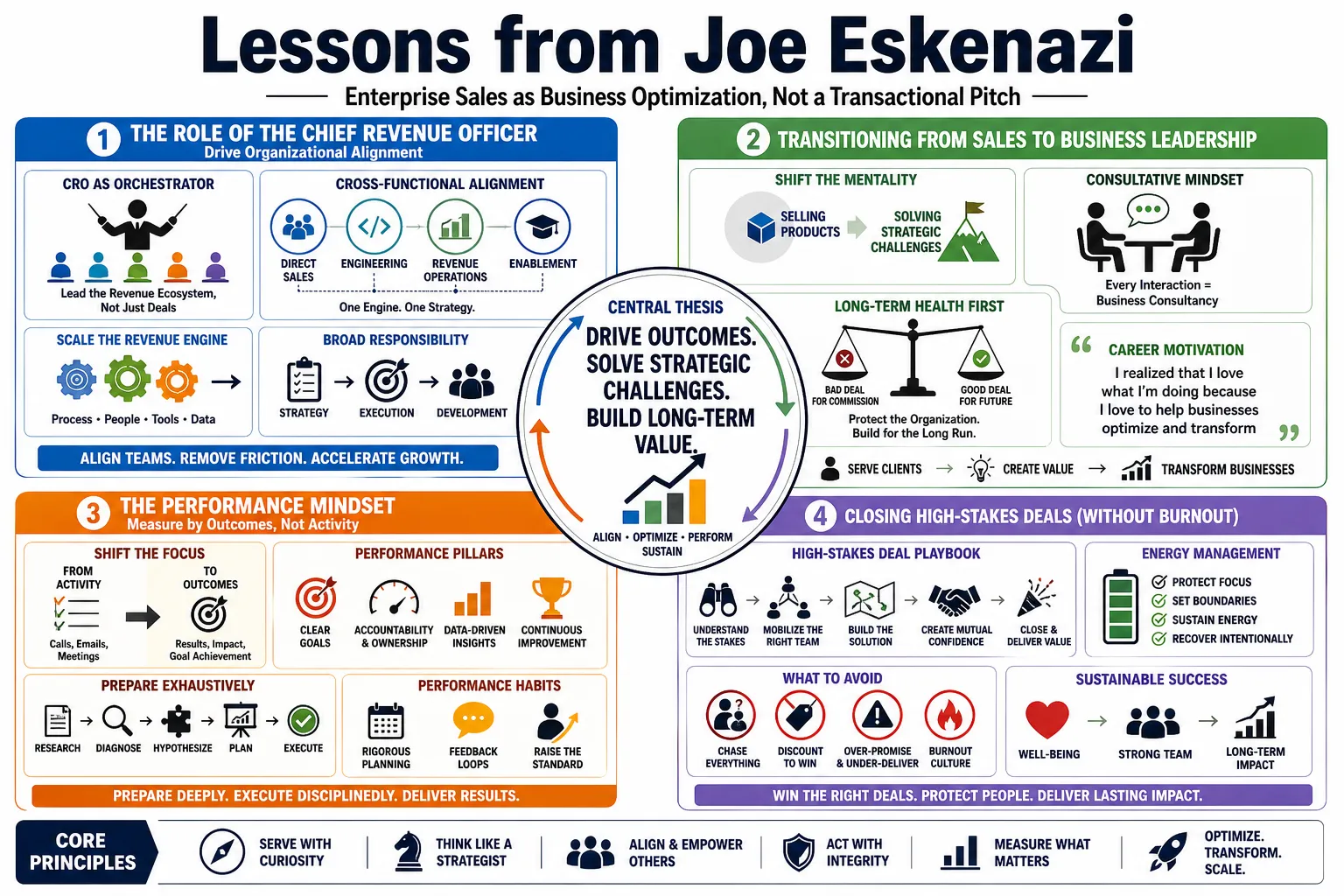
Part 1: The Role of the Chief Revenue Officer
- On organizational alignment: A modern CRO must drive alignment across direct sales, engineering, revenue operations, and enablement to successfully scale a company's revenue engine. — Reference: Kong Inc.
- On broad responsibilities: The executive role requires orchestrating a comprehensive cross-functional ecosystem rather than narrowly focusing on closing individual deals. — Reference: Hunters and Unicorns
Part 2: Transitioning from Sales to Business Leadership
- On strategic focus: To reach the executive tier, professionals must shift their mentality from selling software products to actively solving a client's strategic business challenges. — Reference: Hunters and Unicorns
- On consultative selling: Reps can bypass the traditional salesperson label by treating every customer interaction as an opportunity for business consultancy. — Reference: Hunters and Unicorns
- On long-term health: True business leaders refuse to push through bad deals simply to secure a commission, prioritizing the organization's long-term health. — Reference: Hunters and Unicorns
- On career motivation: "I realized that I love what I'm doing because I love to help businesses optimize and transform" — Source: Hunters and Unicorns
Part 3: The Performance Mindset
- On shifting focus: Sales organizations should cultivate a performance mindset that measures success by outcomes and goal achievement rather than the mere accumulation of knowledge. — Reference: Force Management
- On maintaining standards: Adhere to an unshakeable standard of excellence, as shortcutting small details eventually results in both personal and professional erosion. — Reference: Hunters and Unicorns
- On tactical execution: "The best leaders focus on the how in sales." — Source: Revenue Builders Podcast
- On personal touch: "You bring the character, the courage, the art, the curiosity by applying your style to the skills and knowledge." — Source: Revenue Builders Podcast
Part 4: The Importance of Preparation
- On pressure: "The difference between stress and pressure is preparedness." — Source: Revenue Builders Podcast
- On accountability: "You gotta participate in your own rescue. You gotta put in the work." — Source: Revenue Builders Podcast
- On internal drivers: "Preparation was always my calling card... I absolutely have a big fear of failure" — Source: Hunters and Unicorns
- On confidence building: Exhaustive preparation helps salespeople transform high-stakes pressure into sustained confidence in front of the client. — Reference: Revenue Builders Podcast
Part 5: Skill Development and Role-Playing
- On repetition: "Skills need to be done hundreds of times, if not thousands, to be performed flawlessly." — Source: Revenue Builders Podcast
- On handling adversity: "Our development often focuses on what could go right; the real bar is how you handle things when they don’t." — Source: Revenue Builders Podcast
- On authenticity in execution: Sales training and role-playing should emphasize delivering genuine conversations rather than reciting rigid, mechanical responses. — Reference: Revenue Builders Podcast
Part 6: Navigating the Sales Cycle
- On early groundwork: "Openers are closers; the groundwork you lay in the beginning determines your success." — Source: Revenue Builders Podcast
- On enterprise range: Experience across SaaS and on-premises enterprise technology—and deals spanning the mid-market through the Fortune 100—builds the pattern recognition needed to lead a scaled revenue organization. — Reference: Kong Inc.
Part 7: Empowering and Coaching Teams
- On reinforcement: "You empower people by recognizing and rewarding the behavior you want to see." — Source: Revenue Builders Podcast
- On simplifying processes: "You have to give them the way. But make it simple." — Source: Revenue Builders Podcast
- On authentic leadership: "Find your voice. Find out who you are as a leader". — Source: Hunters and Unicorns
Part 8: Managing Burnout and Resilience
- On hustle culture: High performers frequently fall into the trap of trying to out-work every problem, an approach that leads directly to burnout. — Reference: Hunters and Unicorns
- On physical limits: "I tell AEs who become leaders, you can't outwork the job. Just know that". — Source: Hunters and Unicorns
- On daily recovery: Sustaining energy in a high-intensity role requires ruthless prioritization and physical resilience practices like breathwork and cold plunging. — Reference: Hunters and Unicorns
- On personal boundaries: Leaders will inevitably compromise their professional effectiveness if they sacrifice their health or neglect their family. — Reference: Hunters and Unicorns
Part 9: Experience and Technological Foresight
- On market position: "There’s no AI without APIs... we like to be the picks and shovels leading to the gold". — Source: Hunters and Unicorns
- On scaling engines: Successfully navigating both SaaS and on-premises environments is critical when scaling a software company's revenue from early stages to IPO. — Reference: Kong Inc.
Part 10: Discovery and Deal Preparation
- On starting with the customer: Discovery preparation should begin with what the customer is trying to accomplish and why they accepted the meeting before the seller defines an internal agenda. — Reference: Revenue Builders
- On preparing for exposure: Spend the largest share of meeting preparation on what worries the team, where the deal is exposed, and how likely objections will be handled. — Reference: Revenue Builders
- On testing assumptions: Do not accept discovered pain, metrics, or a supposed champion at face value; validate findings across the buying organization before treating them as fact. — Reference: Revenue Builders
- On reading resistance: When a buyer resists access or commitment, investigate the interest behind the stated position instead of treating the first explanation as the whole truth. — Reference: Revenue Builders
- On listening as an elite skill: Preparation frees a seller to remain present, listen closely, notice human behavior, and use intuition rather than mentally searching for the next scripted response. — Reference: Revenue Builders
Part 11: Building a Coaching System
- On coaching in the workflow: Forecast calls, discovery preparation, and deal reviews are development opportunities; leaders should pause routine operating meetings when a live issue can teach the whole team. — Reference: Revenue Builders
- On peer accountability: A performance culture becomes durable when peers practice together, challenge one another, and hold each other to a high standard without waiting for the manager. — Reference: Revenue Builders
- On mastery over compliance: Qualification frameworks should build confidence and conviction, not become a checklist culture where managers merely inspect whether fields are complete. — Reference: Revenue Builders
- On rewarding development behavior: Reinforce the people who help teammates practice and improve, not only those who post the largest number at the end of the quarter. — Reference: Revenue Builders
- On front-line leadership: Companies undermine seller development when they train individual contributors but fail to invest in the managers directly responsible for coaching them. — Reference: Hunters and Unicorns
Part 12: Scaling the Revenue Organization
- On predictable scale: A CRO must install rigor, process, and repeatability while preserving the human judgment and individual style that make enterprise selling effective. — Reference: Hunters and Unicorns
- On alignment through communication: Ruthless prioritization and short, frequent pulse checks help cross-functional teams stay aligned without turning every decision into a large meeting. — Reference: Hunters and Unicorns
- On moving from product to solution: Scaling an enterprise technology company requires changing enablement, development, marketing, and go-to-market execution so customers buy outcomes rather than a collection of features. — Reference: Hunters and Unicorns
- On governing AI at scale: Enterprise AI adoption depends on governance across models, data, cost, and policy; API infrastructure becomes the control layer that lets companies innovate without surrendering security. — Reference: Revenue Builders
Part 13: Building Careers and Leaders
- On developing business acumen deliberately: A nontraditional start in sports broadcasting did not have to remain a gap; studying for an MBA while leading an Oracle partner sales team helped turn practical selling experience into a broader understanding of how businesses operate. — Reference: Hunters and Unicorns
- On producing talent predictably: A sales leader is responsible not only for pursuing opportunities but for repeatedly bringing people into the organization, developing them, and making them productive. — Reference: Hunters and Unicorns
- On career growth versus market hype: Joining a company riding a powerful AI or market wave does not guarantee that an individual will grow; candidates should examine whether leaders will actively invest in their development and next career step. — Reference: Hunters and Unicorns
- On creating a career arc: Enablement and leadership training should do more than improve the current quarter; the deeper aim is to give talented people skills and opportunities that can change the direction of their careers. — Reference: Hunters and Unicorns
- On accepting the development tradeoff: Pulling a global leadership team out of the field for several days costs selling time, but the long-term value of in-person development can justify the short-term sacrifice. — Reference: Hunters and Unicorns
- On complementary hiring: Build leadership teams from varied backgrounds so people strengthen one another, while insisting on a shared appetite for learning, curiosity, and growth. — Reference: Hunters and Unicorns
Part 14: Healthy Intensity and Team Culture
- On competing through preparation: Respect every competitor without fearing one; confidence should come from doing the work and preparing more thoroughly, not from dismissing the opposition. — Reference: Hunters and Unicorns
- On healthy intensity: High talent, demanding expectations, and disciplined execution naturally create intensity, and strong performers often want to work in an environment that holds that bar. — Reference: Hunters and Unicorns
- On seeing the distance traveled: Ambitious teams spend most of their time looking up the mountain; leaders should also help them look back occasionally and recognize how far they have already come. — Reference: Hunters and Unicorns
- On recognizing extraordinary work: Premium recognition should be intentional and memorable because it signals how seriously a company values the people and effort required to perform at the highest level. — Reference: Joe Eskenazi on LinkedIn
- On winning across functions: Great companies are built when high performers across sales, customer success, partnerships, marketing, product, and engineering commit to one mission and help one another succeed. — Reference: Joe Eskenazi on LinkedIn
Part 15: Coaching and Executive Partnership
- On coaching the method: A deal clinic should define what must be accomplished and then coach the leader on how to get there, adapting the conversation to the person and situation rather than running an inspection-heavy review. — Reference: Hunters and Unicorns
- On founder–CRO partnership: The strongest founders challenge a revenue leader’s blind spots and ask hard questions from genuine curiosity while still providing the autonomy and space to run the go-to-market organization. — Reference: Hunters and Unicorns
Part 16: Choosing and Scaling an AI Opportunity
- On substance over corporate vanity: Evaluate an opportunity through the size of the market, the quality and history of the product, and the strength of the founders—not merely through how famous or fashionable the company already appears. — Reference: Hunters and Unicorns
- On AI connectivity: Every agent, LLM interaction, MCP server, and intelligent application ultimately depends on APIs and services communicating securely at scale, making visibility, reliability, governance, and control production requirements rather than optional infrastructure. — Reference: Joe Eskenazi on LinkedIn