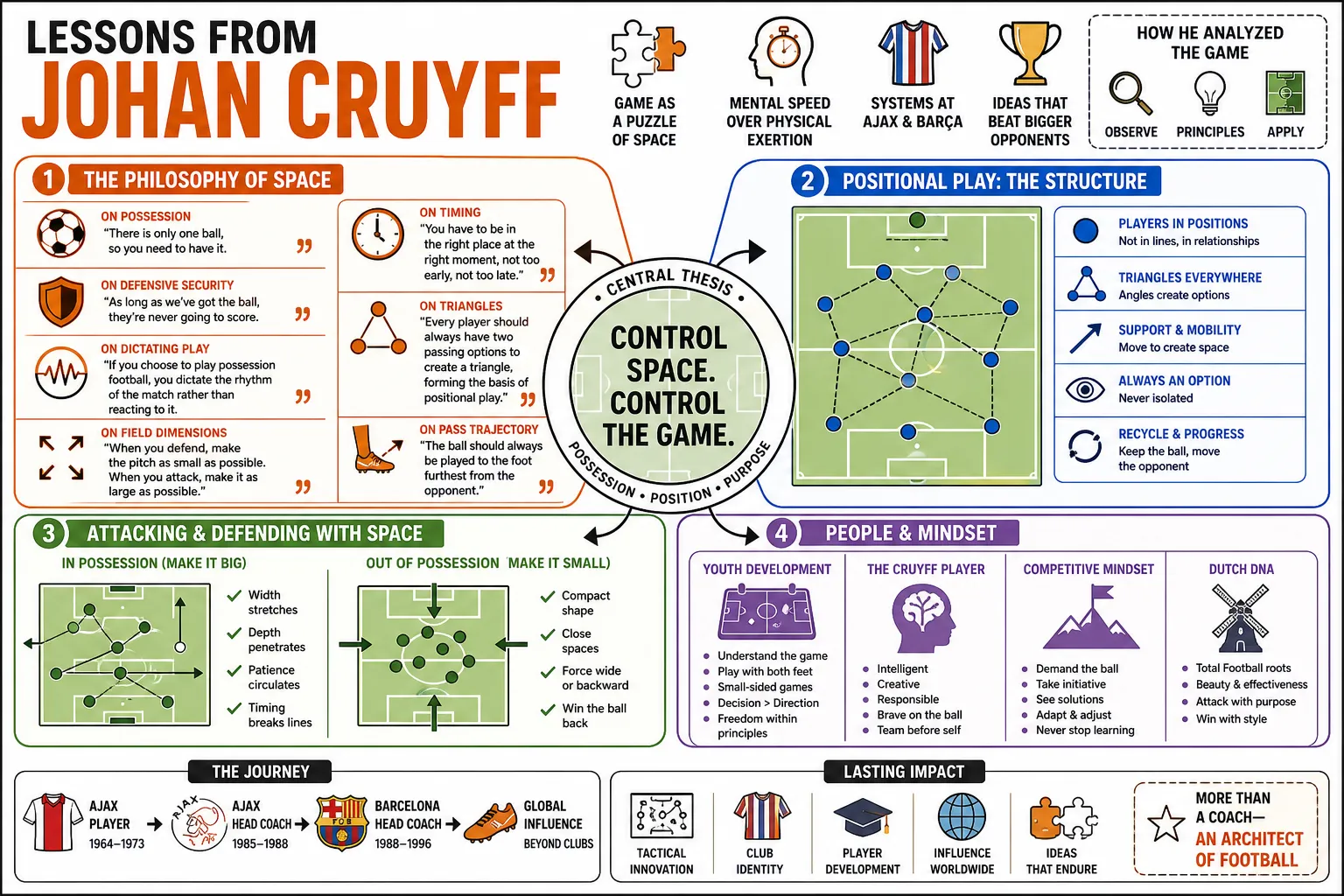
Lessons from Johan Cruyff
Johan Cruyff described football built around controlling the ball, pressing to recover it, and letting players think and create within a team. — Guardian Cruyff Interview.
Part 1: The Philosophy of Space
- On Possession: Cruyff's maxim was that there is only one ball, so his team needed to have it. — UEFA Cruyff Profile.
- On Defensive Security: Keeping the ball also defended: the opponent could not attack with a ball it did not possess. — Perarnau Interview (Italian translation).
- On Dictating Play: With the ball, his team could decide whether to attack quickly or pause, making the opponent respond to its choices. — Perarnau Interview (Italian translation).
- On Field Dimensions: Cruyff wanted his team to make the pitch large in possession and small when defending. — UEFA Cruyff Profile.
- On Timing: Good positioning meant arriving at the right place at the right moment—not too early or too late. — Barça Innovation Hub.
- On Passing Options: His positional play sought to keep passing routes available as players moved into and out of one another's spaces. — Jordi Cruyff Interview.
- On Spatial Management: Cruyff learned to look for usable space and to turn apparent obstacles into advantages. — My Turn Autobiography Excerpt.
- On Removing Complications: Jordi Cruyff recalled his father solving a marking problem by refusing to mark a striker whose strength was escaping a marker. — Jordi Cruyff Interview.
Part 2: Technique and Execution
- On True Technique: He valued one-touch execution over juggling tricks because quicker control and passing kept the move alive. — Jordi Cruyff Interview.
- On Execution: Playing football is simple; playing simple football is the hard part. — Cruyff: Simple Football.
- On The First Touch: Fast, well-directed control helped a player retain and use the ball under pressure. — Perarnau Interview (Italian translation).
- On Mental Play: Cruyff described football as played with the feet but directed by the head. — VICE Cruyff Interview.
- On Efficient Movement: Coordinated possession and pressing could let his team run less while controlling more of the game. — Miguel Delaney Cruyff Interview.
- On Dribbling: A well-positioned winger could use a one-on-one dribble to create space for the team. — Observer Cruyff Interview.
- On Practical Skill: Players needed functional skills with both feet, including passing and controlling the ball, not just a single showy technique. — Miguel Delaney Cruyff Interview.
Part 3: Football Intelligence
- On Insight: Anticipation could make an intelligent player effectively faster than a physically quicker opponent. — Jordi Cruyff Interview.
- On Observation: He admired Di Stéfano's understanding of how to use space and made that a way of reading the pitch. — My Turn Autobiography Excerpt.
- On Off-the-Ball Impact: Cruyff used a three-minutes-with-the-ball versus 87-minutes-without-it illustration to emphasize off-ball positioning and decisions. — Barça Innovation Hub.
- On Spatial Awareness: A player needed to see what teammates were doing before deciding where and how to pass. — Miguel Delaney Cruyff Interview.
- On Spatial Constraints: Street-football constraints taught him to adapt his technique to awkward spaces and unpredictable bounces. — My Turn Autobiography Excerpt.
Part 4: Strategy and Tactics
- On Roles: In Cruyff's approach, the goalkeeper began the attack and the striker began the defence. — UEFA Cruyff Profile.
- On Defensive Zones: He used Guardiola to show how a player who struggled to defend a vast area could excel when given a smaller zone and support nearby. — Guardian Cruyff Interview.
- On Collective Movement: For Cruyff, sport meant playing, learning, winning, losing and helping one another together. — Miguel Delaney Cruyff Interview.
- On Formations: He treated the formation as a consequence of where his players needed to control the ball and press, not as the starting point. — Perarnau Interview (Italian translation).
- On Pressing: Closing a defender's passing options could provoke a hurried error and return possession without a direct tackle. — Perarnau Interview (Italian translation).
- On Fluidity: Total Football kept positions occupied while different players moved through them, making fixed marking difficult. — Jordi Cruyff Interview.
- On Minimizing Errors: Mistakes were inevitable; by studying where and why they happened, a coach could position players to reduce repeat errors. — Miguel Delaney Cruyff Interview.
Part 5: Leadership and Coaching
- On Team Composition: Selecting players meant asking what a particular position and team actually needed, not collecting unrelated stars with the same nominal role. — Miguel Delaney Cruyff Interview.
- On Motivation: Enjoyment was essential to youth development: eager young players could learn ball control and positional play in a setting they wanted to join. — Player Development Interview.
- On Accountability: He treated an analysed technical mistake as a chance to learn rather than a reason to stop trying. — Miguel Delaney Cruyff Interview.
- On Delegation: He wanted players to think for themselves and create within the team's performance. — Guardian Cruyff Interview.
- On Managing Egos: An individual's distinctive quality mattered only when it could function inside the team's way of playing. — Miguel Delaney Cruyff Interview.
- On Adaptation: He urged coaches to see players as distinct types and fit their qualities to the team's style, not treat every player in one position as interchangeable. — Miguel Delaney Cruyff Interview.
- On Ambition: He acknowledged that money mattered, but said players also needed to play with heart and want to belong to the team. — Scotsman Cruyff Interview.
Part 6: Youth Development
- On Learning vs. Winning: He described youth development as building technical and positional understanding, with first-team opportunities and learning from difficult competition more important than easy youth wins. — Perarnau Interview (Italian translation).
- On Player Growth: He gave the example of moving a young winger to full-back so the player would understand a defender's one-on-one problem. — Perarnau Interview (Italian translation).
- On Individual Focus: Individual coaching could help a player overcome a specific limitation for the team's benefit. — Guardian Cruyff Interview.
- Tailor development to the player: Cruyff credits his youth coach Van Veen with noticing his physical limitations and devising individual, functional training that strengthened his first step while continuing to challenge him. — Player Development Project — Johan Cruyff Interview
- On Street Football: On Amsterdam streets, he learned to use a kerb as a teammate for one-twos and to adapt to unpredictable rebounds. — My Turn Autobiography Excerpt.
- Train balance through varied surfaces: Cruyff said street football's uneven bounces and hard ground taught him to adjust and keep his balance; he advocated flat-soled play for young players to develop that ability. — My Turn — Autobiography Excerpt
- On Size Constraints: He valued smaller players who handled the ball intelligently and resisted judging youth prospects mainly by physique. — Perarnau Interview (Italian translation).
- On Patience: Developing young players and good people required patience rather than rushing a judgment of their potential. — Player Development Interview.
- On Talent Evaluation: Beyond ball skill, he assessed a young player's character, habits, preparation and capacity to learn. — Player Development Interview.
- Look at habits as well as skill: Cruyff said technical ability alone did not predict a young player's development; coaches should also attend to character, preparation, behavior and mindset. — Player Development Project — Johan Cruyff Interview
Part 7: Mindset and Perspective
- On Risk: Trying something new risked failure, but Cruyff regarded the attempt and the lesson from it as worthwhile. — VICE Cruyff Interview.
- Look back to learn, not to dwell: In his autobiography, Cruyff says he concentrated on future progress and looked back mainly to learn from mistakes rather than revisit past matches. — My Turn — Autobiography Excerpt
- On Entertainment: He considered creating attacking football one of the game's most beautiful possibilities, even when defensive approaches won. — Scotsman Cruyff Interview.
- On Handling Critics: He expected criticism when proposing unfamiliar changes and judged those ideas by trying them, not by avoiding opposition. — VICE Cruyff Interview.
- On Legacy: He said he was especially proud that players he had coached, including Guardiola, became coaches themselves. — UEFA Cruyff Interview.
Part 8: Identity and Vision
- On Authenticity: Changing Barcelona meant changing its mentality and style, and Cruyff said his staff were convinced that approach would succeed. — UEFA Cruyff Interview.
- On Financial Power: Cruyff's retort to richer clubs was that he had never seen a bag of money score a goal. — UEFA Cruyff Profile.
- On Style vs Results: He prized beautiful play but also expected gifted players to produce a return; style and outcome were not alternatives for him. — Observer Cruyff Interview.
- On Institutional Philosophy: At Ajax, he wanted football decisions made by people who understood the game and could build a coherent club approach. — Miguel Delaney Cruyff Interview.
- On Evolution: He thought a youth system had to keep innovating rather than assume a successful model would remain sufficient unchanged. — Scotsman Cruyff Interview.