Lessons from Johann Hari
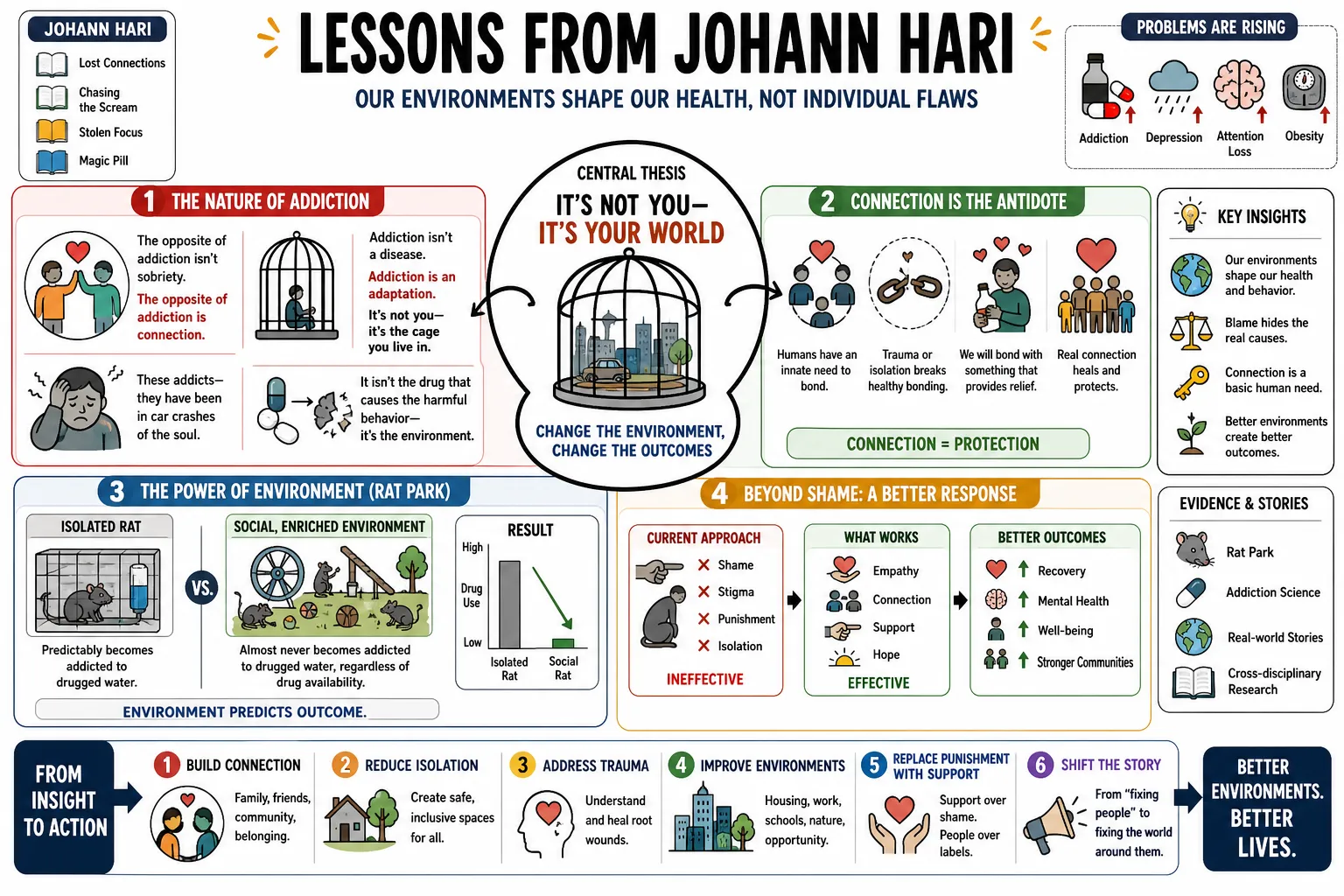
British journalist Johann Hari argues that our environments, not individual biological flaws, drive rising rates of addiction, depression, attention loss, and obesity. This profile summarizes his major books to explain how society shapes our health and behavior.
Part 1: The Nature of Addiction
- On the opposite of addiction: "The opposite of addiction isn't sobriety. The opposite of addiction is connection." — Source: [TED Talk (2015)]
- On environmental adaptation: "Addiction isn’t a disease. Addiction is an adaptation. It’s not you—it’s the cage you live in." — Source: [Chasing the Scream]
- On inner pain: "These addicts—they have been in car crashes of the soul." — Source: [Goodreads]
- On the cause of harmful behavior: "It isn’t the drug that causes the harmful behavior—it’s the environment." — Source: [Chasing the Scream]
- On bonding: Human beings have an innate need to bond, and if trauma or isolation prevents healthy bonding, people will bond with something that provides relief. — Source: [TED Talk (2015)]
- On Rat Park: An isolated rat will predictably become addicted to drugged water, but a rat in a socially rich environment almost never will, regardless of drug availability. — Source: [TED Talk (2015)]
- On shame and stigma: The current approach to drug use effectively soaks users in shame, worsening the isolation that fuels their addiction. — Source: [The Guardian]
- On the myth of chemical hooks: Physical dependence on a substance is only a minor component of severe addiction, far outweighed by psychological despair. — Source: [Chasing the Scream]
- On viewing addiction as a social disorder: Addiction should be treated as an indicator of broader social fragmentation and lack of community. — Source: [Psychology Today]
- On shifting our perspective: "For 100 years now, we've been singing war songs about addicts. I think all along we should have been singing love songs to them." — Source: [TED Talk (2015)]
Part 2: Rethinking Policy and Punishment
- On the efficacy of punishment: "Punishment makes them sicker; compassion can make them well." — Source: [Chasing the Scream]
- On the Iron Law of Prohibition: Banning substances incentivizes the creation of more concentrated, dangerous variants because they are easier to smuggle and more profitable. — Source: [LitCharts]
- On narrative-driven policy: The century-long war on drugs has been sustained by emotionally charged stories rather than empirical facts or scientific consensus. — Source: [LitCharts]
- On institutional ignorance: "I’ve made up my mind [about drugs]—don’t confuse me with the facts." — Source: [Chasing the Scream]
- On the Portugal model: Portugal successfully lowered addiction rates by decriminalizing drugs and investing the saved funds into job creation and social reintegration. — Source: [TED Talk (2015)]
- On social prescribing: Helping addicts find purpose, housing, and relationships is far more effective than putting them in prison. — Source: [DailyGood]
- On treating the symptom: Fighting the drug trade without addressing the pain of users is akin to fighting an infection by only targeting the fever. — Source: [Chasing the Scream]
- On the cost of prohibition: The violence associated with the drug trade is entirely a product of its illegality, not the pharmacology of the drugs themselves. — Source: [Chasing the Scream]
- On social reintegration: The ultimate goal of drug policy should not be abstinence, but rather reconnecting marginalized individuals with broader society. — Source: [TED Talk (2015)]
Part 3: The True Causes of Depression
- On broken machinery vs. unmet needs: "You aren't a machine with broken parts. You are an animal whose needs are not being met." — Source: [Lost Connections]
- On the chemical imbalance myth: The idea that depression is primarily caused by low serotonin levels has been heavily marketed by pharmaceutical companies despite weak evidence. — Source: [Lost Connections]
- On depression as a signal: "Depression isn't a disease; depression is a normal response to abnormal life experiences!" — Source: [QuoteFancy]
- On a spectrum of distress: "Depression and anxiety... are only the sharpest edges of a spear that has been thrust into almost everyone in our culture." — Source: [Medium]
- On grief for lost connections: "What if depression is, in fact, a form of grief—for our own lives not being as they should?" — Source: [Lost Connections]
- On biological limitations: Antidepressants provide a floor for some people, but they rarely resolve the underlying distress that drives the condition. — Source: [Feel Better, Live More Podcast]
- On societal gaslighting: We are often told our sadness is a biological glitch, which distracts us from identifying the toxic aspects of the environments we inhabit. — Source: [Lost Connections]
- On the nine disconnections: Hari identifies nine specific disconnections (such as from meaningful work, status, the natural world, and others) that generate modern mental illness. — Source: [Lost Connections]
- On the illusion of consumerism: "What you really need are connections. But what you are told you need, in our culture, is stuff and a superior status." — Source: [Lost Connections]
- On bio-psycho-social health: We must look beyond purely biological treatments and incorporate psychological and social reforms to address mass despair. — Source: [Feel Better, Live More Podcast]
Part 4: The Epidemic of Loneliness
- On the definition of loneliness: "Loneliness isn't the physical absence of other people, it's the sense that you're not sharing anything that matters with anyone else." — Source: [Lost Connections]
- On meaningful work: A vast percentage of the workforce feels no connection to their daily labor, leading to profound psychological detachment and apathy. — Source: [Lost Connections]
- On disconnection from nature: Modern humans spend unprecedented amounts of time indoors, depriving themselves of the psychological grounding that natural environments provide. — Source: [Lost Connections]
- On childhood trauma: Unresolved adverse childhood experiences are a powerful, often overlooked driver of adult anxiety and depression. — Source: [Lost Connections]
- On status and respect: Societies with high inequality create environments where people constantly feel their status is threatened, elevating chronic stress. — Source: [Lost Connections]
- On the gap in signals: The friction between our biological need for community and society's demand for individualism causes anxiety to thrive. — Source: [Medium]
- On prescribing community: Medical professionals should prescribe social engagement, like joining a community garden or choir, alongside traditional treatments. — Source: [Feel Better, Live More Podcast]
- On a hopeful future: A major source of modern depression is the loss of a secure, predictable future, especially regarding economic stability. — Source: [Lost Connections]
- On mutual support: Overcoming loneliness requires reciprocal relationships where people feel they are both receiving help and actively contributing to others. — Source: [Lost Connections]
Part 5: Reclaiming the Modern Mind
- On systemic distraction: "The truth is that you are living in a system that is pouring acid on your attention every day." — Source: [Stolen Focus]
- On self-blame: People are told to blame themselves for their inability to focus, which distracts from the institutional forces deliberately fragmenting their minds. — Source: [Stolen Focus]
- On the myth of multitasking: The human brain cannot genuinely multitask; it can only rapidly switch between tasks, which degrades performance and burns cognitive energy. — Source: [Stolen Focus]
- On the necessity of facing problems: "Not everything that is faced can be changed, but nothing can be changed until it is faced." — Source: [Goodreads]
- On deep thought: Without the ability to sustain attention, we lose our capacity for complex problem-solving and deep reading. — Source: [Stolen Focus]
- On individual versus collective action: Digital detoxes are a band-aid; truly solving the attention crisis requires structural changes to how technology operates. — Source: [Stolen Focus]
- On the speed of life: The sheer acceleration of modern life, characterized by constant news cycles and instant communication, prevents the mind from digesting information. — Source: [Stolen Focus]
- On the value of mind-wandering: Daydreaming is not a waste of time but a crucial cognitive state where the brain processes experiences and generates creativity. — Source: [Stolen Focus]
- On stress and hypervigilance: When we are financially or emotionally stressed, our brains enter a state of hypervigilance that makes sustained focus biologically impossible. — Source: [Stolen Focus]
- On reading fiction: Sustained engagement with long-form fiction builds empathy and trains the brain to hold complex narratives, a skill eroded by social media. — Source: [Stolen Focus]
Part 6: Systemic Threats to Attention
- On the attention economy: Tech companies are financially incentivized to maximize screen time, engineering their products to hijack human vulnerabilities. — Source: [Stolen Focus]
- On surveillance capitalism: The business model of tracking user behavior to serve targeted ads directly relies on constantly interrupting our focus. — Source: [Stolen Focus]
- On democracy and focus: "Democracy requires the ability of a population to pay attention." — Source: [Goodreads]
- On collective problem-solving: If society cannot focus for sustained periods, we will be unable to unite and solve existential threats like climate change. — Source: [Stolen Focus]
- On the decline of childhood play: Restricting unstructured, unsupervised outdoor play prevents children from developing their own internal mechanisms for focusing. — Source: [Stolen Focus]
- On poor diets: Highly processed foods cause severe energy spikes and crashes that destabilize the physical energy required for concentration. — Source: [Stolen Focus]
- On environmental pollution: Rising levels of air pollution and endocrine-disrupting chemicals have a measurable, degrading impact on brain development and cognitive function. — Source: [Stolen Focus]
- On sleep deprivation: Chronic lack of sleep prevents the brain from clearing out metabolic waste, directly impairing our ability to hold attention the next day. — Source: [Stolen Focus]
- On treating tech like utilities: Just as we regulated water and electricity to ensure public safety, we may need to heavily regulate social media to protect public cognition. — Source: [Stolen Focus]
Part 7: The Complexity of Weight-Loss Drugs
- On the obesity epidemic as a symptom: The dramatic rise in obesity is a logical result of a toxic food system and stressful environments, not a sudden failure of willpower. — Source: [Magic Pill]
- On modern irony: "We built a food system that poisons us, then decided en masse to inject ourselves with a different potential poison that puts us off all food." — Source: [Goodreads]
- On the limitations of GLP-1 drugs: While these medications effectively reduce physical mass, they do not resolve the psychological trauma or systemic inequalities that often drive overeating. — Source: [The Guardian]
- On treating the biology, not the root: Viewing weight-loss injections as a pure miracle ignores the fact that they function as biological band-aids for a deeply sick food culture. — Source: [Magic Pill]
- On appetite and reward: Drugs like semaglutide alter the brain's reward centers, changing not just hunger, but how we experience pleasure and cravings altogether. — Source: [Magic Pill]
- On cross-addiction: Early evidence suggests GLP-1 drugs may reduce the desire for alcohol and nicotine, indicating a broader dampening effect on compulsive behaviors. — Source: [Magic Pill]
- On personal vulnerability: Taking appetite suppressants can turn previously beloved meals into unappealing chores, fundamentally altering a person's cultural and social relationship with food. — Source: [Oprah Daily]
- On the pressure to be thin: The frantic demand for these drugs highlights how intensely modern culture weaponizes shame against heavier bodies. — Source: [Magic Pill]
- On sustainable health: Relying exclusively on medication is insufficient; long-term vitality still requires developing habits that actively nourish the body through real food and movement. — Source: [Oprah Daily]
Part 8: Reconnecting with Meaning and Health
- On the limitations of self-help: Individual behavioral tweaks are often overwhelmed by the power of the environments and systems in which we live. — Source: [Stolen Focus]
- On the power of environment: In nearly all areas of psychological struggle, context dictates behavior far more than innate character. — Source: [Lost Connections]
- On structural compassion: Rebuilding society around human needs, rather than corporate profit, is the only sustainable way to cure modern epidemics of despair. — Source: [TED Talk (2015)]
- On shared vulnerability: Recognizing that millions of others share our hidden struggles with focus or sadness is the first step toward building political momentum for change. — Source: [Stolen Focus]
- On meaningful labor: Providing people with work that offers autonomy and a clear purpose is a vital public health intervention. — Source: [Lost Connections]
- On resisting reductionism: Humans are complex social animals, and reducing our struggles to mere chemical imbalances or willpower deficits strips us of our agency. — Source: [Feel Better, Live More Podcast]
- On community as the cure: Whether addressing drug addiction or severe loneliness, the most robust interventions always involve integrating the sufferer into a supportive community. — Source: [Chasing the Scream]
- On acknowledging trauma: We must shift the question we ask troubled individuals from "What is wrong with you?" to "What happened to you?" — Source: [Lost Connections]
- On the necessity of hope: People require a credible narrative that their future will be secure and meaningful in order to thrive in the present. — Source: [Lost Connections]