Lessons from Johannes Reck
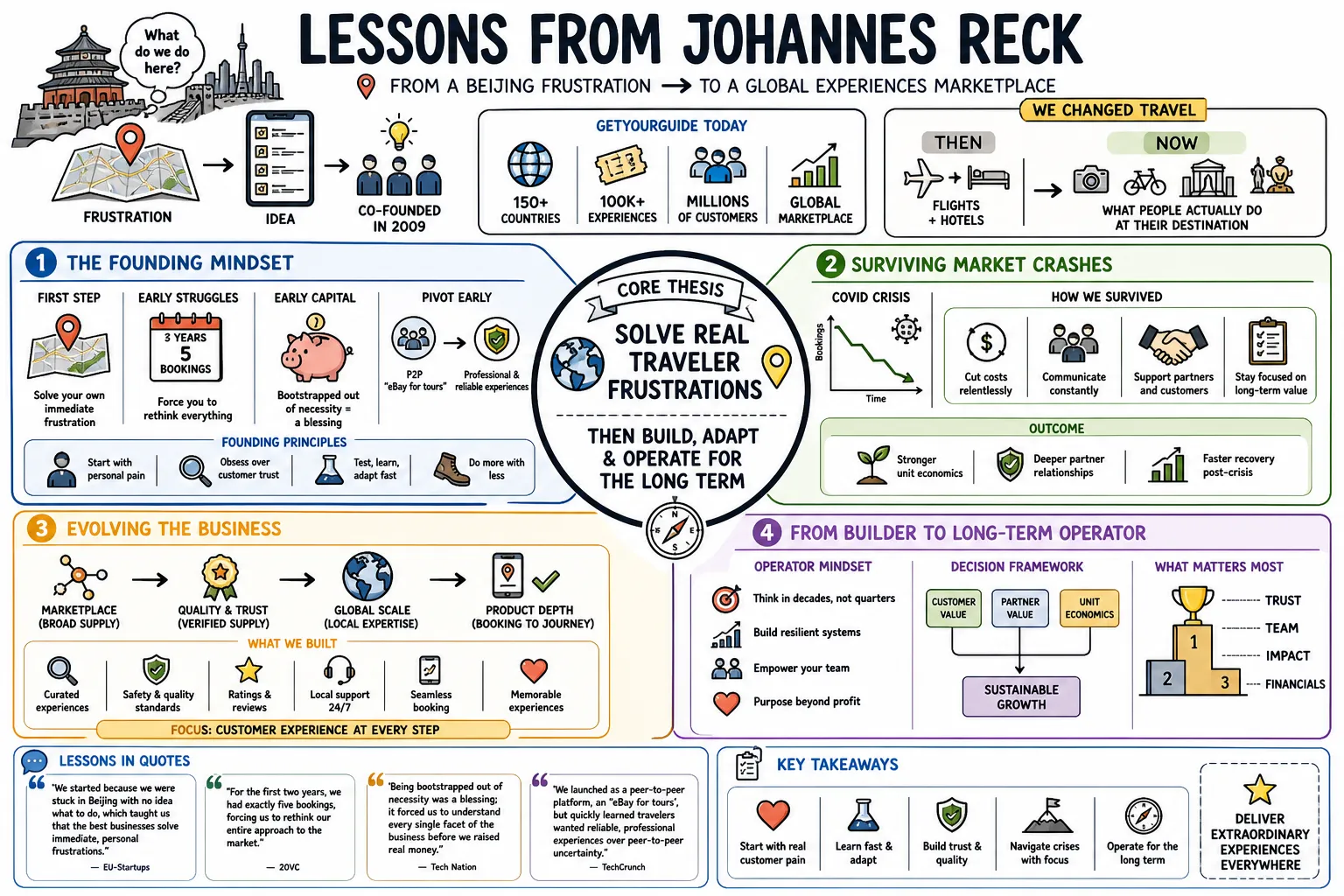
Johannes Reck co-founded GetYourGuide in 2009 after a frustrating trip to Beijing left him unable to find reliable local activities. He built the company into a global marketplace, pushing the travel industry to focus on what people actually do at their destinations rather than just flights and hotels. This collection gathers his notes on bootstrapping a startup, surviving market crashes, and evolving from an early-stage builder into a long-term operator.
Part 1: The Founding Mindset
- On taking the first step: "We started because we were stuck in Beijing with no idea what to do, which taught us that the best businesses solve immediate, personal frustrations." — Source: EU-Startups
- On early struggles: The 20VC episode description captures how brutally slow the start was: GetYourGuide logged only five bookings in its first two years, which forced Reck and the team to keep reworking the model until the marketplace actually fit traveler demand. — Reference: 20VC episode description on GetYourGuide getting only five bookings in its first two years
- On early capital: "Being bootstrapped out of necessity was a blessing; it forced us to understand every single facet of the business before we raised real money." — Source: Tech Nation
- On pivoting: "We launched as a peer-to-peer platform, an 'eBay for tours', but quickly learned travelers wanted reliable, professional experiences over amateur guides." — Source: Medium
- On founders rolling up their sleeves: "In the beginning, you have to do everything—coding, customer service, sales, and logistics. It builds the foundation for how you will scale." — Source: Billion Success
- On conviction: "The biggest regrets are the decisions you didn't dare to make." — Source: Tech Nation
- On surviving doubt: "When we started, experiences were an afterthought in tourism. We had to hold onto the belief that they represented a core human need for connection." — Source: GetYourGuide Press
- On early rejections: "We faced hundreds of rejections from investors before anyone believed in the model. You have to treat no as a starting point." — Source: The Delta
- On long-term focus: "Building a category-defining company is a marathon. The initial sprint only gets you to the starting line." — Source: Highland Europe
Part 2: Leadership and Transition
- On evolving as a CEO: "My role shifted from doing everything to enabling others." — Source: Tech Nation
- On letting go: "As we scaled, I had to learn to trust the team and focus on vision rather than execution. The company can only grow as fast as you let go." — Source: Tech Nation
- On the founder transition: "The transition from builder to leader is not natural for founders. We are wired to be in the details." — Source: Tech Nation
- On setting direction: "As you move past the early stage, your primary job is communicating where the ship is headed, not rowing." — Source: The Delta
- On organizational agility: "You have to maintain a mindset of growth over comfort, encouraging teams to navigate changes quickly and follow through." — Source: GetYourGuide Careers
- On making hard choices: "Leadership often means making the decisions that no one else wants to make, especially when the path forward is ambiguous." — Source: Forbes
- On self-awareness: In the same 20VC conversation, Reck says the post-Series A attention made him feel like a celebrity and led to some of his biggest mistakes, a reminder that founders need to notice when outside validation is distorting their judgment. — Reference: 20VC transcript on fundraising attention leading to Reck's biggest mistakes
- On managing expectations: "You need to be completely honest with your team about what is working and what is failing. Sugarcoating delays fixes." — Source: The Delta
- On defining values: "We had to write down our guiding principles so the organization could make decisions without me being in the room." — Source: GetYourGuide Careers
- On staying grounded: In GetYourGuide's Phocuswright recap, Reck brushes off exit chatter and says the experiences industry is still early enough that the real job is customer innovation, not financial victory laps. — Reference: GetYourGuide Phocuswright recap on focusing on customer innovation over exit talk
Part 3: Navigating Crisis
- On total revenue collapse: "During the pandemic, our revenue went from a €200 million run rate to almost zero in weeks. It forced a total reevaluation of how we operate." — Source: The Delta
- On radical transparency: "I sent weekly emails detailing our challenges and shared our actual bank account balance with the entire company so everyone knew exactly where we stood." — Source: The Delta
- On avoiding mass layoffs: "Despite pressure to cut deep and fast, we viewed our team as a long-term asset. We refused to adopt a hire-and-fire mentality." — Source: GetYourGuide Careers
- On momentum during stagnation: "We implemented a 'wave strategy' to keep the company moving forward together, even when sales were paused." — Source: GetYourGuide Careers
- On innovating under pressure: "We used the downtime to build features like 'Beat the Crowds', keeping the team focused on what travelers would need when borders reopened." — Source: Forbes
- On the value of constraints: "We found that forcing teams to work with severe financial constraints actually led to stronger, more creative solutions than simply spending money." — Source: Highland Europe
- On the Sequoia tree mindset: "Some companies need to grow through fire. You have to treat systemic shocks as a way to burn away inefficiencies." — Source: PhocusWire
- On clear communication: "When uncertainty is highest, your communication must be the clearest. People can handle bad news, but they cannot handle silence." — Source: The Delta
- On recovering stronger: "By preserving our core team and culture, we were able to accelerate past competitors the moment demand returned." — Source: GetYourGuide Press
Part 4: The Experience Economy
- On shifting travel priorities: "The travel industry used to be about flights and hotels, but experiences are now the primary reason people decide to take a trip." — Source: GetYourGuide Press
- On the value of memories: "Travelers no longer want to just get there or stay somewhere; they are motivated entirely by the connections they make at the destination." — Source: Medium
- On market size: "The global experiences market represents hundreds of billions of euros. It is the largest untapped segment in the travel industry." — Source: GetYourGuide Press
- On moving away from commodities: "Flights and beds are commodities. What you do with your time is the actual product." — Source: PhocusWire
- On the guided future: "The future of travel is guided. Travelers want curated discovery to avoid tourist traps and experience authentic local culture." — Source: Top 100 Startups
- On digitizing supply: "We had to take a fragmented industry relying on paper ledgers and phone calls and bring it online." — Source: GetYourGuide Careers
- On creating categories: "Experiences went from being the forgotten stepchild of travel planning to the very first thing people book." — Source: Skift
- On consumer spending: "People are traveling seven to eight times a year now and dedicating a larger share of their budget to what they do rather than how they sleep." — Source: GetYourGuide Press
- On standardizing quality: In the TechCrunch Disrupt recap, Reck says GetYourGuide's edge is offering vetted, recommended experiences while helping operators improve itineraries with the company's knowledge, data, and capital. — Reference: GetYourGuide TechCrunch Disrupt recap on vetted experiences and operator improvement
- On building exclusive content: "By investing in 'Originals', we created exclusive inventory that drives higher satisfaction and gives people a reason to come directly to us." — Source: PhocusWire
Part 5: Hiring and Team Culture
- On the early hiring trap: "After Series A, I made the mistake of hiring shiny talent from big tech companies. They had impressive resumes but were entirely wrong for our stage." — Source: Tech Nation
- On culture-market fit: "Culture-market fit matters just as much as product-market fit. The team has to match the specific chaos of the environment." — Source: Tech Nation
- On shared passion: "We look for modern explorers. A shared passion for travel creates an alignment that no corporate process document ever could." — Source: Tech Nation
- On the building mindset: "Our foundational culture is the building mindset. We want people who are hungry and willing to actually construct the solutions." — Source: Billion Success
- On internal promotion: In the 20VC transcript, Reck says that after layoffs and a reset he promoted the best people already inside the company rather than hiring expensive outside executives, calling it one of the best decisions he made. — Reference: 20VC transcript on promoting the best internal people instead of hiring outside executives
- On interviewing for drive: "You have to prioritize hunger and curiosity over pedigree. Skills can be taught; the drive to solve hard problems cannot." — Source: Top 100 Startups
- On remaining involved: "For key leadership roles, the founders must remain directly involved in the interview process to protect the core vision." — Source: GetYourGuide Careers
- On alignment: "A cohesive culture acts as the operating system for your company. It tells people how to act when you aren't watching." — Source: Billion Success
- On managing performance: "You have to run the company on data. Passion gets people in the door, but data drives actual productivity and scale." — Source: Billion Success
Part 6: Scaling and Growth
- On platform dynamics: "A marketplace relies on a flywheel. More travelers attract more operators, which improves selection and draws even more travelers." — Source: Tech Nation
- On fragmentation as an advantage: "The extreme fragmentation of the tours industry made it difficult to build, but it also created a massive moat once we achieved scale." — Source: PhocusWire
- On sustainable unit economics: "You cannot subsidize your way to a lasting marketplace. The value proposition for both the supplier and the customer has to make fundamental sense." — Source: The Delta
- On capital constraints: "Having less money forces you to build a better business. It eliminates the temptation to buy temporary growth." — Source: Highland Europe
- On localizing supply: "Scaling a global travel platform requires winning market by market. You have to acquire the best local inventory before you can market to global tourists." — Source: GetYourGuide Careers
- On shifting bottlenecks: "As a company scales, the bottleneck moves from product to distribution to organizational design. You have to constantly hunt for the new constraint." — Source: Tech Nation
- On pacing growth: Reck says in the 20VC interview that GetYourGuide went too broad, hired people who were wrong for the company's stage, and watched expenses spiral while growth cooled, which is a sharp lesson in matching pace to stage-fit. — Reference: 20VC transcript on hiring too broadly for the company stage and cooling growth
- On competitive moats: "True scale in travel comes from integrating directly with the point-of-sale systems of thousands of independent operators." — Source: PhocusWire
- On milestone metrics: "Reaching profitability was less about the specific financial number and more about proving that the operational model was permanently self-sustaining." — Source: GetYourGuide Press
Part 7: The Role of Technology and AI
- On the limits of text search: Skift quotes Reck arguing that travel search still works like a pile of destinations and filters, which is too mechanical to capture what travelers actually want out of a trip. — Reference: Skift on Reck criticizing travel search as mechanical filters
- On AI curation: In the same Skift interview, Reck says the opportunity for AI is to move search beyond blue-link style filtering and toward recommendations shaped by how a traveler wants to feel at a destination. — Reference: Skift on using AI to recommend experiences based on how travelers want to feel
- On immersive planning: "AI should generate tailored itineraries featuring rich media that actually resonate with the traveler's emotions." — Source: Skift
- On reducing friction: "Technology in travel should be invisible. The goal is to remove the logistical friction so the customer only experiences the joy of the activity." — Source: Tech.eu
- On supplier infrastructure: "We aren't just a consumer app; we provide the backend infrastructure that allows small tour operators to manage their entire digital business." — Source: GetYourGuide Careers
- On machine learning for discovery: In his Skift Global Forum talk, Reck says richer travel content creates data signals that let GetYourGuide train AI on which kinds of experiences actually work for different customers. — Reference: Skift Global Forum transcript on using data signals to train AI for travel recommendations
- On the evolution of booking: "The transition from physical tickets to mobile barcodes took a decade, but AI will change the discovery phase in a fraction of that time." — Source: Skift
- On engineering focus: "Our product teams are structured to solve specific traveler pain points rather than simply shipping isolated features." — Source: GetYourGuide Careers
- On staying ahead: "If you view technology merely as a way to lower costs, you miss the opportunity to completely redefine the customer experience." — Source: PhocusWire
Part 8: Customer Obsession
- On the core directive: "The most powerful advice we follow is simple: only do what customers love. It forces you to ignore distractions." — Source: Billion Success
- On shifting focus: "You have to actively train the organization to act customer-first, rather than company-first. It is a constant battle against internal gravity." — Source: Billion Success
- On solving real problems: "We only succeeded because we stopped trying to sell a theoretical marketplace and started fixing the actual pain of booking a tour in a foreign city." — Source: Medium
- On reading reviews: "If you want to know what is broken in your company, you don't need a consultant. You just need to read your lowest customer reviews." — Source: The Delta
- On prioritizing reliability: Reck's TechCrunch Disrupt remarks frame GetYourGuide as a company that wins by delivering a seamless journey and surfacing vetted recommendations, because trust in the experience matters more than just listing inventory. — Reference: GetYourGuide TechCrunch Disrupt recap on seamless journeys and vetted recommendations
- On localized support: "Customer obsession means recognizing that a booking issue in Rome requires a different solution than a booking issue in Tokyo." — Source: GetYourGuide Careers
- On the value of curation: "Having endless choice actually paralyzes the customer. Obsession means doing the hard work of curation for them." — Source: PhocusWire
- On post-purchase experience: "The transaction is just the beginning. The real metric of success is whether the customer actually enjoyed the three hours they spent on the tour." — Source: Medium
- On anticipating needs: "Great products solve problems before the customer even realizes they have them. That requires deep empathy for the travel experience." — Source: GetYourGuide Press
- On long-term loyalty: "You build a multi-billion euro business by ensuring that every single vacation is slightly better because your app was on the customer's phone." — Source: Skift