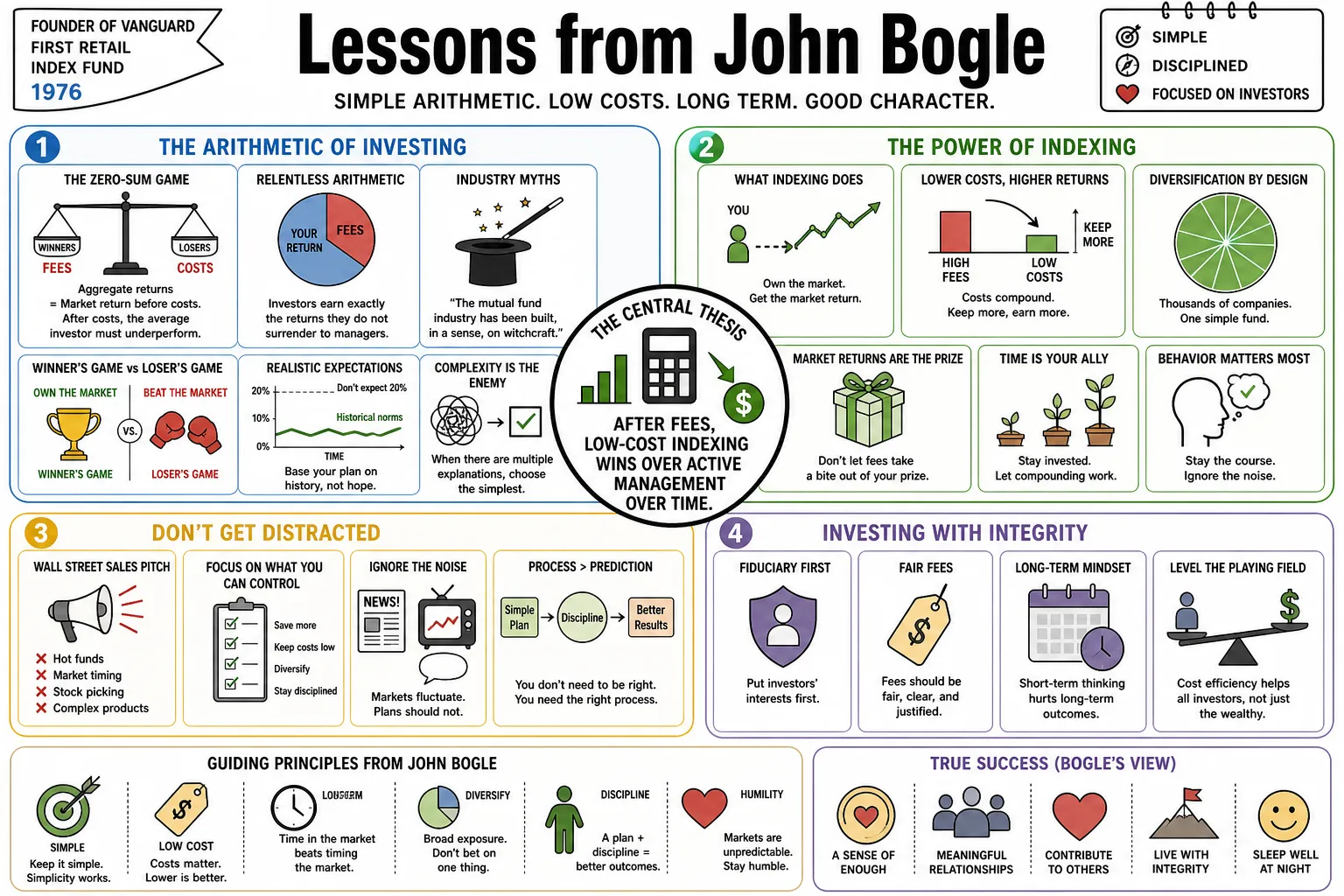
Lessons from John Bogle
John C. Bogle founded Vanguard and created the first retail index mutual fund. He argued that broad ownership, low costs and patience help investors retain more of the returns businesses generate, while fiduciary service and a sense of enough matter beyond portfolio performance. — Bogle Archive.
Part 1: The Arithmetic of Investing
- On the zero-sum game: Investors collectively earn the market’s gross return before intermediation costs; fees, trading and taxes reduce the net return they share. — Relentless Rules of Humble Arithmetic.
- On industry myths: Bogle warned that elaborate financial strategies can look like a perfect plan while adding cost and failing to deliver; simplicity is often the more robust choice. — The Dream of a Perfect Plan.
- On market beating: Owning the market over the long run captures the returns generated by businesses, whereas collectively trying to beat it turns into a loser’s game after intermediation costs. — Relentless Rules of Humble Arithmetic.
- On realistic expectations: Build expectations from dividends, earnings growth and current valuations rather than assuming unusually high past returns will repeat. — Character Counts.
- On financial complexity: When several reasonable investment plans are available, Bogle favors the simplest diversified, low-cost one consistent with the investor’s own circumstances. — Twelve Pillars of Wisdom.
- On the basic formula: Bogle’s core index-fund idea was to own the broad stock market at low cost and hold it for the long term. — As the Index Fund Moves from Heresy to Dogma.
- On fighting the last war: Do not make a new investment strategy merely because a stock, fund or asset class won the last cycle; consider how circumstances and risks have changed. — Twelve Pillars of Wisdom.
- On avoiding errors: Bogle argues that successful investing requires a few sound choices and avoidance of serious mistakes, not extraordinary market-forecasting skill. — Twelve Pillars of Wisdom.
Part 2: The Logic of the Haystack
- On diversification: Broad diversification reduces the risks tied to individual securities and styles, although it cannot eliminate market risk. — Twelve Pillars of Wisdom.
- On the illusion of perfection: Bogle applied a maxim he attributed to von Clausewitz: the search for a perfect plan can keep investors from following a workable, simple one. — The Dream of a Perfect Plan.
- On discipline: Set an allocation that fits your risk tolerance and circumstances, then make only infrequent, deliberate adjustments rather than reacting to daily prices. — Twelve Pillars of Wisdom.
- On evaluating ETFs: Bogle treated the ETF as an effective trading product but questioned whether its ease of trading improved long-term investor outcomes. — As the Index Fund Moves from Heresy to Dogma.
- On proper ETF usage: A broad-market, low-cost ETF can serve the same long-term purpose as an index mutual fund if the investor holds it rather than repeatedly trades it. — As the Index Fund Moves from Heresy to Dogma.
- On sector betting: Narrow sector and style funds add concentration and timing risks that a broad-market fund avoids. — As the Index Fund Moves from Heresy to Dogma.
- On market efficiency: Judge an index product by diversification, cost and how it is likely to be used; the ETF label alone does not make it a sound long-term holding. — As the Index Fund Moves from Heresy to Dogma.
- On winning managers: Past winning active funds have often lost their lead in the following period, so a strong track record alone cannot reliably identify tomorrow’s winners. — The Dream of a Perfect Plan.
Part 3: The Tyranny of Costs
- On compound interest: Costs compound against investors: a recurring fee reduces not only this year’s return but also the future growth on money no longer invested. — Relentless Rules of Humble Arithmetic.
- On paying for nothing: The portion of the market return that investors do not surrender to fund fees, trading costs or avoidable taxes remains theirs to compound. — In Investing, You Get What You Don’t Pay For.
- On long-term fee damage: In a modeled retirement example, Bogle estimated that high all-in active-fund costs could consume roughly two-thirds of the potential wealth accumulation over an investment lifetime; the exact outcome depends on assumptions. — Senate Finance Committee Testimony.
- On value extraction: Bogle argues that a fund industry rewarded by fees and asset gathering can extract returns from clients unless its structure and duties put investors first. — The Fiduciary Principle.
- On the true enemies: High expenses reduce returns directly, while emotional reactions to market swings can lead investors to abandon a sound plan at the wrong time. — Twelve Pillars of Wisdom.
- On active trading costs: For the 100 largest ETFs in 2015, Bogle calculated 864% annualized share turnover; that historical figure describes trading of ETF shares, not turnover of the securities inside every ETF. — The Index Mutual Fund at 40.
- On guaranteed losses: Bogle distinguished useful low-cost active management from frequent, costly speculation; as a group, investors who trade against one another lose more to costs. — As the Index Fund Moves from Heresy to Dogma.
Part 4: Investment versus Speculation
- On market noise: Daily stock-price noise can distract investors from the long-term returns of businesses and from the allocation they chose for their needs. — Twelve Pillars of Wisdom.
- On defining the terms: Bogle separates investment return—dividends and earnings growth—from speculative return driven by changing valuations and short-term investor expectations. — Relentless Rules of Humble Arithmetic.
- On real-time trading: Bogle questioned the advertised ability to trade an index throughout the day because instant liquidity can invite speculation rather than improve a long-term plan. — As the Index Fund Moves from Heresy to Dogma.
- On true wealth creation: The durable source of stock-market wealth is ownership of companies and their earnings over time, not investors’ collective buying and selling of the same shares. — Relentless Rules of Humble Arithmetic.
- On leverage: Bogle warned that triple-leveraged and narrowly specialized ETFs were speculative products, not substitutes for a broad-market index fund designed to be held long term. — The Index Mutual Fund at 40.
- On ETF marketing: Bogle warned that product innovation driven by marketing appeal can conflict with investment integrity and the duty to offer useful funds to clients. — The Fiduciary Principle.
- On short-term renting: Short-term trading weakens the incentive to exercise the responsibilities of corporate ownership; long-horizon institutional owners should vote and engage on behalf of their clients. — The Ownership of Corporate America.
- On passive funds: The portfolio inside an index ETF may be passively managed while its shares are actively traded; Bogle cared about the investor’s behavior as well as the fund’s design. — As the Index Fund Moves from Heresy to Dogma.
- On intraday pricing: Intraday ETF trading can turn a diversified index position into a short-term bet on price movements, even though the underlying portfolio tracks a broad market. — As the Index Fund Moves from Heresy to Dogma.
Part 5: Reversion to the Mean
- On the iron law: Bogle’s mean-reversion examples warn that exceptional market or fund returns may not persist; he treats the pattern as a caution against extrapolation, not a calendar for prediction. — Twelve Pillars of Wisdom.
- On chasing performance: Choosing a fund solely because it recently outperformed is unreliable; Bogle showed how prior top-quartile funds often lost their lead in later decades. — The Dream of a Perfect Plan.
- On temporary winners: A strategy that looks dominant in one measured period can disappoint in the next; Bogle’s WBI example cautions against extrapolating a recent winner over centuries. — Numbers Games.
- On cyclical trends: In Bogle’s study of 40 top-performing funds in the 1980s, 39 saw their margin over the market shrink in the 1990s and 30 fell below the market; this is an example, not a universal law. — The Dream of a Perfect Plan.
- On market timing: Bogle cautions that investors rarely know when to exit a market decline and then re-enter at the right moment; a suitable allocation reduces the need for those paired forecasts. — Twelve Pillars of Wisdom.
- On the futility of prediction: A recent backtest or fund record is a fragile guide to future returns; examine the period, assumptions, risk and costs before treating it as predictive. — Numbers Games.
- On accepting reality: A diversified portfolio still bears market risk; the investor should choose an allocation that fits risk tolerance, time horizon, wealth and income needs. — Twelve Pillars of Wisdom.
- On basic truths: Over very long periods, Bogle links stock returns chiefly to dividend yield and earnings growth, while valuation changes can dominate shorter periods. — Relentless Rules of Humble Arithmetic.
Part 6: Emotion, Patience, and Time
- On time horizons: Time allows compounding to work; impulsive responses to temporary price moves can interrupt a long-term investment program. — Twelve Pillars of Wisdom.
- On action vs. inaction: In his costs parable, Bogle reverses Wall Street’s call to action: investors as a group often benefit by trading less and letting business returns compound. — Relentless Rules of Humble Arithmetic.
- On temperament: Temperament matters when prices rise or fall sharply; a plan aligned with one’s risk capacity is easier to hold through market extremes. — Twelve Pillars of Wisdom.
- On self-sabotage: Investors can undermine their own returns by chasing hot funds or making short-term trades in response to fear and excitement. — Twelve Pillars of Wisdom.
- On ordinary virtues: Bogle’s investing guidance emphasizes common sense, realistic expectations, thrift on costs, patience and perseverance rather than a complicated secret. — Twelve Pillars of Wisdom.
- On market storms: Bogle urges long-term investors to stay with a suitable program through turbulent markets, while adjusting it when their own needs or circumstances genuinely change. — Twelve Pillars of Wisdom.
- On coping with loss: Stocks can suffer substantial losses even within a diversified index; anyone unable to tolerate that risk should choose a more conservative stock–bond allocation. — Twelve Pillars of Wisdom.
Part 7: Corporate Governance and Fiduciary Duty
- On the ultimate rule: Bogle uses the principle that one cannot serve two masters to criticize fund-adviser conflicts and argue that managers must act for investors rather than themselves. — The Fiduciary Principle.
- On the industry's failure: An investor-first fund structure should put the shareholder’s interests ahead of the manager’s asset growth, fees and product sales. — The Fiduciary Principle.
- On corporate democracy: Bogle argues that corporate owners should be able to assert their authority through director elections and shareholder proposals rather than defer automatically to management. — Creating Sound Governance.
- On silent managers: Bogle criticized private fund managers that stayed silent on proxy access and other governance questions despite voting shares on behalf of their fund investors. — The Ownership of Corporate America.
- On the power of institutions: Large institutions collectively hold substantial voting power, which Bogle argued they should exercise as responsible long-term owners for their clients. — The Ownership of Corporate America.
- On board responsibility: Corporate directors should represent shareholders and provide independent oversight rather than function as an extension of the chief executive. — Creating Sound Governance.
- On salesmanship vs. stewardship: Bogle contrasts stewardship of other people’s savings with a product-sales culture that prioritizes marketing appeal or adviser revenue. — The Fiduciary Principle.
- On a national standard: Bogle called for a federal fiduciary standard for institutional money managers so that investor interests would be a binding obligation, not merely a marketing claim. — Senate Finance Committee Testimony.
Part 8: Leadership, Character, and Enough
- On true wealth: Bogle argues that wealth, fame and power alone are shallow measures of success; service, integrity and contribution to others matter more. — The Right Kind of Success.
- On satisfaction: Bogle uses Joseph Heller’s “enough” remark, relayed by Kurt Vonnegut, to question whether accumulating ever more money is a sufficient aim for a life or career. — Enough — Georgetown Address.
- On metrics vs. trust: Bogle uses measurable costs and returns to test whether financial firms serve clients, but insists that integrity and client-first conduct remain central to their character. — Character Counts.
- On managing vs. leading: Bogle describes leadership as choosing the long-term right course, earning trust and communicating a clear purpose—not merely following a process correctly. — Triple Crown Leadership Interview.
- On humility: Bogle tells a direct interviewer that success depends on luck and other people; he rejects the claim that anyone accomplishes everything alone. — Philadelphia Inquirer Interview.
- On equality: Bogle urges decency and warns against treating wealth or status as proof that one is better than others. — Philadelphia Inquirer Interview.
- On authenticity: Bogle advises leaders to be themselves because people can spot inauthenticity; his own original wording differs from the profile’s alleged quotation. — Leadership: Creating a Firm With Character.
- On respecting workers: Bogle says to treat people as equals and give more credit to those doing the hard work rather than demeaning them. — Philadelphia Inquirer Interview.
- On the bottom line: For Bogle, integrity, service to others and professional obligation are foundations of a financial firm, not decorative values to invoke while putting clients second. — Character Counts.