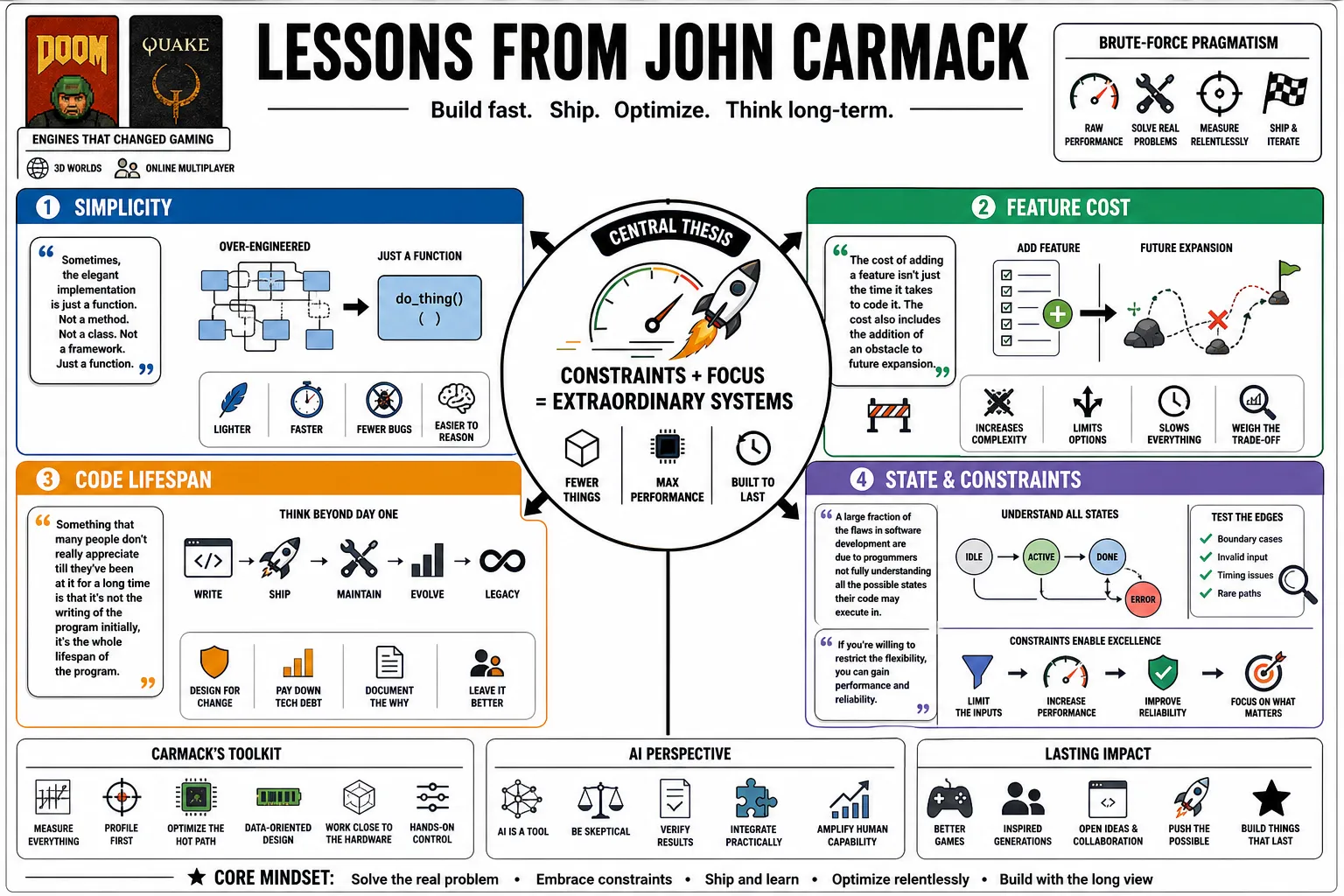
John Carmack developed core technology behind Doom and Quake and later worked in virtual reality and artificial general intelligence. His interviews and writing show an engineer attentive not only to performance, but also to maintainability and the value software delivers to users. This collection examines those ideas in his own words and documented work. — Lex Fridman Podcast #309.
Part 1: Programming & Architecture
- On Simple Functions: Carmack finds value in isolating a difficult computation as a pure function with explicit inputs and outputs. In his C++ practice, that can make a tricky piece of code easier to test and understand without requiring a wholesale change of language or architecture. — Functional Programming in C++.
- On Feature Cost: A feature's true cost includes the future work it makes harder. Carmack described how Quake's auto-animation complicated its model format and deterred more useful later features. — Carmack's 1997 .plan.
- On Code Lifespan: The first implementation is only one part of a program's life. Carmack emphasizes whether the software can bend and adapt as situations change over time. — Lex Fridman Podcast #309.
- On State and Flaws: Carmack argues that many software flaws arise when programmers do not understand all the states their code can enter. Making state explicit helps them reason about those possibilities. — Functional Programming in C++.
- On Useful Constraints: Carmack looks for a system-level trade-off: give up an assumed requirement when doing so creates a larger gain elsewhere. That approach informed work he describes in games, VR, and aerospace. — Lex Fridman Podcast #309.
- On Functional Programming: A functional style makes the state supplied to a function more explicit and easier to reason about. Carmack notes that a completely pure system avoids thread races, while real C++ programs still require attention to externally mutable data and performance tradeoffs. — Functional Programming in C++.
- On User Value: Carmack says developers should judge their work by the value it delivers to users, not by pride in a particular architecture or technical achievement alone. — Lex Fridman Podcast #309.
- On Automated Guardrails: In a large codebase, good intentions alone cannot keep every problematic pattern out. Carmack advocates automated guardrails, including static types and assertions, to catch recurring mistakes. — Lex Fridman Podcast #309.
- On Automated Guardrails: In sufficiently large programs, Carmack says patterns allowed by a language will eventually appear despite good intentions. He therefore favors automated checks such as static types and assertions when software must be maintained and deployed widely. — Lex Fridman Podcast #309.
Part 2: Optimization & Performance
- On Old Hardware: In a 2025 thought experiment, Carmack argued that much software could run on older hardware if optimization became an economic priority. He also warned that scarce compute would make innovative new products rarer. — Carmack's 2025 hardware post.
- On Abstraction Costs: Carmack warns that abstractions can become a burden when maintainers must first learn a custom layer before changing code. He weighs that cost against the benefit instead of rejecting abstraction categorically. — Lex Fridman Podcast #309.
- On Proportionate Engineering Rigor: Carmack distinguishes a quick experiment from software expected to run for years and serve millions. Rough prototypes can be acceptable; long-lived products with other contributors deserve stronger analysis and automated checks. — Lex Fridman Podcast #309.
- On Future-Proofing: Carmack says broad future-proofing rarely pays off when it is detached from a real product. At id Software he built games first, then reused technology that proved useful beyond the original game. — Carmack's Connect 2021 talk.
- On Building to Test Ideas: Carmack urges people with promising ideas to build prototypes and test them early. Working through the implementation exposes flaws and can generate better ideas; merely holding a compelling idea in mind does not. — Carmack's Deep Thoughts engineering talk.
- On VR Responsiveness: For some VR experiences, Carmack treats low latency as essential to responsiveness. In Connect 2021 he pointed to table tennis players noticing even small controller-prediction errors and to voice-delay improvements that made virtual meetings feel more immediate. — Carmack's Connect 2021 talk.
- On 2007 Mobile Java: Discussing mobile games in 2007, Carmack preferred Qualcomm's native BREW platform to the Java phone platforms then available because BREW gave developers more direct hardware access and richer game capabilities. He also noted that Java reached a much larger market. — Carmack mobile-game interview archive.
- On Craftsmanship: Carmack finds fulfillment in developing deep craft. He suggests that sustained attention can reveal interest and complexity even in work that did not initially seem appealing. — Lex Fridman Podcast #309.
- On VR Audio Latency: Carmack treated voice latency as a product-level VR problem, pointing to the improvement from a redesigned Workrooms audio stack and urging work on low-level DSP processing to cut another roughly hundred milliseconds. — Carmack's Connect 2021 talk.
Part 3: Problem Solving & Engineering Mindset
- On Testing Alternatives: When two implementation approaches are plausible, Carmack recommends trying both and comparing the results rather than relying on abstract debate. — Carmack's Ion Storm commentary.
- On Weaponized Curiosity: Carmack calls curiosity something you can deliberately deploy: exploring the layers of a field can reveal useful opportunities even when the subject does not immediately appeal to you. — Lex Fridman Podcast #309.
- On Stress-Testing Ideas: Carmack tries to challenge a promising idea early, before it turns into a pet idea he feels obliged to defend. He treats finding a flaw as progress toward a better solution, not a failure of creativity. — Carmack's Deep Thoughts engineering talk.
- On Epiphanies: Carmack cautions against treating a breakthrough moment as the main source of great work. In his experience, sustained labor and integrating what one already knows usually matter more. — FiringSquad interview.
- On Fallible Code: Carmack says recurring mistakes are normal even in experienced programmers' code. He favors automated checks and assertions because confidence and good intentions alone will not catch every flaw. — Lex Fridman Podcast #309.
- On Preparation: Carmack advises building a broad set of tools, staying aware as the world changes, and looking for opportunities to apply those tools rather than pursuing a single fixed goal blindly. — Lex Fridman Podcast #309.
- On Rocket Engineering and Industry Structure: Carmack challenged the mystique around rocket science while distinguishing suborbital flight from the much harder orbital problem. He argued that established aerospace incentives made experimentation difficult, much as successful game studios can become constrained by what already works. — GameSpy's QuakeCon 2003 Carmack interview.
- On Reliable Rocket Iteration: In Armadillo's early flight tests, crashes and catalyst-pack redesigns delayed a planned manned hop. Carmack treated repeatable back-to-back operation as a prerequisite before putting a person on the vehicle. — Carmack's archived Slashdot posts.
- On Software Patents: Carmack objected to software patents that could prevent a programmer from using a solution reached independently by ordinary reasoning. He said he did not know an easy technical fix and refused to patent his own work. — Knee Deep in John Carmack interview.
- On Entering an Unfamiliar Field: Carmack approached AGI from outside the field by studying its foundations and testing whether he could contribute. He openly acknowledged blind spots and the achievements of established researchers while deciding to commit to the work. — Lex Fridman Podcast #309.
Part 4: Focus & Work Ethic
- On Focused Work: Carmack argues that sustained, focused work and repeatedly taking the next concrete step matter more than waiting for inspiration. — Carmack's Ion Storm commentary.
- On Protecting Focus: After Armadillo Aerospace fell short of its suborbital goal, Carmack concluded that splitting his effort between id Software and the rocket venture had limited what he could contribute. He said that, for himself, a serious return to rocketry would require full-time focus. — Joe Rogan Experience #1342.
- On Working Hours: Carmack believes extra hours can advance work a person considers important, but he distinguishes that view from saying everyone should work long hours and acknowledges personal limits and other priorities. — Lex Fridman Podcast #309.
- On Chosen Obsession: Carmack sees creative power in people who choose to devote exceptional effort to a life's work. He also acknowledges that his founder's freedom shapes that view and that overworked employees may face a different reality. — Joe Rogan Experience #1342.
- On Fatigue Limits: Carmack says his own programming judgment deteriorates after roughly 12 hours, so he avoided the all-night marathons some peers could manage. He stresses that people differ. — Lex Fridman Podcast #309.
- On Sleep: Even during periods of long working hours, Carmack says he tries to get eight hours of sleep because he does worse work without it. He frames this as what works for him, not a prescription for everyone. — Lex Fridman Podcast #309.
- On Immersion in a New Problem: When learning a new programming paradigm or technology, Carmack says sustained immersion has sometimes carried into his dreams. He regards those dreams as a sign that he is absorbing and synthesizing the subject, not as a required method for everyone. — Joe Rogan Experience #1342.
- On the Grind: Carmack advises people excited by technical opportunity to accept the hard work of understanding a field, while staying ready to use what they learn when opportunities arise. — Lex Fridman Podcast #309.
- On Learning Retreats: To understand machine learning more deeply, Carmack described taking a week with a computer and reference materials to reimplement fundamentals before speaking seriously with researchers. — Dallas Innovates Q&A.
Part 5: Management, Teams & Process
- On Organizational Efficiency: In his 2022 Meta departure memo, Carmack said Quest 2 was a valuable product but criticized the organization's inability to turn its people and resources into faster progress. He acknowledged that his own influence had been limited. — Carmack's Meta departure memo.
- On Public Work Logs: At id Software, Carmack turned his Unix .plan file from a personal to-do list into short work logs and technical notes that fans could follow. It became an early public record of what he was building. — Lex Fridman Podcast #309.
- On Deadlines: Carmack later recanted id Software's 'it'll be done when it's done' approach for major delays: a month or two may be acceptable, but a year or two can mean the team should be making a different game. — WIRED Doom Q&A.
- On Programming Skill in Large Projects: Discussing flexible scripting in a large game project, Carmack cautioned that handing programming work to people without strong programming skills can impose costs later. His point concerned responsibility for consequential code in a complex project, not a blanket dismissal of non-programmers. — QuakeCon 2011 Carmack keynote.
- On Builders and Learning: Carmack asked whether it is easier to motivate a knowledgeable person who does nothing or educate an inexperienced person who actually builds. In context, he was discussing an amateur rocketry project and valued tangible progress over credentials alone. — Carmack's archived Slashdot posts.
- On Many Smart Decisions: Carmack says good development is usually the result of hundreds of sound decisions throughout a project, not one brilliant decision at the start. He illustrates this with Quake III's long list of possible improvements. — FiringSquad interview.
- On Product Skills Beyond Coding: Asked whether AI would make a coding career obsolete, Carmack advised developing broad product skills and using whatever tools best deliver value. The lesson is about the outcome for users, not allegiance to hand-written code. — Carmack's product-skills exchange (archived image).
- On Staying Close to Engineering: Carmack said he was happiest doing direct technical work and did not want a management role to pull him away from building. He recognized the value of management while explaining his own preference for hands-on engineering. — FiringSquad's Carmack interview.
- On Caring About Products: Carmack ended his Meta departure memo by urging better decisions and more care in finished products. That appeal followed a critique of organizational inefficiency, not a generic instruction simply to work harder. — Carmack's Meta departure memo.

Part 6: Virtual Reality & The Metaverse
- On Screens in VR: Carmack proposed that shared virtual spaces with flexible screens might be a strong practical use for VR, alongside VR-native games. — Carmack's Connect 2021 talk.
- On the Metaverse Trap: Carmack warned that a grand metaverse initiative can draw teams into abstract architecture while neglecting GPU, network, asset, and other product-level details that users actually experience. — Carmack's Connect 2021 talk.
- On Experience Over Photorealism: Carmack argued that visual metrics alone do not determine a good VR experience. He favored some simple, stylized worlds that felt convincing and valuable to users, even while continuing to improve technical fidelity. — WIRED's VR interview with Carmack.
- On Headset Friction: Carmack compared the stronger retention of Oculus Go with phone-docking Gear VR, arguing that setup friction mattered even when the phone had better components. He wanted Quest users to get into an experience much faster. — Carmack's Connect 2021 talk.
- On Building Toward the Metaverse: Carmack argued that setting out to build a metaverse in the abstract may be less effective than building useful products now and letting a larger ecosystem emerge from their proven value. — Carmack's Connect 2021 talk.
- On Product Evidence: Carmack said Horizon Worlds should be judged as a product: by how many people use it, what they do there, and whether it delivers value. He cautioned that a technology or architecture can too easily claim success when users have not benefited. — Carmack's Connect 2021 talk.
- On Standalone VR: Carmack favored lower-cost, lighter standalone headsets over making high-end PC tethering the primary route to VR adoption. He argued that extra features add price, weight, and battery demands, while broad use requires a device many people can own. — Lex Fridman Podcast #309.
- On Headset Tradeoffs: Carmack warned that adding a verifocal display could improve a headset only if the benefit justified its dollar, size, weight, thermal, and processing costs; an imperfect implementation might even worsen the visual experience. — Carmack's Connect 2021 talk.
Part 7: Artificial General Intelligence
- On AGI Code Size: Carmack has argued that the core programming needed for AGI might be only a few tens of thousands of lines—small enough, in his view, for one person to write. He presents this as a conjecture, not a known solution. — Dallas Innovates Q&A.
- On Key AGI Insights: Carmack speculates that fewer than six relatively simple insights may remain before AGI becomes possible. He presents that number as his bet, not as a known count. — Lex Fridman Podcast #309.
- On Data and Generalization: Carmack considers the counterargument that enough data could turn hard tasks into interpolation problems, but he remains uncertain whether that would resolve the long tail of autonomous driving without more general intelligence. — Lex Fridman Podcast #309.
- On Physical Embodiment: Carmack argues that an AGI need not begin with a physical body: simulated environments can provide much of the relevant learning experience, while real-world robotics adds mechanical constraints. He also sees value in robotic bodies after AGI exists. — Lex Fridman Podcast #309.
- On Animal and Human Intelligence: Carmack thinks animal intelligence is closer to human intelligence than many assume; culture and modes of communication can make the gap appear larger. — Lex Fridman Podcast #309.
- On Individual Leverage: Carmack regards AGI research as a potentially unusually high-leverage opportunity for one individual because he believes its core code and remaining insights may be comparatively small. He stresses that this is uncertain. — Lex Fridman Podcast #309.
- On Universal Remote Workers: As a hypothetical application of human-level AGI, Carmack imagines cloud-hosted artificial coworkers that a team could call on for computer-mediated work. He calls this a prosaic use case, not a product that already exists. — Dallas Innovates Q&A.
- On His AGI Timeline: In a 2023 interview, Carmack said he had raised his personal estimate from a 50% chance to about 60% that there would be early signs of AGI by 2030. He distinguished those signs from immediate large economic impact. — Dallas Innovates Q&A.
- On Substrate-Independent Intelligence: Carmack sees the brain as a biological implementation of a learning system, but argues that AI and consciousness need not use the same substrate or architecture. He treats the brain as one important existence proof, not a complete AGI blueprint. — Lex Fridman Podcast #309.
Part 8: Philosophy, Life & The Future
- On Local Progress: Carmack argues that major progress often emerges from many small steps using local information, rather than from a complete grand vision. He says attention to the here and now is an effective motivator for him. — Lex Fridman Podcast #309.
- On Evolution and Motivation: Carmack describes human motivations as shaped partly by evolution and partly by individual upbringing and experience. He says he has not found a need to search for a deeper account of meaning for himself. — Lex Fridman Podcast #309.
- On Open-Source Access and Real Barriers: Carmack valued open source because it let a developer inspect and fix a driver bug without waiting for a vendor. He also acknowledged that commercial game development had become harder and more resource-intensive. — Carmack's archived 1990s interviews.
- On Sharing Knowledge: Programming is not a zero-sum game. Teaching another programmer does not take knowledge away from you; Carmack said he shared source code for the love of programming. — Graphics Programming Black Book Foreword.
- On AI and Jobs: In an April 2025 post, Carmack argued against rejecting AI tools solely because they may displace jobs. He explicitly left open whether game development would ultimately employ more or fewer people. — Carmack's AI-tools post (archived).
- On Creative Reach: Carmack expects AI tools to help strong creators reach further, enable smaller teams, and bring new groups into game creation. He also expects dedicated teams to keep making some of the strongest work. — Carmack's AI-tools post (archived).
- On Obsolete Manual Work: Carmack compared hand-assembling machine code for his early games with work made unnecessary by later software tools. The analogy was part of his argument for developing better tools, including AI, rather than preserving old workflows for their own sake. — Carmack's AI-tools post (archived).
- On Optimism About Human Talent: In a 2020 post, Carmack explained his optimism by pointing to how many highly capable people exist beyond anyone's immediate circle. He offered this as a reason to believe people can build a better future, not as a measured count of exceptional talent. — Carmack's 2020 optimism post (archived).
- On Suborbital Ambition: Carmack described the X-Prize's suborbital flight as a trip to 100 kilometers followed by roughly ten minutes of weightlessness and a return to Earth—a very tall roller-coaster ride. He distinguished that reachable goal from the much harder task of orbit. — GameSpy's QuakeCon 2003 Carmack interview.