Lessons from John Chambers
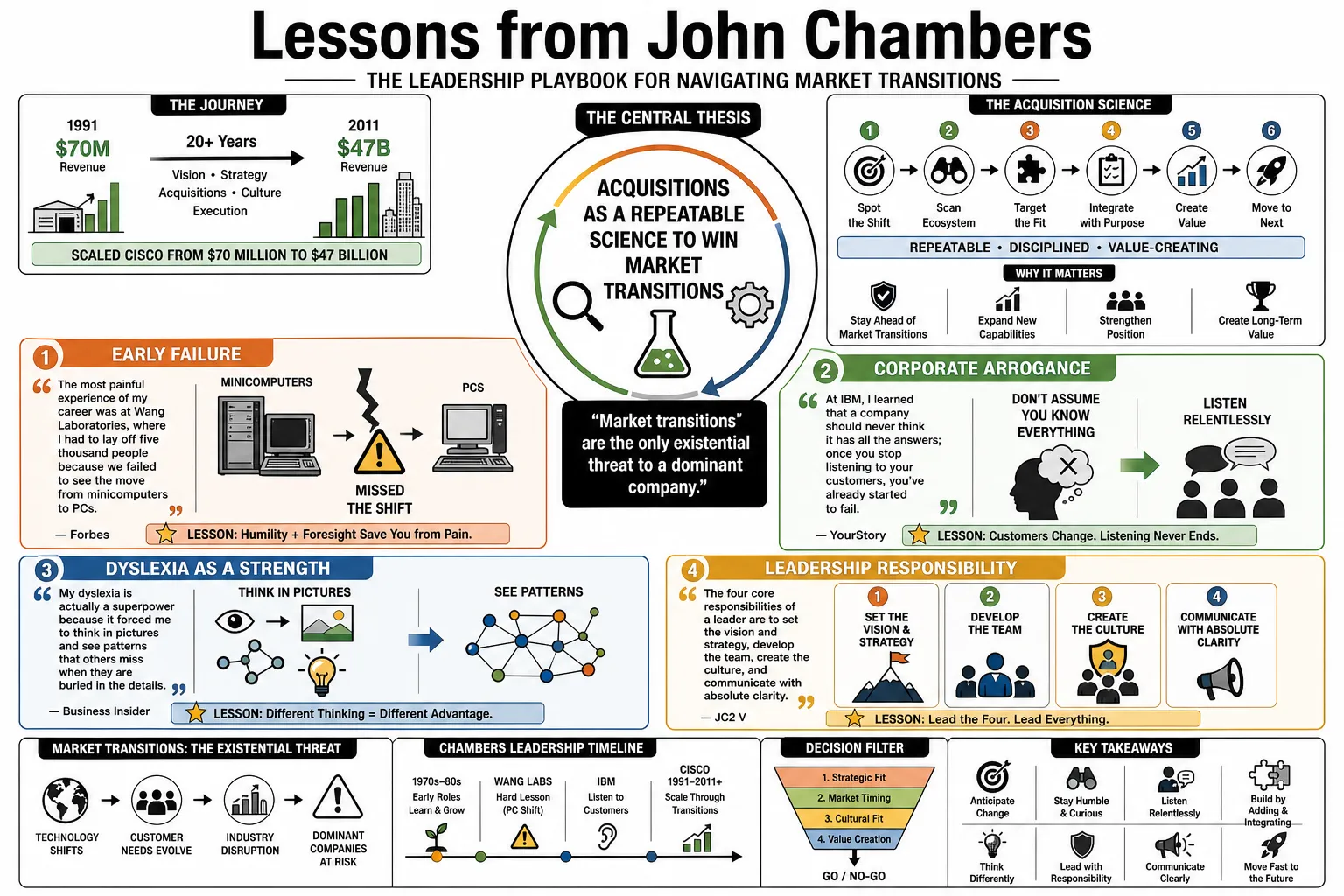
John Chambers scaled Cisco from $70 million to $47 billion by turning corporate acquisitions into a repeatable science. He famously argued that "market transitions" are the only existential threat to a dominant company. This profile breaks down the leadership playbook he used to navigate those shifts over two decades.
Part 1: The Foundations of Leadership
- On Early Failure: "The most painful experience of my career was at Wang Laboratories, where I had to lay off five thousand people because we failed to see the move from minicomputers to PCs." — Source: Forbes
- On Corporate Arrogance: "At IBM, I learned that a company should never think it has all the answers; once you stop listening to your customers, you've already started to fail." — Source: YourStory
- On Dyslexia as a Strength: "My dyslexia is actually a superpower because it forced me to think in pictures and see patterns that others miss when they are buried in the details." — Source: Business Insider
- On Leadership Responsibility: "The four core responsibilities of a leader are to set the vision and strategy, develop the team, create the culture, and communicate with absolute clarity." — Source: JC2 Ventures
- On the Leader’s Currency: "Your true currency in business consists of three things: your track record, your relationships, and the trust you have built over decades." — Source: Nasdaq
- On Strategic Planning: "I always start by writing the press release I want to see three to five years from now, and then I work backward to identify the steps needed to make it a reality." — Source: Masters of Scale
- On Personal Growth: "You are never too young to mentor someone else, and you are never too old to start a completely new chapter in your career." — Source: LinkedIn
- On High Performers: "I learned the hard way that a leader should spend more time with their top producers to accelerate their success rather than over-investing in low performers who aren't a fit for the role." — Source: Great Leadership Podcast
- On Defining Success: "You're more a product of how you handle your setbacks and your mistakes than you ever are of your successes." — Source: Accel
Part 2: Mastering Market Transitions
- On Industry Shifts: "Market transitions wait for no one; if you don't disrupt your own business model, a competitor eventually will do it for you." — Source: Cisco
- On Staying Relevant: "Many companies fail not because they did the wrong thing, but because they did the right thing for too long while the market moved past them." — Source: YourStory
- On Pattern Recognition: "When you compete against another company, you are looking backward; when you compete against a market transition, you learn how to see around corners." — Source: Connecting the Dots
- On Innovation Speed: "In the digital age, it is not the big that eat the small; it is the fast that eat the slow." — Source: Forbes
- On Self-Cannibalization: "You have to be willing to cannibalize your most successful product lines to lead the next wave of technology." — Source: Business Insider
- On Inflection Points: "I look for moments where technology, customer needs, and business models converge to create a new reality that didn't exist a year ago." — Source: Techonomy
- On Global Disruption: "Every company is becoming a digital company, and every person on the planet has the potential to compete against a multinational and win." — Source: McKinsey
- On Technology Evolution: "Video is the new voice; it will become the primary way we communicate, collaborate, and do business globally." — Source: Network World
- On the Internet of Things: "The Internet of Everything will be ten times more impactful than the first wave of the internet because it connects people, process, data, and things." — Source: Forbes
Part 3: The Art of the Acquisition
- On Acquisition Philosophy: "We couldn't just build our way into being a market leader in every category; there simply wasn't enough time, so we made M&A a core competency." — Source: Mayfield
- On the Five-Minute Rule: "I can usually tell within the first five minutes of meeting a CEO if their company culture is a fit for ours; if it isn't, the technology doesn't matter." — Source: Business Insider
- On Shared Vision: "Both companies must agree on where the industry is going before the deal is signed; if you aren't aligned on the destination, the integration will fail." — Source: Harvard Business Review
- On Buying Talent: "In the technology world, you aren't just buying code; you are buying the people who wrote it and the people who will write the next version." — Source: Cisco
- On Win-Win Deals: "The acquisition must benefit the shareholders, the employees, and the customers of both sides, or it isn't a sustainable deal." — Source: YourStory
- On Post-Merger Integration: "The integration process starts long before the deal closes; you need a dedicated team that treats integration as a repeatable science." — Source: Knowledge at Wharton
- On Product Synergy: "Don't buy for current revenue; buy for the products that will lead the next market transition three to five years down the road." — Source: Forbes
- On Geographic Focus: "In our early years, we preferred to acquire companies close to our headquarters because proximity makes the cultural integration significantly easier." — Source: Business Insider
- On the 'A&D' Strategy: "We moved from R&D to A&D—Acquisition and Development—because it allowed us to enter new markets at the speed of the internet." — Source: Mayfield
- On Walking Away: "If the top engineering talent won't commit to staying for at least two years, we walk away from the acquisition no matter how good the product is." — Source: TechCrunch
Part 4: Managing Through Crisis
- On Staying Calm: "Panicking over the symptoms of a crisis does not help you diagnose the disease; as a leader, you must be the calmest person in the room." — Source: Connecting the Dots
- On 'Holding the Pole': "My father taught me during a flood to hold onto a sturdy pole and wait for the current to slow down; in business, that pole is your core strategy and values." — Source: YourStory
- On Transparent Communication: "When the market crashes, you don't hide in your office; you become more visible to your employees and your customers than ever before." — Source: Accel
- On Necessary Cuts: "If you have to make painful changes like layoffs, do them once and do them deeply; multiple 'shoes' dropping destroys the trust of your remaining team." — Source: Business Insider
- On Realistic Assessment: "Deal with the world the way it is, not the way you wish it was; distinguish clearly between market-wide problems and your own execution failures." — Source: Stanford eCorner
- On Leading Through Downturns: "Startups and great companies are often forged in economic downturns because that is when the competition is most distracted and vulnerable." — Source: JC2 Ventures
- On Recovering from Mistakes: "Your legacy is defined by how you handle your setbacks, not your successes; everyone wins when the sun is shining." — Source: Forbes
- On Defensive Strategy: "In a crisis, the first step is to protect your existing customer base at all costs; it is five times harder to win a new customer during a recession." — Source: CNBC
- On Resilience: "Success is a lousy teacher; you learn much more about your team and your strategy when everything is going wrong." — Source: Thirty Minute Mentors
Part 5: Customer-First Strategy
- On Listening to 'Whines': "I spent 50 percent of my time with customers because they will tell you what the next market transition is long before your engineers or consultants do." — Source: YourStory
- On Tying Bonuses to Satisfaction: "We tied a significant portion of executive bonuses directly to customer satisfaction scores to ensure the entire leadership team was aligned with the user's success." — Source: Harvard Business Review
- On Selling Outcomes: "Stop selling boxes and technology; start selling the business outcomes and the 'changing of the way the world works, lives, learns, and plays.'" — Source: Cisco
- On Customers as R&D: "Our customers were effectively our primary R&D department; if three major customers asked for the same feature, it became a priority on our roadmap." — Source: Forbes
- On Building Trust: "The goal isn't just to make a sale; the goal is to become a trusted advisor who helps the customer navigate their own market transitions." — Source: JC2 Ventures
- On Executive Visibility: "I personally took calls from frustrated customers because seeing the reality of their problems kept me grounded in the actual state of our business." — Source: Connecting the Dots
- On Data vs. Connection: "Data might tell you if a crisis is real, but it is no substitute for connecting directly with the people who buy your products." — Source: Sellingsherpa
- On the 'Customer-Success' Mandate: "If a customer isn't successful with our technology, we haven't actually completed the sale, regardless of what the contract says." — Source: Cisco Newsroom
- On Partner Ecosystems: "You cannot meet every customer need by yourself; you must build a robust partner ecosystem that scales your reach and expertise." — Source: CRN
- On Long-term Relationships: "I would rather lose a deal today than lose a relationship that could last twenty years; trust is built through consistency and transparency." — Source: Great Leadership Podcast
Part 6: Organizational Design and Execution
- On Breaking Silos: "We moved from a command-and-control model to a system of councils and boards to force cross-functional collaboration and break down internal silos." — Source: McKinsey
- On Scaling Opportunity: "Councils were for $10 billion opportunities, Boards were for $1 billion opportunities, and Working Groups were for smaller, agile project-specific tasks." — Source: Harvard Business Review
- On 'Three-in-a-Box': "Every major initiative was led by three distinct voices: an engineering leader, a sales leader, and an operations leader to ensure balance." — Source: HBS Working Knowledge
- On Repeatable Playbooks: "Don't treat every new market entry as a unique event; document what works and turn it into a repeatable process that anyone in the company can follow." — Source: Connecting the Dots
- On Collaboration vs. Accountability: "The danger of management by committee is the loss of individual accountability; you must balance collaborative input with clear ownership." — Source: Business Insider
- On Decentralized Decision Making: "The goal of our organizational structure was to empower mid-level executives to make high-stakes decisions without the CEO's direct involvement." — Source: McKinsey
- On Culture and Strategy: "Early in my career, I thought strategy was everything; now I realize that culture is at least equal to strategy in determining a company's success." — Source: Wharton
- On Speed as a Metric: "We measured our success by how quickly we could enter and lead a new market transition compared to the traditional, slower competitors." — Source: Cisco
- On Removing Friction: "A leader's job is to remove the organizational friction that prevents the best ideas from reaching the customer as quickly as possible." — Source: JC2 Ventures
Part 7: The Startup Mindset
- On Reinvention: "You are never too successful to be disrupted; even at the peak of Cisco's valuation, we were constantly looking for ways to reinvent our core business." — Source: Masters of Scale
- On Risk-Taking: "If you aren't failing at least 15 to 20 percent of the time, you aren't taking enough risk to win in a rapidly changing market." — Source: Forbes
- On Perfectionism: "Speed and innovation are what you are after, and the biggest inhibitor to that is trying to be perfect before you launch." — Source: JC2 Ventures
- On Mentoring Founders: "I tell startup founders to focus on the 'dots' of the solution rather than getting lost in the emotions of the problem." — Source: YourStory
- On Market Timing: "The best time to build a market leader is when everyone else is pulling back; that is when you can hire the best talent and win the most mindshare." — Source: CNBC
- On Strategic Agility: "Paint your North Star clearly, but stay incredibly agile in how you get there; the path will change, but the destination should remain constant." — Source: Connecting the Dots
- On Choosing Partners: "I look for founders who have a healthy level of paranoia and an obsession with their customers' long-term success." — Source: JC2 Ventures
- On Post-Cisco Life: "Starting JC2 Ventures at age 68 allowed me to apply the lessons of a multinational to the speed and passion of a startup environment." — Source: Forbes
- On Continuous Learning: "The day you stop being a student of your industry is the day you begin your decline as a leader." — Source: Thirty Minute Mentors
- On Visionary Thinking: "A leader must be able to describe the future so clearly that employees can see themselves living in it before the first product is even built." — Source: TED
Part 8: The Digital Future and Global Impact
- On National Digitization: "Digitization is revolutionary but brutal; countries that don't embrace it will see their GDP growth and standard of living fall behind." — Source: YourStory
- On India’s Potential: "India is the only country in the world that has the potential to become the number one economy if it continues to execute on its digital initiatives." — Source: Financial Express
- On the 'Voice is Free' Prediction: "I predicted fifteen years ago that voice would eventually be free, just another app on a data network; companies like Jio proved that was true." — Source: Economic Times
- On Cybersecurity: "There are only two types of companies: those that have been hacked, and those that don't know they have been hacked." — Source: Network World
- On the AI Era: "The AI revolution will move at five times the speed and three times the outcome of the original internet wave." — Source: Nasdaq
- On Education as an Equalizer: "There are two great equalizers in life: education and the internet; together, they give anyone, anywhere, the chance to succeed." — Source: Cisco
- On Government Partnerships: "Governments must act more like startups and partner with the private sector to build the digital infrastructure required for the next century." — Source: USISPF
- On Leapfrogging Technology: "Developing nations have a unique advantage because they lack legacy infrastructure, allowing them to leapfrog developed nations straight into the latest technology." — Source: Techonomy
- On the Future of Work: "The office is no longer a place you go; it is a collaborative experience that happens wherever you have a high-speed connection and a camera." — Source: Cisco Newsroom