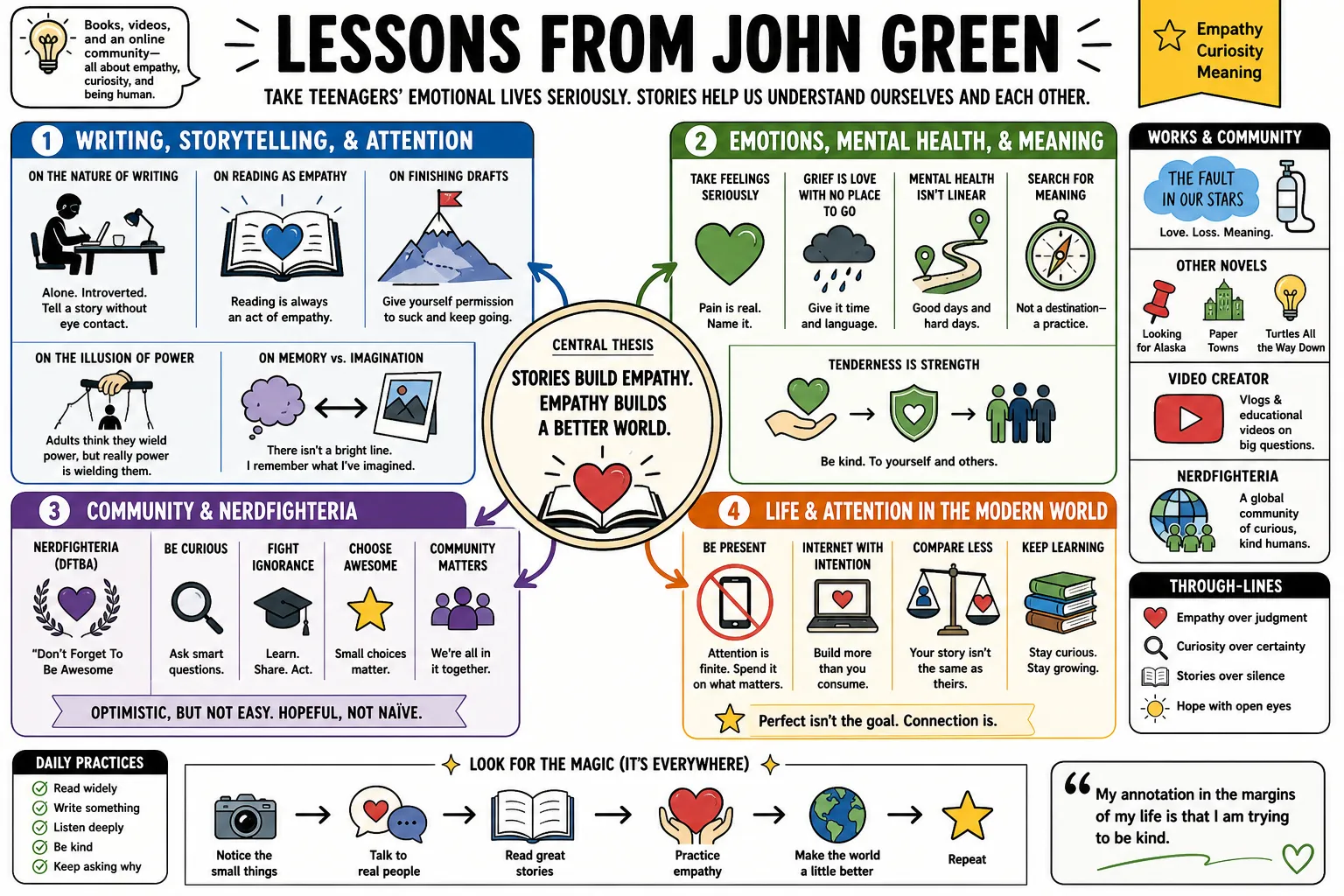
Lessons from John Green
John Green is a novelist and video creator whose books and online work explore adolescence, grief, mental health, and how people find meaning. The lessons below distinguish Green's own commentary from ideas voiced by characters in his fiction. — John Green Biography.
Part 1: Writing, Storytelling, and Attention
- Writing alone can lead to shared connection: Green describes writing as solitary, then contrasts it with the surprising communal experience of meeting readers on tour. The work starts alone, but its life with an audience can be deeply social. — Thoughts from Places: The Tour.
- Writing as an exercise in empathy: Green describes fiction writing as an attempt to imagine another person's experience rather than simply express his own. He also acknowledges the limits of how far he can write outside himself. — John Green Writing FAQ.
- Know when to revise and when to let a draft go: Green expects extensive rewriting and often discards much of a first draft. He does not insist on finishing every book; the difficult judgment is whether a stalled story needs persistence or should be abandoned. — John Green Writing FAQ.
- Question how much control people actually have: Turtles All the Way Down raises the possibility that adults do not wield as much power over their lives as they assume. The publisher presents this among the novel's questions about agency; it is a fictional perspective to examine, not Green's settled assertion about every adult. — Turtles All the Way Down teaching resource.
- Memory and imagination can blur: Green recalls noting that there may be no bright line between memory and imagination, perhaps after hearing Sarah say a version of it. He later gave that experience to Aza in Turtles All the Way Down; it is not a claim that every memory is invented. — Notes App and Sports Rivalries.
- Let readers make a book their own: After publication, Green says his books belong to readers and gain power in their hands. An author's private intent need not settle what a reader finds in the work. — John Green Writing FAQ.
- Thought spirals can make agency feel uncertain: Aza's sense that others tell her life story is part of the intrusive-thought experience Green explores in Turtles All the Way Down. He says he wanted to convey what it can feel like when a person cannot choose her thoughts, not to declare that people never shape their lives. — John Green on Writing and OCD.
- Question what it means to matter: Green says An Abundance of Katherines explores why people fixate on fame, notoriety and leaving a legacy. Colin's search for specialness gives way to the possibility of lasting peer relationships, rather than a simple formula for measuring worth. — An Abundance of Katherines FAQ.
Part 2: Mental Health, OCD, and Intrusive Thoughts
- Recognize the grip of intrusive thoughts: Describing his own OCD, Green compares an intrusive thought to a weed that can spread until it crowds out nearly everything else he can think about. This is his account of an experience, not a universal description of OCD. — Fresh Air Interview.
- Treatment can change one's relationship to a body: In a direct interview, Green says exercise and cognitive-behavioral techniques helped him stop seeing his body as the opposite of himself. That is his personal experience with OCD, not a treatment instruction or a guarantee for others. — Fresh Air interview.
- Hold room for hope during illness: After a severe period of mental illness, Green wrote that improvement was possible even though getting good treatment can be difficult. He framed hope alongside recurrent illness, not as a promise that every episode ends quickly. — John Green on Mental Illness.
- Treat chronic illness as ongoing: Green rejects the image of chronic illness as a single enemy to defeat. In his account, living with it can include better periods, worse periods, and improvement again. — John Green on Mental Illness.
- Understand intrusive thoughts as embodied experience: In explaining the personal roots of Aza's story, Green describes the fear of thoughts he cannot choose alongside the feeling of being trapped inside a body he cannot control. His account resists treating mental distress as merely abstract. — John Green on Writing and OCD.
- See why psychic pain can isolate: Green says Aza's struggle to put her pain into words was partly drawn from his own experience. The difficulty of conveying an inner experience can make someone feel alone, which is why he hoped the novel would help readers feel less so. — John Green on Writing and OCD.
- Notice when worry becomes a spiral: Green describes worries arriving one after another until they can feel like a blinding snowstorm. He presents this as his own experience with OCD, not a test or diagnosis for others. — Wild Card Interview.
- Ask who steers an unchosen thought: Green says Aza's OCD raises a frightening question for her: if thoughts help make a self, what happens when she cannot choose them? He presents this as a question explored by the novel, not a settled rule about identity. — John Green on Writing and OCD.
- Give inner pain a form others can hear: Green wrote Turtles All the Way Down partly to find a form for psychic pain that Aza cannot describe directly. His observation is that language can struggle to convey an internal experience, making empathy harder. — John Green on Writing and OCD.
- A difficult present need not define the future: Turtles All the Way Down offers hope that a painful present can change. Green's signed account of mental illness also makes clear that improvement can fluctuate and that hope is not a guarantee of permanent recovery. — John Green on Mental Illness.
Part 3: Loving the World and The Anthropocene
- Love the world despite its impermanence: Green writes that knowing love ends does not make him want to withdraw from the world. He wants to remain open to its beauty, even when that openness makes him vulnerable. — The Anthropocene Reviewed — Introduction.
- Do not overlook suffering when you notice beauty: For Green, loving the world does not require ignoring human or nonhuman suffering. He holds attention to beauty and attention to pain together. — The Anthropocene Reviewed — Introduction.
- Recognize humanity's reach into other lives: Green uses an analogy from his brother Hank: a present-day river, desert, or polar bear can be both vulnerable to and dependent on people. The point is that human power now reshapes life far beyond human society. — The Anthropocene Reviewed — Introduction.
- Distinguish failed doomsday predictions from real danger: Green recalls his professor Donald Rogan's warning against confidently predicting the end of the world. He immediately distinguishes that quip from the ongoing climate crisis, which he says warrants urgency. — Humanity's Temporal Range.
- Remember those who loved you into the present: In his reflection on Auld Lang Syne, Green raises a toast to people he can no longer speak with but whose love helped shape his life. Remembering them connects the present to those earlier relationships. — Auld Lang Syne.
- Treat awareness as a responsibility to life: Green argues that humans are, as far as we know, the part of the universe able to reflect on its own place in it. In that same reflection he calls for valuing biodiversity as well as human survival. — Humanity's Temporal Range.
- Use reviews to reveal a point of view: Green turned the five-star review format toward everyday life, then learned from Sarah that even a review is personal rather than a view from nowhere. The format became a way to write about his own participation in the world. — The Anthropocene Reviewed — Introduction.
- Carry distant friendships with you: Recalling his friend Todd and their Academic Decathlon years, Green says that Todd's care still helps sustain him despite the distance of time and geography. — Monopoly and Academic Decathlon.
- Practice the attention that wonder needs: Green describes missing the complexity of a nearby leaf while looking for a grand view; when he followed his son's attention, the ordinary leaf became wondrous. His point is about how we look, not an automatic feeling of cosmic connection. — Capacity for Wonder and Sunsets.
Part 4: Adolescence, Identity, and Coming of Age
- Seek the Great Perhaps: In Looking for Alaska, Miles takes a phrase associated with Rabelais as a reason to seek a life beyond the familiar. Asked about his own Great Perhaps, Green says the pleasure lies in the seeking rather than arriving at a fixed answer. — Looking for Alaska FAQ.
- Discover that strange feelings are shared: A narrator in Looking for Alaska is surprised to find that others also have difficult, unusual thoughts. Green later described the realization that one is not alone as a central part of adolescence. — An Abundance of Katherines FAQ.
- See the person behind the projection: In explaining Paper Towns, Green says treating a loved person as superhuman is another way of failing to see their full humanity. Empathy is imperfect, but it is the tool he offers for resisting that projection. — Paper Towns FAQ.
- Notice when the imagined future displaces today: Looking for Alaska treats imagining the future as a kind of nostalgia: anticipation can become another way of missing the present. It is a character's reflection in the novel, not a command from Green to act immediately. — Penguin Teen's Looking for Alaska excerpts.
- Do not mistake appearance for knowing someone: Paper Towns uses a breakfast-cereal simile to question attraction based only on how someone looks. It is a character's image about superficial attraction, distinct from Green's broader critique of idealizing another person. — Penguin Teen's Paper Towns excerpts.
- Treat courage and caution as context-dependent: In discussing Paper Towns, Green says fear can protect people or limit them, while fearlessness can also help or harm. He resists treating either one as a simple virtue. — Paper Towns FAQ.
- Leaving can feel different after the first step: Paper Towns captures the gap between dreading a departure and finding movement easier once it has begun. Treat this as a moment in the novel, not a universal instruction to leave a place or relationship. — Penguin Teen's Paper Towns excerpts.
- Allow hope without claiming invincibility: Green says he remains proud of Looking for Alaska's closing hope that people are not irreparably broken. The novel offers a reason to keep going, not a literal claim that people cannot be hurt. — Looking for Alaska FAQ.
Part 5: Grief, Suffering, and the Labyrinth
- Forgiveness is Pudge's response to loss: In Looking for Alaska, Pudge's belief that Alaska forgives him is one hopeful response to unresolved grief. Green presents it alongside other responses, not as a universal way to end suffering. — Looking for Alaska FAQ.
- Choosing the labyrinth is another response: The Colonel's decision to choose the labyrinth in Looking for Alaska accepts life's difficulty without giving up on it. Green describes this as a different, still hopeful response to loss from Pudge's belief in forgiveness. — Looking for Alaska FAQ.
- A metaphor can show how someone feels: Green says the drizzle-and-hurricane image in Looking for Alaska was shaped with editor Julie Strauss-Gabel. Read it as Pudge's way of conveying an overwhelming encounter with Alaska, not as a claim that one person is objectively more important than another. — Looking for Alaska FAQ.
- Use images to communicate invisible pain: Green says an acquaintance supplied the broken-strings image that he used in Paper Towns. The metaphor offers a way to discuss despair that has no visible physical location; its source should not be mistaken for Green's own coined maxim. — Paper Towns FAQ.
- Grief can unsettle even our strongest values: Green says Hazel's usual compassion breaks down under the weight of losing Augustus. Her grief is neither a simple revelation of a fixed self nor a lesson that suffering always improves a person. — The Fault in Our Stars FAQ.
- Let pain be seen without romanticizing it: The line about pain demanding to be felt belongs to fictional Peter Van Houten, not to Green speaking personally. Green's own account of The Fault in Our Stars resists the notion that illness or suffering necessarily strengthens someone. — The Fault in Our Stars FAQ.
Part 6: Love, Intimacy, and Relationships
- Share a third thing: Borrowing Donald Hall's idea of a third thing, Green describes art as the first shared focus that brought him and Sarah joy. A relationship can be enriched by something both people attend to together. — Green's Third Things newsletter.
- Shared attention can feel intimate: Turtles All the Way Down describes two characters looking at the same sky rather than directly at each other. The novel treats seeing a world together as one form of closeness; it is a fictional moment, not a universal prescription for intimacy. — Penguin Teen's Turtles All the Way Down excerpts.
- Avoiding love does not eliminate pain: Green says Will Grayson's reluctance to pursue romance grows from a mistaken belief that pain can be avoided. The novel tests that defense rather than endorsing unrequited love as a safer strategy. — Will Grayson FAQ.
- Caring is risky but worth choosing: Will Grayson begins with the belief that caring always ends badly. Green says that rule makes Will miserable and that he has to abandon it to form a fulfilling relationship with Tiny. — Will Grayson FAQ.
- Friendship deserves to be named as love: Green explains that Will and Tiny's friendship in Will Grayson, Will Grayson matters beyond romance. The novel asks why people readily say they love romantic partners but hesitate to tell close friends the same thing. — Will Grayson FAQ.
- Love can become clear gradually: The Fault in Our Stars uses falling asleep as a metaphor for Hazel's experience of falling in love: slowly, then suddenly. It is a fictional description of one relationship, not a universal sequence everyone must follow. — Penguin Teen's The Fault in Our Stars excerpts.
- Do not blame people for every hardship: Green chose The Fault in Our Stars to answer a line from Shakespeare: hardship is not always the sufferer's fault. He describes an unjust world where suffering is distributed unevenly and asks how to live honestly and hopefully within it. — The Fault in Our Stars FAQ.
Part 7: Internet Culture, Community, and The Test
- Choose collaborators, not just a job title: In a Vlogbrothers answer about careers, Green advises studying widely and making things with people one likes. In his experience, who he works with has mattered more than the label of his job. — What To Do With Your Life.
- Some infinities really are larger: Green confirms that mathematicians distinguish larger and smaller infinities, while correcting Hazel's interval example in The Fault in Our Stars. The true mathematical idea should not make every comparison in a fictional speech correct. — The Fault in Our Stars FAQ.
- Hope is a response to practice: Green says he keeps relearning hope as a response to the human condition because despair returns for him. The claim is a lived commitment, not a promise that hope comes easily or suffering disappears. — Wild Card interview.
- Keep evidence of progress close: Green describes carrying a note about falling child mortality to remind himself that collective action can reduce suffering. When despair feels persuasive, he deliberately returns to a concrete example of improvement rather than claiming optimism is effortless. — Wild Card interview.
- Build community through shared projects: Green says early Nerdfighters grew by connecting with people in other online communities who shared their values and enjoyed similar projects. The lesson is about cultivating common interests, not a guarantee that every online space transcends geography. — John Green's Vlogging FAQ.
- Persist without denying the odds: Green acknowledges serious threats to humanity yet chooses to believe persistence and adaptability can extend its future. His hope is a call to act despite uncertainty, not a dismissal of climate risk. — Humanity's Temporal Range.
- Pay attention to your attention: Green credits Amy Krouse Rosenthal for urging him to notice what holds his attention. Writing personal reviews helped him practice that borrowed principle after a period when his attention felt fractured. — The Anthropocene Reviewed introduction.
- Treat learning as a lifelong test: Opening Crash Course World History, Green frames the real test as how people live as informed and engaged citizens beyond school. It is a teaching metaphor in the original video, not a literal exam with a grade. — Crash Course: The Agricultural Revolution.
Part 8: Curiosity, Ambition, and Existence
- Resist simple stories about complex histories: In a Crash Course lesson on Iran, Green corrects his own tendency to generalize about a vast region and warns that the truth resists simplicity. His point is about doing the work to understand a specific history, not a line from The Fault in Our Stars. — Crash Course: Iran's Revolutions.
- Small gestures can matter more than greatness: Green says the demand to do something remarkable belongs to Colin in An Abundance of Katherines, not to Green himself. In his view, a meaningful life also consists of small gestures that can be missed in a compulsory pursuit of greatness. — An Abundance of Katherines FAQ.
- Worth need not depend on fame: Green says Colin's obsession with mattering historically is part of An Abundance of Katherines. His own explanation points instead toward ordinary gestures and sustaining relationships as sources of meaning, not a numerical ranking of human worth. — An Abundance of Katherines FAQ.
- Books wait for a reader's return: An Abundance of Katherines imagines books as patient companions that can be put down and picked up again. This is a playful novel line, not a factual claim that reading provides unconditional love. — Penguin Teen's An Abundance of Katherines excerpts.
- Do not date someone who resents your intelligence: Asked whether boys dislike girls who are smarter than they are, Green answers that such boys are not good dating prospects. It is a concise response to a viewer's specific dating worry, not a general claim about all relationships. — Love and Romance Questions ANSWERED.
- Shared passions can connect people: Green describes how supporting a football club can connect people across distance and language. He also cautions that rivalries can dehumanize, so shared enthusiasm should not require contempt for others. — Notes App and Sports Rivalries.
- Be unembarrassed about enthusiasm: Green celebrates the freedom to love books, films and other interests openly instead of affecting indifference. In his Vlogbrothers example, being a nerd means allowing oneself to be excited about something. — Harry Potter Nerds Win at Life.
- Isolation is not proof that understanding is impossible: Green uses Aza's intrusive thoughts to show how psychic pain can isolate someone when words fail to convey it. He also hopes the story helps readers with similar thoughts feel less alone and helps others understand them better. — John Green on Writing and OCD.
- Use a spiral to make invisible thought visible: Turtles All the Way Down uses an older infinite-regress image as a motif. Green says Aza's unwanted thought spirals borrow from his own OCD experience; the image helps give a form to pain that can otherwise be hard to describe. — John Green on Writing and OCD.