Lessons from John Mackey
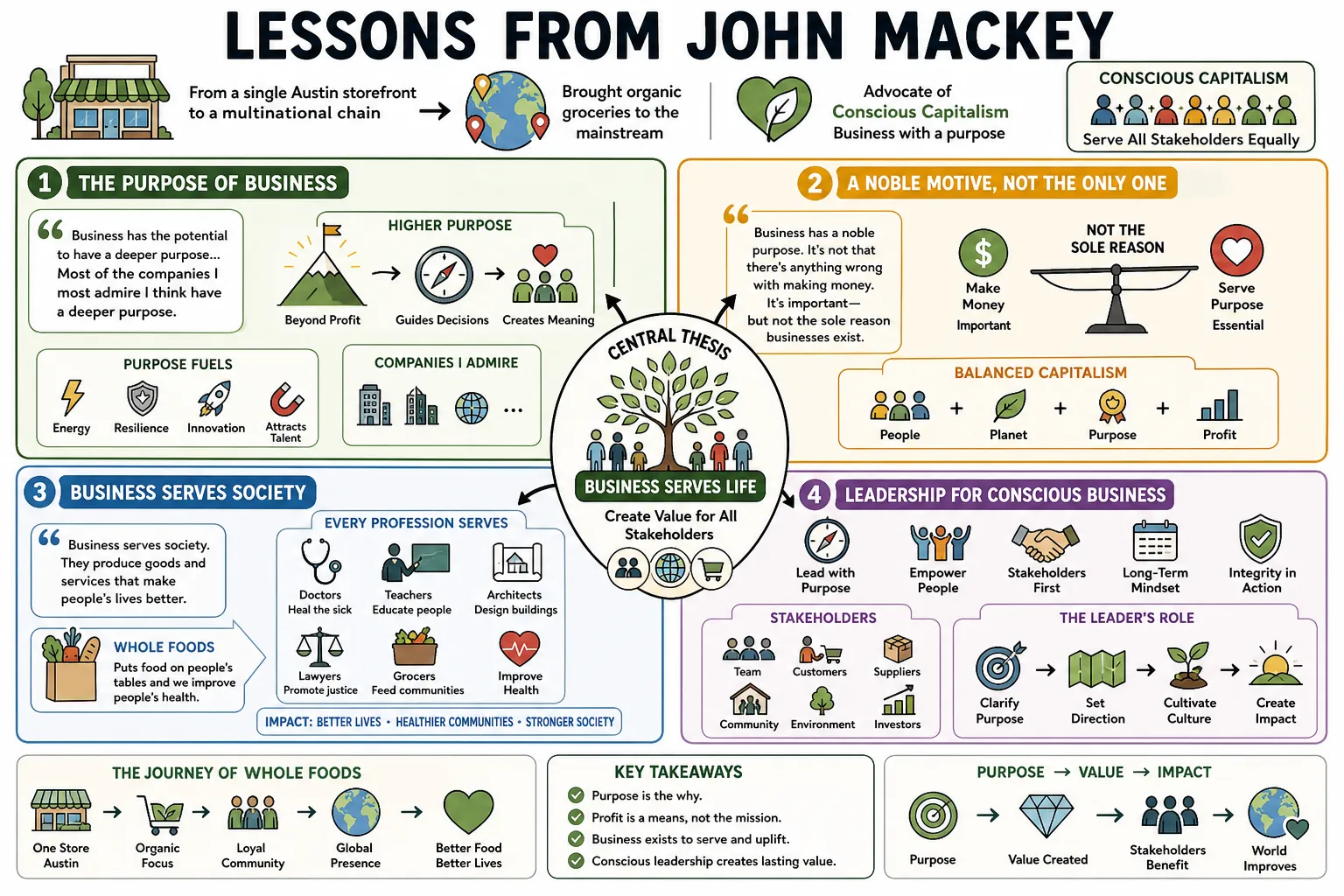
John Mackey built Whole Foods Market from a single Austin storefront into the multinational chain that brought organic groceries to the mainstream. He is a primary advocate of "Conscious Capitalism," the argument that businesses should pursue a purpose beyond profit and serve all stakeholders equally. This collection covers his views on food ethics, leadership, and the role of modern business.
Part 1: The Purpose of Business
- On higher purpose: "It means that business has the potential to have a deeper purpose... Most of the companies I most admire in the world I think have a deeper purpose." — Source: [Matt Perman]
- On the primary motive: "I think that business has a noble purpose. It's not that there's anything wrong with making money. It's one of the important things that business contributes to society. But it's not the sole reason that businesses exist." — Source: [Matt Perman]
- On business serving society: "Business serves society. They produce goods and services that make people's lives better. Doctors heal the sick. Teachers educate people. Architects design buildings. Lawyers promote justice. Whole Foods puts food on people's tables and we improve people's health." — Source: [Matt Perman]
- On making money versus purpose: "Why should the purpose of business be to make money? When asked, a doctor doesn't say his purpose is to make money, but to rather heal people." — Source: [Stanford University]
- On a heroic spirit: "The heroic business is motivated by the desire to change the world... to truly make the world better, to solve insoluble problems, to do the really courageous thing even when it is very risky, and to achieve what others say is impossible." — Source: [QuotesWise]
- On the nature of capitalism: "Resources are limited; creativity is unlimited." — Source: [Goodreads]
- On the reputation of capitalism: "The myth that profit maximization is the sole purpose of business has done enormous damage to the reputation of capitalism and the legitimacy of business in society." — Source: [Goodreads]
- On recapturing the narrative: "We need to recapture the narrative and restore it to its true essence: that the purpose of business is to improve our lives and to create value for stakeholders." — Source: [Goodreads]
- On changing the world: "A business that puts purpose first is a business that has the potential to change the world." — Source: [Medium]
Part 2: Profit and Capitalism
- On defining the philosophy: "It is a way of thinking about business that is more conscious of its higher purpose, its impacts on the world, and the relationships it has with its various constituencies and stakeholders." — Source: [Goodreads]
- On conscious capitalism: "It reflects a deeper consciousness about why businesses exist and how they can create more value." — Source: [Goodreads]
- On being a capitalist: "As an unapologetic capitalist, I believe capitalism is the greatest driver of human progress and value creation in history." — Source: [John Mackey's Website]
- On the necessity of profit: "Just as people cannot live without eating, so a business cannot live without profits." — Source: [Goodreads]
- On the purpose of profit: "But most people don't live to eat, and neither must businesses live just to make profits." — Source: [Goodreads]
- On the paradox of profit: "Just as happiness is best experienced by not aiming for it directly, profits are best achieved by not making them the primary goal of the business." — Source: [Goodreads]
- On how to achieve profit: "They are the outcome when companies do business with a sense of higher purpose, build their businesses on love and caring instead of fear and stress, and grow from adversity." — Source: [Goodreads]
- On business nobility: "We believe that business is good because it creates value, it is ethical because it is based on voluntary exchange, it is noble because it can elevate our existence..." — Source: [Cato Institute]
- On the heroism of business: "...and it is heroic because it lifts people out of poverty and creates prosperity." — Source: [Cato Institute]
- On shareholders as stakeholders: "Shareholder value is a wonderful and desirable end, and investors are a critical stakeholder group with legitimate claims." — Source: [Conscious Capitalism]
Part 3: Conscious Leadership
- On the primary job of a leader: "The first and foremost job of every conscious leader… is to connect people to purpose." — Source: [Tammira Blog]
- On being appreciative: "A conscious leader needs to be actively appreciative." — Source: [Goodreads]
- On balancing toughness and care: "We can be tough leaders at times, we can and should be strong, but at the end of the day, human beings respond best to care and appreciation." — Source: [Goodreads]
- On true leadership: "Leadership is not about position or power. It is about taking responsibility and making a positive difference in the world." — Source: [Medium]
- On a leader's motivation: "A conscious leader is one who is primarily driven by service to the purpose of the business, and not by the pursuit of power or personal enrichment." — Source: [John Mackey's Website]
- On the front page test: "I realized that with everything I did from that point onward, I would have to ask myself this question: 'How would I feel if what I'm doing right now is written up on the front page of the Wall Street Journal or the New York Times or if it is on television? Would I still do it?'" — Source: [Goodreads]
- On avoiding embarrassment: "That is a very useful exercise for leaders to engage in, because we shouldn't do anything we might be embarrassed by or ashamed of." — Source: [Goodreads]
- On love in business: "Love is not an emotion reserved for our personal lives. It is essential to the success of our business and the well-being of our employees and customers." — Source: [Medium]
- On fear as a motivator: "Fear can be an effective short-term motivator; in a crisis situation, it can elicit extraordinary efforts for a short time. But as an ongoing policy, it's a disaster." — Source: [Goodreads]
- On command and control: "Conscious leaders are not command-and-control leaders and do not use carrots and sticks to motivate people. Instead, they lead by example and mentor, motivate, develop, and inspire those around them." — Source: [John Mackey's Website]
Part 4: Stakeholders and Ecosystems
- On the harmony of interests: "The beauty, in my opinion, of capitalism is that it has a harmony of interests. All these stakeholders are important." — Source: [Forbes]
- On cooperation: "It is important that the owners and workers cooperate to provide value for the customer. That's what all business is about, and I'd say that's a beautiful thing." — Source: [Forbes]
- On achieving through others: "It's important to remember that in business, everything we accomplish is ultimately done with and through other people." — Source: [Goodreads]
- On a leader's role with others: "That is what conscious leaders do—we inspire, motivate, develop, and lead others." — Source: [Goodreads]
- On institutionalizing appreciation: "Conscious leaders should consider ways to institutionalize a culture of appreciation—their teams will thank them for it." — Source: [Goodreads]
- On win-win-win outcomes: "We must seek outcomes where the business, the employees and customers, and the larger community all benefit simultaneously." — Source: [Molly Fletcher]
- On people as sources: "Business must view people not as resources but as sources." — Source: [QuotesWise]
- On the difference between resources and sources: "A resource is like a lump of coal; you use it and it's gone. A source is like the sun—virtually inexhaustible and continually generating energy, light, and warmth." — Source: [QuotesWise]
- On authenticity: "When you're truly authentic, a lot of good things happen." — Source: [How Leaders Lead]
Part 5: Organizational Culture and Management
- On the strength of culture: "Conscious culture and management provide strength and stability to conscious businesses, helping to ensure they remain committed to their purpose." — Source: [Conscious Capitalism]
- On enduring values: "The culture of a conscious business is a source of great strength and stability for the firm, ensuring that its purpose and core values endure over time and through leadership transitions." — Source: [Hope Gibbs]
- On a living system: "A conscious business is a type of self-organizing, living system that learns, grows, evolves, self-organizes, and even self-actualizes on its own." — Source: [Goodreads]
- On decentralization: "The right degree of decentralization, empowerment, collaboration, love, and care in the workplace enables organizations to adapt, innovate, and evolve faster." — Source: [Goodreads]
- On making purpose alive: "Conscious leaders infuse their organization’s purpose with authenticity and meaning. They make it come alive, in little ways and big ways, every day." — Source: [Goodreads]
- On order of operations: "Choose purpose first, then strategy." — Source: [Fresh Gigs]
- On learning and growth: "Business can be a wonderful vehicle for both personal and organizational learning and growth." — Source: [Goodreads]
- On overcoming adversity together: "They said to us, in effect, 'Come on, guys; let's get to work. Let's clean it up and get this place back on its feet. We're not going to let this store die. Stop moping and start mopping.' You can imagine the galvanizing effect this had on us..." — Source: [Logo Maker]
- On trust and transparency: "Fostering an environment of trust, transparency, integrity, and care is essential for any conscious management team." — Source: [Bookey]
Part 6: Entrepreneurship and Venture Capital
- On defining the business: "Entrepreneurs discover and/or create the purpose of a business—not investors, or politicians, or lawyers, or economists." — Source: [Whole Foods Market]
- On the advantage of ignorance: "I had no way of knowing how many accepted business practices I was ignoring and that gap gave me the opportunity to innovate freely without the burden of too many legacies to overcome." — Source: [QuotesWise]
- On venture capitalists: "I began to think of our VC partners as hitchhikers with credit cards." — Source: [Medium]
- On the limits of venture capital commitment: "They were along for the ride and benefiting from our progress, and as long as they felt that they were going where they wanted to go, they would help pay for gas, but they did not want to have the same level of commitment to stay in the car for the entire journey." — Source: [Medium]
- On selling to Amazon: "The honest answer is, I regret that circumstances made that the best alternative for Whole Foods." — Source: [Castos]
- On what an entrepreneur is: "Entrepreneurs are panhandlers for dreams." — Source: [Podcast Notes]
- On infectious belief: "An infectious belief system is necessary to recruit others into your vision when you are building something new." — Source: [Podcast Notes]
- On timeline misalignment: "There is often a founder-VC timeline misalignment, where venture capitalists operate on short-term horizons that can threaten mission-driven businesses." — Source: [Podcast Notes]
- On following the heart in business: "I have learned that we can channel our deepest creative impulses in loving ways toward fulfilling our higher purposes, and help evolve the world to a better place." — Source: [Goodreads]
Part 7: Health, Diet, and Animal Ethics
- On the magic food myth: "There is no single food that will bring you everlasting health, no matter how much you wish it to." — Source: [Blue Zones]
- On dietary variety: "It's about teaching yourself to love a variety of the healthiest foods in the world." — Source: [Blue Zones]
- On the impact of our choices: "Our purpose is to teach people that what you put into your body makes a difference, not only to your health and to that of the people who supply the food, but also to the health of the planet as a whole." — Source: [QuotesWise]
- On processed plant-based meat: "I don't think eating highly processed foods is healthy. I think people thrive on eating whole foods." — Source: [Reddit]
- On the limits of his endorsement: "As for health, I will not endorse that, and that is about as big a criticism that I will do in public." — Source: [Reddit]
- On his personal shift: "I have been vegan and 100 percent plant-based since 2003 for both ethical and health and vitality reasons and have experienced so many positive differences after making this lifestyle change." — Source: [John Mackey's Website]
- On ethical choices: "Becoming vegan was the most ethical choice. I want a life of compassion for all beings, not exploitation." — Source: [QuotesWise]
- On factory farming: "I actually think that a hundred years from now we'll look back on the factory-farm era with the same kind of ethical revulsion that we look back on slavery." — Source: Conscious Capitalism
- On the whole foods diet: "People should eat a diet rich in minimally processed, plant-based foods—such as vegetables, beans, grains, and nuts—to promote longevity and prevent disease." — Source: [John Mackey's Website]
Part 8: Personal Growth and Forgiveness
- On deathbed reflections: "When you are on your deathbed, you think you're going to be having regrets that you didn't make enough money, didn't work hard enough, could have built a bigger business, could have been more successful?" — Source: [Medium]
- On true priorities at the end of life: "What will you be thinking about on your deathbed? You're going to be thinking about people you love and the people that you didn't say things to that you should have said before they passed on..." — Source: [Medium]
- On early decisions: "In my early twenties, I made what has proven to have been a wise decision: a lifelong commitment to follow my heart wherever it led me..." — Source: [Goodreads]
- On the result of following his heart: "...which has been on a wonderful journey of adventure, purpose, creativity, growth, and love." — Source: [Goodreads]
- On the longest journey: "As the saying goes, 'The longest journey that people must take is the eighteen inches between their heads and their hearts.'" — Source: [Goodreads]
- On ceremonies of forgiveness: "Speaking words of forgiveness aloud is a necessary practice for transforming relationships and letting go of the past." — Source: [Podcast Notes]
- On familial regrets: "Some of my greatest personal regrets involve unresolved tensions with my parents, which taught me that forgiveness must be actively practiced before it is too late." — Source: The Rich Roll Podcast
- On continuous evolution: "The journey of leadership is ultimately a journey of continuous personal evolution." — Source: [Goodreads]
- On acknowledging mistakes: "A conscious leader must be willing to acknowledge when they are wrong and use those moments as ceremonies of forgiveness and growth." — Source: [Feedspot]
- On the ultimate goal: "Building a successful company is secondary to living a fully integrated, loving, and conscious life." — Source: Conscious Capitalism