John McMahon is a five-time Chief Revenue Officer (PTC, GeoTel, Ariba, BladeLogic, and BMC) and the originator of the MEDDIC sales qualification framework. He currently serves on the board of directors for Sigma Computing and Observe. He is also the author of the widely read enterprise sales book, The Qualified Sales Leader.
- "Found business pain creates opportunity. Quantified business pain drives higher price points. Implicated business pain drives urgency." [1]
- "Business pain and urgency finds business Champions. Business champions get you to the Economic Buyer. The Economic Buyer has access to major funds. You sell big deals based on value." [1][2]
- "If you're not coachable, you won't learn. If you won't learn, you won't adapt. Adaptability is a critical trait in any rapidly growing company." [1][2]
- "Stop confusing activities with accomplishment. Stop pushing reps to rush through the sales process." [1][3]
- "Your intuition needs a clear, open mind. It won't work if it's competing with other distracting thoughts, fears, or prejudices of your own past experiences." [1][3]
- "Time kills all deals without urgency." [4]
- "People don't leave companies, they leave managers." [4]
- "Simplicity becomes a limitless gift presented to individuals that master the fundamentals." [4]
- "If you can't measure something, you can't understand it. If you can't understand it, you can't control it. If you can't control it, you can't improve it." [5][6]
- "You are paid to be the mirror of reality." [6]
- "Good sales leaders realize that it's about putting their people first. It's all about their reps. Gaining an intimate understanding of their reps' strengths, weaknesses, fears, desires, and motivations. It's the leader's job to find a way to make them successful." [5][6]
- "Champions have personal aspirations. To realize those aspirations, they need to differentiate themselves within the organization. One way to do that is to solve notable business problems." [4][5]
- "If you haven't established urgency, then, as time moves on, the customer believes they can continue to operate without your solution." [5]
- "The customer won't magically understand the value of your product." [5]
- "What do you need managers for if they're not helping their people and coaching them on moving deals along?" [2]
- "If you won't be selfless, you won't be a good leader." [2]
- "If you didn't stick to the process, you were out." [2] (Referring to the accountability within the MEDDICC process at PTC)
- "When I was in a meeting one time with all the second-line managers, third-line managers, and even the top VPs, they never talked about what's going on with the sales reps, like how do we make them more productive? What are the issues they're facing? Who's the competition? How do we get better?" [7]
- "All they were doing was talking about these bureaucratic, inside-the-company wall-type things and I thought, I don't want to grow up to be like these guys." [7]
- "You're going to have to do thousands and thousands of repetitions before you're going to get good." [8]
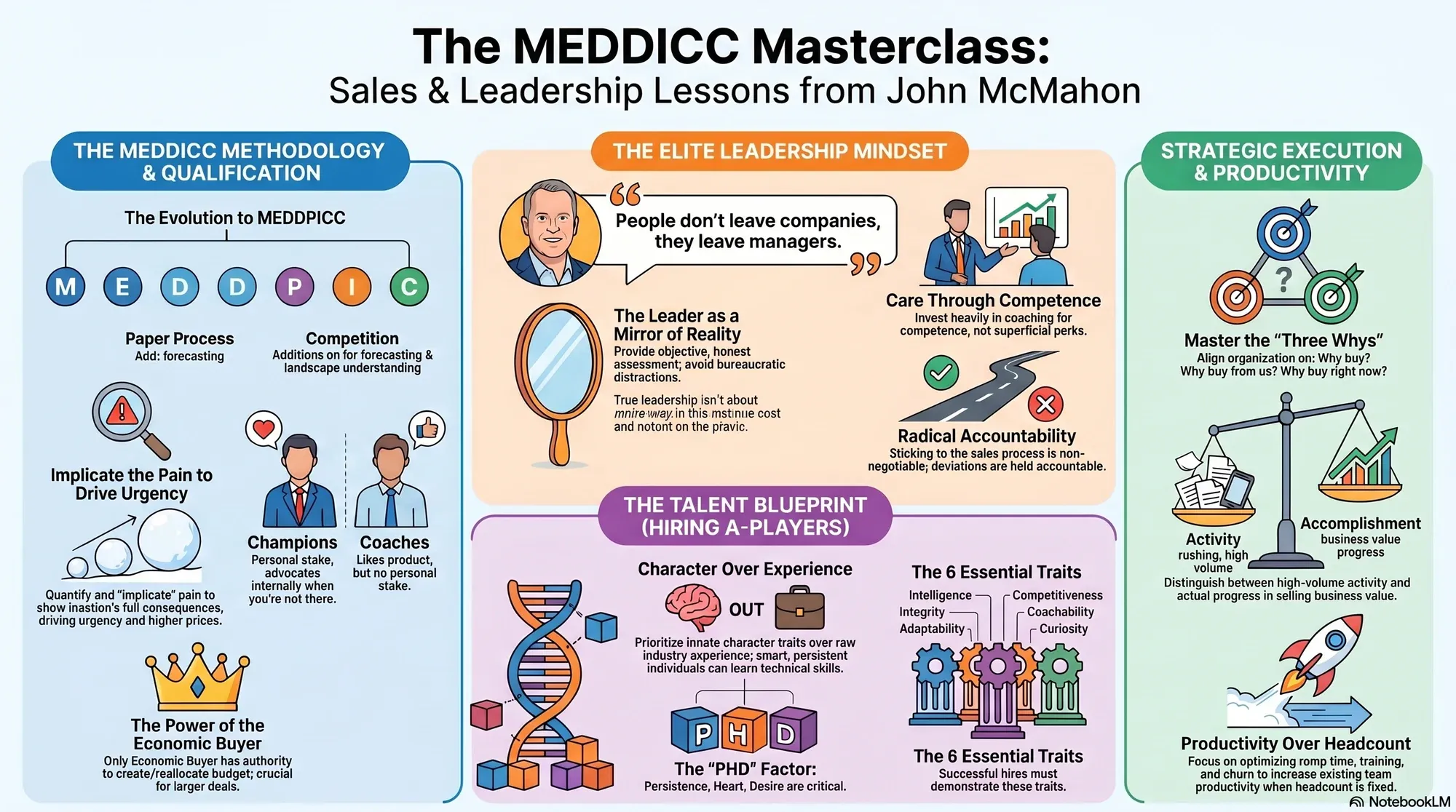
Learnings from John McMahon
On the MEDDIC/MEDDPICC Framework
- The Genesis of MEDDIC: MEDDIC was not born in a theoretical brainstorming session but evolved from the practical need to qualify deals effectively at PTC. It was a way to codify the successful habits of top-performing sales reps. [7][9]
- Evolution to MEDDPICC: McMahon later expanded MEDDIC to MEDDPICC, adding "Paper Process" and "Competition." He emphasized that without understanding the customer's procurement process and the competitive landscape, accurate forecasting is impossible. [1]
- Metrics are Key for Value: To justify a higher price, you must understand the customer's metrics and build a cost justification based on their financial data and the tangible business value your product delivers. [1]
- The Economic Buyer Has the Power: The Economic Buyer is the only one who can create a budget where one doesn't exist or reallocate funds. Without access to this individual, you are likely to be stuck with smaller deals. [10]
- Champions vs. Coaches: A common mistake is confusing a coach with a champion. A coach likes you and your product, but a champion has a personal stake in your success and will advocate for you, especially when you're not in the room. [1][3]
- Implicate the Pain: It's not enough to identify a customer's pain; you must "implicate" it, meaning you help the customer understand the full consequences and urgency of that pain. [11]
- A Common Language for Sales: The MEDDIC framework provides a consistent language for sales teams to discuss opportunities, identify gaps, and improve forecasting accuracy. [4][12]
- Use MEDDICC as Navigation, Not Administration: Use MEDDICC to locate a deal, expose what is missing, and choose the next route forward; running through its letters as a CRM checklist is not qualification. — How To Build A Sales Machine With MEDDICC
- Separate the Sales Process from Qualification: The sales process defines the ideal execution path, while qualification locates the actual deal on that path and tests whether it can close. — Expert’s Guide to Building, Scaling & Managing Enterprise Sales Teams
- Give Every Stage Explicit Exit Criteria: A sales stage is not complete until its required actions and evidence are defined and satisfied. — How To Build A Sales Machine With MEDDICC
On Sales Leadership
- Care Through Competence: True leadership isn't about being friends with your team or providing perks like ping-pong tables. It's about investing heavily in their development to make them more competent and successful. [1][13]
- Focus on the Fundamentals: Maniacal focus on the fundamentals of recruiting, development, leadership, and forecasting is what builds elite sales organizations. [13]
- Leaders as Coaches: Sales managers should prioritize coaching and developing their team's skills. A great seller doesn't automatically make a great manager; it's a learned skill. [2][14]
- Improve Manager-to-Seller Relationships: The quality of the relationship between managers and their reps is directly tied to the success of the sales organization. [2][14]
- Leave Your Ego at the Door: Effective leadership is about selflessness and focusing on the success of your people. When your team wins, you win. [2]
- Develop Your People's Goals: A leader's role is to push people beyond what they thought they could achieve and find joy in their development and the achievement of their personal goals. [13]
- Simplify the Message: In enterprise sales, especially with new technology, a key skill is to simplify the message and clearly articulate what the product does, why it's different, and why it's important now. [13]
- Make Early Adopters Prove the Methodology: Train the team, help a few willing reps win with the new method, and let their concrete results create wider buy-in. — How To Build A Sales Machine With MEDDICC
- Treat Management Capacity as a Productivity Investment: Compare the cost of added managers with the revenue gained from faster ramp, higher rep output, and lower attrition. — Expert’s Guide to Building, Scaling & Managing Enterprise Sales Teams
- Make Bad News Immediate: Early truth gives a leader time to help repair a deal; half-truths remove that option and destroy trust. — How To Build A Sales Machine With MEDDICC
- Develop People Until They No Longer Need You: Leadership succeeds when the team can operate independently rather than requiring permanent hand-holding. — How To Build A Sales Machine With MEDDICC
- Build the Management Pillars Before Adding Reps: Plan headcount early, hire leaders first, and avoid scaling a sales force faster than it can be recruited, trained, and managed. — The Startup Sales Playbook Every Founder Needs
On Hiring and Talent
- Character Over Experience: McMahon prioritizes character traits in interviews, spending significant time evaluating attributes he can't change. [3]
- The Six Key Traits: The six traits he values most are intelligence, competitiveness, integrity, coachability, adaptability, and curiosity. [3]
- Intelligence and a "PHD": The top two characteristics he looks for are intelligence and a "PHD" – Persistence, Heart, and Desire. He believes if someone is smart and persistent, they can learn the necessary skills. [1][13]
- The Importance of Adaptability: In the fast-changing environment of high-growth startups, a salesperson's ability to be coached and adapt is crucial for keeping pace. [1][13]
- Hire A-Players: If you hire only A-grade players and do everything else average, the A-players will help you find a way to win. [2]
- Hire for Characteristics, Not Résumé Familiarity: Domain experience and job history reveal little about skill or character; intelligence, drive, coachability, adaptability, and integrity are more predictive. — How To Build A Sales Machine With MEDDICC
- Probe for Drive Through Lived Difficulty: Ask about the hardest situation in a candidate’s life and follow the story deeply enough to understand the source of their persistence. — How To Build A Sales Machine With MEDDICC
- Choose Drive Over Unused Brilliance: A moderately intelligent person with exceptional drive can outgrow a brilliant person who will not practice or adapt. — How To Build A Sales Machine With MEDDICC
On Sales Process and Strategy
- Voracious Qualification is a Leading Indicator: Hitting revenue numbers consistently is nearly impossible without a rigorous sales qualification process like MEDDICC. [2]
- Understand the "Three Whys": Your entire organization must be aligned on: Why do prospects have to buy? Why do they have to buy from you? And why do they have to buy now? [2]
- Don't Confuse Activity with Accomplishment: Focus on selling business value and developing metrics to predict sales outcomes accurately, rather than just pushing for more activities. [14][15]
- Master the Customer Conversation: Salespeople need to master conversations tailored to specific personas and use cases to effectively sell business value. [3]
- Focus on What Matters: McMahon is known for his ruthless focus on activities that directly contribute to selling more. He famously threw away any paperwork that didn't help him or his team sell more. [6]
- Productivity Over Headcount: When you can't control headcount, you must control productivity. This involves optimizing ramp time, ongoing training, and managing churn. [6]
- No Two Reps are the Same: Training and development should not be one-size-fits-all. Understanding individual strengths and weaknesses is key. [6]
- The Learning is in the Struggle: Some of the best leaders were great reps who initially struggled as managers. They learned how to coach others through their own challenges. [2]
- Decisions Based on Facts and Intuition: Make decisions based on the facts at hand and common sense, not just on ideas from business books. Also, learn to trust your intuition when your brain and gut are aligned. [1][13]
- Quickly Correct Wrong Decisions: If a decision turns out to be wrong, change it quickly without letting your ego get in the way. [13]
- Sales as a Profession: Selling complex enterprise solutions requires formal training and a structured process; it's not something most can succeed at without being properly schooled. [8]
- Diagnose the Organization Through Operating Metrics: Compare new- and existing-customer deal size, logo creation, rep productivity, and sales-cycle length before blaming product, market, or talent. — How To Build A Sales Machine With MEDDICC
- Speak the Language of Each Executive Level: Connect a CEO to revenue, profitability, and risk, then translate those outcomes into the operational measures owned by lower-level buyers. — How To Build A Sales Machine With MEDDICC
- Know the Use Case Cold Enough to Detect the Wrong Contact: Deep process knowledge lets a seller predict credible answers and recognize when the person in front of them lacks ownership or urgency. — How To Build A Sales Machine With MEDDICC
- Balance Process with Flexibility: Define enough structure to diagnose breakdowns and coach execution without turning the sales system into bureaucracy. — How To Build A Sales Machine With MEDDICC
- Qualify Weak Deals Off the Forecast Early: Removing fantasy pipeline with weeks left redirects sellers toward opportunities that can actually close. — How To Build A Sales Machine With MEDDICC
- Prioritize Propensity to Buy Now, Not Theoretical Market Size: The best initial target is the segment with urgent need, fast product cycles, and manageable sales complexity, not necessarily the biggest enterprise logo. — Expert’s Guide to Building, Scaling & Managing Enterprise Sales Teams
- Use Early Deal Momentum to Teach the Product Team: Concentrated wins expose missing product pieces inside a repeatable use case and create the basis for expanding into adjacent markets. — Expert’s Guide to Building, Scaling & Managing Enterprise Sales Teams
Learn more:
- Quotes by John McMahon (Author of The Qualified Sales Leader) - Goodreads
- Top 5 Takeaways from Our Conversation with John McMahon - Force Management
- The Qualified Sales Leader Quotes by John McMahon - Goodreads
- The Qualified Sales Leader | Summary, Quotes, FAQ, Audio - SoBrief
- Best Quotes Of The Qualified Sales Leader With Page Numbers By John McMahon - Bookey
- Sales Best Practices: The What and How with John McMahon - InAccord
- GODFATHER: A Deep Dive into John McMahon and the MEDDIC Sales Process - YouTube
- Author of “The Qualified Sales Leader,” John McMahon: The Five-Time CRO - YouTube
- MEDDIC Sales Methodology Guide & Template
- What is the MEDDIC sales methodology? - QuotaPath
- MEDDIC Sales Explained: A Simpler Way To Qualify Buyers - Dock.us
- What Is MEDDIC Sales Methodology and How to Put It Into Practice? - Highspot
- How to Build a Winning Sales Culture: A Q&A with John McMahon | Sprinklr
- John McMahon: Lessons for Sales Leaders - Revenue Grid
- The Qualified Sales Leader by John McMahon: 7 Minute Summary - YouTube
- How To Build A Sales Machine With MEDDICC
- Expert’s Guide to Building, Scaling & Managing Enterprise Sales Teams
- The Startup Sales Playbook Every Founder Needs