Lessons from John McWhorter
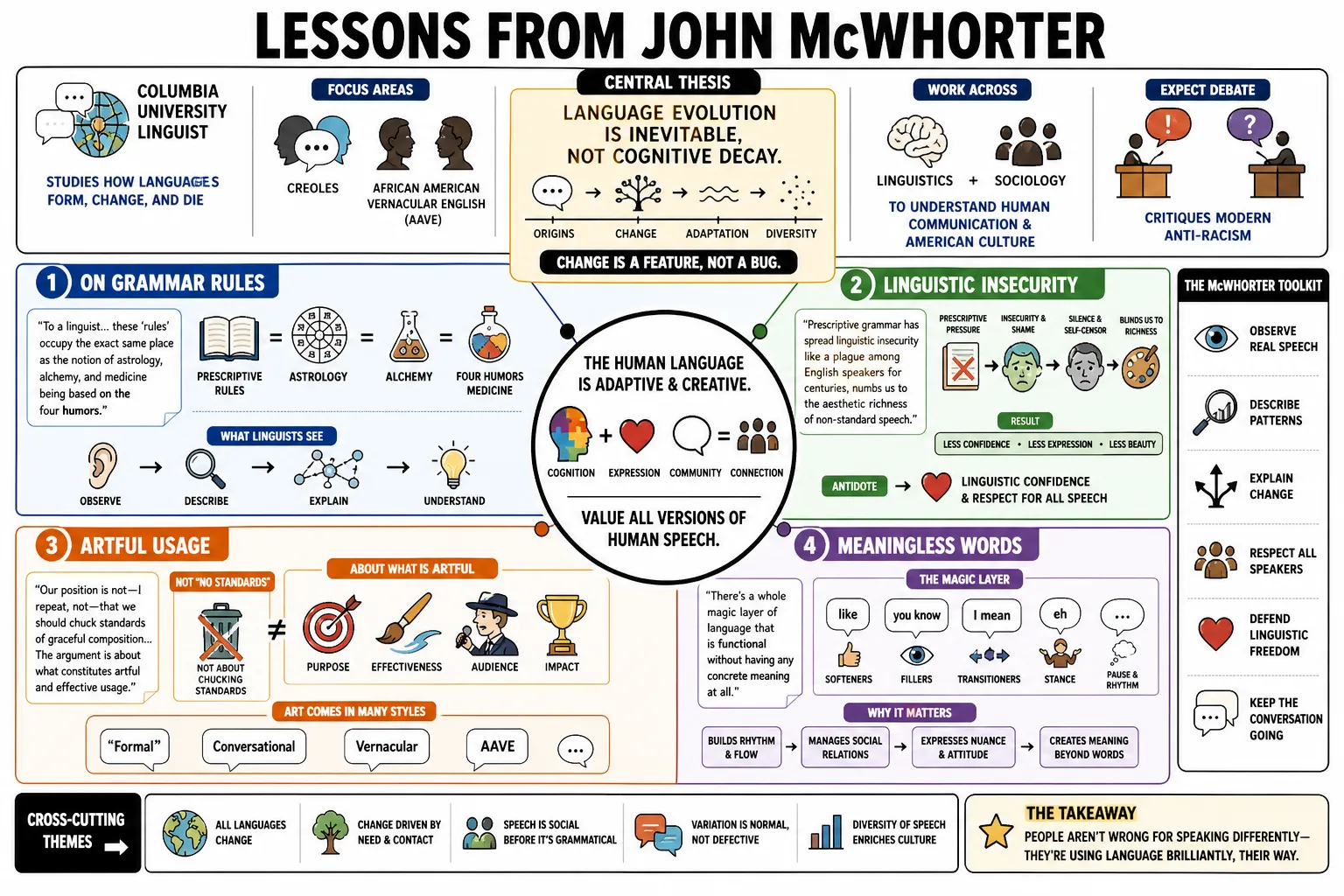
Columbia University linguist John McWhorter studies how languages form, change, and die, focusing on creoles and African American Vernacular English. He argues that language evolution is an inevitable process rather than a sign of cognitive decay, though he regularly draws more debate for his critiques of modern anti-racism. This compilation organizes his work across linguistics and sociology to clarify his positions on human communication and American culture.
Part 1: Grammar and "Rules"
- On Grammar Rules: "To a linguist... these 'rules' occupy the exact same place as the notion of astrology, alchemy, and medicine being based on the four humors." — Source: Our Magnificent Bastard Tongue
- On Linguistic Insecurity: "Prescriptive grammar has spread linguistic insecurity like a plague among English speakers for centuries, numbs us to the aesthetic richness of non-standard speech." — Source: Goodreads
- On Artful Usage: "Our position is not—I repeat, not—that we should chuck standards of graceful composition... The argument is about what constitutes artful and effective usage." — Source: Goodreads
- On Meaningless Words: "There's a whole magic layer of language that traditional ways of teaching grammar tend to ignore, and therefore we don't think of it as real language." — Source: EconTalk
- On the Word "Well": Conversational fillers like "well" serve a specific function to acknowledge the previous speaker or signal a contradiction, even if they lack a strict dictionary definition. — Source: EconTalk
- On Language as Convention: "Language is not based on logic or consistent rules. It is convention (and ever changing convention) all the way down." — Source: EconTalk
- On Redundancy: Words like "irregardless" or "overwhelm" often begin as redundancies where speakers are simply trying to be more forceful, not illogical. — Source: Words on the Move
- On Grammar "Don'ts": Rigid adherence to prescriptive grammar usually stems from class anxiety rather than adherence to historical linguistic truths. — Source: The New York Times
- On Formal Language: "I would hope, however, that we might think of these things as what they are: arbitrary fashions of formal language that we must attend to just as we dress according to the random dictates of the fashions of our moment." — Source: Our Magnificent Bastard Tongue
Part 2: The Evolution of English
- On English's Oddity: "English, however, is kinky. It has a predilection for dressing up like Welsh on lonely nights." — Source: Our Magnificent Bastard Tongue
- On Historical Influences: "The real story of English is about what happened when Old English was battered by Vikings and bastardized by Celts." — Source: Our Magnificent Bastard Tongue
- On Perception vs. Reality: "People's sense of how they talk tends to differ from the reality." — Source: Words on the Move
- On the Word "About": "The word about is not the scion of some ancient Old English word... but a melding of at, by, and out." — Source: Words on the Move
- On Musical Analogies: "When a note stays unchanged for an eternity, it's unexpected, suggesting either plainchant, willful modernist contrarianism, or bagpipes." — Source: Words on the Move
- On Lexical Fluidity: "What a word means today is a Polaroid snapshot of its lexical life, long-lived and frequently under transformation." — Source: David Labaree
- On Constant Transformation: "Because all languages are and have always been in a state of continual transformation, anything we see in a language today is the result of change." — Source: Goodreads
- On Language Decay: Language change is an organic, inevitable process of human adaptation, rather than a symptom of deterioration or societal decline. — Source: Lexicon Valley
- On "Errors" as Evolution: Grammatical mistakes and deviations from the standard are rarely signs of degradation; they are often the leading edge of the future of the English language. — Source: The New York Times
- On Biological Adaptation: Linguistic evolution mirrors biological adaptation, continuously remodeling itself to fit the communicative needs of its speakers in real time. — Source: Words on the Move
Part 3: African American Vernacular English (AAVE)
- On AAVE's Systematicity: AAVE is not broken English, but a highly systematic, rule-governed language variety with its own complex grammar and internal logic. — Source: Talking Back, Talking Black
- On AAVE Nuance: The AAVE use of "done" (as in "You done drank the juice") conveys a specific disappointed past state that lacks a direct, single-word equivalent in standard grammar. — Source: Talking Back, Talking Black
- On AAVE's Origins: AAVE is primarily a product of early contact between enslaved Africans and British indentured servants, rather than possessing a heavy West African grammatical structure. — Source: Talking Back, Talking Black
- On the "Bridging" Debate: While AAVE is a legitimate language system, formal programs using it as a classroom bridge to Standard English are largely unnecessary for language acquisition. — Source: Talking Back, Talking Black
- On Sociopolitical Confusion: The public frequently confuses the valid linguistic reality of AAVE with complex sociopolitical debates, such as the 1996 Oakland Ebonics controversy. — Source: Talking Back, Talking Black
- On Cultural Contexts: Accepting AAVE as a valid alternative form of the language requires respecting its use across various cultural contexts, including literature and art. — Source: Talking Back, Talking Black
- On Minstrel Misimpressions: The idea that AAVE is merely lazy articulation is an earnest misimpression that ignores its deep structural complexity. — Source: Lexicon Valley
- On Speech Pathology Bias: Certain clinical assessment tests used by speech-language pathologists contain systemic biases against children who naturally speak AAVE instead of Standard American English. — Source: The New York Times
- On Dialect Equality: All dialects, including colloquial and non-standard forms of speech, are created equal from a strict linguistic perspective. — Source: Lexicon Valley
- On Standard English Acquisition: Children who grow up speaking AAVE are entirely capable of acquiring Standard English naturally, without their home dialect needing to be formally taught. — Source: Talking Back, Talking Black
Part 4: The Fallacy of Linguistic Determinism
- On Universality: "If you want to learn about how humans differ, study cultures. However, if you want insight as to what makes all humans worldwide the same... there are few better places to start than how language works." — Source: The Language Hoax
- On True Intelligence: "Skepticism—that is, a dedication to applying one's mind to taking the measure of things before coming to a judgement—is the heart of intelligence." — Source: Goodreads
- On Linguistic Determinism: The specific language a person speaks does not fundamentally dictate or constrain their cognitive thought processes, a theory often exaggerated by neo-Whorfianism. — Source: The Language Hoax
- On Popular Whorfianism: The media frequently exaggerates minor linguistic experiments to falsely suggest that speakers of different languages inhabit entirely different cognitive realities. — Source: The Language Hoax
- On Patronizing Cultures: Focusing heavily on minor linguistic differences can serve as a well-meaning but flawed excuse for elites to patronize other cultures. — Source: The Language Hoax
- On Shared Cognition: The study of grammar across different societies reveals the basic, shared cognitive capacity of all humans, rather than exposing deep psychological divides. — Source: The Language Hoax
- On Language and Worldview: While a language undoubtedly reflects the culture and identity of its speakers, it does not act as a restrictive lens that limits how they can perceive the world. — Source: The Language Hoax
- On Experimental Findings: Small lab findings regarding how language affects color perception or spatial awareness do not equate to vastly different ways of experiencing human life. — Source: NYU Press Reviews
- On Global Similarities: Despite vast differences in vocabulary and grammar, the fundamental mechanics of how humans use language to express thought look remarkably the same in any language. — Source: The Language Hoax
Part 5: The Dynamics of Profanity
- On the Shift in Swearing: "To wit, profanity first involved the holy, and only later the holes." — Source: Nine Nasty Words
- On Religious Transgression: Centuries ago, the most offensive language was exclusively religious in nature, reflecting an era where blasphemy was the ultimate societal taboo. — Source: Nine Nasty Words
- On Bodily Functions: In the 20th century, societal focus shifted away from religion, causing the nastiest words to center around the body and bodily functions. — Source: Nine Nasty Words
- On Modern Taboos: In the contemporary era, the absolute highest tier of taboo language has transitioned once again, now taking the form of identity-oriented slurs. — Source: Nine Nasty Words
- On Slurs as Profanity: Racial and identity slurs have effectively become the new profanity, eliciting the same visceral shock and social condemnation that religious curses did centuries ago. — Source: The New York Times
- On Clever Euphemisms: "There's a word for ladies like you but you don't use it outside of a kennel." — Source: Reddit AMAs
- On the Brain and Cursing: The urge to swear does not originate from the same part of the brain that processes standard, deliberate speech, explaining its automatic nature. — Source: LitReactor
- On Carlin's Seven Dirty Words: George Carlin's famous list of Seven Dirty Words represents a snapshot of 20th-century bodily taboos that have since lost much of their original shock value. — Source: Nine Nasty Words
- On the Gutter's Evolution: What a society deems offensive is never permanent; the vocabulary of the gutter is constantly shifting to reflect a culture's deepest, unstated anxieties. — Source: Nine Nasty Words
Part 6: Woke Racism and "The Elect"
- On Circular Logic: "The circularity here—'You're a racist, and if you say you aren't, it just proves that you are'—is the logic of the sandbox." — Source: Woke Racism
- On Dissent: "People who are in disagreement are not just wrong. They are filthy. They are heretics. They can't be around." — Source: Substack
- On the Behavior of the Elect: "We need them to go back to doing this while seated, with the rest of us, rather than standing up and getting their way by calling us moral perverts if we disagree." — Source: Woke Racism
- On Ideological Goals: "It's that there is a religion that specifies that your main goal is to show that you are aware that racism exists." — Source: Substack
- On Infantilizing Policies: Movements claiming to dismantle racist structures often pass policies that actively infantilize Black Americans and disproportionately damage Black communities. — Source: Columbia University Discussions
- On Artistic Burden: Expecting Black authors to focus primarily on race sits as a gloomy and pointless burden upon individuals whose creative energy should be directed freely. — Source: Christopher Wink
- On the New Religion: Woke ideology functions precisely as a religion, complete with original sin, clergy, and the aggressive excommunication of heretics. — Source: Woke Racism
- On Setting Up Failure: Lowering academic or behavioral standards under the guise of anti-racism is a misguided approach that ultimately sets Black students up for long-term failure. — Source: Columbia University Discussions
- On Illiberal Progressivism: The ideological rigidity of "The Elect" represents an illiberal form of progressivism that hinders the precise communities it loudly claims to champion. — Source: The New York Times
- On Moral Panic: The current cultural climate often substitutes practical problem-solving with performative moral panic designed to showcase the speaker's purity. — Source: Woke Racism
Part 7: Victimhood and Self-Sabotage
- On the Solidarity of Defeat: "Marx warned... of a 'solidarity of defeat,' where what energizes people's sense of themselves as a group is obstacles forced on them from an enemy above." — Source: Losing the Race
- On Badges of Pride: Black America can sometimes seem stuck in a holding pattern, oddly brandishing historical and present defeat as a badge of cultural pride. — Source: Losing the Race
- On Honesty: "We must neither behave as children by resisting honesty, nor allow ourselves to be treated as children by having honesty withheld." — Source: Losing the Race
- On Respect and Expectations: "A person you excuse from any genuine challenge is a person you do not truly respect." — Source: Losing the Race
- On the Cult of Victimology: An overarching focus on historical grievance has created a cult of victimology that discourages individual accountability and proactive success. — Source: Losing the Race
- On the Cult of Separatism: The urge to separate Black identity entirely from mainstream American culture often acts as a self-imposed barrier to broader socio-economic integration. — Source: Losing the Race
- On Anti-Intellectualism: A localized cult of anti-intellectualism mistakenly equates academic striving with acting white, fundamentally sabotaging educational outcomes. — Source: Losing the Race
- On the Disease of Defeatism: Focusing primarily on systemic racism as the defining factor of Black life cultivates a paralyzing disease of defeatism rather than resilience. — Source: Losing the Race
- On Thriving Despite Racism: Progress requires a cultural shift toward individual empowerment, demanding that individuals strive for excellence and success despite the enduring presence of racism. — Source: Losing the Race
Part 8: Language as Culture and Society
- On Cultural Appropriation: Strict boundaries regarding cultural exchange in language are misguided, as American culture and dialects are deeply and historically intertwined. — Source: The New York Times
- On Shared Language: Black English doesn't have to be just for Black people, reflecting the reality that cultural mingling cannot be artificially halted at the border of language. — Source: The New York Times
- On the Etymology of Slurs: Understanding the history and evolution of racial slurs is necessary to comprehend why they have become modern society's most severe profanities. — Source: Why Evolution Is True
- On Pronoun Debates: Current linguistic controversies, such as the debate over gender-neutral pronouns, follow predictable, historical patterns of semantic shift and grammaticalization. — Source: The New York Times
- On "Woke" Terminology: The rapid shifting of acceptable terminology on the euphemism treadmill is a natural linguistic phenomenon, though often weaponized in modern social justice discourse. — Source: The New York Times
- On Language Extinction: The rapid disappearance of creole languages and isolated dialects represents a heartbreaking loss of complex mechanics and cultural history. — Source: Lexicon Valley
- On Broad Contexts: Studying language mechanics provides a window into broader cultural topics, from the history of music to the evolution of socio-political dynamics. — Source: Lexicon Valley
- On Distracting Fashions: Hyper-fixating on proper English distracts speakers from attending to genuine issues of narrative style, clarity, and rhetorical substance. — Source: Our Magnificent Bastard Tongue
- On Language as a Living Organism: Language is not a fragile museum piece requiring protection, but a resilient, fluid, and adaptable organism built to survive continual disruption. — Source: Words on the Move