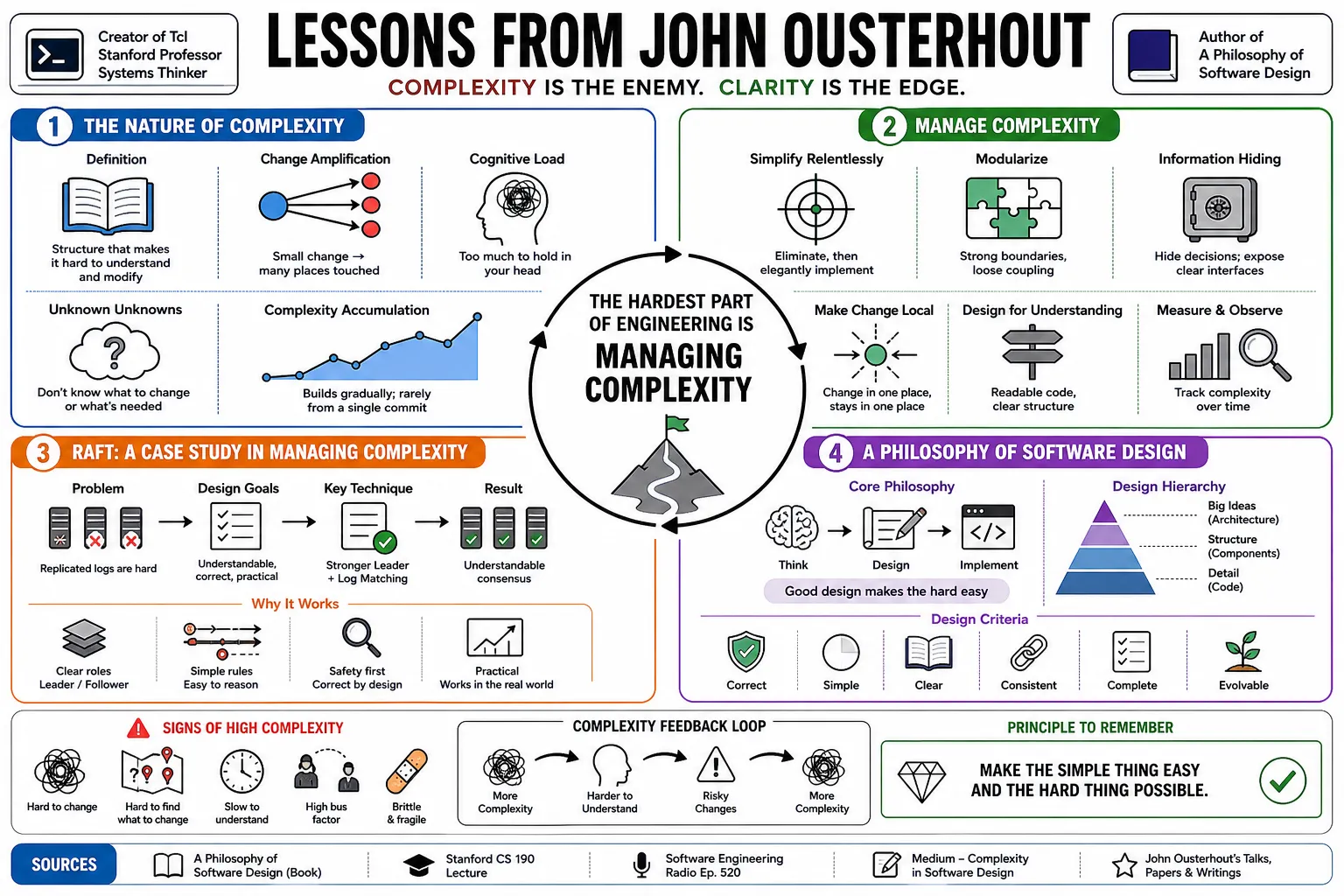
Lessons from John Ousterhout
John Ousterhout, a Stanford professor and creator of Tcl, argues that the hardest part of engineering is simply managing complexity. From his work on the Raft algorithm to his book A Philosophy of Software Design, he provides a practical manual for building systems that stay maintainable.
Part 1: The Nature of Complexity
- On the Definition of Complexity: "Complexity is anything related to the structure of a software system that makes it hard to understand and modify the system." — Source: A Philosophy of Software Design (Book)
- On Change Amplification: Complexity is present when a seemingly simple change requires modifications in many different places across the codebase. — Source: Stanford CS 190 Lecture
- On Cognitive Load: High complexity forces a developer to keep too much information in their head at once to complete a single task. — Source: Software Engineering Radio Ep. 520
- On Unknown Unknowns: The worst symptom of complexity is not knowing what parts of the code must be modified or what information is needed to perform a task safely. — Source: Medium - Complexity in Software Design
- On Complexity Accumulation: "Complexity isn't caused by a single catastrophic error; it accumulates in lots of small chunks." — Source: Google Tech Talk - A Philosophy of Software Design
- On Dependencies: Complexity is born when code cannot be understood or modified in isolation; every dependency adds a potential path for complexity to travel. — Source: Pragmatic Engineer Interview
- On Obscurity: Complexity occurs when important information is not obvious, such as a variable name that doesn't reflect its purpose or a hidden side effect in a function. — Source: A Philosophy of Software Design (Book)
- On Zero Tolerance: To slow the growth of complexity, engineers must adopt a zero-tolerance philosophy where every change is scrutinized for its impact on the system's clarity. — Source: Book Overflow Podcast
- On the Cognitive Limit: "The greatest limitation in writing software is our ability to understand the systems we are creating." — Source: Stanford Faculty Profile
Part 2: Module Design and Abstraction
- On Deep Modules: The best modules provide powerful functionality through a very simple interface, hiding significant internal complexity from the user. — Source: Google Tech Talk
- On Shallow Modules: A shallow module has a complex interface relative to the small amount of functionality it provides, increasing the total complexity of the system without enough benefit. — Source: A Philosophy of Software Design (Book)
- On Information Hiding: "It is more important for a module to have a simple interface than a simple implementation." — Source: Stanford CS 190 Design Principles
- On the Unix File I/O Example: The Unix `open`, `read`, and `write` calls are classic deep modules because they hide thousands of lines of disk management and caching logic behind five simple parameters. — Source: Software Engineering Radio
- On Information Leakage: Information leaks when a design decision is reflected in multiple modules, forcing a developer to change all of them if that decision is ever reversed. — Source: Medium - Information Hiding
- On Pulling Complexity Downwards: It is better for a module to be complex internally than to force its users to deal with that complexity; developers should suffer so their users don't have to. — Source: A Philosophy of Software Design (Book)
- On Classitis: The "Clean Code" trend of creating many tiny classes often leads to shallow modules and "classitis," where the logic of a single task is fragmented across dozens of files. — Source: Book Overflow Podcast
- On Interface Simplicity: An interface should be designed to make the most common tasks as easy as possible while still allowing for more complex use cases. — Source: Google Tech Talk
- On General-Purpose vs. Special-Purpose: Modules should be slightly more general-purpose than what is currently needed; this usually leads to cleaner abstractions and better information hiding. — Source: Stanford CS 190
- On Hidden State: Abstractions fail when the user has to understand the internal state of a module to use its public methods correctly. — Source: A Philosophy of Software Design (Book)
Part 3: Strategic vs. Tactical Programming
- On Working Code: "The first step towards becoming a good software designer is to realize that working code isn't enough." — Source: A Philosophy of Software Design (Book)
- On the Tactical Tornado: A tactical tornado is a prolific programmer who pumps out features quickly but leaves a trail of complexity that slows down the entire organization later. — Source: Medium - Tactical Tornadoes
- On Strategic Programming: The primary goal of a strategic programmer is a great design; working code is merely a byproduct of that design process. — Source: Stanford CS 190
- On the 10-20% Investment: Engineers should spend 10–20% of their total development time on activities that don't directly implement features, such as design thinking and refactoring. — Source: Software Engineering Radio
- On Technical Debt: Technical debt is the cumulative result of tactical decisions; eventually, the cost of adding new features becomes so high that the project grinds to a halt. — Source: Google Tech Talk
- On the "Hacker" Culture: The industry often rewards tactical speed because it is visible, while ignoring the long-term value of strategic design because its benefits are invisible (avoided problems). — Source: Book Overflow Podcast
- On Incremental Design: Software design is never "done"; it must be an ongoing process where the system's structure is continuously refined as more is learned about the problem. — Source: A Philosophy of Software Design (Book)
- On Refactoring Costs: It is much cheaper to fix a design flaw early than to wait until thousands of lines of code depend on a broken abstraction. — Source: Medium - Design Investment
- On Design as a Skill: Great design is not a talent one is born with; it is a skill that can be taught and learned through deliberate practice and critique. — Source: Stanford Faculty Profile
Part 4: The Raft Consensus Algorithm
- On Designing for Humans: The primary goal of Raft was to create a consensus algorithm that was easy for humans to understand, implement, and reason about. — Source: Raft Paper - In Search of an Understandable Consensus Algorithm
- On the Failure of Paxos: Paxos's core protocol is dense and subtle enough that, in the Raft authors' telling, it is hard to develop an intuition for why it works, which is part of why they set out to design a more understandable alternative. — Source: Raft Website
- On Understandability as a Metric: "Understandability deserves more emphasis in algorithm design. Making a system simpler can have high impact." — Source: John Ousterhout's Stanford Page
- On Decomposition in Raft: Raft achieved simplicity by decomposing the consensus problem into three independent subproblems: leader election, log replication, and safety. — Source: Raft Paper
- On the Strong Leader Model: By enforcing a strong leader who manages the entire log, Raft reduces the number of states the system can be in, making it easier to verify. — Source: Raft User Study Presentation
- On the Raft Name: The name "Raft" is a play on the goal of creating something Reliable, And Fault-Tolerant, and a metaphor for "escaping the island of Paxos." — Source: Wikipedia - Raft (algorithm)
- On the User Study: To prove Raft was more understandable, Ousterhout and Ongaro conducted a study with 43 students and showed they performed significantly better on Raft exams than Paxos exams. — Source: Raft Paper
- On Practicality over Theory: While Paxos is elegant in its mathematical minimalism, Raft is superior for engineering because it addresses practical needs like cluster membership changes. — Source: InfoQ - Raft vs Paxos
- On Logic Separation: Raft's design ensures that the safety logic is separate from the performance-optimizing logic, allowing engineers to tune the system without breaking its correctness. — Source: Raft Paper
Part 5: Tcl, Tk, and the Ousterhout Dichotomy
- On the Purpose of Tcl: Tcl was designed as a "Tool Command Language"—a small, embeddable library that could give any C application a programmable interface. — Source: Tcl/Tk History
- On the Ousterhout Dichotomy: Software development should be split into two layers: system programming (for performance/algorithms) and scripting (for gluing components together). — Source: Scripting: Higher-Level Programming for the 21st Century
- On Glue Languages: "System programming languages were designed for building data structures and algorithms from scratch... In contrast, scripting languages are designed for gluing." — Source: IEEE Computer - Scripting Paper
- On Everything is a String: Tcl's most famous design choice—treating every piece of data as a string—simplified the interface between the core C code and the scripting layer. — Source: Tcl/Tk History
- On the Birth of Tcl: Ousterhout created Tcl in 1988 because he was tired of writing a new, mediocre command language for every interactive engineering tool he built. — Source: Stanford Tcl History
- On the Tk Toolkit: Tk revolutionized GUI development by allowing developers to build professional interfaces with a few lines of script instead of thousands of lines of C++. — Source: ACM Software System Award Citation
- On the "Two-Language" Benefit: Using a scripting language for the UI and high-level logic allows for rapid prototyping and interactive development that is impossible in compiled languages. — Source: Scripting Paper
- On Embeddability: Tcl's design as a C library (rather than a standalone interpreter) was key to its early adoption in the EDA and CAD industries. — Source: Tcl/Tk History
- On Performance Trade-offs: Scripting languages are slower than system languages, but for 80% of application code, developer productivity is more important than raw execution speed. — Source: Scripting Paper
Part 6: Operating Systems and High-Performance Storage
- On the Log-structured File System (LFS): LFS was born from the insight that as RAM grew, almost all disk I/O would eventually be write-dominated because reads would hit the cache. — Source: The Design and Implementation of a Log-Structured File System
- On Sequential Writing: Traditional file systems were slowed down by disk seeks; LFS solved this by treating the entire disk as a single, append-only sequential log. — Source: Berkeley Sprite Project
- On the Segment Cleaner: The greatest challenge in LFS was the "cleaner" process that had to reclaim space from old parts of the log without killing performance. — Source: LFS Paper
- On Hardware/Software Symbiosis: "The changed workloads require a write-optimized rather than read-optimized disk access technique." — Source: CMU Lecture on LFS
- On SSD Foundations: Modern SSD controllers use a "Flash Translation Layer" that is effectively a log-structured file system because flash cannot be overwritten in place. — Source: Wikipedia - Log-structured file system
- On Sprite OS: The Sprite operating system's core philosophy was to integrate networking into the kernel so thoroughly that a cluster appeared as a single time-sharing system. — Source: Sprite OS Paper
- On Network Transparency: In Sprite, a process could be migrated from one machine to another without the user or the application even noticing. — Source: Sprite Project History
- On Caching Strategy: Sprite relied on large, variable-sized caches to minimize network traffic, a strategy that anticipated the massive increase in RAM sizes of the 1990s. — Source: Sprite OS Design Principles
- On the "Write-Back" Risk: LFS and Sprite demonstrated that while "write-back" caches are dangerous for data integrity, they are the only way to achieve high performance on mechanical disks. — Source: LFS Paper
Part 7: The Design Process and Engineering Mindset
- On Design it Twice: "Designing software is hard, so it's unlikely that your first thoughts... will produce the best design. Design it twice." — Source: A Philosophy of Software Design (Book)
- On Defining Errors Out of Existence: Instead of throwing exceptions for edge cases, design the interface so the "common case" behavior naturally handles those situations correctly. — Source: Software Engineering Radio
- On the Substring Example: A substring function should return an empty string if the range is invalid, rather than throwing an error; this simplifies the caller's logic. — Source: Google Tech Talk
- On White-Box Testing: Ousterhout prefers writing tests while looking at the code to ensure every branch and control structure is exercised, rather than just testing the public API. — Source: Stanford CS 190 Unit Testing
- On the Failure of TDD: "Test-Driven Development encourages a tactical mindset where you focus on passing the next test rather than thinking about the overall architecture." — Source: Book Overflow Podcast
- On When TDD Works: Writing the test first is only the superior approach when fixing a bug, as it ensures the bug is reproducible and the fix is verified. — Source: Pragmatic Engineer Interview
- On Comments as Abstractions: Comments should describe things that cannot be seen in the code, such as the intent behind a design or the abstraction being used. — Source: A Philosophy of Software Design (Book)
- On Meaningful Naming: If you cannot find a clear, concise name for a module or variable, it is often a sign that the underlying design is fragmented or confusing. — Source: Medium - Software Design Principles
- On Performance Intuition: "Before making any changes, measure the system's existing behavior... changes based on intuition waste time on things that don't improve performance." — Source: A Philosophy of Software Design (Book)
- On the "Not Obvious" Rule: "If a reader thinks it's not obvious, then it's not obvious. Instead of arguing, try to understand what they found confusing." — Source: Google Tech Talk
Part 8: Career, Education, and the Future of Design
- On the ACM Software System Award: Ousterhout received this award in 1997 for Tcl/Tk, joining the ranks of the creators of Unix, TCP/IP, and the World Wide Web. — Source: ACM Awards
- On the Sun Microsystems Years: Ousterhout spent four years at Sun Labs, where he led the SunScript team to turn Tcl into a cross-platform standard. — Source: Stanford Faculty Profile
- On Founding Scriptics: In 1998, he founded Scriptics to provide commercial support for Tcl, eventually pivoting the company to XML-based B2B servers (Ajuba Solutions). — Source: Tcl/Tk History
- On Teaching at Stanford: Ousterhout returned to academia in 2008 to teach CS 190, a course designed specifically to teach students how to manage complexity in large systems. — Source: Stanford CS 190 Course Page
- On AI and Design: As AI tools become better at generating low-level code, the human engineer's role will shift almost entirely to high-level architectural design. — Source: Pragmatic Engineer - AI and Software Design
- On AI's Design Dependency: AI performs significantly better on well-designed, modular codebases; bad design now has a "multiplier" cost because it breaks AI assistance. — Source: Software Engineering Radio
- On the "Benevolent Dictator" Model: Ousterhout led the Tcl community for over a decade before handing over governance to the Tcl Core Team in 2000. — Source: Tcl Core Team History
- On the Greatest Performance Improvement: "The greatest performance improvement of all is when a system goes from not-working to working." — Source: Ousterhout's Stanford Page
- On Code as Documentation: Ousterhout disagrees that "tests are the best documentation," arguing they are too verbose and spread out to explain a system's core abstractions. — Source: A Philosophy of Software Design (Book)
- On the Enduring Value of Design: Despite rapid changes in languages and frameworks, the fundamental principles of complexity management remain the most stable knowledge in a developer's career. — Source: Stanford CS 190 Final Lecture