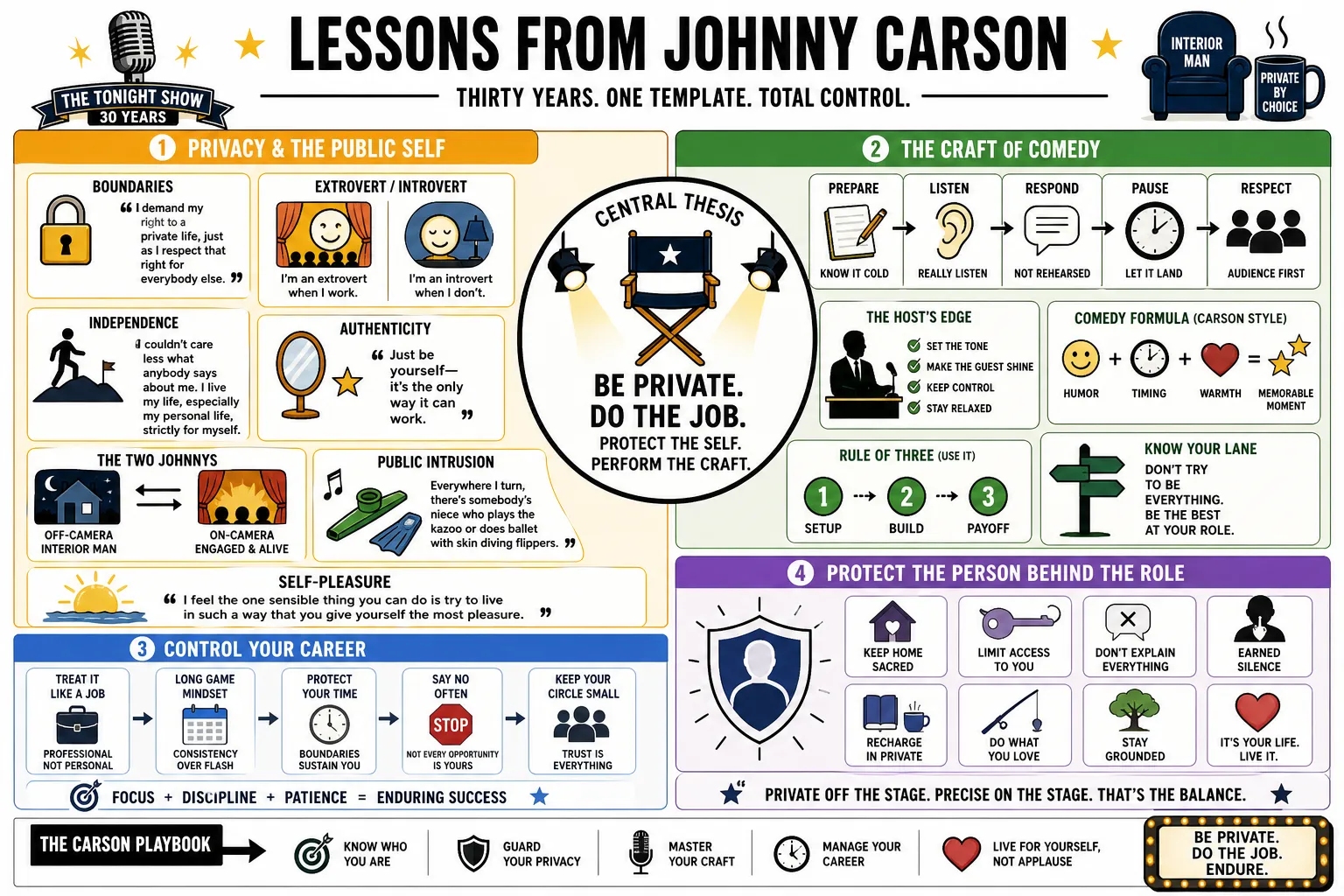
Lessons from Johnny Carson
Johnny Carson hosted The Tonight Show for thirty years and set the template for late-night television. Famously private, he treated broadcasting as a strict job rather than an outlet for personal expression. This profile gathers his direct observations on the mechanics of comedy and how to maintain control over a grueling career.
Part 1: On Privacy and The Public Self
- On Boundaries: "I demand my right to a private life, just as I respect that right for everybody else." — Source: [AZ Quotes]
- On Extroversion: "I'm an extrovert when I work. I'm an introvert when I don't." — Source: [Rolling Stone]
- On Independence: "I couldn't care less what anybody says about me. I live my life, especially my personal life, strictly for myself." — Source: [Playboy]
- On Authenticity: "Just be yourself—it's the only way it can work." — Source: [Goodreads]
- On The Two Johnnys: The man off-camera was famously an "Interior Man," reserving his liveliness and conversational ease entirely for the studio audience. — Source: [Los Angeles Times]
- On Public Intrusion: "Everywhere I turn, there's somebody's niece who plays the kazoo or does ballet with skin diving flippers." — Source: [Playboy]
- On Self-Pleasure: "I feel the one sensible thing you can do is try to live in a way that pleases you. If you don't hurt anybody else, what you do is your own business." — Source: [Playboy]
- On Socializing: Despite hosting the biggest conversational show in America, he notoriously avoided Hollywood parties, preferring the quiet isolation of his own home. — Source: [CBS News]
- On The Cost of Success: "I don't think it's you that changes with success — it's the people around you who change. Because of your new status, they change in relation to you." — Source: [Playboy]
- On Enduring Relationships: His closest personal relationships were famously guarded; he did not rely on entourages for emotional security or external validation. — Source: [PBS]
Part 2: On The Craft of Comedy
- On Simplicity: "Never use a big word when a little filthy one will do." — Source: [Goodreads]
- On Polemics: "When a comic becomes enamored with his own views and foists them off on the public in a polemic way, he loses not only his sense of humor but his value as a humorist." — Source: [AZ Quotes]
- On Entertainment vs Education: "People will pay more to be entertained than educated." — Source: [AZ Quotes]
- On Owning Failure: When a joke failed on air, acknowledging the misfire—often by having the band play music while doing a brief soft-shoe dance—generated a bigger laugh than the original bit. — Source: [The Kennedy Center]
- On The "No Homework" Rule: Audiences tune in at the end of the day to find relief and escape, not to be lectured or given intellectual assignments. — Source: [Britannica]
- On Neutrality: He maintained a strict apolitical stance on the air to ensure the show served as a unifying space rather than a divisive one. — Source: [AllMusic]
- On Spontaneity: The effortless conversational tone of the show was achieved through relentless, highly structured daily preparation by his entire staff. — Source: [Television Academy]
- On Listening: The success of the guest format relied on his ability to actively listen and act as a careful talent broker, letting the guest shine. — Source: [Fast Company]
- On Reading the Room: A comedian must remain hyper-aware of the audience’s temperature, pacing delivery precisely to match their immediate reactions. — Source: [PBS]
- On Longevity in Comedy: True staying power requires an enormous desire to be up on everything and a voracious reading habit to keep material topical. — Source: [Television Academy]
Part 3: On Wealth, Success, and Contentment
- On Financial Freedom: "The only thing money gives you is the freedom of not worrying about money." — Source: [Goodreads]
- On Career Joy: "Never continue in a job you don't enjoy. If you're happy in what you're doing, you'll like yourself, you'll have inner peace." — Source: [Goodreads]
- On True Success: "And if you have that [inner peace], along with physical health, you will have had more success than you could possibly have imagined." — Source: [Goodreads]
- On Delivering Value: "You become successful, the way I see it, only if you're good enough to deliver what the public enjoys." — Source: [AZ Quotes]
- On The Performer's Role: "If you're not [good enough], you won't have any audience; so the performer really has more to do with his success than the public does." — Source: [AZ Quotes]
- On The Core Secret: When asked for the absolute secret to his decades of television dominance, he stated simply: "Be yourself and tell the truth." — Source: [Target]
- On Evolving Success: His unmatched cultural standing evolved from working hard at the business at hand each day, rather than a sudden leap to fame. — Source: [Britannica]
- On Maintaining Standards: A sustained career at the top requires focusing intensely on one's own internal standards of excellence rather than chasing public approval. — Source: [PBS]
- On Groundedness: He largely viewed his enormous wealth functionally—as a tool for securing privacy and autonomy—rather than as a scorecard for happiness. — Source: [CBS News]
Part 4: On Independence and Control
- On Herd Mentality: "I don't run with anybody's herd." — Source: [QuoteFancy]
- On Internal Guidance: He consistently preferred to trust his own intuition about what was funny over analyzing demographic data or trying to cater to specific audience segments. — Source: [Rolling Stone]
- On Taking Responsibility: The world is largely indifferent; instead of complaining about fairness, you must take absolute control of the one variable you can influence: yourself. — Source: [Matthew Powell]
- On Hollywood Therapy: "In Hollywood if you don't have a shrink, people think you're crazy." — Source: [Goodreads]
- On Self-Reliance: He famously operated without managers or handlers hovering on set, maintaining strict authority over his show's creative direction. — Source: [NPR]
- On Saying No: He guarded his energy by routinely rejecting high-profile interviews, social invitations, and opportunities to monetize his fame outside the show. — Source: [Los Angeles Times]
- On Trusting Your Gut: His refusal to over-intellectualize his broad appeal preserved the instinctual rhythm that made his comedy resonate. — Source: [Rolling Stone]
- On Professional Autonomy: Achieving mastery means arriving at a point where your output is dictated entirely by your own taste, independent of network pressure. — Source: [PBS]
- On Knowing When To Walk Away: Retiring while still at the absolute top of the ratings was the ultimate exercise of control over his own narrative. — Source: [Esquire]
Part 5: On The Anatomy of Misery
- On Altering Reality: The first rule to guarantee a miserable life is the regular ingestion of chemicals to alter your mood or perception. — Source: [Matthew Powell]
- On Envy: The second crucial ingredient for a prescribed life of misery is to actively nurture envy toward the success of others. — Source: [Matthew Powell]
- On Resentment: Harboring deep resentment and refusing to let go of past slights completes the trifecta of guaranteed human unhappiness. — Source: [Matthew Powell]
- On Negative Instruction: It is often more practical and honest to teach people what behaviors to avoid than to prescribe a one-size-fits-all formula for happiness. — Source: [Patrick Bet-David]
- On Self-Destruction: "I know a man who gave up smoking, drinking, sex, and rich food. He was healthy right up to the day he killed himself." — Source: [Quotations Page]
- On Misplaced Focus: Spending time agonizing over the unfairness of an industry is a guaranteed way to stall your own progression within it. — Source: [Patrick Bet-David]
- On The Trap of Comparison: True misery sets in when a performer measures their worth strictly against the contemporary standing of their peers. — Source: [Medium]
- On Reliable Failure: The refusal to adapt or learn from anyone else's mistakes is the fastest path to compounding your own misery. — Source: [Medium]
- On Action vs Complaint: Action cures anxiety; dwelling on grievances without taking steps to improve your craft only deepens the resentment. — Source: [Matthew Powell]
Part 6: On Fame and Celebrity Culture
- On Celebrity Obsession: He frequently expressed quiet frustration with the American public's infatuation with celebrity gossip over substantial reading and deeper intellectual pursuits. — Source: [Rolling Stone]
- On Becoming an Institution: To be on television every night for decades is to become a creature of habit for the audience, transcending the role of mere entertainer. — Source: [Britannica]
- On the Ghost of Performance: Ten years after retiring, he admitted: "I still, believe it or not, have dreams in which I am late for The Tonight Show... It's show time and I'm going on—and I've got nothing to say!" — Source: [Esquire]
- On Cultural Power: His casual, on-air joke about a looming toilet paper shortage triggered an actual nationwide panic-buying spree, illustrating the terrifying weight of his platform. — Source: [Los Angeles Times]
- On Being a Kingmaker: A single nod of approval or a gesture to sit on the couch could instantly legitimize a comedian and alter the trajectory of their entire life. — Source: [University of Nebraska-Lincoln]
- On The Illusion of Intimacy: The audience feels a profound, one-sided intimacy with daily broadcasters, expecting off-camera accessibility that the host cannot possibly sustain. — Source: [Playboy]
- On Managing Profile: He understood that extreme overexposure on television required strict underexposure in print and social settings to maintain any semblance of mystique. — Source: [CBS News]
- On Origins: "I started in a gaseous state and then I cooled." — Source: [Goodreads]
- On Letting Go: Stepping away from the center of American culture requires accepting that the world will immediately move on without you. — Source: [Esquire]
Part 7: On Navigating the Unfairness of Life
- On Fairness: "If life were fair, Elvis would be alive and all the impersonators would be dead." — Source: [Goodreads]
- On Mortality: "For three days after death, hair and fingernails continue to grow but phone calls taper off." — Source: [Working Humor]
- On Connection: "In the end, it's true, we each must die alone, but the love and friendship we share with one another show that we do not live alone." — Source: [Goodreads]
- On Returning Home: Going back to your roots after achieving massive fame is often disappointing because people react to the status you hold, not the person you were. — Source: [Playboy]
- On Expectation: It is a mistake to expect the entertainment industry, or life in general, to reward you proportionally for your effort without the presence of actual skill. — Source: [Medium]
- On Public Scrutiny: Surviving intense public criticism requires a hardened emotional exterior and an acceptance that you cannot correct every false narrative. — Source: [Playboy]
- On Enduring Hardship: Humor is the most effective psychological defense mechanism for processing grief, anxiety, and the general absurdity of human existence. — Source: [PBS]
- On Acceptance: You must deal with the reality of the audience in front of you, not the hypothetical audience you wish you had. — Source: [Television Academy]
- On the Unforgiving Camera: The camera acts as an absolute lie detector; it will immediately expose any performer who is trying to be something they are fundamentally not. — Source: [Washington Independent Review of Books]
Part 8: On Preparation and Timing
- On Readiness: "Talent alone won't make you a success. Neither will being in the right place at the right time, unless you are ready." — Source: [AZ Quotes]
- On Magic and Mechanics: His early years performing as a magician taught him the rigid mechanics of misdirection, timing, and holding absolute command over a room. — Source: [Military.com]
- On The Daily Grind: Making a show look like a relaxed, effortless party at night requires treating it like a grueling, regimented factory job during the day. — Source: [PBS]
- On Pacing: The silence between the jokes is often where the actual comedy happens; rushing the delivery destroys the tension the joke requires to work. — Source: [Television Academy]
- On Routine: Achieving a state of "cool" under intense pressure is entirely a byproduct of having executed the exact same routine thousands of times prior. — Source: [Britannica]
- On the Performer's Nightmare: The recurring dream of being on stage unprepared reveals that the fear of failing the audience never entirely leaves a true professional. — Source: [Esquire]
- On Refining the Craft: You cannot shortcut the years of performing in front of hostile, indifferent, or tiny crowds; that friction is what sharpens the instincts. — Source: [NPR]
- On Reading Audiences: A master host knows within the first ten seconds of a monologue whether they will need to fight the room or ride the room for the rest of the hour. — Source: [PBS]
- On The Right Moment: Leaving television before the audience grew tired of him was a calculated masterclass in understanding the exact limits of his own welcome. — Source: [Esquire]
- On Finality: A career is truly finished not when you run out of talent, but when you lose the driving, obsessive need to prove yourself to strangers every night. — Source: [Esquire]