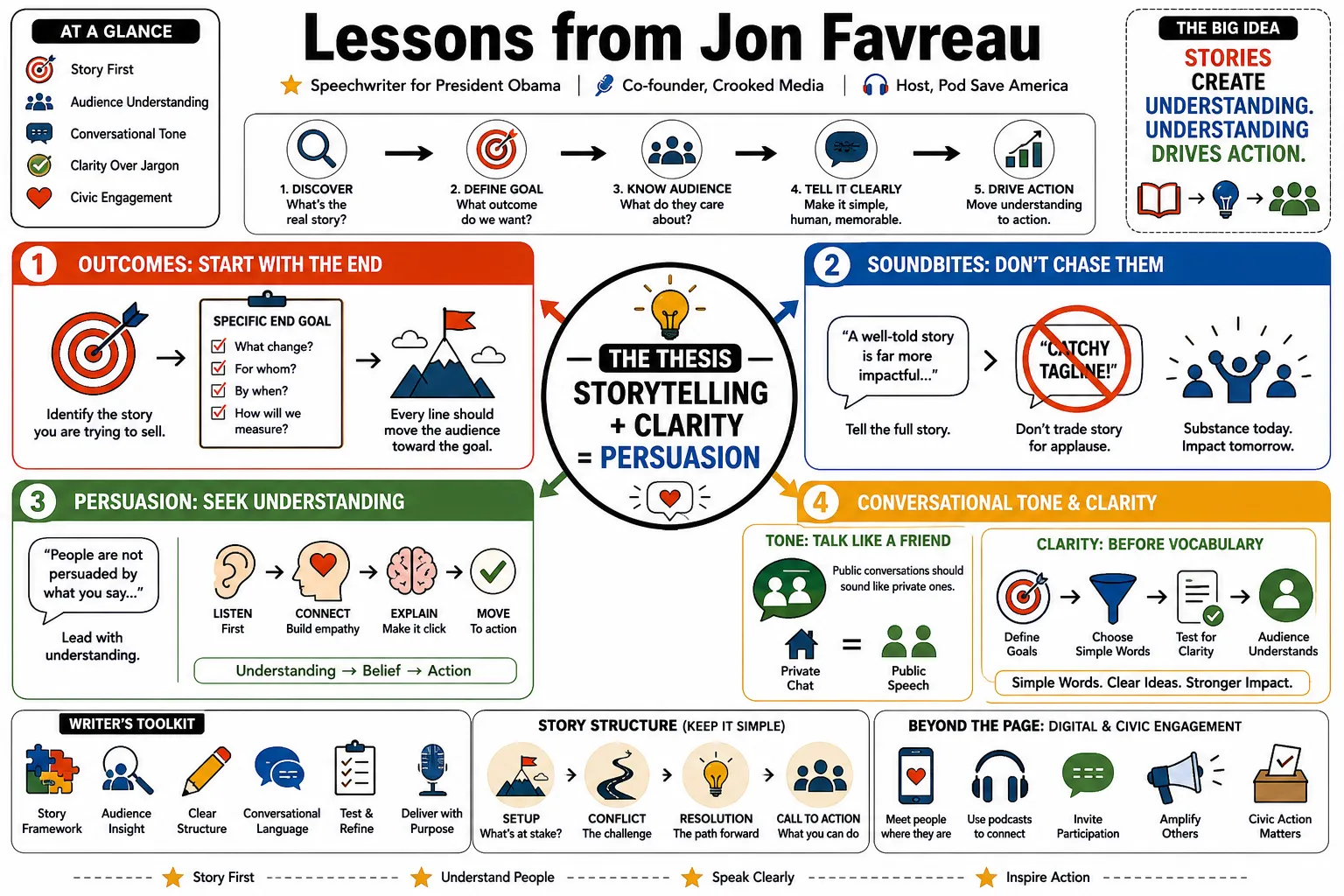
Lessons from Jon Favreau
Jon Favreau served as President Obama's director of speechwriting before co-founding Crooked Media and hosting Pod Save America. He approaches political communication as a storytelling exercise, trading academic jargon for conversational language and clear outcomes. This profile collects his advice on writing, digital media, and civic engagement for anyone trying to persuade an audience.
Part 1: The Core of Speechwriting
- On Outcomes: "Before you write a single word, identify the story you are trying to sell and define the specific end goal you want to achieve with the audience." — Source: [Medium]
- On Soundbites: "A well-told story is far more impactful than a catchy tagline or a cheap applause line. Avoid chasing soundbites at the expense of your core narrative." — Source: [The Eagle]
- On Persuasion: "At the end of the day, people are not persuaded by what you say but by what they understand." — Source: [Jeremy Earth]
- On Conversational Tone: "The way we talk about political issues in public should be as close as possible to the way we talk about political issues in private to a friend." — Source: [Substack]
- On Clarity: "Writers often focus excessively on vocabulary before defining their goals. Ask yourself what the core argument is before you worry about the prose." — Source: [Duke University]
- On Academic Language: "Avoid technical shorthand and overly formal, academic language. Speak like a normal human being at a dinner table." — Source: [Exec Comms]
- On Urgency: "When faced with tight deadlines, strip everything away and ask what single thing you absolutely must communicate right now." — Source: [UK Body Talk]
- On Honesty: "Speeches are most effective when they feel personal and courageous. Authenticity allows a speaker to connect with an audience." — Source: [Duke University]
- On Memorability: "People rarely remember the exact statistics you cite, but they will remember how a specific story made them feel about the issue." — Source: [Crooked Media]
- On Jargon: "If you wouldn't use a word while explaining an issue to your family, you shouldn't use it in a national address." — Source: [NPR]
Part 2: Structure and Argument
- On Outlining: "A great speech requires a clear, logical foundation. The argument must be structured before it is fleshed out with prose." — Source: [Steve Seager]
- On the Backbone: "Structure is the backbone of the speech, which you only later dress up with stories, emotional appeals, and rhetorical flourishes." — Source: [Medium]
- On Logic Flow: "The best speakers can instantly provide a highly logical outline of what needs to be said before any drafting begins." — Source: [Columbia Oral History]
- On Distractions: "Chasing a clever slogan often distracts you from building the strength of your underlying argument. Prioritize the argument first." — Source: [Ragan]
- On Simplicity: "Successful messaging simplifies complex issues without stripping away nuance, allowing people to follow the logic without feeling lost." — Source: [Crooked Media]
- On Building the Case: "Think of a speech like a legal argument. You have to lead the audience step-by-step from the premise to the inevitable conclusion." — Source: [Oxford Union]
- On Editing: "If a draft comes back with massive edits, it means the structure was flawed. If it comes back with a simple request to talk, the entire narrative missed the mark." — Source: [Exec Comms]
- On Transitions: "The way you move from one paragraph to the next is as important as the paragraphs themselves; the transitions determine whether you keep the audience." — Source: [NPR]
- On Pacing: "A structured argument allows you to control the pacing, building tension before delivering the core emotional payoff." — Source: [UK Body Talk]
Part 3: Authenticity and Voice
- On Finding the Voice: "Writing for someone else requires a mind-reader relationship. You have to learn their core beliefs to help them articulate their own voice." — Source: [Oxford Union]
- On Courage: "You have to be willing to be vulnerable. The speeches that resonate the most show a speaker willing to reveal genuine emotion." — Source: [Duke University]
- On Over-Rehearsing: "The most compelling messaging avoids rehearsed rhetoric. It has to sound like a human being sharing a deeply held conviction." — Source: [Substack]
- On Humor: "Take the job seriously, but don't take yourself too seriously. Humor and humility are essential tools for maintaining authenticity." — Source: [Duke University]
- On Conviction: "If you are going to run for office or lead a major initiative, you need to know exactly what you believe before you ask someone to write it down." — Source: [Jon Favreau Interview]
- On Empathy: "Empathy is a vital skill in storytelling. You cannot write authentically for an audience if you do not genuinely understand their anxieties." — Source: [The Skinny Confidential]
- On Re-Humanization: "In a deeply polarized environment, re-humanizing our political discourse is the only way to win back trust and engage thoughtfully." — Source: [Crooked Media]
- On Imitation: "Avoid trying to sound like previous great orators. Trying to sound historic often just makes you sound stiff and disconnected." — Source: [NPR]
- On Personal Anecdotes: "Using personal stories rather than abstract data helps bring ideas to life and connects with the audience on a visceral level." — Source: [UK Body Talk]
- On Trust: "An authentic voice builds trust. Without trust, even the most elegantly crafted policy arguments will fall completely flat." — Source: [Exec Comms]
Part 4: The Collaborative Process
- On Partnership: "Speechwriting is an intensely collaborative relationship with the speaker, rather than a solitary task where you hand off a finished product." — Source: [Exec Comms]
- On Feedback Loops: "The best drafting process begins with intense research, followed by a rough draft that serves primarily as a starting point for the principal's feedback." — Source: [Medium]
- On Rewriting: "Extensive mark-ups from a speaker aren't a failure; they are a critical part of honing their specific voice and clarifying their thoughts." — Source: [Exec Comms]
- On Alignment: "If the writer and the speaker aren't aligned on the core narrative before the drafting begins, the entire speech will feel disjointed." — Source: [Columbia Oral History]
- On Leaving Ego at the Door: "As a speechwriter, your ego has to take a backseat. The goal is to make the speaker sound like the best version of themselves, rather than to showcase your own cleverness." — Source: [NPR]
- On Pushing Back: "A good collaborative relationship means the writer has the standing to tell the speaker when a line fails to work or feels inauthentic." — Source: [Oxford Union]
- On Rehearsal: "Hearing the words spoken aloud during practice sessions often reveals the clunky phrases that looked fine on the page but fail in the air." — Source: [UK Body Talk]
- On Teamwork: "Behind every major address is a team of researchers, fact-checkers, and policy experts. The writer acts as the final synthesizer of all that work." — Source: [Medium]
- On Trusting the Process: "Sometimes you have to write a terrible first draft just to give the principal something to react to and tear apart." — Source: [Duke University]
Part 5: Connecting with the Audience
- On Broadening the Circle: "A great speech should broaden the circle of people who care about the issue, helping voters connect with their better angels." — Source: [Musixmatch]
- On Empathy in Practice: "You have to meet people where they are. If you fail to acknowledge their current reality, they won't follow you to your proposed future." — Source: [Crooked Media]
- On Avoiding Condescension: "Never talk down to an audience. The moment they feel lectured to rather than spoken with, you have lost their attention." — Source: [NPR]
- On Shared Values: "The most effective arguments are rooted in universally shared values, framing complex policy through the lens of basic human fairness." — Source: [Steve Seager]
- On Listening: "Before you can persuade anyone, you have to spend a significant amount of time listening to their concerns and understanding their worldview." — Source: [Time Magazine]
- On Acknowledging Flaws: "Being honest about the shortcomings of your own side or the difficulty of the challenge builds credibility with skeptical listeners." — Source: [The Wilderness]
- On Emotional Resonance: "Logic dictates the structure, but emotion is what ultimately moves an audience to take action or change their mind." — Source: [UK Body Talk]
- On Inclusion: "Use collective language heavily. A speech should feel like a shared journey, rather than a personal monologue from the speaker." — Source: [Oxford Union]
- On Hope: "In the face of difficulty, an audience needs to know that a better outcome is actually possible, rather than just theoretically desirable." — Source: [Duke University]
- On Attention Spans: "In a distracted world, you earn an audience's attention by being immediately relevant to their daily lives, rather than by being loud." — Source: [Crooked Media]
Part 6: Navigating Modern Media and the Internet
- On the Extremely Online Condition: "Our digital existence and smartphone usage are profoundly shaping societal behaviors, political polarization, and our personal mental health." — Source: [Crooked Media]
- On Information Environments: "You cannot understand the modern political era without analyzing how the media landscape shifted from seeking truth to prioritizing algorithmic outrage." — Source: [Podscripts]
- On Disconnecting: "Living a healthier life in a digitally saturated world requires intentional boundaries, like utilizing phone lock boxes and reducing daily screen time." — Source: [Jon and Max Surrender Their iPhones]
- On Algorithmic Traps: "Progressives must learn to navigate the digital landscape effectively to avoid being trapped by algorithms that reward the most extreme rhetoric." — Source: [Offline with Jon Favreau]
- On Media Fragmentation: "With the splintering of traditional media, communicators can no longer rely on a single broadcast to reach everyone; they must build direct-to-audience platforms." — Source: [Audioboom]
- On Doom-Scrolling: "The constant barrage of negative news degrades our focus, making it harder to sustain the attention required for actual democratic participation." — Source: [Offline with Jon Favreau]
- On Influencers: "The rise of pay-for-play political influencers changes the dynamic of trust, pitting authenticity against manufactured virality." — Source: [Reddit]
- On Digital Organizing: "A podcast or media brand is only useful if it can turn passive listeners into active participants in the democratic process." — Source: [Pod Save America]
- On Nuance Online: "Social media platforms are structurally hostile to nuance, meaning communicators have to work twice as hard to maintain empathy in their messaging." — Source: [IHeart]
Part 7: Political Strategy and Cynicism
- On Cynicism: "People are heavily turned off by politics and distrustful of institutions. Our messaging must acknowledge their exhaustion and sadness." — Source: [Time Magazine]
- On Choosing Hope: "Cynicism and hope are both choices. For impactful communication and lasting movements, you must consciously choose hope." — Source: [Duke University]
- On Divisive Rhetoric: "Aggressive, insulting communication styles act as a national psychic wound, succeeding primarily by making people even more cynical about everything." — Source: [Time Magazine]
- On Being Proactive: "Leaders must offer refreshing ideas that explain what they are for, rather than defining themselves strictly by who they are against." — Source: [Crooked Media]
- On Civic Duty: "Vote and participate. Politics is something you simply cannot afford to ignore, regardless of how frustrating the system becomes." — Source: [Demo Finland]
- On Swing Voters: "Understanding swing voters doesn't mean compromising your values; it means recognizing the real disillusionment that keeps them from trusting politicians." — Source: [The Wilderness]
- On the Resistance Mindset: "A movement built entirely on resisting an opponent has a limited shelf life; eventually, you have to build a positive vision." — Source: [Pod Save America]
- On Institutional Trust: "You can't demand that people trust institutions again; you have to reform those institutions and communicate the changes transparently." — Source: [Offline with Jon Favreau]
- On Long-Term Strategy: "Political change isn't achieved in a single election cycle. It requires sustaining engagement long after the initial outrage fades." — Source: [Substack]
Part 8: Leadership and Storytelling in Politics
- On Authentic Leadership: "A true leader knows their own core beliefs so intimately that they don't need a pollster to dictate their stance on an issue." — Source: [Jon Favreau Interview]
- On Defining the Narrative: "If you fail to define your own political narrative, your opponents will define it for you, leaving you entirely on the defensive." — Source: [Ragan]
- On Story vs. Policy: "Voters rarely elect ten-point policy plans; they elect the person whose story about the country's future best aligns with their own." — Source: [Medium]
- On Empathy as Strategy: "Engaging in thoughtful, long-form dialogue is a critical skill that political movements must cultivate to win over skeptics." — Source: [The Skinny Confidential]
- On Actionable Media: "It is insufficient to merely inform listeners about a crisis; responsible media must provide them with tangible ways to help or participate." — Source: [Crooked Media]
- On Honest Discourse: "A straightforward, honest approach to political commentary helps bridge the gap between complex policy debates and the everyday realities of voters." — Source: [Pod Save America]
- On Idealism: "Keeping a sense of idealism isn't naive; it is a necessary strategic tool to craft messages that inspire people to endure difficult fights." — Source: [Exec Comms]
- On Crisis Communication: "In moments of national tragedy, rhetoric must strip away partisan grievances and focus entirely on collective healing and shared humanity." — Source: [Columbia Oral History]
- On Legacy: "The most enduring speeches capture the specific mood of a moment while appealing to values that transcend that specific era." — Source: [Oxford Union]