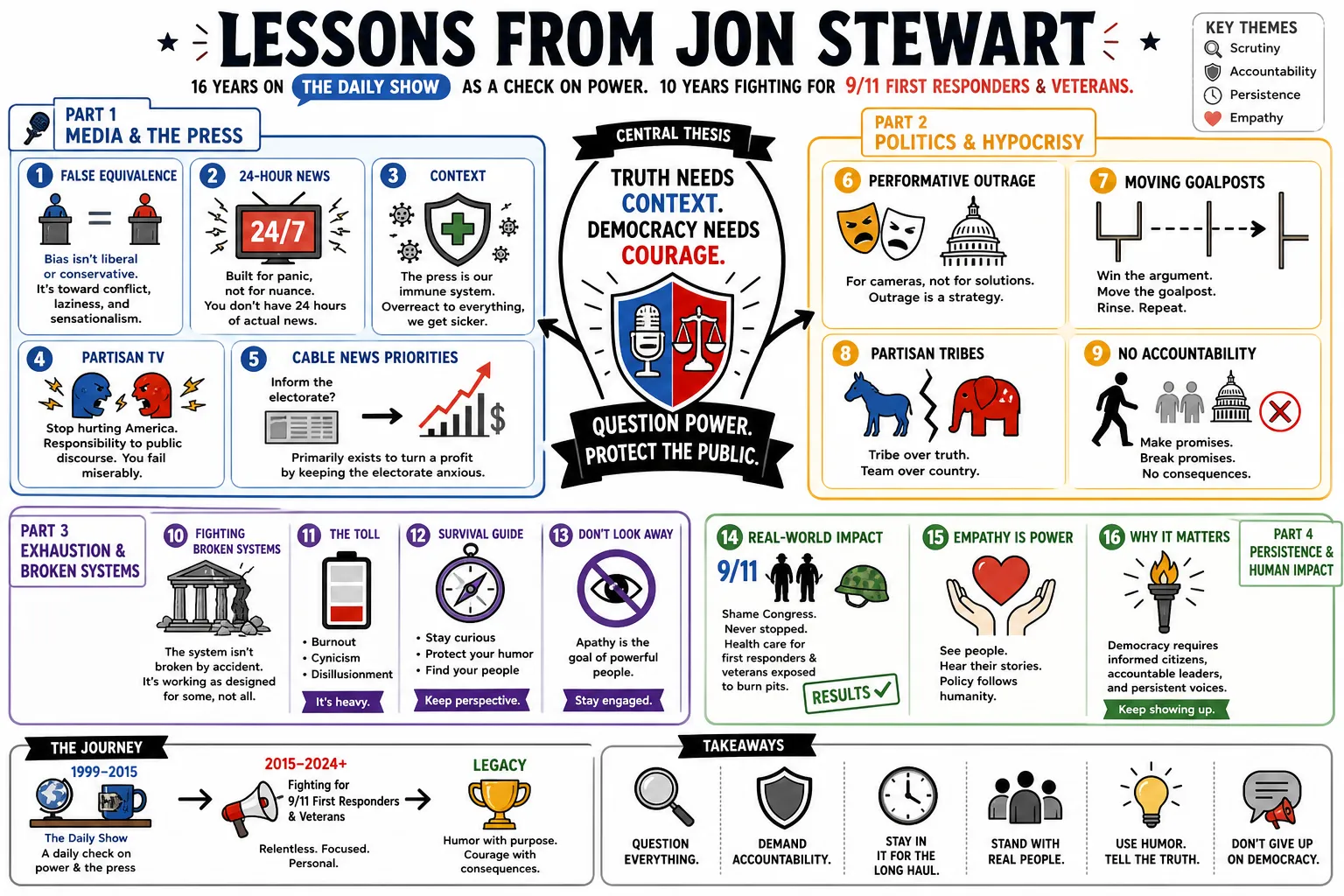
Lessons from Jon Stewart
Jon Stewart spent 16 years turning "The Daily Show" into a genuine check on the media and political establishment, before spending another decade shaming Congress into securing healthcare for 9/11 first responders and veterans exposed to burn pits. This profile breaks down his case against 24-hour news, how modern political hypocrisy operates, and the exhaustion of fighting broken institutions.
Part 1: Media and the Press
- On False Equivalence: "The media’s bias isn’t liberal or conservative. It’s toward conflict, laziness, and sensationalism." — Source: The Daily Show
- On News Channels: "The 24-hour news network is built for panic, not for nuance. You don’t have 24 hours of actual news." — Source: The Problem with Jon Stewart
- On Context: "The press is our immune system. If it overreacts to everything, we actually get sicker and perhaps die from eczema." — Source: Rally to Restore Sanity
- On Partisan TV: "Stop hurting America. You have a responsibility to the public discourse, and you fail miserably." — [Source: CNN Crossfire Interview)]
- On Cable News Priorities: "We are told that the news exists to inform the electorate, but it primarily exists to turn a profit by keeping the electorate anxious." — [Source: America (The Book))]
- On Journalistic Rigor: "The role of the press isn't simply to repeat what politicians say; it's to check if what they're saying is actually true." — Source: Various Media Critiques
- On Punditry: "Pundits are just sports radio callers who went to better colleges." — Source: The Daily Show
- On Financial News: "You guys are treating the stock market like a casino, but you're doing it with other people's retirements." — Source: Jim Cramer Interview
- On The Attention Economy: "We live in an ecosystem where outrage is the most valuable currency, and context is completely worthless." — Source: The Weekly Show with Jon Stewart
- On Comedy vs. News: "The show that leads into me is puppets making crank phone calls. What is your excuse?" — [Source: CNN Crossfire Interview)]
Part 2: Political Dysfunction
- On Congress: "If 'con' is the opposite of 'pro,' then isn't Congress the opposite of progress?" — [Source: America (The Book))]
- On Political Corruption: "The system isn't broken; it's fixed. It is working exactly as it was designed to work by the people who designed it." — Source: The Problem with Jon Stewart
- On Partisanship: "The problem with our political system isn't that they can't agree on anything, it's that they only agree on the things that benefit themselves." — Source: The Daily Show
- On Campaign Finance: "Money does more than talk in Washington; it filibusters." — [Source: The Daily Show (The Book))]
- On Ideological Purity: "If you demand 100% ideological purity from your politicians, you will end up with 0% of what you actually want." — Source: The Weekly Show with Jon Stewart
- On Political Theater: "Most of what we see in Congress is a performance for the cameras. The actual legislation is written by lobbyists in the dark." — [Source: Earth (The Book))]
- On Gerrymandering: "Politicians have figured out how to choose their voters instead of letting the voters choose them." — Source: The Daily Show
- On Apathy: "The most dangerous thing a citizen can do is assume that the people in charge know what they are doing." — Source: Rally to Restore Sanity
- On the Presidency: "The presidency is the only job where the less experience you have, the more the public thinks you're qualified." — Source: The Daily Show
- On Political Promises: "A politician's promise is merely a suggestion they hope you'll forget by the time the next election rolls around." — Source: Naked Pictures of Famous People
Part 3: Satire and Comedy
- On the Purpose of Satire: "Satire isn't meant to change the world; it's meant to make the people who want to change the world feel slightly less crazy." — [Source: The Daily Show (The Book))]
- On Truth in Comedy: "Comedy doesn't invent the absurdity of the world, it merely points a flashlight at it." — Source: Jon Stewart Interviews
- On Punching Up: "You don't mock the person struggling to get by; you mock the system that is keeping them struggling." — Source: The Problem with Jon Stewart
- On Vulnerability: "The best comedy comes from a place of vulnerability and anger, filtered through a lens of extreme absurdity." — Source: Stand-up Specials
- On Censorship: "I'm not going to censor myself to comfort your ignorance." — Source: The Daily Show
- On the Limits of Comedy: "A joke is a terrible weapon to bring to a gunfight." — Source: Rally to Restore Sanity
- On Comedic Priority: Stewart has said he runs by a hierarchy for segments: if it's not funny, go with interesting; if not interesting, hot; if not hot, bizarre; and if not bizarre, break something. — Source: Wikiquote
- On Catharsis: "Sometimes laughing is the only way you can process the fact that the world is on fire." — Source: The Daily Show Monologues
- On Absurdity: "When the reality is this ridiculous, you don't have to write jokes; you simply read the transcript." — Source: The Daily Show
Part 4: 9/11 First Responders
- On True Patriotism: "They responded in five seconds. They did their jobs. With courage, grace, tenacity, humility. Eighteen years later, do yours!" — Source: Congressional Hearing on 9/11 First Responders
- On Congressional Inaction: "Sick and dying, they brought themselves down here to speak to no one." — Source: Congressional Hearing on 9/11 First Responders
- On Grief and Resilience: "The view from my apartment was the World Trade Center... and now it's gone. But you know what the view is now? The Statue of Liberty." — Source: Post-9/11 Monologue
- On Empty Promises: "You can't tweet 'Never Forget' on an anniversary and then forget the people who actually lived it the other 364 days of the year." — Source: The Daily Show
- On Institutional Betrayal: "The indifference shown to these men and women who ran into burning buildings when everyone else ran out is a stain on our national conscience." — Source: The Problem with Jon Stewart
- On First Responder Health: "We didn't simply ask them to breathe toxic dust; we told them it was safe when we knew it wasn't." — Source: Advocacy Interviews
- On Accountability: "I am sorry that we have to come back down here... it is an embarrassment to the country and it is a stain on this institution." — Source: Congressional Hearing on 9/11 First Responders
- On Moral Obligations: "This isn't a New York issue. It's a national issue. These people were defending the country." — Source: The Daily Show
- On True Heroes: "We use the word 'hero' a lot. But true heroism is doing what needs to be done, knowing it might kill you, because it's the right thing to do." — Source: Congressional Hearing on 9/11 First Responders
Part 5: American Hypocrisy
- On American Exceptionalism: "We are a great country, but we are not a perfect country. Acknowledging our flaws is the only way we ever actually get better." — [Source: America (The Book))]
- On Manufactured Outrage: "The people on television telling you to be angry are making millions of dollars off of your elevated heart rate." — Source: Rally to Restore Sanity
- On Cultural Division: "We live in a country where the people in charge want us fighting each other so we don't realize they're picking our pockets." — Source: The Problem with Jon Stewart
- On Religion in Politics: "Religion is a beautiful thing for an individual. It's a terrifying thing when it becomes government policy." — Source: The Daily Show
- On Capitalism: "We have a system of socialism for the rich and harsh, unforgiving capitalism for everyone else." — Source: Jim Cramer Interview
- On Fearmongering: "Fear is the easiest way to control people. If you can convince someone that their neighbor is a threat, they'll hand you the keys to the kingdom." — Source: Rally to Restore Sanity
- On Compromise: "Compromise isn't weakness. It's the only way 330 million people can live in the same house without burning it down." — Source: Rally to Restore Sanity
- On Class Warfare: "They call it class warfare when the poor ask for a raise, but term it 'good business' when the rich get a tax cut." — Source: The Daily Show
- On Historical Memory: "We have a habit of sanitizing our history so we don't have to deal with the uncomfortable realities of how we got here." — Source: The Problem with Jon Stewart
Part 6: Veterans and the True Cost of War
- On Supporting Troops: "We love the military when they are in uniform fighting our wars. We seem to forget them entirely when they come home and need our help." — Source: The Problem with Jon Stewart
- On the Burn Pits: "The government told these soldiers that burning trash, jet fuel, and chemicals right next to where they slept was safe. It wasn't. And now they are dying." — Source: Advocacy for Veterans
- On Bureaucracy: "Veterans shouldn't have to fight a second war against the VA simply to get the healthcare they were promised." — Source: The Problem with Jon Stewart
- On True Cost of War: "The cost of a war isn't limited to the bullets and the bombs. It's the lifelong care of the people we sent to drop them." — Source: The Daily Show
- On Political Exploitation: "Politicians love to stand in front of flags and veterans for photo ops, but when it comes time to fund their healthcare, they suddenly become fiscal conservatives." — Source: The Weekly Show with Jon Stewart
- On Honor: "Honor isn't a ribbon you pin on a chest; it's a commitment you keep long after the parade is over." — Source: Advocacy Speeches
- On PACT Act: "They lived up to their oath. Now it's time for the United States government to live up to its." — Source: Capitol Hill Rally for Veterans
- On Systemic Failure: "The VA backlog is not an accident; it is a consequence of trying to fund a 21st-century war with 19th-century administrative systems." — Source: The Daily Show
- On Sacrifice: "We asked a fraction of a percent of our population to shoulder the entire burden of two wars for two decades. The least we can do is pay their doctor bills." — Source: The Problem with Jon Stewart
Part 7: Rationality and Cynicism
- On Sanity: "Sanity will always be and has always been in the eye of the beholder." — Source: Rally to Restore Sanity
- On Cynicism: "I don't think of myself as a cynic. I think of myself as a disappointed idealist." — Source: Interviews
- On Outrage: "Outrage is a drug. It feels good in the moment, but it ultimately hollows you out." — Source: The Weekly Show with Jon Stewart
- On Nuance: "The real world doesn't happen in black and white. It happens in the gray areas that television news refuses to cover." — [Source: Earth (The Book))]
- On Echo Chambers: "If you only consume information that confirms what you already believe, you aren't learning; you're merely being validated." — Source: The Daily Show
- On Human Nature: "People aren't inherently evil. They are incredibly susceptible to being convinced that someone else is." — Source: The Problem with Jon Stewart
- On Hope: "You can't let the absurdity of the world defeat you. You have to find a way to laugh at it, and then try to fix it." — Source: Stand-up Specials
- On Progress: "Progress is not a straight line. It's a frustrating, messy, two-steps-forward, one-step-back dance." — Source: The Daily Show Monologues
- On Empathy: "The hardest thing to do in a polarized society is to look at someone you completely disagree with and try to understand how they got there." — Source: The Problem with Jon Stewart
Part 8: Activism and Civic Duty
- On Public Service: "Public service shouldn't be a path to personal wealth. It should be a sacrifice you make for the community." — [Source: America (The Book))]
- On Action vs. Words: "Tweeting about a problem is not the same thing as solving it. At some point, you have to show up." — Source: Advocacy Interviews
- On Grassroots Change: "Change doesn't come from the top down. It comes from regular people getting annoyed enough to do something about it." — [Source: The Daily Show (The Book))]
- On Democracy: "Democracy is not a spectator sport. If you sit in the bleachers, you don't get to complain about the score." — [Source: America (The Book))]
- On Protest: "The right to protest is fundamental, but the effectiveness of a protest is determined by what you do the day after it ends." — Source: The Problem with Jon Stewart
- On Civic Duty: "We spend too much time worrying about what our rights are and not nearly enough time thinking about what our responsibilities are." — Source: Rally to Restore Sanity
- On Institutional Friction: "The system is designed to wear you down. The only way to win is to outlast them." — Source: 9/11 First Responders Advocacy
- On Ordinary People: "The real heroes aren't on television. They're the people quietly doing their jobs, taking care of their families, and trying to leave the world a little better than they found it." — [Source: Earth (The Book))]
- On Legacy: "You don't get to choose how you are remembered, but you do get to choose what you fight for while you're here." — Source: Final Daily Show Episode