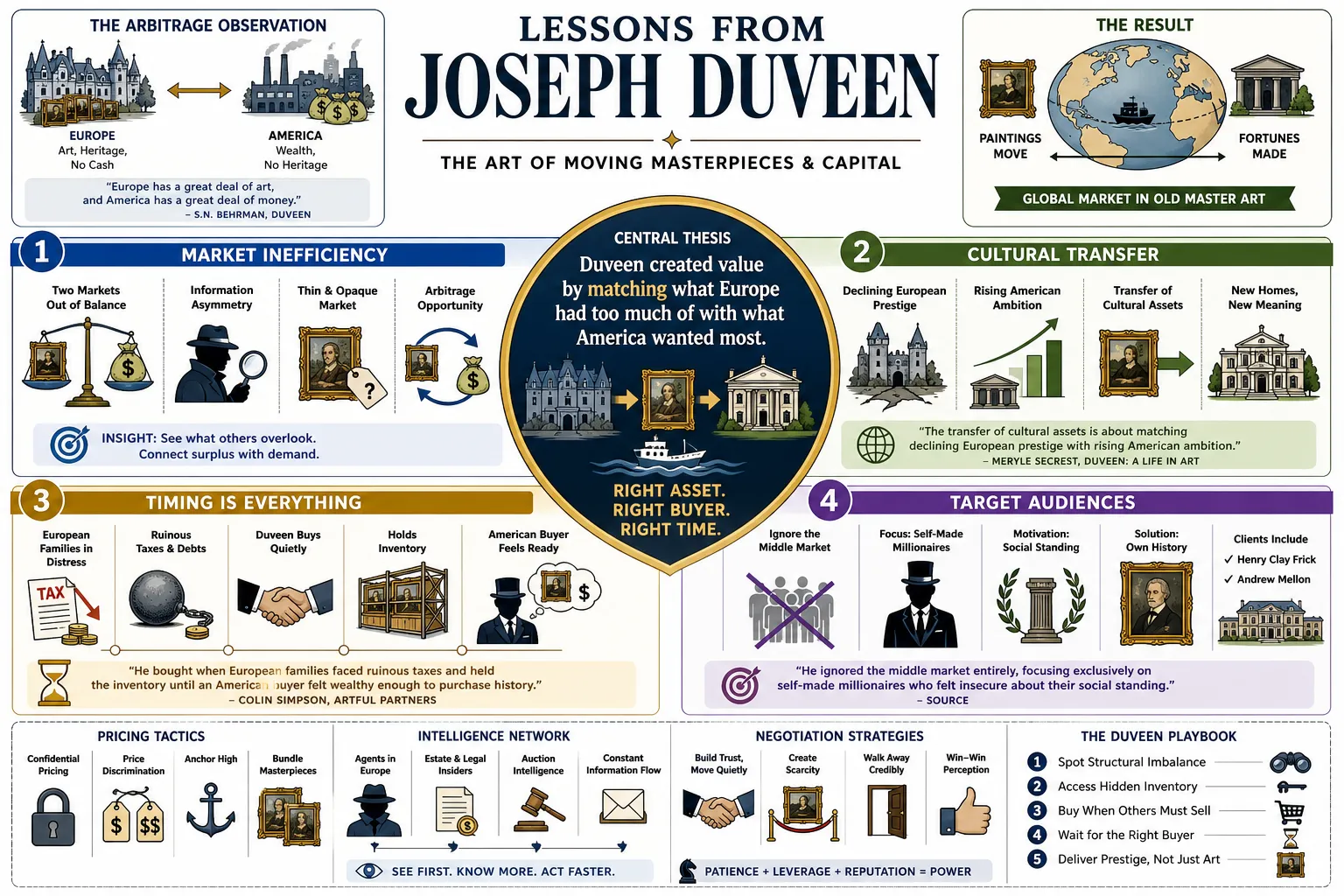
Lessons from Joseph Duveen
Art dealer Joseph Duveen built a global business on a simple observation: European aristocrats had inherited masterpieces but lacked cash, while American industrialists had immense wealth but no cultural heritage. He made his fortune moving these paintings across the Atlantic to clients like Henry Clay Frick and Andrew Mellon. The insights below detail the pricing tactics, intelligence networks, and negotiation strategies he used to corner the market for Old Master paintings.
Part 1: Market Arbitrage
- On Market Inefficiency: "Europe has a great deal of art, and America has a great deal of money." — Source: S.N. Behrman, Duveen
- On Cultural Transfer: "The transfer of cultural assets is about matching declining European prestige with rising American ambition." — Source: Meryle Secrest, Duveen: A Life in Art
- On Timing: "He bought when European families faced ruinous taxes and held the inventory until an American buyer felt wealthy enough to purchase history." — Source: Colin Simpson, Artful Partners
- On Target Audiences: "He ignored the middle market entirely, focusing exclusively on self-made millionaires who felt insecure about their social standing." — Source: Rachel Cohen, Bernard Berenson
- On Patience: "True arbitrage requires the capital to hold a masterpiece for a decade while waiting for the exact right client to materialize." — Source: Getty Research Institute
- On Capital Requirements: "You cannot be a dealer of consequence without the credit lines to outbid everyone else at auction, regardless of the immediate return." — Source: The National Gallery of Art
- On Creating Demand: "He acquired the best works available and then taught the clients why they needed them before they ever asked." — Source: S.N. Behrman, Duveen
- On Geopolitics: "Wars and economic depressions in Europe were treated as acquisition opportunities rather than tragedies." — Source: Meryle Secrest, Duveen: A Life in Art
- On Inventory Location: "Keeping the primary gallery in New York while sourcing from London and Paris ensured the product was always positioned near the deepest pockets." — Source: The Frick Collection Archives
Part 2: The Logic of Pricing
- On Pricing and Quality: "When you pay high for the priceless, you're getting it cheap." — Source: S.N. Behrman, Duveen
- On Premium Positioning: "A high price tag acts as a guarantee; if it were cheap, the client would immediately doubt its authenticity." — Source: Meryle Secrest, Duveen: A Life in Art
- On Setting Records: "Breaking the record for the highest price ever paid for a painting generated free international publicity and validated the buyer's extreme wealth." — Source: The Huntington Library
- On Negotiation: "He never offered discounts. Reducing the price would imply the artwork was a commodity rather than a unique masterpiece." — Source: Colin Simpson, Artful Partners
- On Buyer Psychology: "Men who spent their lives ruthlessly cutting costs in their core businesses were willing to overpay for art because it represented an entirely different realm." — Source: Rachel Cohen, Bernard Berenson
- On Framing Value: "The cost of the painting is irrelevant compared to the cost of letting your rival acquire it." — Source: S.N. Behrman, Duveen
- On Capital Allocation: "He convinced industrialists that spending millions on a single canvas was a safer store of value than railroad bonds." — Source: Getty Research Institute
- On Refusing Sales: "He would sometimes refuse to sell a specific piece to a client, explaining it was too good for their current collection, thereby making them want it even more." — Source: The National Gallery of Art
- On Relative Wealth: "Prices were calibrated directly to the specific net worth of the individual buyer rather than the objective market value of the painting." — Source: The Frick Collection Archives
Part 3: Client Psychology
- On Status Projection: "Showing his multimillionaire clients that he lived better than they did established him as their social superior in matters of taste." — Source: S.N. Behrman, Duveen
- On Frictionless Trials: "When a client hesitated over a price, he would insist they simply keep the art in their home for a year to see how it felt." — Source: Meryle Secrest, Duveen: A Life in Art
- On Attachment: "By the time the year-long trial ended, the client had grown accustomed to the masterpiece and could not bear the embarrassment of returning it." — Source: Colin Simpson, Artful Partners
- On Education: "He never treated his clients as ignorant, framing every lesson as something they already instinctively understood." — Source: Rachel Cohen, Bernard Berenson
- On Competition: "He carefully manufactured rivalries between his clients, letting one know that another was considering the very painting they were looking at." — Source: S.N. Behrman, Duveen
- On Lifestyle Design: "He operated as an advisor for architecture, landscaping, and the exact upholstery that should surround his clients' new acquisitions." — Source: Getty Research Institute
- On Insecurity: "The self-made men of the Gilded Age were terrified of appearing uncultured; his primary product was social confidence." — Source: The Huntington Library
- On Managing Spouses: "He understood that the approval of the client's wife was often the final hurdle, tailoring his pitches to address their specific aesthetic preferences." — Source: Meryle Secrest, Duveen: A Life in Art
- On Perceived Friendship: "He traveled with his clients, dined with them, and made them feel they were part of an exclusive club rather than a retail transaction." — Source: Colin Simpson, Artful Partners
- On Disarming Defenses: "He sometimes feigned a degree of simplicity or clumsiness, a disguise of cleverness that made hard-nosed businessmen lower their guard." — Source: S.N. Behrman, Duveen
Part 4: Monopoly and Scarcity
- On Controlling Supply: "He purchased entire private collections to acquire one masterpiece, burying the inferior works in storage so they would not dilute the market." — Source: The National Gallery of Art
- On Destroying Competition: "He was ruthless in disparaging the authenticity of any artwork purchased from a rival dealer." — Source: Meryle Secrest, Duveen: A Life in Art
- On Exclusive Access: "He convinced his clients that he was the only conduit through which truly great art could be obtained." — Source: Colin Simpson, Artful Partners
- On Buying Back Art: "If a client died, he would aggressively bid at their estate auction to buy back his own paintings, ensuring prices never dropped." — Source: S.N. Behrman, Duveen
- On Manufactured Rarity: "By cornering the market on specific artists, he could single-handedly dictate the appreciation curve of their work." — Source: Getty Research Institute
- On Gallery Aesthetics: "He displayed only one or two paintings in a massive, velvet-draped room to emphasize the singularity and importance of the object." — Source: The Frick Collection Archives
- On The Secondary Market: "He effectively banned his clients from selling to anyone but him, establishing a closed ecosystem where he controlled all liquidity." — Source: Rachel Cohen, Bernard Berenson
- On Auction Strategy: "He would frequently bid against his own syndicate to drive up public auction prices and establish a higher baseline for private sales." — Source: Colin Simpson, Artful Partners
- On Rejecting Clients: "He refused to sell to certain wealthy individuals, calculating that excluding them would make his active clients feel even more elite." — Source: Meryle Secrest, Duveen: A Life in Art
- On Inventory Attrition: "The items that made his mouth water so much that he swallowed the paintings too were the rare objects he kept permanently off the market." — Source: S.N. Behrman, Duveen
Part 5: The "Smokescreen" Strategy
- On Philanthropic Suggestions: "He actively encouraged clients to donate their major collections to public museums as a gesture of civic duty." — Source: The National Gallery of Art
- On Clearing Wall Space: "The true purpose of encouraging museum donations was to clear wall space in a client's mansion so he could sell them a completely new collection." — Source: S.N. Behrman, Duveen
- On Artificial Deflation of Supply: "Moving privately held art into public institutions permanently removed those pieces from circulation, raising the value of his remaining inventory." — Source: Meryle Secrest, Duveen: A Life in Art
- On Tax Advantages: "He worked closely with lawyers to ensure that the museum donations provided massive tax shelters for his clients." — Source: Colin Simpson, Artful Partners
- On Museum Influence: "By seeding museums with his clients' donations, he subtly dictated the curatorial direction of major institutions for decades." — Source: The Frick Collection Archives
- On Civic Virtue as a Sales Tool: "He framed the act of buying a painting as a temporary stewardship prior to public exhibition rather than an act of personal consumption." — Source: Rachel Cohen, Bernard Berenson
- On Gallery Creation: "He often personally funded the architectural expansions of museums simply to provide a venue to absorb his clients' excess art." — Source: Getty Research Institute
- On Public Relations: "The press celebrated him for orchestrating these museum gifts, ignoring the fact that he profited immensely from the resulting empty walls." — Source: S.N. Behrman, Duveen
- On The Final Sale: "He viewed the transfer of art to a museum not as the end of a transaction, but as the beginning of the next sales cycle." — Source: Meryle Secrest, Duveen: A Life in Art
Part 6: Intelligence Gathering
- On Information Networks: "He maintained a vast network of paid informants, treating the high-end art market like a military intelligence operation." — Source: Colin Simpson, Artful Partners
- On Bribing Staff: "He routinely tipped the valets, butlers, and chauffeurs of wealthy collectors to learn exactly who was visiting their homes." — Source: S.N. Behrman, Duveen
- On Tracking Competitors: "If a rival dealer entered a client's house, his informants would alert him immediately, allowing him to counter the pitch before a sale closed." — Source: Meryle Secrest, Duveen: A Life in Art
- On Intercepting Clients: "By knowing travel schedules via ship stewards, he would accidentally run into prospective buyers on trans-Atlantic crossings." — Source: The Frick Collection Archives
- On Understanding Tastes: "His spies reported which paintings clients lingered in front of at dinner parties, allowing him to acquire similar works proactively." — Source: Getty Research Institute
- On Financial Surveillance: "He kept detailed dossiers on the stock portfolios and cash liquidity of every major industrialist in America." — Source: Rachel Cohen, Bernard Berenson
- On European Aristocracy: "He paid scouts to monitor the gambling debts and divorce proceedings of European nobles to know exactly when they would be forced to sell family heirlooms." — Source: Colin Simpson, Artful Partners
- On Manufactured Coincidence: "He used insider information to stage highly coincidental meetings, making clients feel that fate was bringing them together with a specific painting." — Source: S.N. Behrman, Duveen
- On Subverting Experts: "He paid off independent art consultants, ensuring that if a client sought a second opinion, the consultant would validate his exact asking price." — Source: Meryle Secrest, Duveen: A Life in Art
Part 7: Authority and Expertise
- On Academic Alliances: "He recognized early that wealthy buyers required academic authentication to justify spending millions; his partnership with Bernard Berenson provided this seal." — Source: Rachel Cohen, Bernard Berenson
- On The Value of Certainty: "He was breathtakingly confident in his ability to pronounce on the authenticity of a work, replacing the buyer's doubt with his own bravado." — Source: Meryle Secrest, Duveen: A Life in Art
- On The 25 Percent Commission: "By giving Berenson a twenty-five percent cut of profits, he aligned the world's top art historian directly with his sales goals." — Source: Colin Simpson, Artful Partners
- On Telegrams: "A simple telegram reading 'NOT VERONESE. BERENSON.' was enough to completely sink a rival dealer's transaction." — Source: Rachel Cohen, Bernard Berenson
- On Restorations: "He famously ordered extensive restorations to brighten Old Master paintings, knowing American clients preferred a glossy finish over historical accuracy." — Source: The National Gallery of Art
- On Scholarly Friction: "When Berenson refused to authenticate a painting out of academic integrity, the partnership strained under the weight of lost revenue." — Source: Getty Research Institute
- On Controlling the Narrative: "He funded the publication of lavish catalogs that canonized the exact paintings sitting in his inventory." — Source: S.N. Behrman, Duveen
- On Dismissing Critics: "He treated academic detractors as jealous pedestrians who simply lacked the eye and the capital to understand greatness." — Source: Meryle Secrest, Duveen: A Life in Art
- On The Aura of the Expert: "He understood that the expert's primary function was to bless the transaction and remove all doubt from the buyer's mind." — Source: Colin Simpson, Artful Partners
- On Managing Disagreements: "When his own experts disagreed with him on an attribution, he simply locked the painting away until a more compliant expert could be found." — Source: The Frick Collection Archives
Part 8: Selling Immortality
- On The Final Pitch: "He told clients that while their businesses would eventually be forgotten, their art collections would carry their names into eternity." — Source: S.N. Behrman, Duveen
- On Naming Rights: "He focused entirely on ensuring that wings of museums and galleries bore the exact names of the men he sold to." — Source: The National Gallery of Art
- On The Blue Boy: "When he sold The Blue Boy, he orchestrated exhibitions and press campaigns to make the buyer feel they were purchasing a piece of global history." — Source: The Huntington Library
- On Cultural Transformation: "He sold the idea that buying an Old Master painting was a shortcut to acquiring the centuries of lineage that American money could not naturally buy." — Source: Meryle Secrest, Duveen: A Life in Art
- On Posthumous Control: "He often helped draft the wills of his clients to ensure their collections remained intact rather than being dispersed." — Source: Getty Research Institute
- On Architectural Permanence: "He advised on the construction of private homes designed explicitly to function as public museums after the owner's death." — Source: The Frick Collection Archives
- On Redefining Wealth: "He taught robber barons that giving away a Rembrandt projected more power than hoarding cash." — Source: Colin Simpson, Artful Partners
- On Legacy Costs: "He convinced them that the millions spent on art were the fixed costs of historical immortality rather than personal expenses." — Source: Rachel Cohen, Bernard Berenson
- On The Ultimate Arbitration: "His final success was that the institutions he helped create now validate the very market he invented." — Source: S.N. Behrman, Duveen