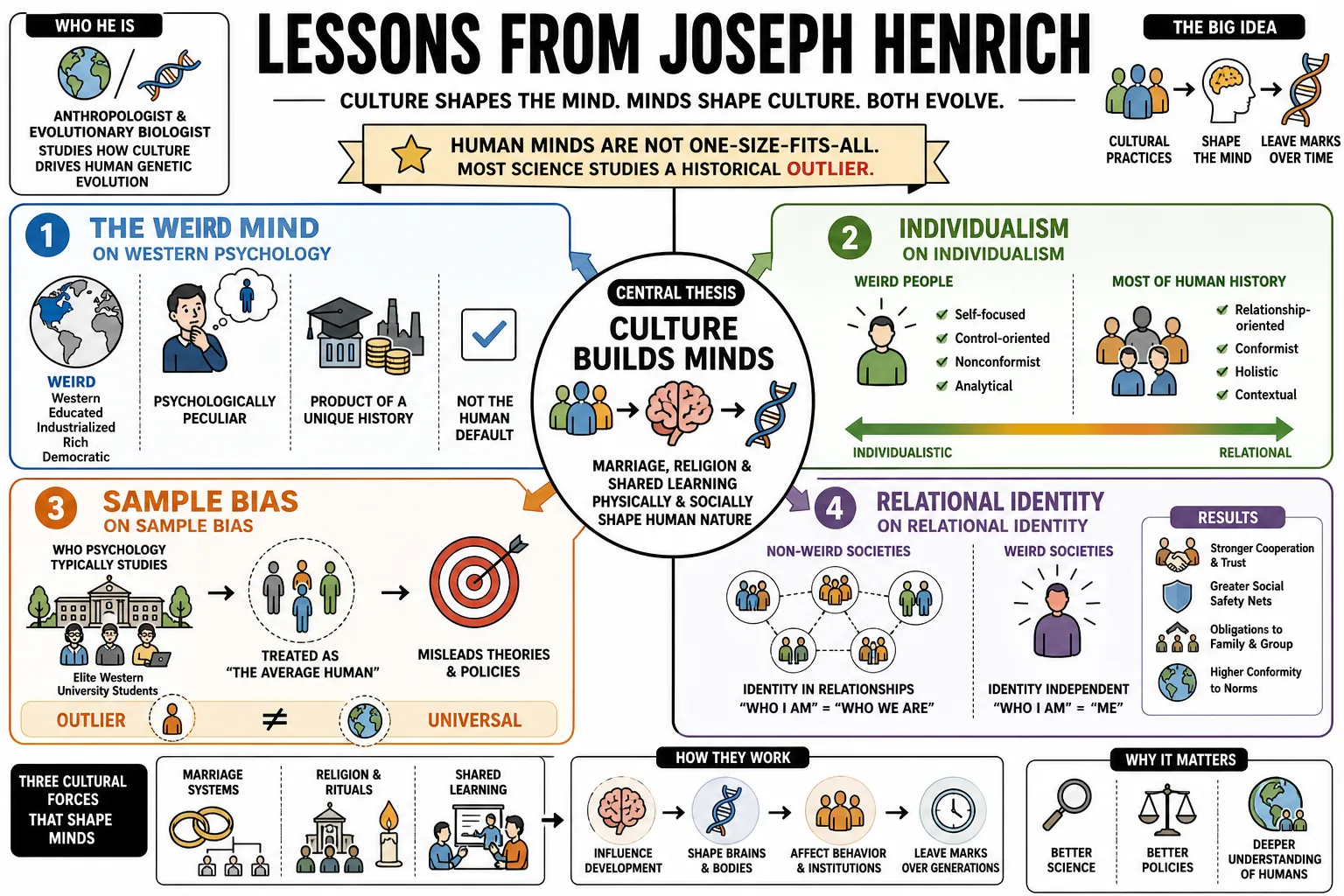
Lessons from Joseph Henrich
Anthropologist and evolutionary biologist Joseph Henrich studies how culture drives human genetic evolution. He introduced the concept of WEIRD (Western, Educated, Industrialized, Rich, and Democratic) psychology to show that most behavioral science relies on a historical outlier population. This compilation tracks his findings on how marriage systems, religion, and shared learning physically and socially alter the human mind.
Part 1: The WEIRD Mind
- On Western Psychology: "Perhaps you are WEIRD, raised in a society that is Western, Educated, Industrialized, Rich, and Democratic. If so, you're likely rather psychologically peculiar." — Source: [The WEIRDest People in the World]
- On Individualism: "Unlike much of the rest of the world today, and most people who have ever lived, we WEIRD people are highly individualistic, self-obsessed, control-oriented, nonconformist, and analytical." — Source: [Harvard Magazine]
- On Sample Bias: "Experimental psychology built its foundation on a highly specific and unusual demographic, students at elite Western universities, treating them as a representative sample of human nature." — Source: [Sean Carroll's Mindscape]
- On Relational Identity: "In non-WEIRD societies, people tend to identify themselves not by their internal traits or personal achievements, but by their relationships and social roles within a dense kinship network." — Source: [The Jim Rutt Show]
- On Guilt vs. Shame: "WEIRD societies rely heavily on internalized guilt as a social regulatory mechanism, whereas kin-based societies rely more on external shame and public reputation." — Source: [The WEIRDest People in the World]
- On Analytical Thinking: "Western populations have a cognitive bias toward analytical thinking, categorizing objects and isolating them from their context, rather than holistic thinking that focuses on relationships between elements." — Source: [Hidden Brain]
- On Impersonal Trust: "WEIRD psychology allows people to comfortably transact with strangers and trust abstract institutions, a requirement for functioning modern markets." — Source: [Armchair Expert]
- On Intentionality in Morality: "When judging moral actions, WEIRD people place an unusually high emphasis on the actor's internal intentions rather than the external outcomes of the action." — Source: [The WEIRDest People in the World]
- On Patience and Deferring Gratification: "The structural demands of Western historical institutions gradually selected for greater patience and the ability to delay gratification for long-term investments." — Source: [Dwarkesh Podcast]
- On the Outlier Status: "WEIRD populations do not just represent one psychological variation among many; they anchor the extreme outlier end of the human distribution." — Source: [The Jim Rutt Show]
Part 2: The Collective Brain
- On Collective Intelligence: "The secret of our species' success resides not in the power of our individual minds, but in the collective brains of our communities." — Source: [The Secret of Our Success]
- On Recombination of Ideas: "The striking technologies that characterize our species emerge not from singular geniuses but from the flow and recombination of ideas, practices, lucky errors, and chance insights among interconnected minds." — Source: [The Secret of Our Success]
- On Social Network Size: "The capacity of a society to innovate and maintain complex technology is directly constrained by the size and interconnectedness of its social network." — Source: [Hidden Brain]
- On Loss of Technology: "When human populations become isolated and their collective brains shrink, as happened with the Indigenous Tasmanians, they can actually lose existing technologies over time." — Source: [The Secret of Our Success]
- On Individual Genius: "The concept of the lone genius is largely a myth; significant innovations are almost always the result of incremental improvements generated by a large community of interacting minds." — Source: [Sean Carroll's Mindscape]
- On Copying Mechanisms: "Humans possess a unique psychological adaptation for copying not just the successful outcomes of others, but their exact physical procedures, even when the purpose of those procedures is not understood." — Source: [The Secret of Our Success]
- On Prestige vs. Dominance: "Human societies organize social learning around prestige, which is freely conferred respect for skill or knowledge, rather than sheer physical dominance common in other primates." — Source: [The Jim Rutt Show]
- On Social Learning: "Our collective brains arise from the synthesis of our cultural and social natures, derived from the fact that we readily learn from others and can live in large, interconnected groups." — Source: [The Secret of Our Success]
- On Imitating Elders: "Children naturally look for cues about who is successful or respected in their community and preferentially copy their behaviors, accents, and dietary choices." — Source: [Armchair Expert]
Part 3: Culture as an Evolutionary Force
- On Gene-Culture Coevolution: "Humans have experienced a feedback loop where cultural knowledge has continuously shaped our genetic evolution for at least a million years." — Source: [The Secret of Our Success]
- On Digestion and Fire: "The cultural invention of cooking food externally acted as a pre-digestion process, which genetically selected for smaller human stomachs and shorter intestines." — Source: [The Secret of Our Success]
- On Information Storage: "Because much of culture can be understood in the most general sense as information stored in human brains, population-dynamic concepts and evolutionary models are extremely useful for understanding how such processes work." — Source: [UBC News]
- On Cultural Adaptations: "Our survival relies on packages of cultural adaptations like tools, techniques, and practices that are too complex for any single human to invent from scratch in a lifetime." — Source: [The Secret of Our Success]
- On Brain Expansion: "Our early capacities for learning from others produced many innovations, which in turn drove the expansion of our brains and altered our physiology, anatomy and psychology." — Source: [Harvard Gazette]
- On the Cultural Species: "We humans are not like other animals. The key to understanding how humans evolved and why we are so different from other animals is to recognize that we are a cultural species." — Source: [The Secret of Our Success]
- On Physical Vulnerability: "Stripped of our cultural adaptations, humans are physically weak, slow, and lack the innate survival instincts seen in almost all other animals." — Source: [The Secret of Our Success]
- On Language Development: "Languages evolved culturally to fit the constraints of the human brain, gradually developing structural complexity over generations of use and transmission." — Source: [Sean Carroll's Mindscape]
- On the Dark Matter of History: "The cultural evolution of psychology is the dark matter that flows behind the scenes throughout history." — Source: [The WEIRDest People in the World]
- On Throwing: "Even basic physical acts like throwing projectiles accurately evolved through a combination of genetic anatomical shifts in the shoulder and culturally transmitted techniques." — Source: [The Secret of Our Success]
Part 4: Marriage, Family, and Kinship
- On Monogamous Marriage: "Monogamous marriage changes men psychologically, even hormonally, and has downstream effects on societies." — Source: [The WEIRDest People in the World]
- On Male Competition: "By enforcing monogamy and reducing the pool of unmarried men, societies suppress destructive male competition and lower overall crime rates." — Source: [The WEIRDest People in the World]
- On Kinship Networks: "Intensive kinship systems provide a deep social safety net but constrain individual autonomy by demanding strict adherence to family obligations." — Source: [Hidden Brain]
- On the Church's Family Policies: "The Catholic Church's prohibition on cousin marriage and polygamy dismantled traditional European kinship structures and forced people to form voluntary associations." — Source: [The WEIRDest People in the World]
- On Trust Horizons: "As dense kinship networks break down, humans are forced to extend their circle of trust outward to include strangers and abstract community institutions." — Source: [The Jim Rutt Show]
- On Economic Accumulation: "Monogamous marriage shifted male psychology toward long-term paternal investments, steady labor, and capital accumulation rather than status-seeking violence." — Source: [The WEIRDest People in the World]
- On Cousin Marriage: "Areas of the world with high rates of cousin marriage today correlate strongly with lower levels of civic participation, institutional trust, and voluntary blood donation." — Source: [Sean Carroll's Mindscape]
- On Voluntary Associations: "The breakdown of kin-based clans in medieval Europe led to the rise of guilds, universities, and cities, which operated as artificial, voluntary families." — Source: [Dwarkesh Podcast]
- On Female Autonomy: "The European Marriage Pattern, which delayed the age of marriage and required couples to establish independent households, increased female agency in partner selection." — Source: [The WEIRDest People in the World]
Part 5: Innovation and Technology
- On the Illusion of Necessity: "Necessity is certainly not the mother of invention. Over the course of human history, people often ignored life-saving inventions." — Source: [The WEIRDest People in the World]
- On Serendipity: "The majority of technological leaps are the result of lucky errors and accidental recombinations of existing tools rather than deliberate, forward-looking engineering." — Source: [The Secret of Our Success]
- On Intergroup Competition: "Societies that develop more effective norms and technologies outcompete others, causing their cultural traits to spread either through conquest or imitation." — Source: [Harvard Magazine]
- On the Industrial Revolution: "If affluence alone drove psychological change, European aristocrats would have led the Industrial Revolution; instead, it was driven by individualistic artisans and the middle class." — Source: [The WEIRDest People in the World]
- On Tool Complexity: "The complexity of a population's toolkit is determined by the number of active minds capable of passing down and refining the information without degradation." — Source: [The Secret of Our Success]
- On Friction in Innovation: "High trust and open communication networks reduce the friction of sharing ideas, accelerating the rate of cumulative cultural evolution." — Source: [Hidden Brain]
- On the Printing Press: "The Protestant Reformation's emphasis on reading the Bible accelerated the spread of literacy, which physically rewired the brains of large populations and spurred further innovation." — Source: [The WEIRDest People in the World]
- On Knowledge Transmission: "Teaching is an evolved human behavior where we actively intervene to correct the learning of our offspring to preserve high-fidelity cultural knowledge." — Source: [The Secret of Our Success]
- On Conformity and Stagnation: "While copying behaviors is necessary for survival, excessive conformity within a highly rigid network can stifle the introduction of novel ideas." — Source: [The Jim Rutt Show]
Part 6: Psychology as a Product of History
- On Historical Roots: "Human psychology is not a static biological constant; it is deeply shaped by historical events, institutions, and religious mandates over centuries." — Source: [Sean Carroll's Mindscape]
- On Reading and the Brain: "Acquiring literacy actually thickens the corpus callosum and alters facial recognition processing, meaning a cultural practice physically modifies brain anatomy." — Source: [The WEIRDest People in the World]
- On Clock Time: "The introduction of mechanical clocks and monastic schedules in medieval Europe trained populations to regulate their internal states according to objective time rather than natural rhythms." — Source: [The WEIRDest People in the World]
- On Protestantism and Work Ethic: "Protestant doctrines that framed labor as a divine calling shifted psychological orientations toward industriousness and the accumulation of wealth." — Source: [Armchair Expert]
- On the Law: "The development of universal legal codes in the West was only possible after kinship systems dissolved enough for people to view individuals as equal units before an abstract authority." — Source: [Hidden Brain]
- On Urbanization: "Cities historically functioned as hubs of innovation because they forced interactions between people stripped of their traditional kin-based safety nets." — Source: [The WEIRDest People in the World]
- On Personality Traits: "The classic Big Five personality traits are not a universal human baseline, and in many small-scale societies, these specific dimensions do not clearly emerge." — Source: [The WEIRDest People in the World]
- On Fairness: "The willingness to punish free-riders in economic games varies significantly across cultures and correlates with the degree of market integration in a society." — Source: [The Jim Rutt Show]
- On Democratic Institutions: "Democratic governance systems require a specific psychological foundation of impersonal trust and individualism that took centuries of cultural evolution to build." — Source: [The WEIRDest People in the World]
Part 7: Religion and Social Norms
- On Big Gods: "The evolution of moralizing, omniscient gods provided a mechanism to scale up cooperation, as people believed they were being watched even when dealing with strangers." — Source: [The Secret of Our Success]
- On Rituals: "Expensive or painful religious rituals serve as costly signals of commitment, helping groups identify true believers and weed out free-riders." — Source: [Hidden Brain]
- On the Success of Religions: "Religions evolve like biological organisms; those that develop doctrines promoting high fertility, trust, and group cohesion outcompete and replace other belief systems." — Source: [Dwarkesh Podcast]
- On Universal Morality: "The concept of a universal moral code applicable to all humans, regardless of tribe or family, is a relatively recent cultural invention driven by expanding trade and religion." — Source: [Sean Carroll's Mindscape]
- On Group Cohesion: "The more effectively norms galvanize cooperation within subgroups, the more challenging it can be to unite them and scale up." — Source: [The WEIRDest People in the World]
- On Divine Punishment: "Societies facing severe ecological threats or frequent warfare are more likely to culturally adopt beliefs in punitive deities that strictly enforce social norms." — Source: [The Jim Rutt Show]
- On Social Norm Internalization: "Humans are uniquely adapted to internalize arbitrary local social norms, converting cultural rules into genuine, deeply felt moral intuitions." — Source: [The Secret of Our Success]
- On the Church’s Marriage Policies: "The Western Church’s systematic dismantling of cousin marriage, polygamy, and arranged marriages was the singular most powerful catalyst for the psychological divergence of Western Europe." — Source: [The WEIRDest People in the World]
- On Over-Imitation in Rituals: "When the physical mechanisms of a ritual are entirely opaque, humans default to exact replication, assuming the unobservable details are critical for the outcome." — Source: [The Secret of Our Success]
Part 8: The Illusion of "Natural" Human Behavior
- On Natural Foods: "For many Westerners, 'it's natural' seems to mean 'it's good.' This view is wrong, as plants evolved toxins to deter animals, and many natural foods need processing to detoxify them." — Source: [The Secret of Our Success]
- On Instinctual Survival: "Humans cannot survive by instinct alone; if dropped in the wilderness without cultural knowledge, our natural biological adaptations are completely insufficient for survival." — Source: [The Secret of Our Success]
- On Food Processing: "We are biologically dependent on culturally transmitted cooking techniques to extract enough calories, because humans have lost the genetic ability to digest many raw foods." — Source: [The Secret of Our Success]
- On Child Rearing: "Practices around child-rearing and breastfeeding that feel instinctively right or natural to WEIRD parents are often highly specific cultural adaptations rather than biological baselines." — Source: [Armchair Expert]
- On Rationality: "Human reasoning did not evolve primarily to discover objective truth, but as a social tool to persuade others, defend our reputations, and justify cultural norms." — Source: [Hidden Brain]
- On Biological Dependency: "Humans lost these genetic adaptations and evolved a dependence on cultural know-how, just to eat." — Source: [The Secret of Our Success]
- On the Nuclear Family: "The independent nuclear family is not the default evolutionary state of humanity; it is a late-stage cultural anomaly created by the destruction of broader kin networks." — Source: [The WEIRDest People in the World]
- On Spatial Cognition: "Even our perception of space is culturally trained; many societies navigate using absolute cardinal directions rather than the relative directions of left and right." — Source: [Sean Carroll's Mindscape]
- On Optical Illusions: "Psychological tests demonstrate that visual perception itself is altered by growing up in built environments with right angles, proving that biology and environment are linked." — Source: [The WEIRDest People in the World]
- On Human Nature: "The search for a single, static human nature is fundamentally flawed because our nature is inherently cultural, and therefore constantly evolving across different historical contexts." — Source: [The Jim Rutt Show]