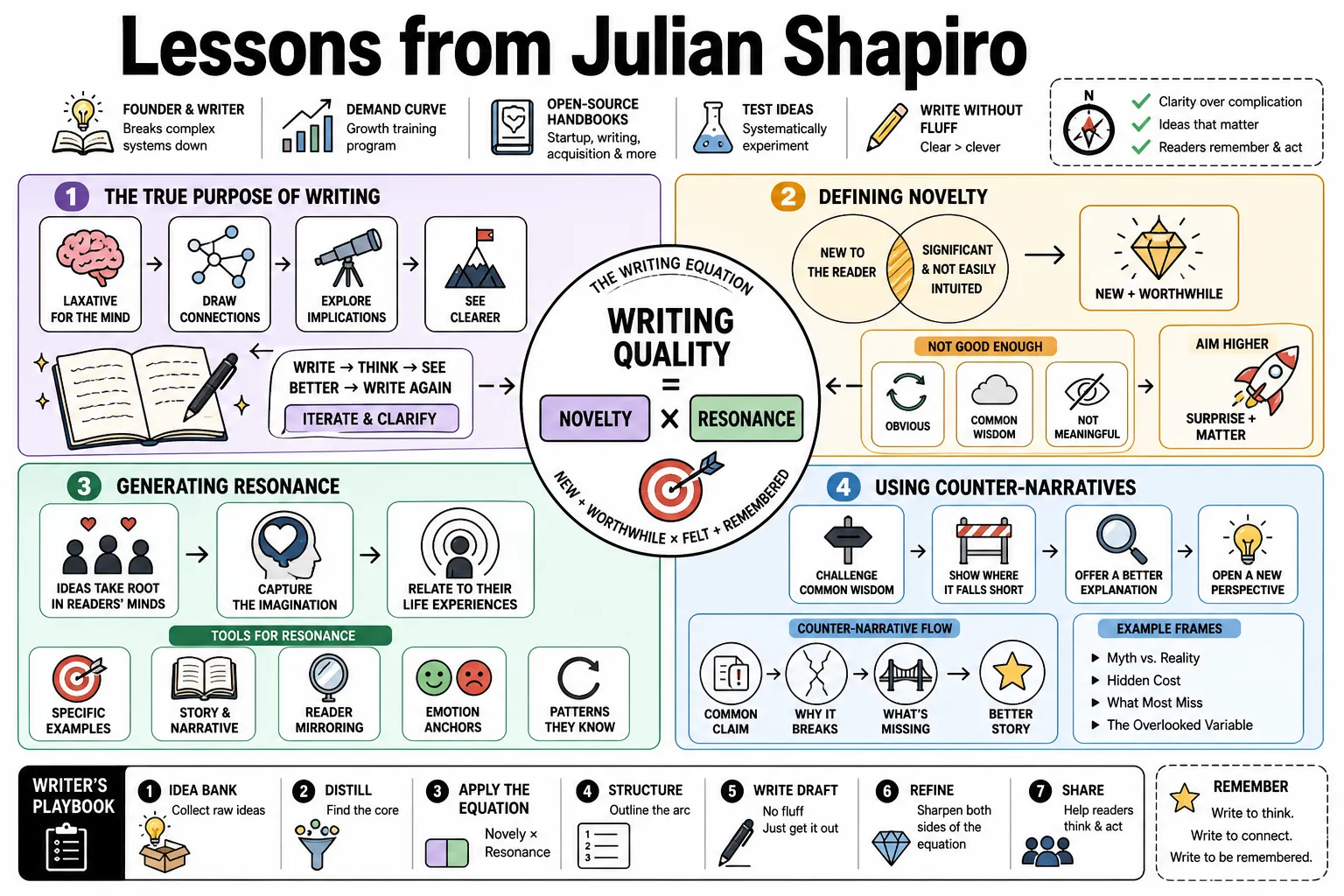
Lessons from Julian Shapiro
Julian Shapiro is a founder and writer who breaks complex systems down into practical handbooks. Best known for building the growth training program Demand Curve, he authors open-source guides on everything from startup acquisition to writing mechanics. Readers use his frameworks to systematically test business ideas and communicate without fluff.
Part 1: The Writing Process
- On the True Purpose of Writing: "Writing is a laxative for the mind. When you write, your brain cannot stop itself from drawing connections between ideas and exploring their implications." — Source: [Julian.com Writing Guide]
- On the Writing Equation: "Writing Quality is defined by a simple formula: Novelty multiplied by Resonance." — Source: [Julian.com Ideas Guide]
- On Defining Novelty: "A novel idea is one that is not just new to the reader, but also significant and not easily intuited. Think of it as new and worthwhile." — Source: [Julian.com Ideas Guide]
- On Generating Resonance: "Resonance is when ideas take root in readers' minds. It is the art of capturing their imaginations and relating to their life experiences so that they feel." — Source: [Julian.com Ideas Guide]
- On Using Counter-Narratives: "You can manufacture novelty by challenging common wisdom. Show people where the accepted status quo is fundamentally broken." — Source: [Julian.com Ideas Guide]
- On Elegant Articulation: "Sometimes novelty is not a new fact, but saying something known so beautifully that others could not phrase it as well." — Source: [Julian.com Ideas Guide]
- On Making Readers Feel Seen: "One of the highest forms of writing is validating the reader's personal, quiet experiences that they have not been able to articulate themselves." — Source: [Julian.com Ideas Guide]
- On Starting Without an Idea: "You do not need a fully formed idea before you sit down. The physical act of writing is what forces you to reason through the topic." — Source: [Julian.com First Drafts]
- On Being a Proxy: "Instead of trying to guess what your readers want, be a proxy for them. Selfishly entertain and surprise yourself, and you will entertain and surprise them too." — Source: [Julian.com First Drafts]
- On Distilling Overwhelming Topics: "Great non-fiction writers act as filters. They take massive, unstructured topics and distill them into approachable, linear guides." — Source: [Julian.com Handbooks]
Part 2: Style and Rewriting
- On Loving the Process: "You will not love writing until you learn to love rewriting. The magic happens when you turn raw thought into polished prose." — Source: [Julian.com Rewriting]
- On the Goal of Editing: "The primary goal of rewriting is to make the work clear, succinct, and intriguing by removing absolutely everything that does not serve the reader." — Source: [Julian.com Rewriting]
- On Finding Your Voice: "Voice is not a stylistic choice or a vocabulary exercise. It is simply your unfiltered self captured on paper." — Source: [Julian.com Style]
- On Conversational Tone: "To find your true voice, write exactly as if you are explaining the concept to a smart friend at a coffee shop." — Source: [Julian.com Style]
- On the Trap of Sounding Smart: "Avoid the temptation to write smart. Using overly complex words or academic jargon usually obscures weak reasoning." — Source: [Julian.com Style]
- On Concision as a Game: "Make it a game to see how tight and concise you can make a paragraph without losing its underlying complexity." — Source: [Julian.com Rewriting]
- On the Hook: "Every piece needs a hook, a peak, and a satisfying ending to maintain the reader's engagement from start to finish." — Source: [Julian.com Writing Guide]
- On Iterating Toward Mastery: "Do not just write to build a daily habit. Practice deliberately to iterate toward mastery of the craft." — Source: [Julian.com Practicing]
- On Removing Fluff: "Fluff is the enemy of respect. If a sentence does not advance the argument, cut it." — Source: [Julian.com Rewriting]
Part 3: Ideation and The Curiosity Faucet
- On the Curiosity Faucet: "To get to the good ideas, you must first let the bad ideas flow out. Think of your creativity as a faucet backed up with murky water." — Source: [Lenny's Newsletter]
- On Resisting Bad Ideas: "Creators often paralyze themselves by resisting their bad ideas. You have to write them down to get them out of your system." — Source: [Lenny's Newsletter]
- On Filtering for Quality: "By rapidly cycling through mediocre ideas, your brain reflexively identifies the patterns causing that mediocrity, leading you to novel concepts." — Source: [Lenny's Newsletter]
- On Compulsion Over Consistency: "Curiosity breeds compulsion, and that is far more important than forced consistency when trying to make work that is fresh and inspired." — Source: [Common Discourse]
- On Identifying Core Interests: "Fall so deeply in love with interesting ideas that you literally cannot help but tell the rest of the world about them." — Source: [Julian.com Ideas Guide]
- On Sourcing Inspiration: "Study prolific creators outside your domain. The work ethic of top musicians or novelists holds lessons for software engineers and essayists." — Source: [Lenny's Newsletter]
- On Idea Validation: "If a concept does not genuinely surprise or entertain you, it will almost certainly bore your audience." — Source: [Julian.com Ideas Guide]
- On Connecting the Dots: "Creativity is not pulling ideas from the ether. It is recognizing unexpected links between existing frameworks." — Source: [Julian.com Guides]
- On Patience in Ideation: "Do not rush the faucet. The clear water only comes after the rust has been completely flushed out." — Source: [Lenny's Newsletter]
Part 4: Startup Growth and Market Pull
- On Market Pull: "Great startups do not force a product into the market. They succeed because they hit a wave of market pull where demand already exists." — Source: [Startup Handbook]
- On the Why Now Question: "If you have bad market timing, it means you launched before the market pull existed. You must be able to explain what recently changed to make this possible." — Source: [Startup Handbook]
- On Painkillers vs. Vitamins: "Avoid building vitamins that are just nice-to-haves. If you are not a painkiller solving a pressing problem, marketing will not save you." — Source: [Startup Handbook]
- On Directional Accuracy: "Do not guess. Buy accuracy by paying domain experts to grill you on what channels actually work for your specific business model." — Source: [Demand Curve Guides]
- On Growth as a Competency: "Growth should not be siloed in a department. It is the intersection of marketing, sales, and product, and must permeate the whole company." — Source: [Demand Curve Guides]
- On Competitive Analysis: "Before inventing a new growth strategy, research how competitors scaled. Read their early interviews and reverse-engineer their proven channels." — Source: [Skio Blog]
- On Strategic Focus: "A common mistake is trying to be everything to everyone. Successful startups are laser-focused on being the absolute best at one specific thing." — Source: [Fast Company Interview]
- On No-Brainer Offers: "Structure your value proposition so it is a no-brainer. Lower friction and provide immediate, undeniable value to the customer." — Source: [Demand Curve Guides]
- On Market Timing Triggers: "Look for shifts in technology, consumer behavior, regulation, or distribution channels. That is where new startup opportunities are born." — Source: [Startup Handbook]
- On Avoiding False Starts: "Many founders waste years pushing a product with no market pull simply because they fell in love with their own solution instead of the user's problem." — Source: [Startup Handbook]
Part 5: Tactics for Acquisition
- On Defining Value Props: "What bad alternative do people resort to when they lack your product? How is your product better? Turn that into an action statement to form your value prop." — Source: [Glasp Notes]
- On Landing Page CTAs: "Think of your Call to Action as the actionable next step to fulfilling the exact claim you made in your header." — Source: [Glasp Notes]
- On Growth Funnels: "While the growth funnel is often depicted as linear, it is actually a series of interconnected loops." — Source: [Glasp Notes]
- On Prioritizing Channels: "When first designing a funnel, use the ICE framework to prioritize the channels most likely to convert based on historical patterns." — Source: [Skio Blog]
- On Channel-Market Fit: "The effectiveness of any acquisition channel depends entirely on your business model. B2C thrives on social channels, while SaaS thrives on product-led growth." — Source: [Demand Curve Guides]
- On Self-Liquidating Funnels: "Aim to build funnels where the acquisition costs are immediately offset by initial customer conversions, allowing you to scale sustainably." — Source: [Demand Curve Guides]
- On Hiring for Growth: "Once the product is built, growth marketers are often the highest-leverage early hires a company can make." — Source: [Startup Handbook]
- On Matching Talent to Motion: "Identify your acquisition motion before hiring. Your growth lead's core competency must match whether you are sales-led, product-led, or paid-led." — Source: [Startup Handbook]
- On Small Launches: "Instead of one massive launch, release products to small, targeted groups to gather iterative feedback and refine the funnel." — Source: [Demand Curve Guides]
- On the Reality of Paid Ads: "Most companies never actually get paid channels to work profitably at scale. They survive on a mix of sales, word of mouth, and product-led growth." — Source: [Glasp Notes]
Part 6: Building Muscle and Systematizing Fitness
- On the Big Three Pillars: "To build muscle, you must consistently focus on three basic variables: eating enough calories, sleeping enough, and lifting heavy enough weights." — Source: [Building Muscle Guide]
- On the Importance of Prep Week: "The non-bodybuilding part of fitness is crucial. Take a prep week to handle logistics like buying equipment to remove future excuses." — Source: [Building Muscle Guide]
- On Efficiency Over Complexity: "Building muscle is not inherently complicated. People fail because they waste time on complex routines instead of executing the basics consistently." — Source: [Building Muscle Guide]
- On Minimalist Routines: "Your fitness program should fit seamlessly into your lifestyle. A sustainable, minimalist routine always beats an intense program you abandon." — Source: [Building Muscle Guide]
- On Maintenance Modes: "You do not always have to be growing. It requires significantly less volume to maintain the muscle you have built than it did to acquire it." — Source: [Building Muscle Guide]
- On Debunking Gym Lore: "Ignore conventional gym lore. Rely on recent sports science research to dictate your volume and recovery periods." — Source: [Smart Blogger]
- On Execution Tracking: "Fitness guides fail when they lack accountability. Use spreadsheets and checklists to track every lift and ensure you are actually executing." — Source: [Building Muscle Guide]
- On Psychological Motivation: "Curating your environment with motivational inputs can artificially maintain the intensity needed to stay consistent during hard weeks." — Source: [Francisco Cortez Blog]
- On Form Over Ego: "Lifting heavy is required, but lifting with improper form is a fast track to injuries that will permanently derail your consistency." — Source: [Building Muscle Guide]
Part 7: Mental Models and Decision Making
- On Defining Mental Models: "Mental models are frameworks for thinking. They simplify complex things so your brain can reason through them. They are shortcuts through the noise." — Source: [The Product Sherpa]
- On the World as Systems: "The world is merely a patchwork of systems. By using mental models, you can assess how these systems function and reverse-engineer them." — Source: [Mental Models Guide]
- On Improving Decisions: "We often rely on volatile instincts or blind momentum. Models force you to step back and systematically evaluate the variables of a decision." — Source: [Mental Models Guide]
- On Forcing Functions: "Apply mental models as forcing functions to hold yourself accountable. They ensure you are being thorough rather than lazy when analyzing a problem." — Source: [Mental Models Guide]
- On Second-Order Effects: "Always ask what happens next. The immediate consequence of a decision is rarely as important as the secondary ripple effects." — Source: [Mental Models Guide]
- On Inversion: "When trying to achieve a difficult goal, invert the problem. Figure out what would guarantee failure, and systematically avoid those actions." — Source: [Mental Models Guide]
- On Information Diet: "The quality of your output is directly correlated with the quality of your inputs. Filter your reading heavily to avoid consuming intellectual junk food." — Source: [Julian.com Guides]
- On Rapid Skill Acquisition: "Deconstruct complex skills into their smallest component parts. Master the sub-skills individually before trying to perform the whole." — Source: [Mental Models Guide]
- On Objective Truth: "Separate your ego from the outcome. Your goal is not to be right, but to find out what is true as quickly as possible." — Source: [Mental Models Guide]
Part 8: Audience Building and Content
- On the Bat Signal: "Writing publicly about your specific interests is a bat signal for your tribe. It is the most efficient way to attract like-minded people." — Source: [Julian.com Writing Guide]
- On Audience as an Asset: "An engaged audience is a monetizable asset. Building trust through content pays dividends across any future project you launch." — Source: [Demand Curve Guides]
- On Creating Handbooks: "Do not just write blog posts. Create comprehensive handbooks that serve as definitive resources and live as permanent assets." — Source: [Podscripts]
- On Content Quality: "Content marketing must be more than just good. It has to directly address deep industry annoyances and establish undeniable credibility." — Source: [Demand Curve Guides]
- On Promoting Content: "When sharing on sites like Hacker News, never ask for upvotes. Title your work to solve a specific pain point that the community already feels." — Source: [Demand Curve Guides]
- On Minimalist Aesthetics: "Use a minimalist design for your content. The aesthetic should never distract from the core goal of deconstructing how things actually work." — Source: [Julian.com Guides]
- On the Value of No Fluff: "Readers are fatigued by academic jargon and dry theory. Write actionable, zero-fluff guides that they can implement immediately." — Source: [Julian.com Handbooks]
- On Earning Attention: "You are not entitled to anyone's time. You must earn their attention in the first paragraph and re-earn it with every subsequent sentence." — Source: [Julian.com Style]
- On Meeting Interesting People: "The most efficient way to meet interesting people is to become someone they already want to meet by doing interesting things and sharing them." — Source: [Julian.com Writing Guide]