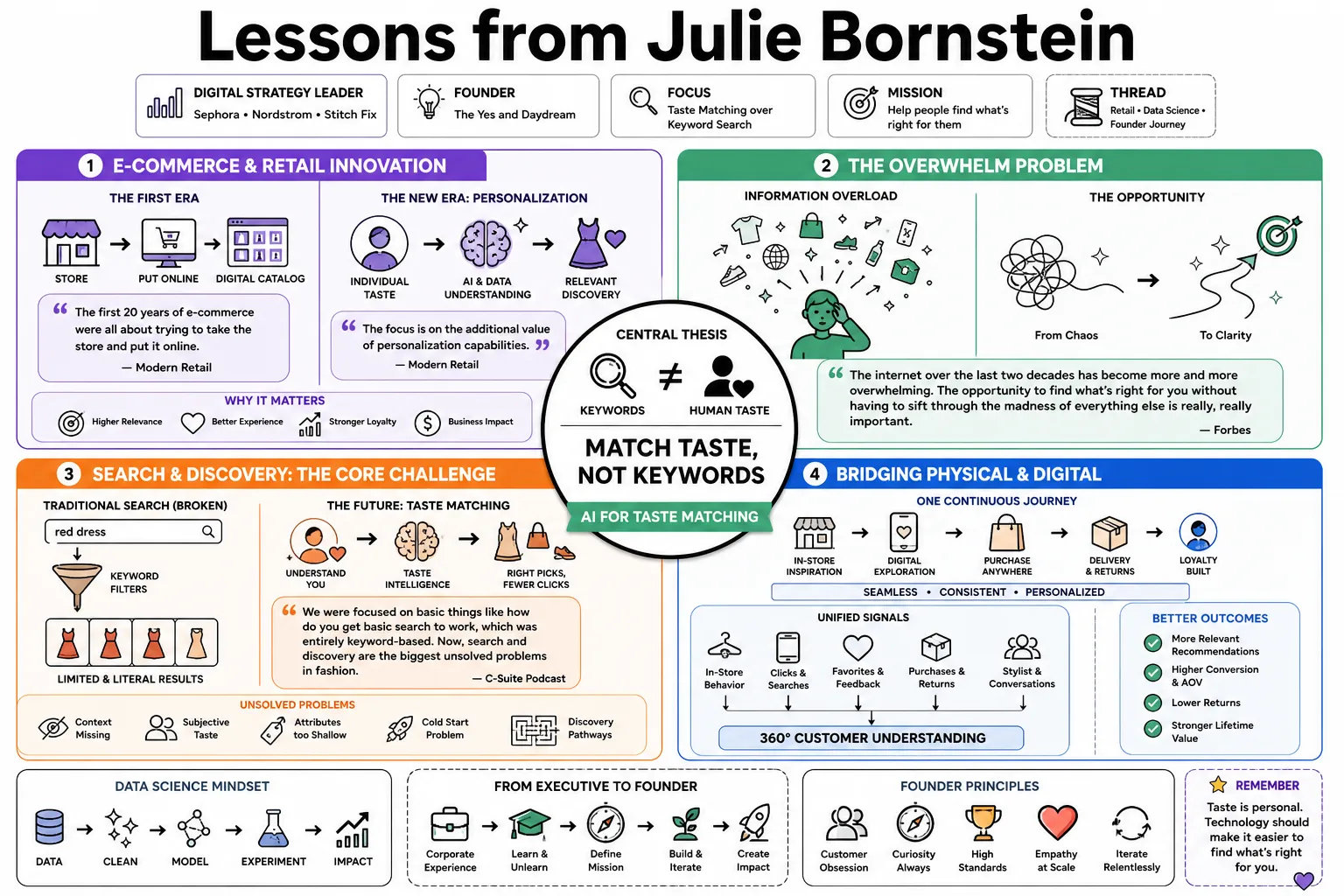
Julie Bornstein led digital strategy at Sephora, Nordstrom, and Stitch Fix before founding The Yes and Daydream. She treats standard e-commerce search as a broken utility, building AI systems designed to match human taste rather than rely on keyword filters. This profile collects her advice on retail, data science, and making the jump from legacy executive to startup founder.
Part 1: E-commerce and Retail Innovation
- On the first era of e-commerce: "The first 20 years of e-commerce were all about trying to take the store and put it online. Today, however, the focus is on the additional value of personalization capabilities." — Source: Modern Retail
- On the problem of overwhelm: "The internet over the last two decades has become more and more overwhelming. The opportunity to find what’s right for you without having to sift through the madness of everything else is really, really important." — Source: Forbes
- On search mechanics: "We were focused on basic things like how do you get basic search to work, which was entirely keyword-based. Now, search and discovery are the biggest unsolved problems in fashion." — Source: C-Suite Podcast
- On bridging physical and digital: "If you can integrate online research with the in-store experience, like allowing shoppers to scan products to recall past purchases, you create a connected loop that traditional retail lacks." — Source: The Brownestone Group
- On the limitations of grids: "The rigid grid-and-filter system of traditional e-commerce hasn't changed in twenty years, making it an inefficient tool for something as subjective and visual as fashion." — Source: Lightspeed Generative Now
- On building Nordstrom's online presence: "We essentially had to invent Nordstrom's e-commerce operations from scratch, growing online sales from $10 million to $350 million by figuring out the basic mechanics of digital retail." — Source: Index Ventures
- On the next wave of technology: "I think the next wave of technology will center around helping people find the items that are exactly right for them and ignoring everything else under the sun." — Source: Forbes
- On the missing piece: "Generative AI is the missing piece I have been waiting for since my early days at Nordstrom.com. It handles the heavy lifting of comparing products across the entire web." — Source: The Kara Goldin Show
- On discovery versus search: "Traditional e-commerce is mechanical. We need to focus on discovery, creating an experience that feels like a dialogue where the technology actually listens and interprets your style." — Source: SME Business Review
Part 2: Leadership and Team Building
- On presenting with impact: "While following speaking guidelines is important, you have to jazz up the presentation with your own personality to make it memorable and authentic." — Source: Pi Beta Phi
- On clarity of purpose: "Write down your goals. Put it on paper. This clarity of intent should be the foundation of any presentation or speech." — Source: Pi Beta Phi
- On finding the win-win: "Observe your audience and figure out how to create a win-win situation where your message aligns directly with their motivations." — Source: The Muse
- On cross-functional collaboration: "You have to merge data science and engineering teams early on. When they work together, they build real-time, responsive consumer models rather than disjointed features." — Source: Index Ventures
- On being a believer: "A leader has to be a believer. You ensure that the metrics and goals of your presentation get everyone focused on the exact same outcome." — Source: National Retail Federation
- On conversational leadership: "Presentations should be less presentation and more conversation. Focus on personalized perspectives rather than rigid slides to engage your team." — Source: National Retail Federation
- On pattern recognition: "Leadership is largely about pattern recognition. When you identify common problems across different teams, you can address them directly in your communication." — Source: Startup Grind
- On setting realistic next steps: "Instead of asking for a 20-minute meeting a busy executive doesn't have, ask to be referred to the best person in the organization to speak with." — Source: Startup Grind
- On building fast-moving teams: "When you build teams in fast-moving spaces, you have to prioritize speed and the ability to build from scratch to avoid the constraints of legacy technology." — Source: Index Ventures
Part 3: Personalization and Customer Experience
- On the store of one: "The entire platform and shopping experience adapts to each user, so every customer is shopping a store built around them." — Source: CommerceNext
- On reducing work for brands: "By using AI to better understand the individual user, we’ve also found ways to reduce the manual merchandising work for the brand itself." — Source: Comcast Ventures
- On humanizing algorithms: "Technology should enhance rather than replace the joy of discovery. Our platforms aim to mimic the experience of talking to a highly knowledgeable personal stylist." — Source: The Remarkable Retail Podcast
- On earning consumer trust: "Trust is everything. You have to be transparent with consumers about how their data is used so they feel the technology is working for them instead of tracking them." — Source: Forbes
- On deep taste profiles: "We use AI to match people with products based on deep taste profiles, ensuring the recommendations reflect their actual preferences instead of strictly their past purchases." — Source: Index Ventures
- On active feedback loops: "When users actively say 'Yes' or 'No' to items, they train a personal algorithm that immediately refines their experience." — Source: Medium
- On moving beyond demographics: "Personalization has to go deeper than basic demographic buckets. It requires a thorough understanding of both the nuanced consumer and the specific attributes of the product." — Source: Modern Retail
- On solving subjective categories: "Fashion is incredibly subjective. You cannot rely on broad categorizations; the personalization engine must respect individual context and aesthetic." — Source: Lightspeed Generative Now
- On adapting to real-time intent: "A true personalization engine adapts in real-time, matching what the user wants in that specific moment rather than assuming their taste is static." — Source: CommerceNext
- On the value of curation: "The primary value proposition for the modern shopper is not unlimited choice, but highly accurate curation that respects their time." — Source: Forbes
Part 4: AI and the Future of Shopping
- On expressive search: "The emergence of large language models marked a turning point, enabling consumers to describe what they want in natural, expressive language." — Source: C-Suite Podcast
- On agentic AI: "AI agents will soon handle the heavy lifting of finding and comparing products across the entire web, acting as true representatives for the consumer." — Source: The Kara Goldin Show
- On conversational interfaces: "Daydream operates as a fashion search engine that uses AI to interact with you exactly as a knowledgeable associate would in a physical store." — Source: Lightspeed Generative Now
- On vibe-based queries: "Users can now search for highly specific, vibe-based queries like 'I’m looking for a revenge dress for a wedding in Paris in the vibe of Saltburn' and actually get accurate results." — Source: C-Suite Podcast
- On bypassing brand taxonomy: "AI allows you to find exactly what you’re looking for without needing to understand or navigate the specific taxonomy of a brand's website." — Source: Lightspeed Generative Now
- On the challenge of reliability: "Trying to build a customer experience that is reliably excellent is one of the distinct challenges of building with A.I. right now." — Source: Forbes
- On processing inputs: "There’s real power in models that can scan millions of data points and make good decisions, but the most important part of AI is understanding the inputs and using them effectively." — Source: CommerceNext
- On the future of Pinterest: "There are 400 million plus active users on Pinterest, there’s no reason why eventually all of them won’t also be shoppers." — Source: Modern Retail
- On replacing the search bar: "We are building a generative AI shopping platform that uses natural language and real-time inventory to completely replace the traditional search bar." — Source: SME Business Review
- On AI as a foundational shift: "Instead of bolting AI onto existing infrastructure, we are building completely new paradigms where the AI operates as the core engine for discovery." — Source: The Remarkable Retail Podcast
Part 5: Career Trajectory and Transitions
- On the second-time founder advantage: "Being a second-time founder means you understand that everything is harder and takes longer than you expect, which allows you to plan your runway more realistically." — Source: The Kara Goldin Show
- On buying time for execution: "I raised the amount of money I did to buy time. When you are building complex AI, you need the financial buffer to get the foundational technology right." — Source: Index Ventures
- On leaving legacy systems: "I realized it would be better to start from scratch than to build THE YES off the back of a bigger business. I couldn't build that off the back of an existing infrastructure." — Source: Forbes
- On scaling Stitch Fix: "Working at Stitch Fix helped me understand the deep synergy between data science and warehouse operations, which was essential for scaling to over a billion in revenue." — Source: Index Ventures
- On transforming Sephora: "Transforming a traditional retailer like Sephora into a digital leader required convincing the organization that digital and physical channels were complementary, not competitive." — Source: The Brownestone Group
- On early days at Urban Outfitters: "Building a brand's initial online presence teaches you how to translate a very distinct physical aesthetic into a digital environment without losing the brand's soul." — Source: Index Ventures
- On the Nordstrom experience: "Growing an e-commerce channel from $10 million to $350 million in the early 2000s meant writing the playbook for online retail as we were executing it." — Source: Forerunner Ventures
- On transitioning to Pinterest: "Integrating THE YES into Pinterest was an opportunity to apply specialized AI shopping technology to an existing base of hundreds of millions of highly visual users." — Source: Modern Retail
- On continuous reinvention: "You have to be willing to leave comfortable executive roles to pursue the technology you believe will fundamentally change the industry." — Source: The Kara Goldin Show
Part 6: Product Strategy and Development
- On complex taxonomies: "To make AI understand the 'why' behind a user's preference, you have to build massive, granular taxonomies of products from the ground up." — Source: Medium
- On simplifying the pitch: "Describe your offering in one succinct, well-articulated sentence. If your mom or dad could understand it, you are on the right track." — Source: Startup Grind
- On providing instant context: "Set the stage immediately by comparing your product to an established player. Let them know you do what an existing tool does, but you do it better or easier." — Source: Startup Grind
- On delivering the value proposition: "Don't ask the client to figure out how you can help them. Clearly deliver your value proposition upfront." — Source: The Muse
- On product mechanics: "The mechanics of the product must align with natural human behavior. The 'Yes' or 'No' swipe works because it is an intuitive way for people to express preference quickly." — Source: Medium
- On solving the cold start problem: "When launching a new discovery tool, you have to design onboarding flows that capture enough baseline data to make the first set of recommendations actually useful." — Source: CommerceNext
- On avoiding feature bloat: "Product strategy is as much about deciding what not to build. We focus entirely on the core utility of discovery and strip away unnecessary features that distract the user." — Source: Index Ventures
- On integrating real-time inventory: "A shopping search engine is useless if the items aren't available. You must connect your conversational interface directly to real-time inventory feeds." — Source: SME Business Review
- On the visual interface: "In fashion, the visual interface is the primary language. The product must display items in a way that allows the user to immediately gauge cut, drape, and context." — Source: Lightspeed Generative Now
Part 7: Data, Analytics, and Growth
- On data and operations: "At Stitch Fix, the real growth engine was the tight integration between predictive data science and warehouse logistics, ensuring inventory matched algorithmic demand." — Source: Index Ventures
- On the limits of past purchases: "You cannot drive meaningful growth if your recommendation engine only looks at what a customer bought yesterday. You have to predict what they want tomorrow." — Source: CommerceNext
- On training data quality: "The effectiveness of an AI model is entirely dependent on the quality and granularity of its training data. If your inputs are broad, your recommendations will be generic." — Source: Comcast Ventures
- On loyalty programs as data engines: "Programs like Sephora's Beauty Insider operated as foundational data engines that allowed us to map consumer behavior across digital and physical touchpoints, moving far beyond basic retention." — Source: The Brownestone Group
- On scaling to a billion: "Scaling a company past the billion-dollar mark requires shifting from manual curation to systems where machine learning models handle the complexity of individual matches." — Source: Index Ventures
- On tracking the right metrics: "Avoid measuring growth entirely by traffic. Measure it by how quickly and accurately a user finds an item they actually decide to keep." — Source: Modern Retail
- On reducing return rates: "Better upfront personalization directly impacts the bottom line by drastically reducing return rates, which is one of the biggest hidden costs in e-commerce." — Source: Forbes
- On mapping brand affinity: "We use data to map brand affinity across categories, understanding that a customer who likes a specific denim brand will likely gravitate toward a specific aesthetic in footwear." — Source: Medium
- On real-time model updating: "Consumer taste changes with seasons and trends. Your models must ingest new interaction data continuously to avoid serving stale recommendations." — Source: CommerceNext
- On building trust through transparency: "When users see that their data inputs directly improve their own experience, they are willing to share more, creating a virtuous cycle for growth." — Source: Forbes
Part 8: Navigating Startups vs Legacy Brands
- On legacy technical debt: "Large retailers often struggle to innovate because they are weighed down by decades of legacy technical debt that prevents them from adopting modern data architectures." — Source: Forbes
- On speed of execution: "In a startup, your primary advantage is speed. You can build and deploy an entirely new taxonomy in the time it takes a legacy brand to approve a project plan." — Source: Index Ventures
- On taking calculated risks: "Leaving an established C-suite role to start a company requires accepting that you will go from having vast resources to having to prove your concept from scratch." — Source: The Kara Goldin Show
- On the innovator's dilemma in retail: "Legacy brands are often hesitant to cannibalize their existing search infrastructure, leaving an opening for startups to build the next generation of discovery tools." — Source: Lightspeed Generative Now
- On startup resource allocation: "When you are building a foundational AI startup, you must allocate the vast majority of your early funding to engineering and data science, not marketing." — Source: Index Ventures
- On driving change from within: "If you want to drive digital transformation inside a legacy brand, you have to prove the ROI of your digital initiatives on physical store sales." — Source: The Brownestone Group
- On the burden of scale: "Building a custom algorithm off the back of a massive existing business is nearly impossible because the system wasn't designed to support that level of individualized processing." — Source: Forbes
- On acquiring innovation: "When big platforms like Pinterest acquire startups, they are often buying the specialized team and the advanced architecture that they couldn't build fast enough internally." — Source: Modern Retail
- On remaining a student: "Whether you are a CMO at a multi-billion dollar retailer or a founder raising a seed round, you have to remain a student of consumer behavior to stay relevant." — Source: The Kara Goldin Show