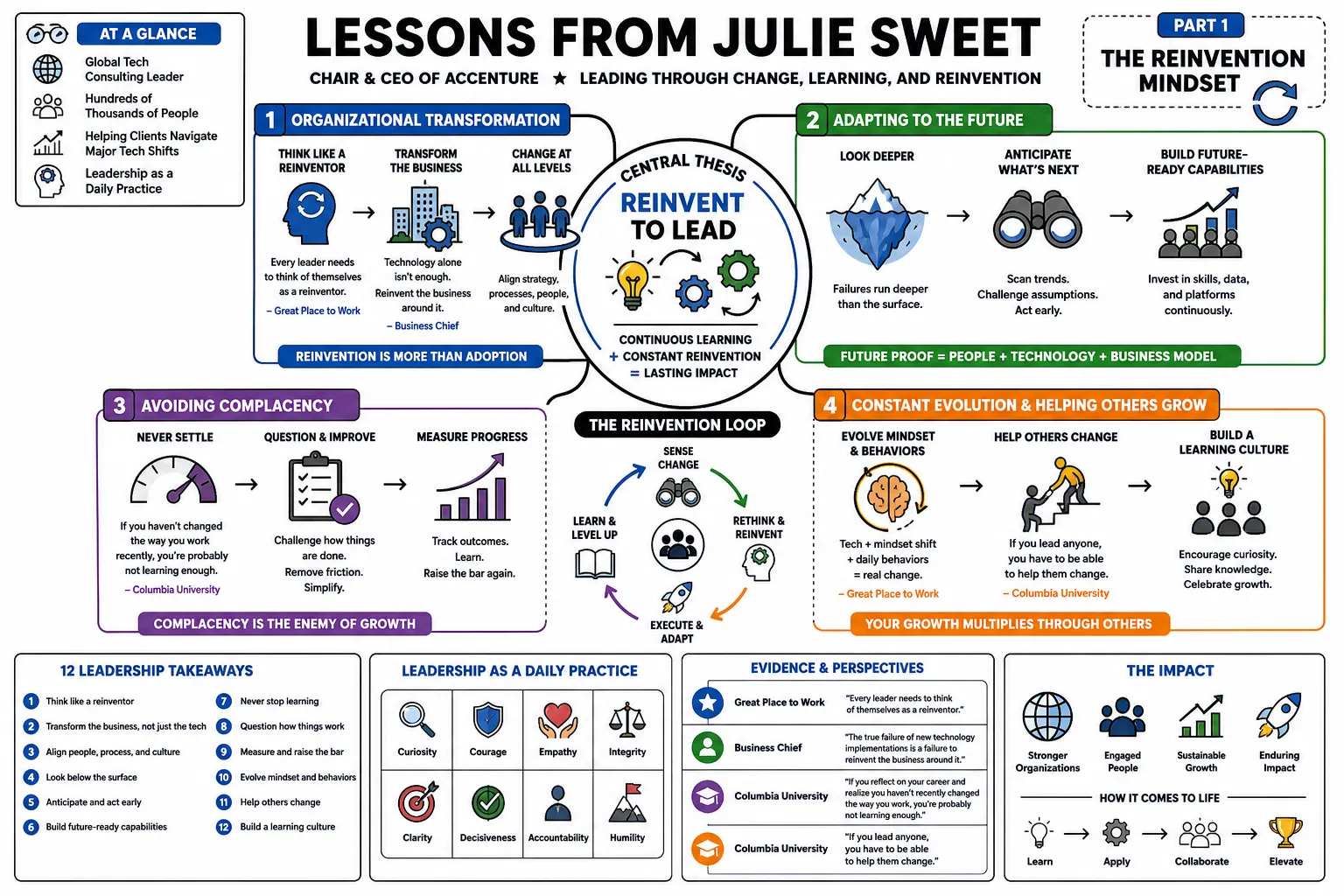
Lessons from Julie Sweet
As Chair and CEO of Accenture, Julie Sweet runs one of the world's largest tech consulting firms. She pushes clients through major technological shifts by demanding continuous learning and constant reinvention. This profile covers her approach to adopting AI, managing global workforces, and treating leadership as a daily practice.
Part 1: The Reinvention Mindset
- On Organizational Transformation: "Every leader needs to think of themselves as a reinventor." — Source: Great Place to Work
- On Adapting to the Future: The true failure of new technology implementations often lies underneath the surface; it is mostly a failure to reinvent the business around it. — Source: Business Chief
- On Avoiding Complacency: If you reflect on your career and realize you haven't recently changed the way you work, it is a clear sign that you are probably not learning enough. — Source: Columbia University
- On Constant Evolution: Adopting new technologies is insufficient without a deeper, parallel shift in organizational mindset and daily behaviors. — Source: Great Place to Work
- On Helping Others Grow: "If you lead anyone, you have to be able to help them change." — Source: Columbia University
- On Crisis Modes: Organizations cannot operate in crisis mode indefinitely; they must translate the speed of emergency response into sustainable structural changes. — Source: Milken Institute
- On Leading Transformation: Transformation is not a one-time project but a continuous state of operation that every part of the company must embrace. — Source: Duke University
- On Competitive Advantage: "You have to be so much better than everyone else, that they must pick you." — Reference: Times of India on Sweet's merit lesson
- On Defining Modern Leadership: The essence of leadership today is being comfortable with constant, unpredictable shifts in the market. — Source: Workday
- On Setting the Tone: Leaders must model the reinvention they expect from their teams by actively upgrading their own skills and approaches. — Source: Great Place to Work
Part 2: Artificial Intelligence as a Growth Engine
- On the True Promise of AI: The greatest promise for artificial intelligence is not merely driving productivity, but serving as a fundamental engine for enterprise growth. — Source: Business Chief
- On the Future of Human Relevance: "There are lots of headlines today that predict less. Less jobs, less opportunity, less human relevance. We are here because we see a future of more." — Source: Business Chief
- On Augmentation: "In the age of AI, you're going to be augmented," rather than replaced. — Source: Time
- On the Three Dimensions of Change: "AI changes the work, it changes the workforce, and it changes the workbench." — Source: Time
- On Daily Life Impact: Sweet says AI changes the work, the workforce, and the workbench, meaning the tools people use will be different across roles. — Reference: TIME interview on AI and work
- On Strategic Investment: Sweet frames AI as a CEO-level reinvention mandate: companies cannot cut their way to growth, so AI has to power both productivity and expansion. — Reference: Phil Fersht podcast note
- On Top-Down Training: To effectively implement AI, companies must take a top-down approach, ensuring executives understand it well enough to explain it to the rest of the organization. — Source: Business Chief
- On Shifting Paradigms: The tools and the workbench you use will be completely different in the coming years, regardless of your specific job title. — Source: Time
- On Scaling Intelligence: Helping clients leverage AI at scale requires moving beyond localized pilot programs into enterprise-wide integration. — Source: Microsoft WorkLab
- On Cost Reduction vs. Value Creation: Focusing solely on AI as a cost-cutting mechanism misses its potential to create entirely new business models and revenue streams. — Source: Masters of Scale
Part 3: Continuous Learning and Adaptation
- On the Baseline of Leadership: "If you’re not learning, you’re not leading." — Source: Columbia University
- On the New Normal: Continuous learning is the new normal; it requires staying engaged with the world, noticing how things work, and constantly asking why. — Source: India Times
- On Updating Mental Models: Professionals must be willing to update their thinking immediately when new information and technological paradigms arrive. — Source: India Times
- On Leading by Example: Sharing your own personal learning agenda with your team sets the right tone for an organization navigating rapid change. — Source: Joorney
- On Humility in Learning: Leaders must be willing to admit what they do not know in order to foster an environment where employees feel safe to learn. — Source: Columbia University
- On Upskilling the Workforce: The shift to an AI-driven economy necessitates a massive and intense focus on training and upskilling employees at every level. — Source: Time
- On Curiosity: Asking why things are done a certain way is the first step toward breaking stagnant corporate habits. — Source: India Times
- On Institutionalizing Learning: Training and change-management must be embedded directly into leadership development rather than treated as an afterthought. — Source: Great Place to Work
- On Entry-Level Adaptation: The nature of entry-level hiring is changing alongside automation, requiring companies to completely rethink how they train new graduates. — Source: Masters of Scale
- On Preparing for Volatility: A learner's mindset is the best defense and preparation for navigating unpredictable economic and technological shifts. — Source: Joorney
Part 4: Career Progression and Risk Taking
- On Facing Intimidation: When offered a stretch role, remember that the person offering it to you is likely just as nervous about it as you are. — Source: Indian Express
- On Accepting Opportunities: Never express self-doubt when handed a major opportunity by asking if they are sure; simply accept it and ask what they have in mind. — Source: Hindustan Times
- On Ambition: "If your dreams don't scare you, they're not big enough." — Source: India Times
- On True Networking: Think about networking not just as who you know to get ahead, but who you know to help you become truly top-tier at what you do. — Source: Forte Foundation
- On Career Agility: A successful career trajectory often involves a willingness to jump between seemingly disparate disciplines, such as moving from law to executive management. — Source: Columbia University
- On Adding Value: Sweet advises people to focus less on transactional networking and more on connecting with people who help them deliver more value for the company and its clients. — Reference: Fortune Titans interview
- On Overcoming Hesitation: Stop waiting for perfect clarity; in times of ambiguity, you have to unfreeze and act. — Source: Masters of Scale
- On Expanding Your Scope: Always look for the empty spaces in your organization where no one is taking ownership, and step into them. — Source: Indian Express
- On the Value of Expertise: Building a reputation for deep, reliable expertise in one area gives you the platform to take risks in others. — Source: Forte Foundation
- On Managing Career Transitions: The early days of any new role should be dedicated primarily to listening and mapping the landscape before making sweeping changes. — Source: Bonnie Marcus Leadership
Part 5: Effective Communication and Leadership Habits
- On Deliberate Improvement: "Every year, I spend time to improve how I communicate." — Source: India Times
- On Communication as a Practice: Communication is not a static innate talent, but an active skill that requires deliberate, ongoing maintenance regardless of seniority. — Source: India Times
- On Entering New Roles: "When you come in as a new leader it’s really important that people do get to know you and that you are constantly communicating." — Source: India Times
- On the Core Pillars of Leadership: Success in a new role requires mastering three specific actions: listening, prioritizing, and communicating. — Source: Bonnie Marcus Leadership
- On Human-Centered Leadership: "Lead with excellence, confidence, and humility." — Source: Accenture
- On Empathy: Even as technology transforms the workplace, genuine human connection, empathy, and transparency remain fundamentally irreplaceable. — Source: Great Place to Work
- On Building Credibility: Spending time on the ground with employees and clients is the only way to build the credibility required to lead massive change. — Source: Bonnie Marcus Leadership
- On Caring for People: True leadership requires caring for your workforce both in their professional capacities and in their personal well-being. — Source: Columbia University
- On Transparency: Being open about the challenges the company faces builds the necessary trust to ask employees to navigate difficult transitions. — Source: Accenture
Part 6: Women in the Workplace and Diversity
- On Leveraging Opportunities: Sweet says the lack of women in many rooms could become a way to get noticed when combined with being very good and using it as motivation to be the best. — Reference: HuffPost interview
- On Proving Exceptionalism: Sweet describes treating underrepresentation as both an opportunity to be noticed and a source of motivation to perform at an exceptional level. — Reference: HuffPost interview
- On the Business Case for Inclusion: Fostering an inclusive environment makes a company stronger, smarter, and more innovative, which directly benefits clients and communities. — Source: Activation Quotes
- On Innovation and Diversity: You cannot generate original thinking unless you have assembled a team with true diversity across gender, ethnicity, and geography. — Source: Activation Quotes
- On Belonging: The ultimate goal of workplace culture initiatives should be creating a broad sense of belonging for all employees. — Source: ESG Dive
- On Navigating Legal Landscapes: Corporate diversity approaches must remain flexible and adapt to evolving legal and political environments while maintaining core commitments to fairness. — Source: The Guardian
- On Meritocracy: A successful enterprise must fiercely protect its status as a meritocracy, ensuring an inclusive, merit-based workplace completely free from bias. — Source: ESG Dive
- On Shared Values: "When you are selecting a partner, you need to select partners who share those same values. Who care about sustainability, diversity..." — Source: Forbes
- On Inclusive Environments: "Being an inclusive place means being inclusive for all people." — Source: Activation Quotes
Part 7: Data, Cloud, and the Technological Foundation
- On the Triad of Modern Tech: "Cloud is the enabler, data is the driver, and AI is the differentiator." — Source: Duke University
- On Data Readiness: "If you want to use AI at scale in your business, you need to be old-fashioned, and be able to actually know where your data is." — Source: Duke University
- On Foundational Trust: "Trust is the foundation for the use of AI. Without trust, companies will hesitate to move beyond pilots, and with it, innovation will blossom." — Source: Time
- On Responsible AI: Deploying artificial intelligence responsibly is not just an ethical obligation, but a strict business requirement for scaling operations safely. — Source: Time
- On the Illusion of Shortcuts: You cannot bypass the hard work of organizing and securing your enterprise data if you want to deploy advanced algorithms effectively. — Source: Duke University
- On Human Control: "Technology, no matter how powerful, is only a tool… It is leaders who decide how to use those tools." — Source: Business Chief
- On Systemic Integration: Every single department within a modern company will eventually need to be reinvented through the aggressive use of data and AI. — Source: Duke University
- On the Role of the Cloud: Cloud computing is the mandatory foundational layer that makes all subsequent digital transformation and agility possible. — Source: Duke University
- On Technological Disruption: Disruption from technology should be viewed as an ongoing environmental condition rather than a temporary storm to wait out. — Source: Startup Hub
Part 8: Leading Through Change and Crisis
- On Asking the Hard Questions: When organizations want to sustain the speed they achieved during a crisis, leaders must ask what they have actually changed to make that speed sustainable. — Source: Milken Institute
- On Managing Scale: When announcing a major Accenture restructuring to 770,000 employees, Sweet chose a direct video message so people could hear the why, excitement, and purpose behind the change. — Reference: Fortune on Accenture restructuring communication
- On Post-Pandemic Realities: The new reality for businesses requires a permanent state of organizational flexibility, far beyond temporary remote work policies. — Source: Milken Institute
- On Leading the Charge: Executive leaders cannot delegate the understanding of technological change; they must be the primary students and teachers of it. — Source: Business Chief
- On Evaluating Partnerships: Companies must evaluate their supply chains and partnerships not just on cost, but on how well they align with the company's commitments to sustainability and shared values. — Source: Forbes
- On Sustainable Practices: Sustainability is no longer a peripheral corporate social responsibility initiative, but a core force of enterprise change and value creation. — Source: Workday
- On Cultivating Resilience: Building resilience into a company requires shifting the focus from anticipating specific crises to building general adaptability. — Source: Masters of Scale
- On the Ultimate Responsibility: At the end of the day, it is the leadership's responsibility to ensure that technology serves to elevate the human workforce rather than diminish it. — Source: Time