Karl Friston is a theoretical neuroscientist and the creator of Statistical Parametric Mapping, the standard technique used worldwide to analyze brain imaging data. He is best known for formulating the Free Energy Principle, a mathematical framework suggesting that all living systems maintain their existence by constantly predicting their environment and minimizing sensory surprise. This profile compiles his insights across physics, psychiatry, and artificial intelligence to clarify how he views the brain as an active inference machine rather than a passive processor.
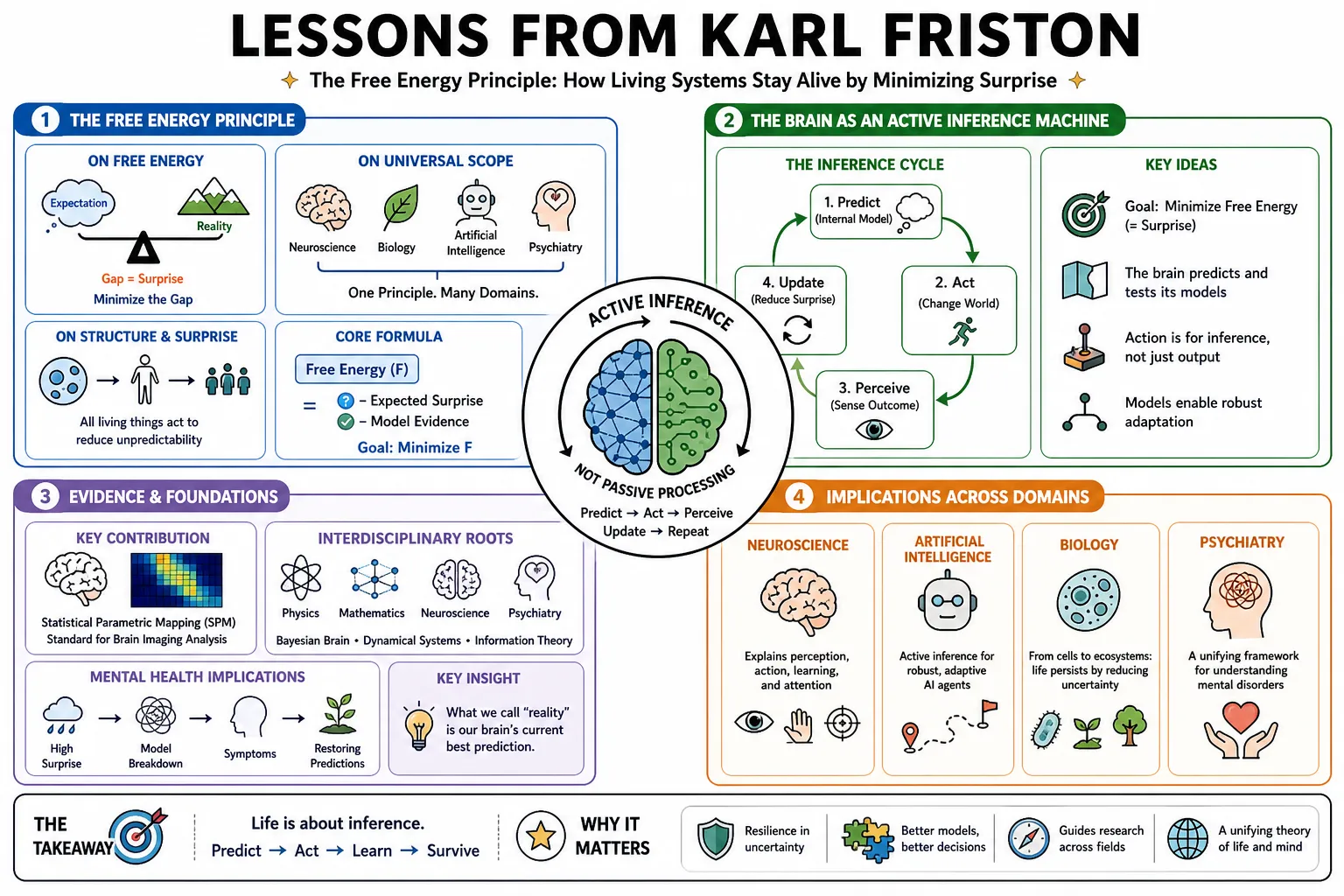
Part 1: The Free Energy Principle
- On Free Energy: "The brain's main task is to minimize the gap between expectation and reality. This gap is what the Free Energy Principle defines as free energy." — Source: UX Design
- On the universal scope: The Free Energy Principle serves as a universal law applicable not just to neuroscience, but to biology, artificial intelligence, and psychiatry. — Source: Lex Fridman Podcast
- On structure and surprise: "All living things, from a single cell to a human being, are constantly trying to make sense of the world and reduce unpredictability. It's this drive to minimize surprise that allows things to exist and maintain their structure." — Source: Karl Friston Interview
- On self-evidencing: Living organisms act as "self-evidencing" systems, constantly updating their internal models to better predict sensory input and mathematically prove their own existence. — Source: National Science Review
- On the nature of observation: When observing early research on movement, he realized that a self-organizing system "just was... in the sense that it could be no other way" if it was actively minimizing free energy. — Source: Surtil
- On bounding surprise: The imperative of any biological system is to place an upper bound on surprise, ensuring its sensory states remain within safe physiological limits. — Source: The Dissenter
- On the thermodynamic link: Minimizing variational free energy is a way for an organism to resist the natural tendency towards thermodynamic entropy and dissolution. — Source: Medium
- On models and existence: A system doesn't just have a model of its environment to minimize free energy; its physical structure is the model itself. — Source: Goodreads
- On action vs. perception: Free energy can be minimized either by updating our internal model to match the world, or by acting on the world to make it match our model. — Source: Sean Carroll's Mindscape
- On non-equilibrium steady states: The Free Energy Principle describes the physics of non-equilibrium steady states, explaining how biological entities maintain their boundaries over time. — Source: Theories of Everything
Part 2: Predictive Processing and the Brain
- On the brain's function: "Your brain is a prediction machine, not a processor." — Source: Karl Friston Interview
- On the embodied brain: "The form, structure, and states of our embodied brains do not contain a model of the sensorium — they are that model." — Source: Goodreads
- On perceiving reality: We do not perceive reality directly; rather, our brains create a model or "fantasy" of reality, which is constantly corrected by sensory prediction errors. — Source: IAI TV
- On prediction error: The brain operates by passing prediction errors up the neural hierarchy, while sending predictions down to suppress those errors. — Source: Lex Fridman Podcast
- On hierarchical models: The brain constructs hierarchical generative models where higher levels represent abstract, slow-changing features, and lower levels represent fast, sensory fluctuations. — Source: Medium
- On hallucination as perception: Normal perception is simply a controlled hallucination, reined in by the sensory evidence gathered from the physical world. — Source: The Dissenter
- On precision weighting: The brain must constantly evaluate the reliability or "precision" of sensory prediction errors, determining which signals to trust and which to ignore. — Source: NIH
- On the illusion of a passive sensorium: The brain does not passively receive data from the outside world; it actively constructs its perceptual reality from the inside out. — Source: Sean Carroll's Mindscape
- On sensory attenuation: In order to move, the brain must temporarily attenuate or ignore the sensory evidence that contradicts its predicted movement. — Source: Avant
- On environmental reflection: "Every aspect of our brain and body can be predicted from our environment." — Source: Goodreads
Part 3: Entropy, Existence, and Life
- On death and entropy: "Low entropy states are not closer to death. Death is characterized by dissipation, decay and dispersion. It is the ultimate high entropy state — literally, the edge of our existential world, when we are gently absorbed back into the universe." — Source: Seven Reflections
- On Markov blankets: "The universe is made up of Markov blankets inside of Markov blankets. Each of us has a Markov blanket that keeps us apart from what is not us." — Source: Surtil
- On biological nesting: Within us are blankets separating organs, which contain blankets separating cells, which contain blankets separating their organelles, defining how biological things behave distinctly. — Source: Surtil
- On surviving surprise: "A 'fish out of water' would be in a surprising state... A fish that frequently forsook water would have high entropy." — Source: UAB
- On maintaining boundaries: Life is fundamentally the process of maintaining a statistical boundary between the internal states of an organism and the external states of the environment. — Source: Medium
- On wandering sets: Biological systems must restrict themselves to a limited set of states—a "pulling attractor"—to avoid the unbounded entropy of the external world. — Source: The Dissenter
- On self-assembly: The very existence of a living system is a testament to its ability to continuously assemble and reassemble itself against the dispersive forces of nature. — Source: Big Biology Podcast
- On avoiding phase transitions: A living system must act to avoid phase transitions that would destroy its Markov blanket, such as freezing or boiling. — Source: Theories of Everything
- On the meaning of life: From a thermodynamic perspective, the meaning of life is simply to persist and resist the pull of maximum entropy for as long as possible. — Source: Lex Fridman Podcast
- On ergodic behavior: Over long time scales, living organisms exhibit ergodic behavior, continually returning to the same physiological states necessary for survival. — Source: Sean Carroll's Mindscape
Part 4: Artificial Intelligence and Natural Intelligence
- On current AI paradigms: Generative AI models often violate the principles of natural intelligence by relying on massive, inefficient data processing rather than active engagement with the world. — Source: Lex Fridman Podcast
- On active AI: True artificial intelligence will require "Active Inference"—agents that autonomously interact with their environment to resolve uncertainty and survive. — Source: VERSES AI
- On data hunger: Biological brains are vastly more sample-efficient than current neural networks because they learn by testing hypotheses in the real world, not by passively consuming static datasets. — Source: Medium
- On explainability: Systems built on Active Inference offer greater explainability because their internal models are explicit representations of the causal structure of their environment. — Source: Brain Inspired
- On the illusion of intelligence: Large language models may mimic human thought convincingly, but without a Markov blanket and a drive to survive, they lack true agency. — Source: The Dissenter
- On embodiment: Natural intelligence is inherently embodied; an agent's physical form constrains and shapes the kind of inferences it must make to persist. — Source: Nature & Nurture
- On artificial curiosity: An AI agent based on the Free Energy Principle will naturally exhibit artificial curiosity, seeking out novel information to improve its internal model. — Source: Lex Fridman Podcast
- On thermodynamic efficiency: The brain operates on roughly 20 watts of power, a stark contrast to the massive energy consumption of modern data centers, highlighting the difference between physical inference and deep learning. — Source: Sean Carroll's Mindscape
- On spatial vs. temporal intelligence: While current AI excels at mapping spatial patterns, natural intelligence is uniquely attuned to temporal dynamics and the causal flow of events. — Source: Theories of Everything
Part 5: Consciousness and Self-Organization
- On the experience of reality: Conscious experience is simply the brain's best guess—a high-level prediction—about the causes of its sensory input. — Source: IAI TV
- On the limits of knowing: Because we only have access to our own subjective experience, we can only infer the internal states of others based on their behavior, leaving the true nature of their consciousness inaccessible. — Source: Frontiers in Psychology
- On self-awareness: To be self-conscious, a system must possess a deep generative model that includes a representation of itself as an agent acting within the world. — Source: Frontiers in Psychology
- On the illusion of self: The "self" is a highly useful construct generated by the brain to predict the sensory consequences of its own autonomous actions. — Source: Lex Fridman Podcast
- On phenomenal consciousness: What we feel is the continuous, dynamic process of our brains updating their models to minimize the prediction error generated by our bodies and the environment. — Source: Sean Carroll's Mindscape
- On artificial sentience: Whether an artificial system possessing a deep hierarchical model and minimizing free energy actually experiences consciousness remains a profound and unresolved philosophical question. — Source: The Dissenter
- On temporal depth: A crucial prerequisite for consciousness is "temporal depth"—the ability of an agent's model to project far into the past and the future. — Source: Active Inference Institute
- On the necessity of consciousness: Consciousness may not be an epiphenomenon, but a functional necessity for systems that must coordinate highly complex, long-term behavior in uncertain environments. — Source: IAI TV
- On continuous updating: Our conscious reality is never static; it is a continuously flowing stream of inferences being constantly revised at multiple timescales. — Source: Lex Fridman Podcast
Part 6: Psychiatry, Schizophrenia, and Hallucinations
- On the nature of schizophrenia: Schizophrenia is characterized not by a failure of prediction itself, but by an aberrant encoding of precision regarding sensory evidence and prior beliefs. — Source: Avant
- On forming delusions: If the brain incorrectly weights sensory noise as highly precise, it will form rigid, delusional beliefs to explain away that noise. — Source: NIH
- On hallucinations: When the brain places too much precision on its own internal predictions and too little on bottom-up sensory data, hallucinations can manifest as perceptual realities. — Source: NIH
- On the dysconnection hypothesis: Schizophrenia can be understood as a disorder of "dysconnection," where the integration of neural signals and the communication of prediction errors across different brain regions are disrupted. — Source: ResearchGate
- On synaptic gain: The computational imbalances seen in psychosis are likely driven by abnormalities in synaptic gain, heavily influenced by neurotransmitter systems like dopamine. — Source: NIH
- On loss of agency: Deficits in "sensory attenuation" can prevent individuals with schizophrenia from distinguishing between self-generated actions and external events, leading to a loss of the sense of agency. — Source: Avant
- On computational psychiatry: Psychiatric conditions should be viewed as computational or neuro-mechanistic disorders, shifting the focus from descriptive symptoms to the underlying math of false inferences. — Source: UCL
- On rigid priors: In conditions like depression or autism, the brain may suffer from overly rigid prior beliefs, making it difficult for the individual to adapt their models to new, contradictory evidence. — Source: Doorknob Comments
- On therapeutic interventions: Therapy, from a predictive coding perspective, involves providing a safe environment where a patient can carefully loosen their rigid prior beliefs and update their internal models. — Source: Doorknob Comments
Part 7: Active Inference and Agency
- On active vs. passive: We don't just passively observe the world; we engage in "active inference," acting upon our environment to generate the sensory data that confirms our predictions. — Source: National Science Review
- On the purpose of movement: All voluntary movement is essentially an attempt to fulfill a proprioceptive prediction about where our limbs should be. — Source: Medium
- On epistemic foraging: When faced with uncertainty, an agent will automatically engage in epistemic foraging—seeking out new information to resolve ambiguity and improve its model. — Source: The Dissenter
- On pragmatic vs. epistemic value: Every action is a balance between pragmatic value (achieving a desired state) and epistemic value (reducing uncertainty about the world). — Source: Lex Fridman Podcast
- On resolving ambiguity: An active inference agent naturally moves its eyes to the edges and salient features of an object because those regions contain the most information to resolve visual ambiguity. — Source: Sean Carroll's Mindscape
- On the illusion of choice: What we experience as conscious decision-making is often the brain calculating the path of least expected free energy into the future. — Source: Lex Fridman Podcast
- On goal-directed behavior: Goals are simply deeply held prior beliefs about the states we expect to occupy; we act to make those expectations a reality. — Source: Theories of Everything
- On habit formation: As an agent repeatedly encounters the same environment, actions that consistently minimize free energy are codified into automatic, highly precise habits. — Source: Brain Inspired
- On multi-agent systems: When multiple active inference agents interact, they naturally tend to synchronize their internal models, leading to shared cultural narratives and language. — Source: The Dissenter
Part 8: Philosophy, Science, and Methodology
- On the philosophy of science: The scientific method itself is a macro-level manifestation of active inference—generating hypotheses (predictions) and conducting experiments (actions) to minimize uncertainty. — Source: Sean Carroll's Mindscape
- On the necessity of math: To truly understand complex biological and cognitive systems, one must translate verbal theories into rigorous mathematical frameworks that can be empirically tested. — Source: Lex Fridman Podcast
- On multidisciplinary bridges: The power of the Free Energy Principle lies in its ability to provide a common mathematical language for physicists, biologists, and psychologists. — Source: IAI TV
- On statistical parametric mapping (SPM): Before the Free Energy Principle, Friston's creation of SPM revolutionized neuroscience by providing a standard statistical method for interpreting brain imaging data. — Source: Lex Fridman Podcast
- On the limits of reductionism: Biological systems cannot be fully understood by looking only at their smallest parts; one must understand the overarching imperative of the entire Markov blanket. — Source: Surtil
- On teleology: The Free Energy Principle offers a way to explain seemingly goal-directed, teleological behavior in biology using purely physical and statistical mechanics. — Source: The Dissenter
- On the beauty of the brain: The most beautiful characteristic of the human brain is its capacity to embody the causal structure of its world with such incredible efficiency and elegance. — Source: Lex Fridman Podcast
- On continuous learning: A model that stops updating is a model of a dead system; true intelligence requires the humility to be constantly proven wrong by incoming data. — Source: Big Biology Podcast
- On the ultimate goal: The ultimate goal of theoretical neurobiology is to write down the exact equations that govern how a system transitions from mere matter to a feeling, thinking entity. — Source: Theories of Everything