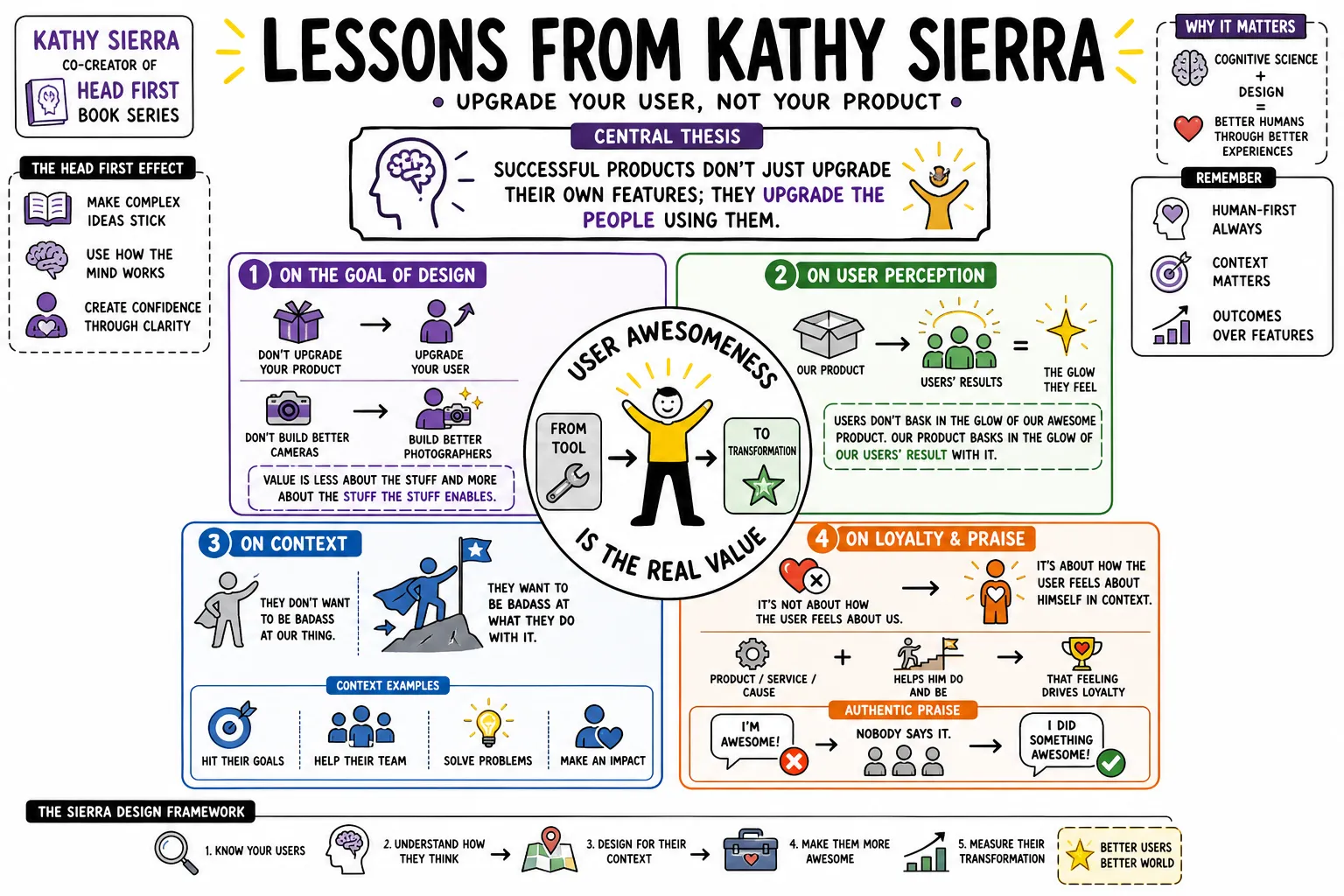
Kathy Sierra co-created the Head First book series and changed how the tech industry approaches user experience. She argued that successful products don't just upgrade their own features; they upgrade the people using them. By applying cognitive science to product design, her work shows developers how to build tools that make users genuinely better at what they do.
Part 1: The Core Philosophy of User Awesomeness
- On the goal of design: "Upgrade your user, not your product. Value is less about the stuff and more about the stuff the stuff enables." — Source: [Sebastien Phlix]
- On true value: "Don't build better cameras — build better photographers." — Source: [AZQuotes]
- On user perception: "Users don't bask in the glow of our awesome product. Our product basks in the glow of our users' result with it." — Source: [Business of Software]
- On context: "They don't want to be badass at our thing. They want to be badass at what they do with it." — Source: [Product Bookshelf]
- On what drives loyalty: "It's not about how the user feels about us. It's about how the user feels about himself, in the context of whatever it is our product, service, or cause helps him do and be." — Source: [Sebastien Phlix]
- On authentic praise: "Nobody says, 'I'm awesome' because of a product. They say, 'I love this' or 'This app is amazing.' It's not about the actual words, it's about the feelings that inspired them to say it." — Source: [Sebastien Phlix]
- On true competition: "Your competitive advantage is not how you compare to the competition but how your users compare to the competition's users." — Source: [Sebastien Phlix]
- On benchmarking: "Instead of marketing based on your benchmarks, show your users' benchmarks." — Source: [Sebastien Phlix]
- On the definition of badass: "Badass means user results. If your users are getting better results, they are badass users." — Source: [Product Bookshelf]
- On feeling vs. being: "It's not enough that they feel badass, they have to be badass." — Source: [SoBrief]
Part 2: Cognitive Load and the Brain
- On the brain's priorities: "Your brain is not your friend. It thinks you're still living in a cave, and its sole job is survival... Learning a programming language isn't high on the brain's list of Things To Keep You Alive." — Source: [Kevin M Conroy]
- On the single energy tank: "Willpower and cognitive processing draw from the same pool of resources. It’s all one tank and it’s zero sum. If we hit one, then we’re hitting the other." — Source: [Nadyne Richmond]
- On daily limits: "Think of cognitive resources as a single bank account, and every cognitive task or use of willpower as a withdrawal from that account." — Source: [Sebastien Phlix]
- On physical impact of UX: "If you spend the day using your cognitive resources, you have less willpower in the evening—you’re more likely to hit the fast food drive-through on the way home." — Source: [Sebastien Phlix]
- On cognitive leaks: "Cognitive leaks are anything which takes brain cycles for thinking, processing, questioning, worrying, self-control, focus, etc." — Source: [Medium]
- On mental focus: "The goal isn't 'don't make me think,' it's 'don't make me think about the wrong things.'" — Source: [Product Bookshelf]
- On micro-frictions: "If you don't pay attention to these, your users will die a death by a thousand micro cognitive leaks." — Source: [Product Bookshelf]
- On conscious control: "The belief that we have 100% conscious control over what we pay attention to is a myth." — Source: [WordPress]
- On winning attention: "If we want our users to pay attention, we have to be provocative... It’s not about responsibility or maturity. It’s not even about interest. It’s about the brain." — Source: [WordPress]
Part 3: The Path to Expertise
- On early skill acquisition: "Nobody’s passionate about things they suck at." — Source: [Global Nerdy]
- On the suck threshold: "The 'Suck Threshold' is the point where a user gives up because they feel stupid. Your job is to get them past it as fast as possible." — Source: [Creating Passionate Users]
- On managing skill piles: "You must move skills from what the user is currently learning to things they have mastered as quickly as possible." — Source: [Business of Software]
- On hitting the wall: "If the pile of things the user is actively trying to learn gets too full, the user hits a plateau or quits." — Source: [YouTube]
- On perceptual learning: "Expose users to a high volume of 'good' vs. 'bad' examples very quickly to build intuitive pattern recognition without requiring them to memorize rules." — Source: [Business of Software]
- On overcoming plateaus: "Helping your users 'find flow through a challenge' doesn't mean that everything has to be fun or easy." — Source: [Sebastien Phlix]
- On measurable progress: "It doesn't matter if our users are getting better unless they know they're getting better and benefit from getting better." — Source: [Sebastien Phlix]
- On the ultimate goal: "The goal is not to have a 'passionate user' of your product, but to have a user who is passionate about the thing your product helps them do." — Source: [Creating Passionate Users]
- On intrinsic motivation: "Being better is better." — Source: [WordPress]
Part 4: Designing for Usability and Flow
- On frictionless design: "Good usability is like water flowing downhill." — Source: [David Lee King]
- On misdirected difficulty: "Playing the game should be challenging. The interface should be brainless." — Source: [David Lee King]
- On behavioral guardrails: "Make the right thing easy for people and the wrong thing hard." — Source: [Creating Passionate Users]
- On defining flow: "Flow is characterized by just the right balance between challenge and reward." — Source: [Product Bookshelf]
- On capturing attention: "The secret is to be more provocative and interesting than anything else in their environment." — Source: [WordPress]
- On interface burden: "Users should spend their cognitive calories on the difficult task, not on trying to figure out how to navigate the book or software." — Source: [O'Reilly]
- On reducing rules: "Move knowledge in the head (memorization) to knowledge in the world (labels, cheat sheets, intuitive design)." — Source: [Medium]
- On the Sad Venn Diagram: "There is a gap where the company is focused on the product while the user is focused on their own life. Success happens in the intersection where the product helps the user achieve their personal goals." — Source: [Business of Software]
- On removing fluff: "Reduce cognitive load by removing the fluff so the brain can focus on the core concept." — Source: [YouTube]
- On intuitive interfaces: "The best user experiences are enchanting. They help the user enter an alternate reality, whether it's the world of making music, writing, sharing photos, coding, or managing a project." — Source: [Sebastien Phlix]
Part 5: Creating Passionate Users
- On true product advocacy: "If your users like themselves better when they use what you make, they'll recommend it with a fervor money simply cannot buy." — Source: [SoBrief]
- On core motivation: "People aren't using the app because they like the app or they like you. They're doing it because they like themselves." — Source: [Business of Software]
- On the kickoff point: "Help your users kick ass, and all else follows." — Source: [Creating Passionate Users]
- On the 'I Rule' moment: "To create passionate users, you must help them get past the 'I suck' phase as quickly as possible so they can experience the 'I rule!' feeling of mastery." — Source: [IRGUPF]
- On shifting focus: "The secret to building great products is not creating awesome features, it's to make your users awesome." — Source: [AZQuotes]
- On genuine loyalty: "True loyalty doesn't come from gamification or engagement hacks. It comes from the user feeling more powerful and capable." — Source: [Business of Software]
- On word of mouth: "People recommend products because they want their friends to be badass too, not because they love the company." — Source: [Business of Software]
- On the Zone of Mediocrity: "Products that are 'just okay' are at risk. You either need to be the low-cost utility or the high-value meaning provider." — Source: [Business of Software]
- On identity through products: "Users are increasingly looking for products that help them express their identity or connect with a larger purpose." — Source: [Business of Software]
Part 6: Learning and the Head First Approach
- On getting past filters: "The inputs that tell your brain that something is important and worth recording are feelings." — Source: [Kevin M Conroy]
- On tricking the brain: "To make information stick, you must use emotion, surprise, and conversational language to trick the brain into thinking the information is vital for survival." — Source: [Kevin M Conroy]
- On timing of knowledge: "It's not what you know, it's when you know it. Just-in-time learning is more effective than just-in-case learning." — Source: [O'Reilly]
- On conversational style: "Speaking directly to the reader keeps the brain engaged." — Source: [O'Reilly]
- On visual processing: "The brain processes images faster than text." — Source: [O'Reilly]
- On memorable constraints: "Roses are red, violets are blue. Square is-a Shape, the reverse isn't true." — Source: [Goodreads]
- On coding metaphors: "Roses are red, violets are blue. Extend only one, but implement two." — Source: [Goodreads]
- On simple explanations: "Generics means more type-safety... code that makes the compiler stop you from putting a Dog into a list of Ducks." — Source: [O'Reilly]
- On metacognition: "Thinking about thinking is the core of effective learning design." — Source: [YouTube]
Part 7: The "Post-UX" Reality
- On the bigger picture: "Our user experience doesn't stand by itself. Instead, our user experience is just a part of the day for our users." — Source: [Trading Academy]
- On the fat UX metaphor: "If your UX is zapping their willpower... you're actually making people fat with your user experience because it's difficult to use, therefore it's zapping their willpower to make healthy choices later." — Source: [Trading Academy]
- On what happens next: "What is the user capable of after they put your tool down? That is the true measure of your product's value." — Source: [Business of Software]
- On marketing vs reality: "The best sales pitch is a story, not a feature tour." — Source: [Creating Passionate Users]
- On post-purchase drop-off: "We treat people really well before they buy, and afterwards, we treat them poorly." — Source: [Creating Passionate Users]
- On smart buyers: "If you teach me how to run a project successfully and I feel smarter because of it, then picking a project management tool is a no-brainer for me." — Source: [Creating Passionate Users]
- On the post-purchase cognitive leak: "Marketing often promises a 'badass' version of the user, but once the user buys the product, the support and documentation focus only on the tool's features, leaving the user to figure out how to be successful on their own." — Source: [Business of Software]
- On tool vs context: "What is the larger context my user wants to be good at? If you sell an IDE, the context is being a great developer." — Source: [Business of Software]
- On the minimum badass: "What is the smallest set of skills they need to feel successful? Build the Minimum Badass User." — Source: [Business of Software]
Part 8: Motivation and Sustained Desirability
- On designing for the real world: "We have to design for the reality of the user's brain, not the brain we wish they had." — Source: [Kevin M Conroy]
- On the illusion of engagement: "Stop trying to engage users with your app. Engage them with the result." — Source: [Sebastien Phlix]
- On the burden of choice: "Every new thing a user has to learn drains their cognitive leak. If you drain too much, they give up." — Source: [Business of Software]
- On the power of progress: "Sustained desirability requires the user to constantly feel a sense of forward motion." — Source: [Product Bookshelf]
- On shifting perspective: "Instead of asking 'how can we make this better?', ask 'how can we make the user better?'" — Source: [AZQuotes]
- On long-term value: "Users don't upgrade because the product has a new version; they upgrade because they want a new version of themselves." — Source: [Sebastien Phlix]
- On the role of documentation: "Manuals shouldn't explain how the software works; they should explain how the user can work better." — Source: [Business of Software]
- On user empowerment: "Make them better at something they care about, and they will care about you." — Source: [Creating Passionate Users]
- On continuous learning: "A good product teaches the user without making them feel like they are in a classroom." — Source: [YouTube]
- On the ultimate metric: "The only metric that matters is how much more awesome the user is today than they were yesterday." — Source: [Product Bookshelf]