Lessons from Keily Blair
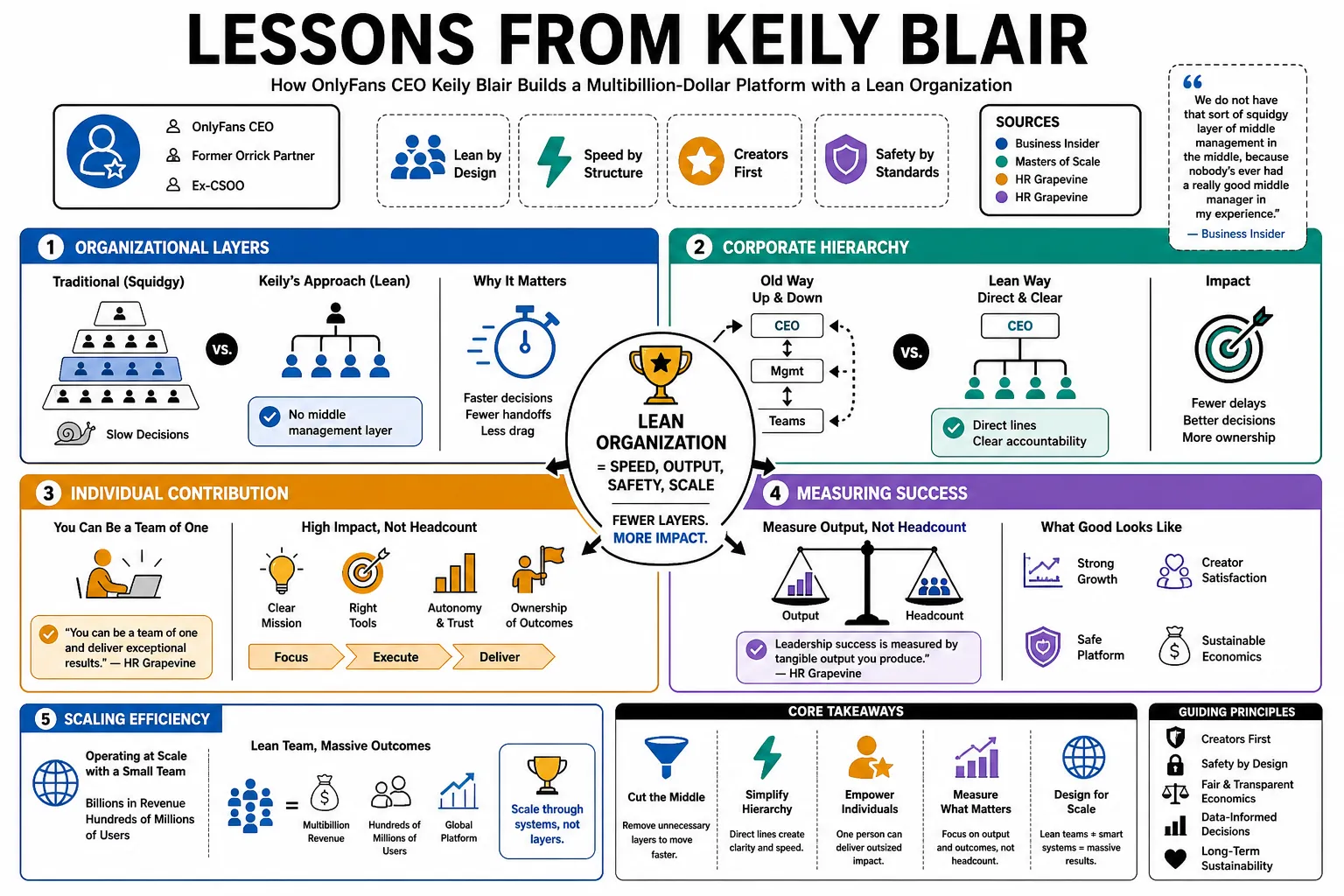
OnlyFans CEO Keily Blair runs the multibillion-dollar platform with an unusually lean corporate structure. A former data privacy partner at Orrick, she previously served as the company's Chief Strategy and Operations Officer. This profile outlines how she cuts middle management, handles creator economics, and enforces content safety.
Part 1: The Lean Organization
- On Organizational Layers: "We do not have that sort of squidgy layer of middle management in the middle, because nobody's ever had a really good middle manager in my experience." — Source: Business Insider
- On Corporate Hierarchy: Flattening the organizational chart eliminates the delays caused by passing decisions up and down unnecessary chains of command. — Source: Masters of Scale
- On Individual Contribution: "You can be a team of one and deliver exceptional results." — Source: HR Grapevine
- On Measuring Success: Leadership success should be measured by the tangible output you produce, rather than the headcount of the team you manage. — Source: HR Grapevine
- On Scaling Efficiency: Operating a platform with billions in revenue and hundreds of millions of users is possible with just a few dozen full-time corporate employees if the structure is correct. — Source: Business Insider
- On Autonomous Work: When employees are trusted as individual contributors rather than micromanaged, they take direct ownership of their strategic projects. — Source: Masters of Scale
- On Operational Agility: A lean core team allows a large technology company to pivot and respond to market changes much faster than heavily layered competitors. — Source: Masters of Scale
- On Redefining the Manager Track: Companies err when they force top performers into management roles; rewarding individual excellence is often a more effective retention strategy. — Source: Business Insider
- On Removing the Middle: Stripping out middle management ensures that the people executing the work maintain a direct line to the executives setting the vision. — Source: HR Grapevine
Part 2: The Creator Economy and Monetization
- On Platform Identity: "We don't try to be everyone's cup of tea. We're happy to be someone's glass of champagne," Blair said at Web Summit, framing OnlyFans as a focused product rather than a universal one. — Reference: Web Summit conversation with Keily Blair
- On Wealth Creation: A successful creator platform must prioritize generating wealth for its users rather than extracting maximum value for itself. — Source: Unusual Whales
- On Financial Inclusion: Providing creators with direct access to monetization tools is a fundamental step toward broad financial empowerment. — Source: Masters of Scale
- On Creator Autonomy: The future of the internet relies on inverting older business models so the creator, rather than the advertiser, holds the power. — Source: Axios
- On Multi-Platform Strategy: At Web Summit, Blair said the creator economy is exceptionally broad and that most creators appear on a variety of different platforms, supporting a safer Reference paraphrase about multi-platform creator businesses. — Reference: Web Summit conversation with Keily Blair
- On Broadening Appeal: Monetization tools originally popularized by niche creators can be successfully adapted by mainstream athletes, musicians, and artists. — Source: SCMP
- On Verified Fan Engagement: Blair said OnlyFans is a true social network because everybody is verified and the company knows who its creators and fans are, which she presented as the foundation for more direct engagement between both sides. — Reference: Web Summit conversation with Keily Blair
- On Retaining Talent: Platforms retain top creators by offering the best economic terms and the most reliable payout infrastructure, rather than relying on restrictive contracts. — Source: Masters of Scale
- On Economic Impact: Paying out tens of billions of dollars to independent creators represents a structural shift in how digital labor is valued. — Source: Unusual Whales
- On Content Ownership: The core promise of the modern creator economy is that individuals should own their content and control their pricing. — Source: Summit
Part 3: Trust, Safety, and Content Moderation
- On Excuses in Moderation: "I don't think 'It costs money and is hard' is an excuse" when it comes to platform accountability. — Source: Techdirt
- On the Foundation of Creativity: Freedom of expression and creativity flourish best within a safe, well-moderated environment. — Source: SXSW London
- On Human Moderation: Despite advances in technology, relying on thousands of human moderators remains critical for understanding context and enforcing community guidelines. — Source: Harper's BAZAAR
- On Verification Standards: The Web Summit transcript argues that OnlyFans is safer than people think because everybody is verified and the platform knows who its creators and fans are, supporting a narrower Reference point about verification as a baseline safety requirement. — Reference: Web Summit conversation with Keily Blair
- On Law Enforcement Collaboration: Technology platforms must proactively engage with law enforcement and organizations like the Internet Watch Foundation to address illegal content. — Source: Harper's BAZAAR
- On Proactive Safety: Safety initiatives must be built into the product design from the very beginning rather than functioning as reactive measures. — Source: TEDx
- On Platform Integrity: Maintaining the integrity of a platform requires constant investment in both automated tools and human review processes. — Source: Business Insider
- On Protecting Users: The ultimate goal of content moderation is to ensure that creators and consumers feel protected while using the service. — Source: CWG Speakers
- On Accountability: Executives must take personal responsibility for the safety outcomes of the platforms they oversee. — Source: Techdirt
Part 4: Privacy, Data, and Cybersecurity Strategy
- On Data Innovation: Navigating the intersection of privacy and technology requires understanding that data regulation is a framework for innovation, rather than a barrier. — Source: Orrick
- On Cybersecurity: A rigorous cybersecurity posture is a fundamental business requirement for platforms handling sensitive personal and financial data. — Source: Orrick
- On Privacy Compliance: Adhering to complex global data privacy laws is a strategic advantage that builds long-term trust with users. — Source: Orrick
- On Data Protection Strategy: Contentious data protection issues require a proactive legal strategy that anticipates regulatory shifts before they happen. — Source: CWG Speakers
- On Managing Risk: Effective risk management in technology means balancing aggressive business growth with strict data governance protocols. — Source: PwC
- On Regulatory Frameworks: Engaging with data protection regulators early and often helps shape practical compliance strategies. — Source: Orrick
- On Information Security: Protecting user identities and payment information must be the top priority for any digital transaction platform. — Source: Masters of Scale
- On Legal Strategy in Tech: A strong legal background in cyber and privacy provides an ideal foundation for operating a high-stakes technology company. — Source: CWG Speakers
- On User Trust: Consumer trust is entirely dependent on how transparently and securely a company handles personal information. — Source: PwC
Part 5: Brand Perception and Stigma
- On Navigating Disagreements: "I'm not keen to name names, because I'm a very classy lady... It's just disappointing to me when that happens. Because you can have different views on things but we should be able to talk." — Source: Financial Times
- On Terminology: Avoiding terms like the "P word" and using "adult content" helps reframe the conversation around personal choice rather than taboo. — Source: Business Insider
- On Double Standards: Female-led companies and platforms focused on adult creators frequently face gendered double standards in media and banking. — Source: Harper's BAZAAR
- On Redefining Brands: Moving a brand beyond its initial public perception requires consistent messaging and expanding the core use case. — Source: Masters of Scale
- On Reframing Stigma: In the Web Summit discussion, Blair argued that the issue is not stigma but something to be proud of when adult content is brought onto a platform with safety controls instead of being scattered across less controlled networks. — Reference: Web Summit conversation with Keily Blair
- On Mainstream Acceptance: Mainstream acceptance is earned by demonstrating rigorous safety standards and undeniable economic value to creators. — Source: SCMP
- On Managing Public Scrutiny: Operating in a highly scrutinized industry requires a thick skin and a clear focus on the company's core mission. — Source: Financial Times
- On Professionalism: Maintaining class and professionalism in the face of public criticism elevates a brand's standing in corporate circles. — Source: Financial Times
- On Empowering Choices: The narrative around adult content platforms should center on the autonomy and economic empowerment of the creators. — Source: Masters of Scale
- On Shifting Culture: Changing the cultural conversation around a controversial product takes time, education, and commitment to the platform's values. — Source: Harper's BAZAAR
Part 6: Legal Advocacy and Regulatory Compliance
- On The Online Safety Bill: Regulatory frameworks like the Online Safety Bill are necessary tools to force platforms to create secure online environments. — Source: New Statesman
- On Working with Regulators: Technology companies must view regulators as partners in building safer internet ecosystems. — Source: New Statesman
- On Legal Operations: Bringing a litigator's mindset to corporate operations ensures that a company is prepared for regulatory scrutiny. — Source: CWG Speakers
- On Compliance as a Feature: Strict compliance with international laws should be marketed as a feature that protects users, rather than a hidden corporate burden. — Source: Orrick
- On Navigating Complexity: Operating a global digital platform requires mastering a patchwork of local laws without compromising the core product experience. — Source: CWG Speakers
- On Policy Development: Internal company policies must be drafted with the foresight of how they will be interpreted by lawmakers and the public. — Source: TEDx
- On Litigation Strategy: A background in contentious legal disputes provides a unique advantage in managing high-risk corporate negotiations. — Source: Orrick
- On Standard Setting: Industry leaders have a responsibility to set the standard for regulatory compliance, forcing competitors to elevate their own practices. — Source: New Statesman
- On Adapting to Law: Successful technology firms adapt their business models to align with new legal realities rather than resisting evolution. — Source: CWG Speakers
Part 7: Hiring and Talent Development
- On Hiring Criteria: "We look for attitude and aptitude in hiring rather than experience." — Source: Business Insider
- On Building Teams: The ideal team structure pairs incredibly senior talent with incredibly hungry junior talent. — Source: Business Insider
- On Evaluating Potential: Past job titles are less important than a candidate's ability to learn quickly and adapt to unstructured environments. — Source: Masters of Scale
- On Senior Leadership: Executive hires must be capable of acting as individual contributors rather than serving solely as managers of people. — Source: HR Grapevine
- On Junior Employees: Entry-level hires should be given the autonomy to make decisions and drive projects from day one. — Source: Masters of Scale
- On Corporate Culture: A culture that values execution over hierarchy naturally attracts high-performing individuals who want to see the immediate impact of their work. — Source: HR Grapevine
- On Retention: Keeping top talent requires offering them the freedom to operate without the friction of bureaucratic approval processes. — Source: Business Insider
- On Mentorship: Senior leaders have a duty to directly mentor junior staff, bridging the gap left by the absence of middle management. — Source: Masters of Scale
- On Organizational Fit: Hiring for a controversial brand requires finding candidates who are deeply aligned with the company's core mission. — Source: HR Grapevine
- On Scaling Talent: You do not need to hire hundreds of people to solve a problem; you need to hire a few of the right people. — Source: Business Insider
Part 8: Women in Leadership and Mentorship
- On Supporting Women: Establishing networks like Fractio Vitri is essential for providing women with the practical tools and connections needed to advance in their careers. — Source: Wikipedia
- On Female Leadership: Having women in top executive roles fundamentally changes how a company approaches product safety, policy, and brand perception. — Source: Harper's BAZAAR
- On Overcoming Bias: Women in business must often navigate structural biases by out-executing their peers and building strong professional alliances. — Source: CWG Speakers
- On Career Progression: True mentorship is actively advocating for women to receive promotions, raises, and high-visibility projects. — Source: Orrick
- On Leading by Example: Award-winning leadership carries the responsibility to pull others up the ladder. — Source: Masters of Scale
- On Industry Representation: Increasing female representation in cybersecurity and technology leadership is critical for building products that serve diverse user bases. — Source: PwC
- On Executive Presence: Navigating high-stakes legal and corporate environments requires a presence that commands respect without conforming to traditional male archetypes. — Source: CWG Speakers
- On Mentorship Networks: While formal networks are powerful, informal mentoring relationships often yield the most direct career benefits. — Source: Orrick
- On the Future of Leadership: The next generation of corporate leadership will be defined by executives who prioritize empathy, direct action, and flat organizational structures. — Source: Masters of Scale