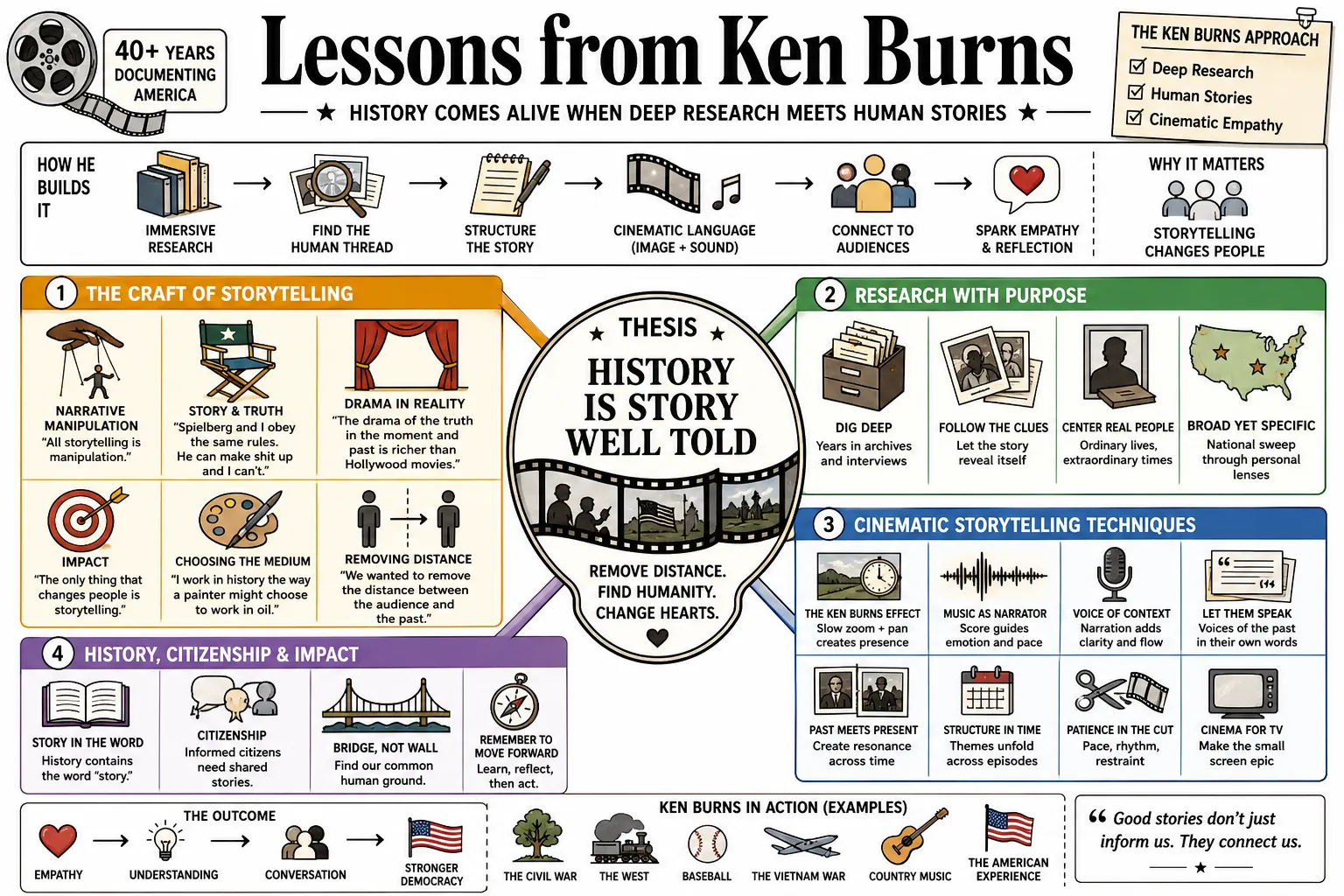
Lessons from Ken Burns
Ken Burns has spent forty years documenting American history on film by anchoring deep research to individual human stories. This profile outlines his specific production techniques alongside his views on history and citizenship.
Part 1: The Craft of Storytelling
- On Narrative Manipulation: "All storytelling is manipulation." — Source: Cut Daily
- On Story and Truth: "Steven Spielberg and I obey the same rules of storytelling. The only difference is that he can make shit up and I can't." — Source: Medium
- On Drama in Reality: "I began to feel that the drama of the truth that is in the moment and in the past is richer and more interesting than the drama of Hollywood movies." — Source: QuoteFancy
- On the Word History: "People tend to forget that the word 'history' contains the word 'story'." — Source: AZ Quotes
- On Impact: "The only thing that changes people is storytelling." — Source: The Guardian
- On Choosing the Medium: "The filmmaker tells good stories, and I happen to work in history the way a painter might choose to work in oil, or watercolor, or do still lifes as opposed to landscapes." — Source: Poynter
- On Removing Distance: "We wanted to remove the distance between us. As if what they were watching was happening now rather than in the past." — Source: Goodreads
- On Equipment vs. Concept: In a short documentary-filmmaking clip, Burns says gear matters far less than whether a filmmaker understands how to tell a story on film, so the more defensible lesson is that craft and narrative judgment outrank equipment choices. — Reference: Ken Burns documentary-filmmaking short on story over gear
- On Subtraction: "True storytelling in documentary isn't about adding facts, it is a subtractive process of finding the emotional core among massive amounts of material." — Source: Maximum Fun
- On Emotional Connection: "The objective of historical storytelling is not simply to transmit facts, but to create a direct emotional connection between the audience and the past." — Source: Milwaukee Independent
Part 2: The Filmmaking Process
- On the Maple Syrup Method: "We make maple syrup. It takes 40 gallons of sap to make one gallon of maple syrup. That's pretty much what we want to do... We are distilling the essence of all that we have collected." — Source: Medium
- On Fluid Production: "If you limit yourself to one research period, one writing period, one shooting period, one editing period, one finishing period, you limit the possibility of discovering what makes the film better." — Source: Medium
- On Rejection and Perseverance: "One of the great platitudes, especially in documentary filmmaking, is perseverance, because there are many more talented filmmakers than there is money to make the films. That means disappointment will be an important character builder." — Source: Men's Journal
- On the Power of Still Photographs: "He views the still photograph as the DNA of his work, treating it as an arrested moment that can be brought to life through careful narrative framing." — Source: Harvard Political Review
- On Audio Design: "The soundscape is what fully immerses the viewer, effectively erasing the divide between the present and a still image." — Source: Fast Company
- On Collaboration: "Long-form documentary filmmaking requires a deeply collaborative environment where editors and writers work simultaneously, constantly refining the narrative over years." — Source: Milwaukee Independent
- On Knowing the Ending: Burns told the Brown Political Review that he prefers sharing a process of discovery with the viewer rather than beginning as the authority who already knows everything, which supports leaving a documentary open enough for the material to sharpen the final argument during the work. — Reference: Brown Political Review interview on discovery-led storytelling
- On Archival Patience: "Collecting fifty times more footage and images than you will ever use is not a waste of time, but the necessary price of finding the exact right frame." — Source: Maximum Fun
- On Pacing: "The deliberate pacing of a documentary is a conscious choice to counter the fractured consumption of modern media, forcing the viewer to slow down and listen." — Source: Conversations with Tyler
Part 3: The Nature of History
- On Historical Rhyming: "History doesn't repeat itself, but it certainly rhymes." — Source: Premiere Speakers
- On the Arrogance of the Present: "It is the great arrogance of the present to forget the intelligence of the past." — Source: AZ Quotes
- On Complexity: In Conversations with Tyler, Burns says the real work of history is often learning contradictory and complicating information rather than flattening events into one clean storyline, which supports the lesson that historical truth has to hold tension instead of erasing it. — Reference: Conversations with Tyler on contradictory and complicating information
- On Malleability: "History is not a fixed set of facts; it is a mysterious and malleable force that constantly shifts based on who is telling the story and what evidence is examined." — Source: WordPress
- On the Function of History: "Studying the past is less about memorizing dates and more about finding the context and patterns necessary to navigate a confusing present." — Source: Stanford News
- On Messy Narratives: "He actively avoids simplistic historical narratives, striving instead to present the majesty, complexity, contradiction, and controversy of the American experience." — Source: Milwaukee Independent
- On No Ordinary People: "You begin to realize there are no ordinary people. That's one of the great lessons of 40 years of doing this history business." — Source: Men's Journal
- On Nuance: "Historical figures must be portrayed as complex individuals with both profound strengths and serious flaws in order to make them relatable and real." — Source: Premiere Speakers
- On Democracy's Flaws: "The study of the American Revolution reveals that democracy was often an unintended consequence of a messy, contradictory struggle rather than a pure, pre-ordained ideal." — Source: Sunday Paper
- On Unheard Voices: "True history must be inclusive, bringing in the perspectives of women, Native Americans, and African Americans who were often excluded from the official record." — Source: Podscripts
Part 4: Humanity and the "Us"
- On Divisive Narratives: "There is no them, there is only us; human-created divisions are a trap that leads to self-imprisonment." — Source: Washington Post
- On the Plural Pronoun: "Films about history are fundamentally films about us—the lowercase, plural pronoun that binds a society together." — Source: Sunday Paper
- On Constant Human Behavior: In discussing The American Revolution, Burns argues that every film rhymes with the present because human nature does not change, which is strong support for the narrower point that the same fears, ambitions, and weaknesses keep resurfacing across eras. — Reference: The Ringer interview on history rhyming because human nature does not change
- On Shared Struggle: "Recognizing the kinship of the soul among all people is the only way to effectively overcome the polarization of modern society." — Source: The Deacon's Bench
- On Othering: "The act of othering is the original sin of any society, preventing a true understanding of the shared burdens we all carry." — Source: Falls Church News-Press
- On Unity: In his Brandeis commencement remarks, Burns says voting underscores both citizenship and kinship with one another, supporting the broader lesson that shared civic participation is one practical path toward social cohesion. — Reference: Brandeis commencement transcript on citizenship and kinship
- On Human Fragility: "Studying the past exposes the fragility of human institutions and the necessity of constantly working to maintain them." — Source: Stanford News
- On Common Ground: "Even in the most bitterly divided eras, such as the Civil War, there remain threads of common humanity that documentarians must find and highlight." — Source: PBS
- On Collective Memory: "A nation's identity is entirely dependent on its collective memory; when we forget our shared past, we lose our shared future." — Source: Washington University
Part 5: Empathy and Emotion
- On the Location of Empathy: The Apple Podcasts description for Burns's conversation with Simon Sinek says empathy lives in the space between what a story includes and what it leaves out, which is solid support for the lesson that narrative omission shapes emotional understanding as much as explicit detail does. — Reference: Apple Podcasts description for A Bit of Optimism with Ken Burns
- On Emotional Architecture: "The structure of a documentary must be built around emotional beats, not just chronological events, to make the viewer feel the weight of history." — Source: Reddit
- On Facts vs. Feeling: "While factual accuracy is the baseline requirement, the ultimate goal of a historical film is to generate a profound emotional response." — Source: Milwaukee Independent
- On Grief: "Grief is a part of life... if you explore its painful precincts, it will make you stronger." — Source: The Deacon's Bench
- On Listening: "True empathy in interviews requires active, quiet listening, allowing the subject the space to stumble upon their own emotional truths." — Source: The Guardian
- On Bridging the Gap: "By focusing on individual, human-scale accounts, filmmakers can bridge the vast gap between modern audiences and historical statistics." — Source: Premiere Speakers
- On Nostalgia: "Nostalgia can be a dangerous, sanitizing force; filmmakers must cut through it to find the raw, often painful emotions of reality." — Source: Poynter
- On Humanizing Icons: "Stripping away the mythology surrounding historical icons to reveal their doubts and failures creates a deeper, more empathetic connection with the audience." — Source: PBS
- On Cinematic Intimacy: "The slow panning across a photograph isn't just a visual trick; it's a tool to force the viewer to look deeply into the eyes of people long gone." — Source: Harvard Political Review
Part 6: Civic Duty and Democracy
- On the Highest Office: "The most important political office is that of the private citizen." — Source: Falls Church News-Press
- On Voting and Service: "True civic responsibility requires active participation: voting, serving the country, and staying engaged in the messy work of democracy." — Source: Time Magazine
- On Defending Institutions: "Citizens must choose honor over hypocrisy, virtue over vulgarity, and character over cleverness in order to sustain democratic institutions." — Source: Falls Church News-Press
- On Neutrality: "While a documentarian should strive for objectivity in the cutting room, there are moments of existential threat to democracy when neutrality is no longer an option." — Source: Washington Post
- On Science and Art: "Science and the arts may not be directly involved in the physical defense of a nation, but they are exactly what make our country worth defending." — Source: Time Magazine
- On Civic Education: "Without a robust understanding of history, a public is easily manipulated by misinformation and authoritarian rhetoric." — Source: Stanford News
- On Patriotism: "True patriotism is not blind allegiance; it is the willingness to look honestly at a nation's darkest moments and demand better." — Source: Brandeis University
- On Sustaining the Republic: "Democracy is a delicate experiment that requires constant vigilance, compromise, and the willingness to engage with those who hold opposing views." — Source: Washington University
- On Truth-Telling: "In an era of fractured realities, insisting on the objective truth of the historical record is a radical and necessary civic act." — Source: Lehigh University
- On Moral Courage: "It takes more courage to confront the uncomfortable realities of one's own national history than it does to fight an external enemy." — Source: Brandeis University
Part 7: Life, Leadership, and Humility
- On Curiosity: "Be curious, not cool." — Source: Brandeis University
- On Insecurity: "Insecurity makes liars of us all." — Source: Brandeis University
- On Leadership: "Leadership is humility and generosity squared." — Source: Washington Post
- On Lasting Work: "Do something that will last and be beautiful." — Source: Goodreads
- On Humility as Default: "Maintaining a quiet life away from industry hubs enforces humility and keeps the work grounded." — Source: Harvard Political Review
- On Fame: "Notoriety and fame have no actual currency in the daily, practical work of researching and editing a film." — Source: Harvard Political Review
- On Listening to Critics: Burns told Politico that a director would be foolish not to listen even to the lowest-ranking teammate offering critical feedback in the edit, supporting the lesson that defensiveness hurts the project while good criticism improves it. — Reference: Politico interview on listening to critical feedback in the editing room
- On Work Ethic: "Talent is common; the willingness to spend a decade meticulously researching a single subject is what actually produces great work." — Source: Men's Journal
- On Embracing Failure: "Mistakes in the cutting room are not setbacks; they are the necessary stepping stones to finding the true structure of the narrative." — Source: Maximum Fun
Part 8: The Power of Long-Form
- On Patient Storytelling: "Long-form storytelling is a necessary antidote to the algorithm-driven, short-form content that dominates modern media." — Source: Harvard Political Review
- On Public Broadcasting: "The freedom to develop a project over ten years is a rare privilege largely sustained by the non-commercial structure of public broadcasting." — Source: Milwaukee Independent
- On Depth Over Speed: "Rushing a historical narrative inevitably flattens the nuance; truth requires the patience to let the story unfold over multiple hours." — Source: Conversations with Tyler
- On Respecting the Audience: In the Brown Political Review interview, Burns says he tries to act as the viewer's representative and share the team's curiosity-driven discovery process, which supports the point that complex long-form work assumes an audience willing to think alongside the filmmaker rather than be spoon-fed a simplified thesis. — Reference: Brown Political Review interview on representing the viewer
- On Independence: "Creating work outside of traditional commercial pressures allows a filmmaker to prioritize historical accuracy over immediate entertainment value." — Source: Milwaukee Independent
- On Narrative Arc: "A ten-part series allows for the natural rhythms of life—including periods of boredom, waiting, and sudden tragedy—to be accurately reflected on screen." — Source: Fast Company
- On Archival Deep Dives: In Conversations with Tyler, Burns describes treating a still photograph as a moment with a past and a future and exploring it visually and sonically to bring it alive, which supports the lesson that long-form archival work rewards lingering on one image until its full context emerges. — Reference: Conversations with Tyler on treating photographs as living moments
- On Building Trust: "The slow, deliberate unveiling of a story over many hours builds a level of trust with the viewer that a standard two-hour film cannot achieve." — Source: PBS
- On The Final Cut: "The luxury of time means never having to lock the picture until every single element—image, sound, and script—is perfectly aligned." — Source: Medium