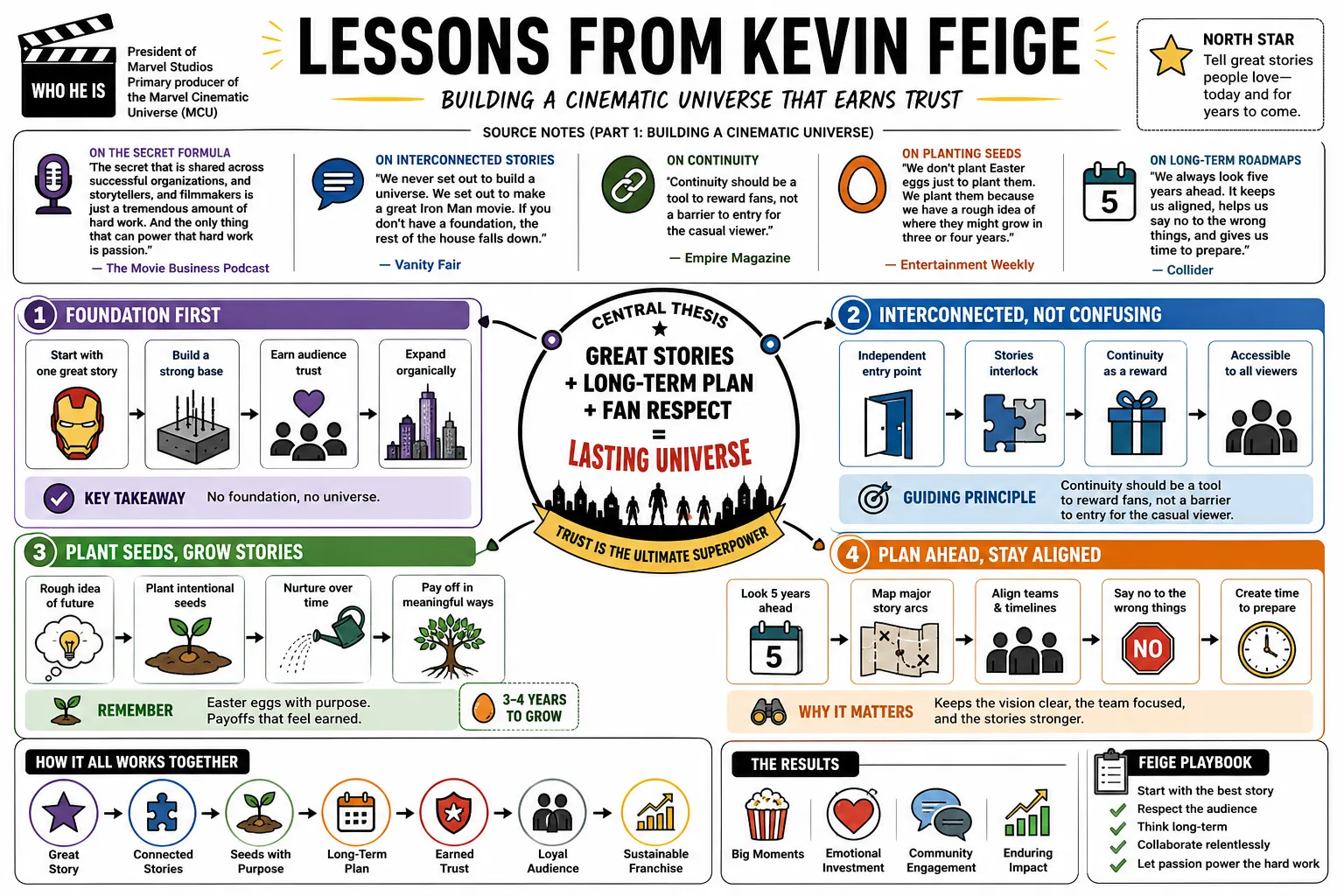
Lessons from Kevin Feige
Kevin Feige, president of Marvel Studios and primary producer of the Marvel Cinematic Universe, proved that serialized comic storytelling can anchor a stable film franchise. This collection gathers his observations on wrangling interconnected plots and managing creative teams without losing the audience's trust.
Part 1: Building a Cinematic Universe
- On the secret formula: "Looking back on Iron Man, Feige emphasizes that enduring franchises come from painstaking development work on the first film rather than from a shortcut formula." — Reference: Iron Man: 15 Years Later with Kevin Feige and Jon Favreau
- On interconnected stories: "We never set out to build a universe. We set out to make a great Iron Man movie. If you don't have a foundation, the rest of the house falls down." — Source: Vanity Fair
- On continuity: "Continuity should be a tool to reward fans, not a barrier to entry for the casual viewer." — Source: Empire Magazine
- On planting seeds: "We don't plant Easter eggs just to plant them. We plant them because we have a rough idea of where they might grow in three or four years." — Source: Entertainment Weekly
- On long-term roadmaps: "We always look five years ahead. Sometimes it changes, but you need a North Star to aim for so that every individual movie has a purpose beyond itself." — Source: Collider
- On standalone quality: "Before a movie can be a good MCU movie, it just has to be a good movie. If it doesn't work on its own, the connected tissue doesn't matter." — Source: The Hollywood Reporter
- On trusting the source material: "The blueprints are all there. Stan Lee, Jack Kirby, and Steve Ditko created an amazing world over the course of fifty plus years. Our job is just to translate it." — Source: Digital Spy
- On franchise fatigue: "I've been hearing about superhero fatigue since 2003. The answer isn't making fewer movies; the answer is making different kinds of movies under the superhero umbrella." — Source: Deadline
- On the illusion of a master plan: "People think we have a master board with everything locked in. In reality, we have a general direction, but we pivot constantly based on what works in the editing room and how audiences react." — Source: SlashFilm
- On paying off promises: "If you tease something in a post-credits scene, you owe it to the audience to deliver on it. You can't just dangle threads forever." — Source: IGN
Part 2: Finding and Guiding Talent
- On hiring indie directors: "We don't need someone who knows how to shoot a massive action set piece. We have a team for that. We need someone who knows how to get a performance out of an actor and make us care about the characters." — Source: Variety
- On casting the person, not the star: "Choosing Robert Downey Jr. for Iron Man was the biggest risk we ever took, but it was also the most liberating. It taught us to cast for the character, not the marquee." — Source: Rotten Tomatoes
- On director collaboration: "You want a filmmaker who will come in and push back, who will bring their own tone and vision. We provide the sandbox, but they build the castle." — Source: Los Angeles Times
- On protecting the creative process: "My job as a producer is to create a bubble around the filmmakers so they don't feel the pressure of the studio or the overarching universe while they're on set." — Source: Producers Guild of America
- On managing egos: "The best idea wins, no matter where it comes from. If the PA has a better idea for a scene than the director or the producer, you use the PA's idea." — Source: Fast Company
- On writer retention: "Keeping writers like Christopher Markus and Stephen McFeely around for multiple movies ensures the characters' voices remain consistent even as the universe expands." — Source: Screen Rant
- On casting chemistry: "We do extensive screen tests not just to see if an actor can play the part, but to see how they bounce off the actors we've already cast. The MCU relies on banter." — Source: GQ
- On giving directors freedom: "We tell directors the rules of our universe, but within those boundaries, we want them to take massive swings." — Source: The Wrap
- On handling disagreements: "Creative friction is good. If everyone agrees immediately, the idea probably isn't pushing the envelope enough. You have to argue it out in the room." — Source: Rolling Stone
Part 3: Storytelling Mechanics
- On character over spectacle: "Visual effects will always get better, but a visual effect means nothing if you don't care about the person in the middle of the explosion." — Source: Wired
- On humor as a defense mechanism: "Humor is the best way to get an audience to accept something ridiculous. If the movie acknowledges it's weird before the audience does, they'll go along for the ride." — Source: Vulture
- On the importance of villains: "A hero is only as good as their villain. We haven't always gotten it right, but when you have a Thanos or a Killmonger, it elevates the entire narrative." — Source: Esquire
- On structural variety: "We try to make different genres. The Winter Soldier is a political thriller, Ant-Man is a heist movie, Guardians is a space opera. They just happen to star characters from comic books." — Source: IndieWire
- On origin stories: "You don't always need an origin story. Sometimes you can just drop the audience into the middle of the action and let them catch up, like we did with Black Panther in Civil War." — Source: CinemaBlend
- On emotional stakes: "The end of the world is a hard stake to care about because you know the world won't end. But the end of a friendship? That's terrifying. That's Civil War." — Source: Polygon
- On endings: "Endings are crucial. You have to be willing to say goodbye to characters permanently, or the stakes evaporate. Endgame only works because the sacrifices are real." — Source: Time Magazine
- On the element of surprise: "Marketing should never reveal the third act. Give the audience enough to get them in the theater, but hide the real emotional turn." — Source: GamesRadar
- On keeping it grounded: "Even when you're dealing with magic or cosmic entities, the character's internal struggle has to be something mundane and relatable, like family issues or self-doubt." — Source: NPR
Part 4: Managing Fandom and Expectations
- On listening to fans: "You have to listen to the fans, but you can't just give them exactly what they ask for. You have to give them what they don't know they want yet." — Source: ComicBook.com
- On toxic backlash: "You focus on the work. There will always be people who resist change or new characters, but the only response is to make the movie undeniably good." — Source: The New York Times
- On test screenings: "We rely heavily on test screenings, not to change the vision, but to see where the audience is confused or where they start checking their watches." — Source: Den of Geek
- On comic accuracy: "The comics are the North Star, but if a costume or a plot point looks silly on screen, you have to adapt it. Literal translation is not the goal; emotional translation is." — Source: Nerdist
- On spoilers and secrecy: "The culture of spoilers has gotten out of hand, but protecting the audience's first viewing experience is worth the extreme security measures we take." — Source: BBC
- On subverting expectations: "If everyone thinks they know how a movie is going to end based on the comic, that's the perfect opportunity to pull the rug out from under them." — Source: Syfy
- On convention culture: "Going to Hall H at Comic-Con is our barometer. The energy in that room tells us instantly if we are on the right track or if we need to pivot." — Source: MTV News
- On honoring legacy characters: "When you handle characters that people have loved for fifty years, you are just a custodian. You have to leave them in better shape than you found them." — Source: Complex
- On the casual viewer: "My mom is our test case. If my mom can understand the emotional core of the movie without having seen the last six films, we've succeeded." — Source: USA Today
Part 5: Balancing Art and Commerce
- On box office pressure: "You can't engineer a billion-dollar movie. If you start making creative decisions based on a box office target, the movie loses its soul and the audience will smell it." — Source: Forbes
- On studio interference: "We've been very lucky that Disney lets us be Marvel. They understand that our specific culture and way of working is what generates the results." — Source: Wall Street Journal
- On merchandising: "We never put a vehicle or a suit in a movie just to sell a toy. The story dictates the design. If it makes a cool toy later, that's a bonus." — Source: Business Insider
- On taking financial risks: "Putting a talking raccoon and a tree in a big-budget summer movie was seen as a massive financial risk, but to us, the bigger risk was becoming boring." — Source: The Guardian
- On franchise synergy: "Corporate synergy is a bad word to some, but when used creatively, it allows us to tell stories across movies and television that no one else can do." — Source: Bloomberg
- On the volume of output: "We have to be careful. If the volume of our output degrades the quality of the individual project, the entire brand suffers. Quantity cannot trump quality." — Source: The Ringer
- On respecting the audience's wallet: "Going to the movies is expensive. If someone is going to pay for a ticket, buy popcorn, and hire a babysitter, we owe them an absolute spectacle." — Source: Chicago Tribune
- On streaming economics: "Disney+ allowed us to tell stories that didn't fit the feature film model, but we quickly learned that television requires a completely different pacing and production structure." — Source: Decider
- On international markets: "We don't try to reverse-engineer movies for specific global markets. We find that specific, culturally authentic stories travel better than generic, homogenized ones." — Source: South China Morning Post
- On the cost of visual effects: "We spend a lot on VFX, but the most expensive shots are the ones you do at the last minute because the script wasn't locked. Preparation saves millions." — Source: Cinefex
Part 6: Adapting Comic Books
- On embracing the weirdness: "For a long time, Hollywood was ashamed of comic books. They tried to make them dark and gritty. We decided to embrace the bright colors and the inherent absurdity." — Source: Marvel
- On the multiverse concept: "The multiverse is a comic book staple, but it's dangerous in film. If everything is possible, nothing matters. You have to establish very strict rules." — Source: Inverse
- On redesigning costumes: "A costume has to look functional. If an actor can't move their neck or go to the bathroom, their performance will suffer, and the audience will notice the stiffness." — Source: ScreenCrush
- On honoring creators: "Whenever possible, we try to weave the original comic creators into the fabric of the films, whether through cameos, credits, or direct consultation." — Source: Newsarama
- On updating outdated material: "Some of the older comics have elements that haven't aged well. Our job is to extract the core essence of the character and leave the archaic baggage behind." — Source: HuffPost
- On picking storylines: "We rarely adapt a specific comic issue directly. Instead, we take the best elements from various eras of a character and synthesize them into a new cinematic story." — Source: CBR
- On the importance of secret identities: "We threw out the secret identity trope in the first Iron Man. It freed us up from spending half the movie watching characters lie to their friends." — Source: Slate
- On comic book dialogue: "What works in a speech bubble often sounds ridiculous spoken aloud. The dialogue has to be grounded by the actor's natural cadence." — Source: The A.V. Club
- On magical realism: "When introducing magic with Doctor Strange, we had to make it look distinct from the science fiction of Iron Man and the cosmic scale of Thor. It needed its own visual vocabulary." — Source: FXGuide
Part 7: Handling Growth and Scale
- On organizational structure: "As we grew, the biggest challenge was making sure the left hand knew what the right hand was doing without creating a slow, bureaucratic nightmare." — Source: Harvard Business Review
- On avoiding complacency: "The moment you think you've figured it out, you're dead. We are constantly terrified that the next movie will be the one that bombs." — Source: Men's Journal
- On phase transitions: "Ending a phase is harder than starting one. You have to provide closure while simultaneously teasing the next five years of stories." — Source: The Washington Post
- On the burden of knowledge: "It's become harder for writers coming in because they have to watch 30 movies just to understand the baseline. We have to work to keep the lore from choking the new stories." — Source: Vanity Fair
- On scaling production: "You can't just throw more money at a problem when you're making four movies a year. You need rigorous pipelines and people you trust implicitly running the day-to-day." — Source: Produced By Conference
- On course correction: "If a movie isn't working in post-production, we will reshoot it until it does. We never release a movie just to hit a release date if the story isn't right." — Source: The Hollywood Reporter
- On the pandemic's impact: "The pause forced us to look at our slate and realize we were moving too fast. It gave us the breathing room to re-evaluate our long-term pacing." — Source: Variety
- On returning to underdog status: "After Endgame, we were on top of the world. But I prefer being the underdog. It forces you to be hungrier and more experimental." — Source: Reddit
- On homework fatigue: "When audiences feel like they have to watch a TV show to understand a movie, it starts to feel like homework. We have to ensure every project is a complete meal on its own." — Source: Entertainment Weekly
Part 8: Leadership and Culture
- On the value of film school: "USC taught me how to collaborate. Filmmaking is not a solo endeavor; it's a massive team sport, and if you can't communicate your vision, you will fail." — Source: USC
- On learning from failure: "Our missteps teach us far more than our hits. Whenever a character doesn't land or a joke falls flat, we dissect it endlessly so we don't repeat the mistake." — Source: Fast Company
- On empowering teams: "My role isn't to direct the movies. My role is to hire brilliant people and then run interference so they can do their best work." — Source: Forbes
- On maintaining enthusiasm: "If I ever get bored watching these characters, the audience will too. I have to maintain the perspective of the fan who waited in line for opening night." — Source: Collider
- On the Marvel method: "People talk about the Marvel formula, but the only real formula is putting characters through the wringer and trusting the audience to follow their emotional growth." — Source: Empire Magazine
- On patience in storytelling: "We waited ten years to bring Thanos to the forefront. In Hollywood, waiting ten years for a payoff is unheard of, but it's the only way to build genuine anticipation." — Source: IGN
- On taking responsibility: "When a movie succeeds, it's because of the director and the cast. When a movie fails, it's on me for not guiding the ship correctly." — Source: Deadline
- On the power of optimism: "In a cynical world, telling stories about people who try to do the right thing is surprisingly radical. We lean into optimism." — Source: Time Magazine
- On navigating corporate changes: "The leadership above me has changed several times, but my focus remains on the script in front of me. You can't control the boardroom, but you can control the story." — Source: Wall Street Journal
- On legacy: "I don't think about my legacy. I think about whether the kids watching these movies today will feel the same sense of wonder I felt watching Star Wars in 1977." — Source: Los Angeles Times