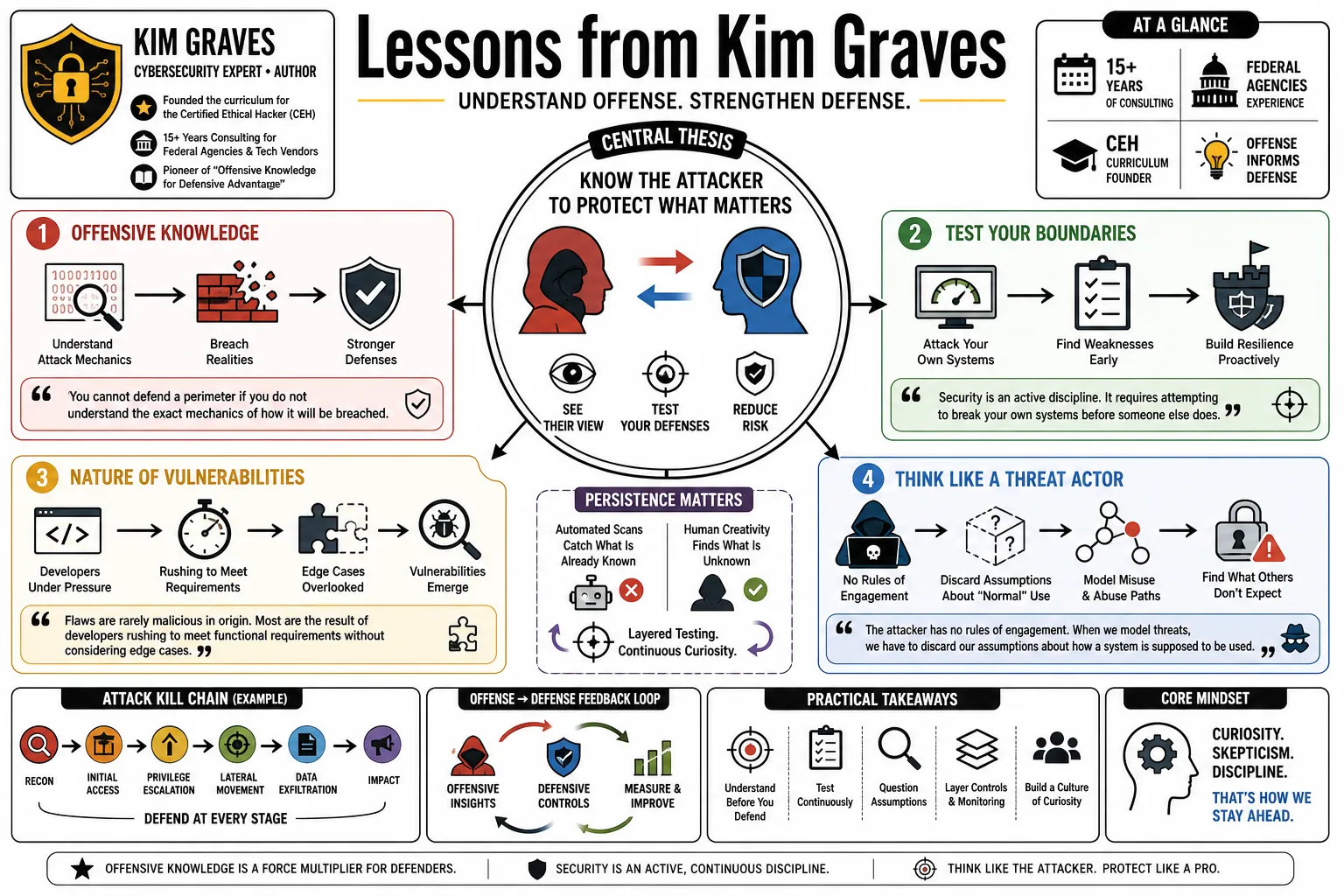
Kim Graves is a cybersecurity expert and author who established the foundational curriculum for the Certified Ethical Hacker (CEH) certification. She is known for formalizing the concept that defenders must understand offensive tactics to effectively secure modern networks. This profile explores her insights across 15 years of consulting for federal agencies and technology vendors, offering a practical framework for information security.
Part 1: The Attacker's Mindset
- On offensive knowledge: "You cannot defend a perimeter if you do not understand the exact mechanics of how it will be breached." — Source: [CEH Certified Ethical Hacker Study Guide]
- On testing boundaries: "Security is an active discipline. It requires attempting to break your own systems before someone else does." — Source: [Network Security Fundamentals]
- On the nature of vulnerabilities: "Flaws are rarely malicious in origin. Most are the result of developers rushing to meet functional requirements without considering edge cases." — Source: [CEH Certified Ethical Hacker Study Guide]
- On thinking like a threat actor: "The attacker has no rules of engagement. When we model threats, we have to discard our assumptions about how a system is supposed to be used." — Source: [Techsource Consulting Seminar]
- On persistence: "Automated scans only catch what is already known. Advanced threats rely on human patience and iterative probing." — Source: [Information Security Practice]
- On footprinting: "Reconnaissance dictates the success of a hack. The more time spent mapping the target, the fewer alarms triggered during the exploit." — Source: [CEH Certified Ethical Hacker Study Guide]
- On exploiting trust: "Attackers look for the weakest link in the trust chain. Often, this is a third-party vendor with unrestricted access to the target network." — Source: [Cybersecurity Symposium]
- On incident anticipation: "Assume breach. The goal of modern security architecture is to contain lateral movement after the initial intrusion occurs." — Source: [Federal IT Security Conference]
- On zero-day exploits: "Unknown vulnerabilities receive media attention, but missing patches for known vulnerabilities cause the majority of actual compromises." — Source: [CEH Certified Ethical Hacker Study Guide]
- On motive: "Understanding why an attacker wants your data dictates how you should apply resources to protect it." — Source: [Network Defense Seminar]
Part 2: Network Defense Fundamentals
- On defense in depth: "A single firewall is a single point of failure. Layering different types of controls ensures that a bypass of one does not compromise the entire environment." — Source: [CEH Certified Ethical Hacker Study Guide]
- On default configurations: "Out-of-the-box settings prioritize ease of use over security. Hardening requires systematically disabling unused services and changing default credentials." — Source: [Techsource Network Solutions]
- On logging: "If a system does not generate auditable logs, it is invisible. You cannot investigate an anomaly you have no record of." — Source: [Information Systems Security]
- On segmentation: "Flat networks allow an infection on a receptionist's workstation to reach the database servers. Segmenting by function limits the blast radius." — Source: [Federal Network Defense]
- On intrusion detection: "An IDS is only as useful as the team reviewing its alerts. Tuning signatures to reduce false positives is a continuous requirement." — Source: [CEH Certified Ethical Hacker Study Guide]
- On access controls: "The principle of least privilege is easy to understand but difficult to enforce. Users should only have access to the exact resources required for their daily tasks." — Source: [Cybersecurity Education Symposium]
- On patching: "Timely patch management is an operational challenge, not a technical one. It requires testing environments and agreed-upon maintenance windows." — Source: [Network Security Principles]
- On physical security: "A server room with an open door negates every digital encryption measure you have implemented." — Source: [CEH Certified Ethical Hacker Study Guide]
- On protocol vulnerabilities: "Legacy protocols transmit data in cleartext. Transitioning to encrypted alternatives is mandatory for internal traffic." — Source: [Network Defense Seminar]
- On endpoint protection: "Antivirus software is a baseline, not a comprehensive solution. Behavioral analysis is necessary to catch polymorphic malware." — Source: [Techsource Consulting Guidelines]
Part 3: Wireless Security Realities
- On wireless transmission: "Radio waves do not stop at the walls of your building. A wireless network extends your physical perimeter into the parking lot." — Source: [CWNA Certified Wireless Network Administrator Study Guide]
- On legacy encryption: "WEP is easily compromised with basic tools. Any network still using it is effectively open to the public." — Source: [CWSP Certified Wireless Security Professional Study Guide]
- On rogue access points: "Employees often plug in unapproved wireless routers for convenience, creating an unmonitored backdoor directly into the internal network." — Source: [Wireless Security Defense Course]
- On MAC filtering: "Spoofing a MAC address takes seconds. Relying on address filtering for access control provides a false sense of safety." — Source: [CWNA Certified Wireless Network Administrator Study Guide]
- On hidden SSIDs: "Disabling SSID broadcasting does not hide the network from packet sniffers; it merely stops the name from appearing in casual user lists." — Source: [CWSP Certified Wireless Security Professional Study Guide]
- On enterprise authentication: "WPA2-Enterprise with 802.1X requires a RADIUS server, ensuring that access is tied to individual user identities rather than a shared passphrase." — Source: [Wireless Infrastructure Brief]
- On site surveys: "Proper AP placement minimizes signal leakage. Tuning power levels contains the signal within the intended coverage area." — Source: [CWNA Certified Wireless Network Administrator Study Guide]
- On Bluetooth risks: "Unpaired Bluetooth devices can be exploited for eavesdropping. Default settings should disable discoverability." — Source: [Techsource Wireless Security]
- On guest networks: "Visitor access must be logically isolated from production traffic, typically routed directly to a segmented internet gateway." — Source: [CWSP Certified Wireless Security Professional Study Guide]
- On continuous monitoring: "Wireless intrusion prevention systems are necessary to detect deauthentication attacks and unauthorized hardware." — Source: [Cybersecurity Symposium]
Part 4: Vulnerability Assessment and Penetration Testing
- On scoping: "A penetration test without a strict scope can cause operational outages. Rules of engagement define what is tested and what remains untouched." — Source: [CEH Certified Ethical Hacker Study Guide]
- On scanning tools: "Automated vulnerability scanners produce data, not intelligence. The analyst must interpret the output to discard false positives." — Source: [Penetration Testing Frameworks]
- On open-source intelligence: "Public records, DNS registries, and social media provide enough data to map an organization's structure before a single packet is sent to their servers." — Source: [CEH Certified Ethical Hacker Study Guide]
- On exploitation: "Finding a vulnerability is an assessment; proving it can be used to extract data is a penetration test." — Source: [Federal IT Security Conference]
- On reporting: "A technical vulnerability is meaningless to executives unless translated into business risk. Reports must quantify potential financial and operational impact." — Source: [Techsource Consulting Seminar]
- On post-exploitation: "Gaining access is step one. The true measure of a network's weakness is how easily privileges can be escalated once inside." — Source: [CEH Certified Ethical Hacker Study Guide]
- On remediation: "A test report is a liability if left unaddressed. Organizations must allocate time to fix the identified flaws, starting with critical findings." — Source: [Network Defense Seminar]
- On continuous testing: "An annual penetration test only proves you were secure on a specific date. Security posture changes daily as new code is deployed." — Source: [Information Security Practice]
- On custom scripts: "Commercial tools miss proprietary logic flaws. Manual testing with custom scripts is required for complex web applications." — Source: [CEH Certified Ethical Hacker Study Guide]
Part 5: Social Engineering and the Human Element
- On human vulnerabilities: "You can spend millions on firewalls, but if an employee hands their password to a caller posing as IT support, the technical defenses are irrelevant." — Source: [CEH Certified Ethical Hacker Study Guide]
- On phishing: "Email filters block bulk attacks. Spear phishing succeeds because it is highly targeted and uses specific details about the recipient's role." — Source: [Social Engineering Defense]
- On pretexting: "Social engineers build a scenario to gain trust. They often create a false sense of urgency to force the target into skipping verification steps." — Source: [Federal IT Security Conference]
- On tailgating: "Physical access controls fail when employees hold the door open out of politeness. Security culture requires challenging unbadged individuals." — Source: [Techsource Consulting Guidelines]
- On training effectiveness: "Annual compliance videos do not change behavior. Regular, simulated phishing campaigns build reflex and awareness." — Source: [Cybersecurity Education Symposium]
- On baiting: "Leaving a USB drive labeled 'Q4 Layoffs' in a parking lot exploits human curiosity. The payload executes the moment it is plugged in." — Source: [CEH Certified Ethical Hacker Study Guide]
- On insider threats: "Disgruntled employees already have authorized access. Monitoring changes in data export patterns helps detect malicious intent." — Source: [Information Systems Security]
- On authority: "People are conditioned to obey leadership. Attackers impersonating executives in emails are highly successful in directing wire transfers." — Source: [Network Security Principles]
- On incident reporting: "Employees must feel safe reporting their mistakes. Punishing someone for clicking a bad link guarantees they will hide it next time." — Source: [Techsource Network Solutions]
Part 6: Cryptography and Data Protection
- On key management: "Encryption algorithms are mathematically sound; the implementation usually fails in how the decryption keys are stored and rotated." — Source: [CEH Certified Ethical Hacker Study Guide]
- On hashing: "Storing passwords in plaintext is negligence. They must be hashed and salted to prevent dictionary attacks in the event of a database dump." — Source: [Cryptography Standards]
- On data at rest: "Full disk encryption protects against hardware theft. It prevents someone from pulling a hard drive and reading the filesystem directly." — Source: [Federal IT Security Conference]
- On certificates: "A compromised certificate authority undermines the trust of the entire PKI. Strict controls over the root CA are non-negotiable." — Source: [Information Security Practice]
- On proprietary encryption: "Never write your own cryptographic algorithm. Rely on tested, peer-reviewed standards like AES." — Source: [CEH Certified Ethical Hacker Study Guide]
- On digital signatures: "Signatures provide non-repudiation. They prove who sent a message and guarantee the content was not altered in transit." — Source: [Techsource Consulting Guidelines]
- On data transit: "SSL/TLS is required for all web traffic, even internal pages. Intercepting unencrypted session tokens allows account takeover." — Source: [Network Security Principles]
- On secure deletion: "Deleting a file only removes the pointer. Sensitive data must be securely wiped or the storage media physically destroyed." — Source: [Cybersecurity Education Symposium]
- On side-channel attacks: "Attackers can infer cryptographic keys by measuring power consumption or timing differences during computation." — Source: [CEH Certified Ethical Hacker Study Guide]
Part 7: Security Policies and Compliance
- On policy enforcement: "A security policy is useless if management does not enforce it uniformly. Exceptions for executives create systemic weaknesses." — Source: [Information Systems Security]
- On acceptable use: "Employees need clear guidelines on what they can do with company hardware. Ambiguity leads to risky behavior." — Source: [Techsource Network Solutions]
- On disaster recovery: "A backup is only valid if you have successfully restored from it. Untested backups often fail during an actual crisis." — Source: [CEH Certified Ethical Hacker Study Guide]
- On regulatory requirements: "Compliance does not equal security. Meeting a checklist standard like PCI-DSS is the bare minimum, not a comprehensive defense." — Source: [Federal IT Security Conference]
- On incident response: "During a breach, panic destroys evidence. A documented incident response plan dictates the immediate steps for containment." — Source: [Network Defense Seminar]
- On third-party risk: "Outsourcing a service does not outsource the risk. Vendors must be audited to ensure they meet your internal security standards." — Source: [Cybersecurity Education Symposium]
- On asset inventory: "You cannot patch what you do not know you own. Maintaining an accurate hardware and software inventory is the foundation of security." — Source: [CEH Certified Ethical Hacker Study Guide]
- On role-based access: "Tying access rights to job roles simplifies onboarding and ensures permissions are revoked when an employee changes departments." — Source: [Information Security Practice]
- On data classification: "Treating all data equally wastes resources. Identify public, internal, and confidential data to apply appropriate controls." — Source: [Techsource Consulting Guidelines]
Part 8: The Future of Security Operations
- On automation: "Security teams are drowning in alerts. Automating the initial triage process frees analysts to investigate complex threats." — Source: [Federal IT Security Conference]
- On threat intelligence: "Subscribing to threat feeds provides indicators of compromise. Applying those indicators to your environment shifts defense from reactive to proactive." — Source: [Techsource Network Solutions]
- On cloud security: "Moving to the cloud shifts the responsibility model. The provider secures the infrastructure, but the customer remains responsible for data access controls." — Source: [CEH Certified Ethical Hacker Study Guide]
- On IoT vulnerabilities: "Internet-connected appliances are shipped with minimal security and rarely receive patches. They provide easy footholds for botnets." — Source: [Network Defense Seminar]
- On multi-factor authentication: "Passwords are compromised too frequently to be trusted alone. Hardware tokens or application-based MFA must be mandatory for all remote access." — Source: [Information Systems Security]
- On machine learning: "AI helps baseline normal network behavior. When traffic deviates from the model, it flags anomalies that manual rules would miss." — Source: [Cybersecurity Education Symposium]
- On deception technology: "Deploying honeypots on the internal network wastes the attacker's time and generates high-fidelity alerts the moment they are touched." — Source: [CEH Certified Ethical Hacker Study Guide]
- On zero trust architecture: "Trust nothing by default. Every request, whether internal or external, must be authenticated and authorized before granting access." — Source: [Information Security Practice]
- On continuous education: "The tools change constantly. A security professional's value lies in their ability to learn new attack vectors faster than they are deployed." — Source: [Techsource Consulting Guidelines]