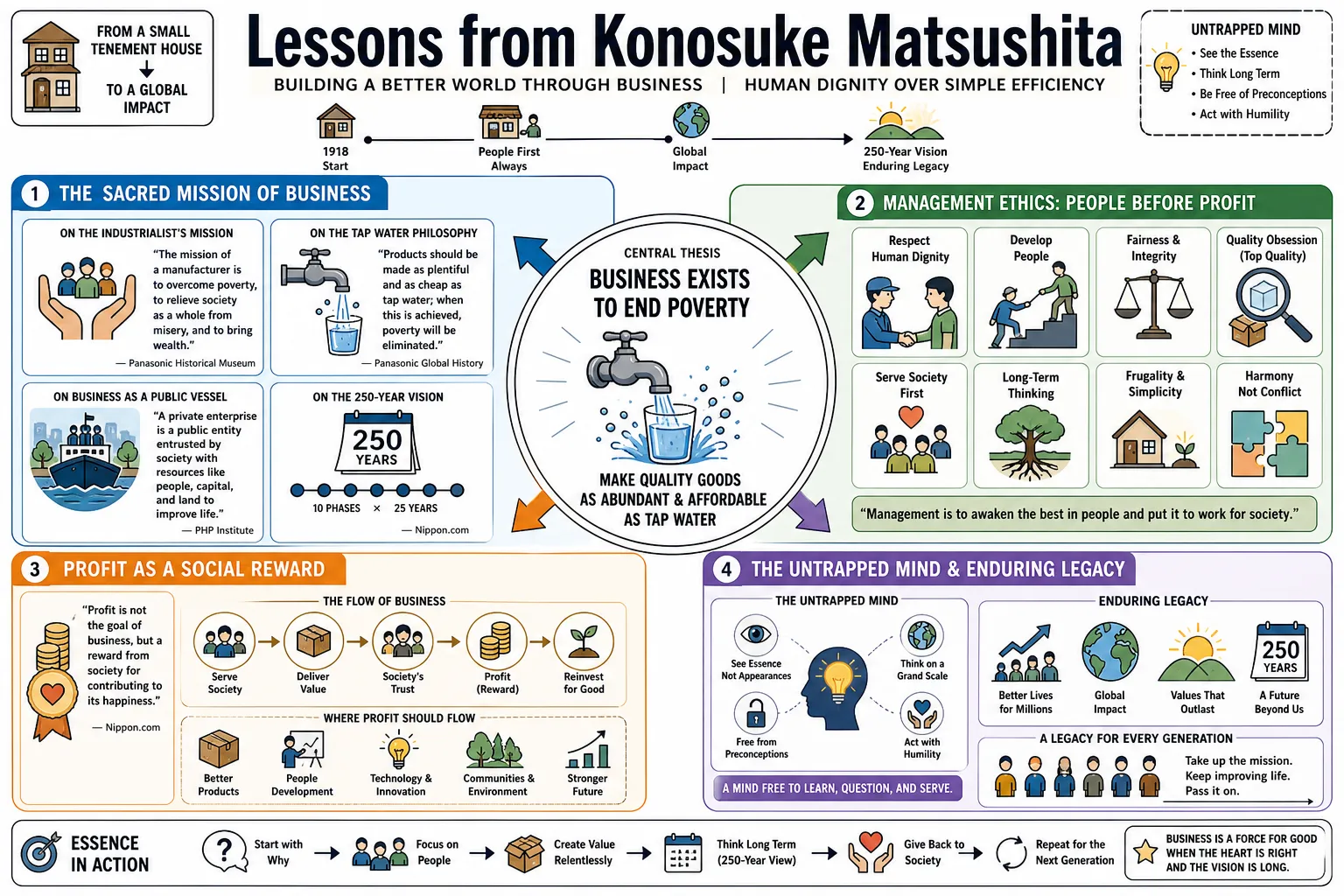
Lessons from Konosuke Matsushita
Konosuke Matsushita, founder of the business that became Panasonic, saw manufacturing as a way to improve society. His philosophy linked practical management with developing people and cultivating an open, or sunao, mind. — PHP Ideals.
Part 1: The Sacred Mission of Business
- On the Industrialist’s Mission: Matsushita frames manufacturing as a mission to reduce poverty by supplying useful goods abundantly and affordably. — 1932: The Company’s Mission.
- On the Tap Water Philosophy: Matsushita describes abundant production as a way to make useful goods affordable, comparing it with plentiful tap water. — The Mission of Manufacturers.
- On Business as a Public Vessel: Matsushita treats enterprise as a public concern and asks managers to consider the community impact of their decisions. — A Company Is a Public Entity.
- On the 250-Year Vision: Panasonic records Matsushita’s 1932 plan as ten 25-year periods directed toward fulfilling the company’s social mission. — 1932: The Company’s Mission.
- On Profit as a Social Reward: Matsushita regards profit as a reward for providing customers with value through efficient production. — Making a Profit — PHP Institute.
- On the "Crime" of No Profit: Matsushita views a company’s deficit as a failure of responsibility to society, not merely a private loss. — Matsushita Perspective on Business.
- On Reasonable Profit and Customer Care: Matsushita advocates reasonable profit alongside considerate treatment of customers. — Reasonable Profit.
- On Economic Contribution: Matsushita treats earning reasonable profit and returning part through taxes as corporate responsibilities. — Making a Profit — PHP Institute.
- On Spiritual and Material Wealth: Matsushita sees human well-being as requiring both material provision and spiritual fulfillment. — 1932: The Company’s Mission.
Part 2: Human Development as Strategy
- On Making People First: Matsushita places developing people before making products. — Our Founder’s Enduring Philosophy.
- On Emphasizing Strengths: Matsushita recommends noticing strengths more often than weaknesses, so managers can put people’s abilities to use. — Matsushita Perspective on Business.
- On Delegation and Checking: Delegate work, request progress reports when needed, and help when problems arise; responsibility should not become abandonment. — Delegate Responsibility with a Watchful Eye.
- On Collective Wisdom: Matsushita urges presidents to seek counsel from everyone involved rather than making every decision alone. — Collective Wisdom.
- On the Mini-Company System: Matsushita gives product divisions responsibility for development, manufacturing, sales and profits, aiming to develop autonomous managers. — 1933: The Divisional System.
- On Ownership: Matsushita invites employees’ views on assignments, encouraging them to undertake work with initiative and responsibility. — Matsushita Perspective on Business.
- On Character and Skill: The Seven Principles place personal integrity alongside knowledge and ability as a foundation for trustworthy business conduct. — The Company Creed and the Seven Principles.
- On Polishing Diamonds: Matsushita compares people’s potential to rough diamonds, whose different qualities emerge through development. — Our Founder’s Enduring Philosophy.
Part 3: The Spirit of Management
- On Contribution to Society: The Seven Principles call for contributing to society through business activities. — The Company Creed and the Seven Principles.
- On Fairness and Honesty: The Seven Principles require fair dealing and personal integrity. — The Company Creed and the Seven Principles.
- On Cooperation and Team Spirit: The Seven Principles call for pooling abilities toward shared goals. — The Company Creed and the Seven Principles.
- On Untiring Effort for Improvement: The Seven Principles encourage continual improvement in the ability to contribute through business. — The Company Creed and the Seven Principles.
- On Courtesy and Humility: The Seven Principles emphasize cordiality, modesty and respect for others’ rights and needs. — The Company Creed and the Seven Principles.
- On Adaptability: The Seven Principles encourage adapting thought and behavior to changing conditions. — The Company Creed and the Seven Principles.
- On Gratitude: The Seven Principles encourage gratitude for the support received from others. — The Company Creed and the Seven Principles.
- On Character in Leadership: Matsushita links courage and sound judgment with setting aside personal interest and acting on what one believes is right. — The Human Ideal — PHP Institute.
- On Care and Direction: Matsushita pairs respect and encouragement for employees with a leader’s responsibility to give direction. — Matsushita Perspective on Business.
Part 4: Operational Resilience
- On Dam Management: Matsushita’s dam-management approach calls for appropriate reserves across funds, equipment, personnel and other resources, based on realistic expectations. — Dam Management — PHP Institute.
- On Financial Reserves: Matsushita recalls building financial reserves gradually and borrowing within the credit banks would extend, helping the business maintain its own pace. — Matsushita’s Life and Management: Official Q&A.
- On Stability Over Speed: Matsushita warns that overexpansion can endanger a company, even while building for future needs. — 1933: The Divisional System.
- On Management in Bad Times: Matsushita believes sound management and well-trained people matter especially when recession makes customers more selective. — Doing Well in Good Times and Even Better in Bad Times.
- On Self-Reliance in Crisis: Matsushita urges managers to examine their own decisions when business goes badly, rather than blaming luck. — Matsushita Perspective on Business.
Part 5: Customer Relations and the Public
- On After-Sales Service: Matsushita urges continuing interest in products after sale as a way to build mutual trust with customers. — Matsushita Perspective on Business.
- On Anticipating Customer Needs: Matsushita asks businesses to anticipate customers’ needs and prepare to meet them, rather than waiting until wanted goods are unavailable. — The Invisible Contract.
- On the Public as God: Matsushita treats society’s response as a reason to reconsider methods, rather than insisting that his own approach must be right. — Society Is Right.
- On Complaints as Gold: Matsushita treats a complaint as an opportunity to correct its cause and strengthen the customer relationship. — Matsushita Perspective on Business.
- On Price vs. Value: Matsushita advises explaining why a carefully determined price is fair, rather than relying on opportunistic discounts. — Reasonable Profit.
- On Sincerity in Service: Matsushita describes gratitude and respect for customers as central to business, beyond exchanging goods for payment. — Customer First.
Part 6: The Sunao Mind (Untrapped Heart)
- On the Definition of Sunao: Matsushita describes sunao as an open, unselfish mind, not mere obedience or agreement. — A Sunao Mind.
- On Seeing White as White: PHP explains sunao as trying to see things as they are, rather than through self-interest or preconceptions. — PHP Ideals: The Untrapped Mind.
- On Learning from Everyone: Matsushita’s sunao ideal includes listening humbly to anyone and learning from everything. — Sunao Mind — PHP Institute.
- On Overcoming Ego: Matsushita recommends stepping back to examine oneself fairly, including one’s strengths, aptitudes and weaknesses. — Contemplating the Self.
- On Reconsidering Disadvantages: Matsushita recalls changing his viewpoint in difficulty, looking for possibilities within apparent disadvantages. — Ways of Seeing and Thinking: Author’s Preface.
- On Humility as Power: Matsushita recognizes employees’ abilities as exceeding his own in important respects, making humility part of personnel management. — Matsushita Perspective on Business.
- On Steady Resolve: Matsushita urges steady resolve and continued effort in both difficult and favorable circumstances. — Steady Resolve — The Path.
Part 7: Practical Wisdom and Common Sense
- On Using an Umbrella: Matsushita uses opening an umbrella in rain to illustrate adapting practical action to actual conditions. — Put up an Umbrella When It Rains.
- On Natural Law: Matsushita emphasizes sensible business basics, including fair margins and collecting payments on time. — Matsushita Perspective on Business.
- On Learning Through Practice: Matsushita emphasizes learning management through personal experience, using books and others’ teachings as references rather than substitutes. — Learning for Yourself.
- On Failure as Growth: Matsushita treats a costly first mistake as experience, while insisting on measures to prevent it happening again. — The First Time Is Experience; the Second Is Failure.
- On Rethinking the Method: Matsushita asks engineers to redesign a product when its existing economics cannot meet a customer’s requirements. — Matsushita Perspective on Business.
- On Daily Renewal: Matsushita links starting afresh each day with his belief that life and business continually change. — Start Anew Every Day.
Part 8: The Path and Personal Growth
- On Opening the Way: Matsushita urges people to keep moving along their own irreplaceable path, even when it becomes difficult or uncertain. — The Path.
- On Persistence: Matsushita advises continuing patiently after setbacks, since changing circumstances may open new possibilities. — Keep on Trying Until You Succeed.
- On the Sacred Mission: Matsushita describes business as potentially sacred when it supplies the necessities for human happiness. — 1932: The Company’s Mission.
- On Happiness through Gratitude: Matsushita sees cultivating gratitude as a way to deepen one’s sense of happiness. — Gratitude as a Source of Happiness.
- On the Continuous Journey: Matsushita encourages continually taking on challenges as a way to develop personally and professionally. — The Path Has No Limits.
- On the Future: Matsushita presents prosperity, peace and happiness as possibilities to pursue by correcting human attitudes and pooling wisdom. — Message from Founder — PHP Institute.